Channels
...

 Channels
Why This iPad Pro Feels Different
Making Apple Music Truly Work ‘For You’
Channels
Why This iPad Pro Feels Different
Making Apple Music Truly Work ‘For You’ David Barnard, developer of apps like Weather Up and Launch Center Pro, has written an extensive overview of tactics that are commonly used each day to game the App Store. He writes:
Any one of these tactics might seem somewhat bland individually, but when tens of thousands of apps deploy multiple tactics across many categories of apps, the impact can be measured in hundreds of millions of users and likely billions of dollars.
Tactics mentioned include employing specific keywords, buying fake reviews, implementing misleading subscriptions, and more. The idea is that bad actors can squeeze the most money out of users by following the approach Barnard outlines, which ultimately provides a bad user experience that degrades the App Store’s reputation.
Barnard concludes the article with a challenge to Apple:
Featuring an app is a great carrot, and Apple doesn’t generally feature apps that so blatantly flaunt App Store manipulation and user hostile tactics, but the carrot of getting featured pales in comparison to how much money can be made by gaming the App Store. It’s well past time for Apple to employ more carrots to create great experiences on the App Store, and to use a bigger stick on those manipulating the App Store and creating terrible user experiences for Apple’s customers.
I love this idea as a potential solution to encourage quality apps on the App Store. The revamped App Store from iOS 11 with daily feature articles is great, as are things like the Apple Design Awards at each WWDC, but if Apple wants to retain a strong quality brand for the App Store, it wouldn’t hurt to find more ways to reward good developers.
YouTube’s take on the popular Stories format from Instagram and Snapchat was previously only available to select YouTubers, but starting today it’s rolling out to all accounts with over 10,000 subscribers. Sarah Perez, writing for TechCrunch:
YouTube is beginning to roll out Stories to a wider set of creators, giving them access to the new creation tools that include the ability to decorate the videos with text, stickers, filters, and more.
The feature is very much inspired by rival social apps like Snapchat and Instagram – except that, in YouTube’s case, Stories disappear after 7 days, not 24 hours.
The idea behind YouTube Stories is to give creators any easy way to engage with their fans in between their more polished and produced videos. Today’s creators are no longer simply turning a camera on and vlogging – they’re creating professional content that requires editing and a lot of work before publication, for the most part.
While I haven’t encountered any of my favorite YouTubers using Stories yet, I hope that changes after today. While Instagram’s IGTV seems like it hasn’t taken off very well, plenty of YouTubers remain heavy users of Instagram Stories. If YouTube Stories can offer a similar experience, without users needing to leave YouTube, it could be a really solid addition to the platform.
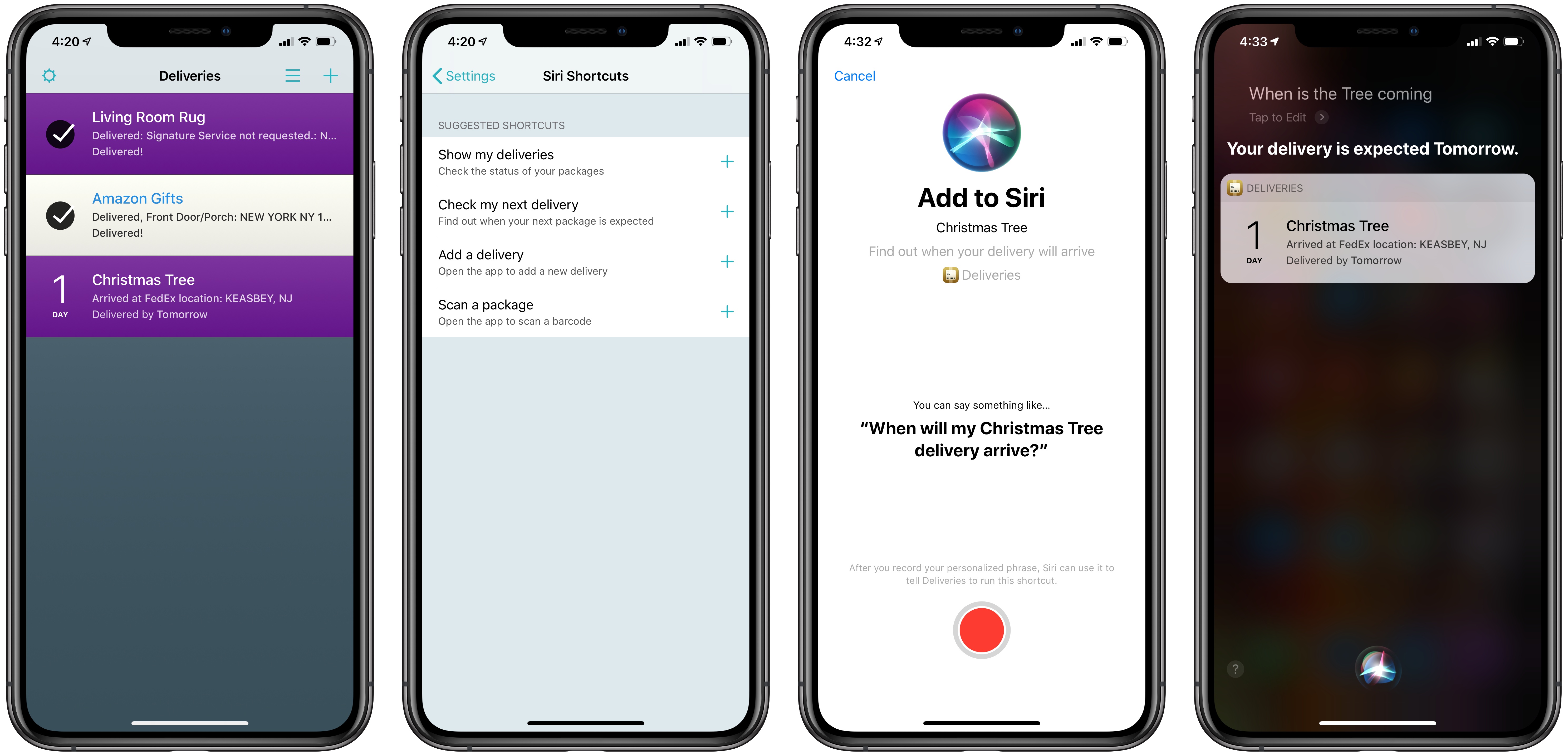
If you’re at all like me, then now is the time of year you receive the most packages. In the midst of the holiday season, the usual assortment of deliveries my wife and I have coming for ourselves are joined by all the gifts we’ve purchased for others. It couldn’t be better timing, then, that my package tracker of choice, Deliveries, has added Siri shortcut support today.
Big announcement from Supertop’s blog today:
We have some news to share. Tiny has purchased a majority stake in Castro. We are still shareholders and will continue working on the app full time.
The post goes on to explain the reasons for this transfer of ownership.
Castro has reached a size where the demands of running the business have been pulling us in too many different directions. We haven’t been able to focus as much on the core work of designing and building a product. Selling to Tiny gets Castro access to more resources, contacts and expertise. By growing the team we can specialize our roles to be more focused individually and get more done collectively. We can get back to what we’re good at and what we love doing.
Castro underwent a business model transition earlier this year, moving from paid up front with Castro 2 to free with Castro 3 alongside the launch of the Castro Plus subscription option. It sounds like that shift has led to an increased amount of administrative work for Supertop’s development team, which should be alleviated thanks to this acquisition. The post concludes:
We’ve started work on Castro 4. The plan is to improve the design to bring more listeners into the Castro flow. We’re excited, because for the first time in five years of work on Castro, we’ll have the resources to focus exclusively on it as product designers and developers, without contract work to distract us, and with a team around us to handle the administrative tasks.
Castro is one of the best podcast clients on iOS, so I’m thankful that today’s announcement doesn’t spell its end. On the contrary, it sounds like there’s reason to be hopeful about the app’s future in Tiny’s hands. Only time will tell, of course, so I’ll be curious to watch the app’s update cycle over the coming year.
Forward-looking columns about Apple’s business in the new year are usually saved for late December, but I wanted to get ahead of all those pieces because we now know what Apple’s full 2018 product lineup looks like. While new AirPods and the AirPower charging mat are both suspiciously still absent, and one or both could in theory be launched via press release any time, most likely what we have now from Apple is what we’ll be left with until after the new year begins. As such, today seems like a great time to start sharing hopes and expectations for the year ahead.
Getting Things Done Together