
Federico Viticci

10804 posts on MacStories since April 2009

Federico is the founder and Editor-in-Chief of MacStories, where he writes about Apple with a focus on apps, developers, iPad, and iOS productivity. He founded MacStories in April 2009 and has been writing about Apple since. Federico is also the co-host of AppStories, a weekly podcast exploring the world of apps, Unwind, a fun exploration of media and more, and NPC: Next Portable Console, a show about portable gaming and the handheld revolution.

Microsoft Launches ‘Flow’ Preview for Web Automation

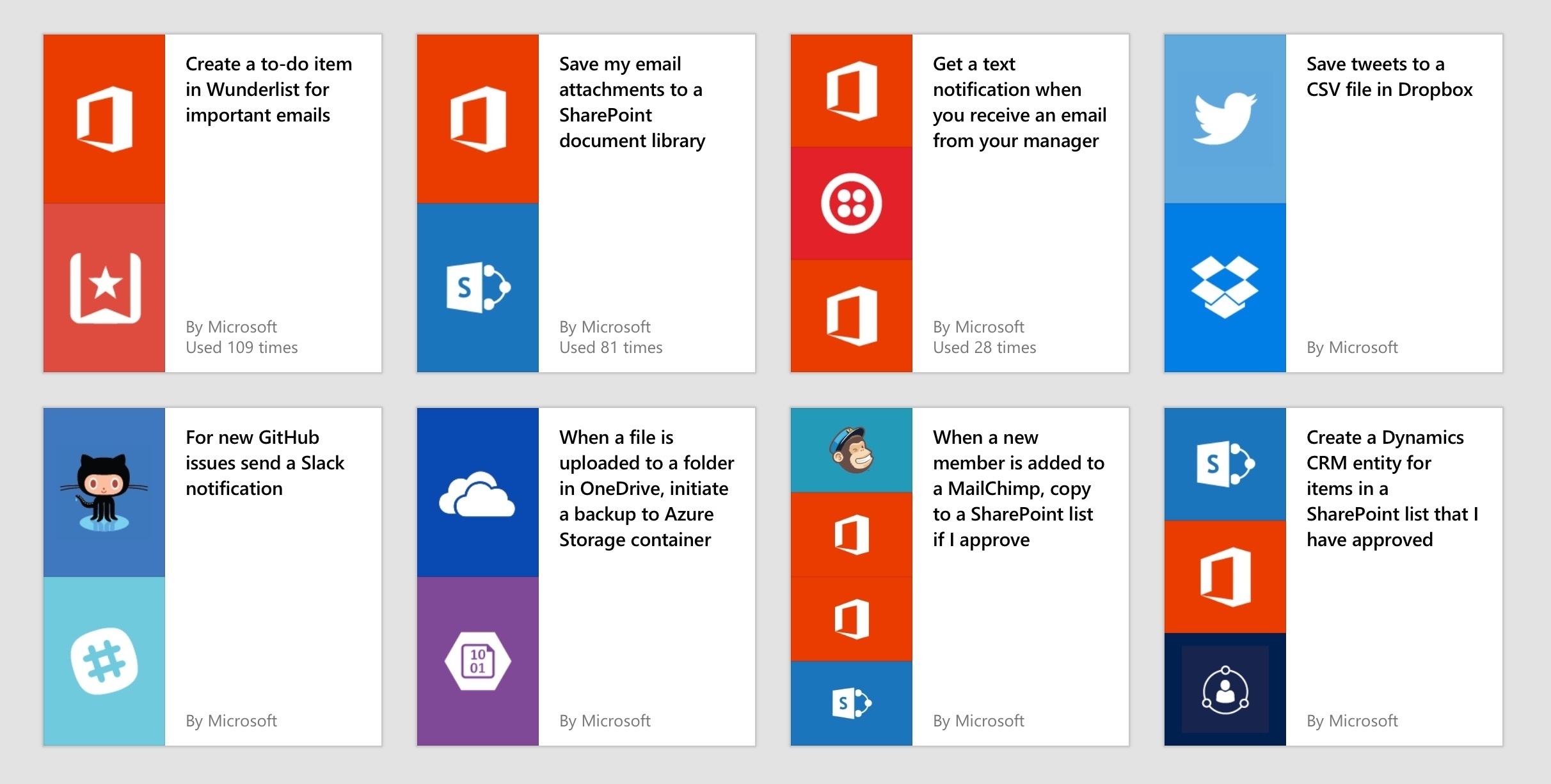
Microsoft has entered the web automation space with Flow, a new service currently in public preview that aims to connect multiple web apps together. Microsoft describes Flow as a way to “create automated workflows between your favorite apps and services to get notifications, synchronize files, collect data, and more”.

From the Microsoft blog:

Microsoft Flow makes it easy to mash-up two or more different services. Today, Microsoft Flow is publicly available as a preview, at no cost. We have connections to 35+ different services, including both Microsoft services like OneDrive and SharePoint, and public software services like Slack, Twitter and Salesforce.com, with more being added every week.

I took Flow for a quick spin today, and it looks, for now, like a less powerful, less intuitive Zapier targeted at business users. You can create multi-step flows with more than two apps, but Flow lacks the rich editor of Zapier; in my tests, the web interface crashed often on the iPad (I guess that’s why they call it a preview); and, in general, 35 supported services pales in comparison to the hundreds of options offered by Zapier.

Still, it’s good to see Microsoft joining this area and it makes sense for the new, cloud-oriented Microsoft to offer this kind of solution. Flow doesn’t have the consumer features of IFTTT (such as support for home automation devices and iOS apps) or the power of Zapier (which I like and use every day), but I’ll keep an eye on it.


The Convergence of Emoji

Good post by Sebastiaan de With on how different companies are quietly agreeing on emoji conventions:

Companies like Google and Microsoft are entirely free to attempt to reshape our popular culture by changing the way their emoji look. They could easily dig their heels in and refuse to change their emoji iconography despite jarring differences between sets.

Fortunately, this isn’t the case. What we’re seeing instead is that the new emoji sets from Google and Microsoft have converged to a look that is far more similar to Apple’s, often mimicking particular peculiarities in expression or design that Apple apparently chose on a whim.

The peach emoji example is a great one – it shows how Google prioritized common usage over Android’s history.

See also: emoji fights at the Unicode Consortium.

Permalink

Canvas, Episode 9: Presenting with iOS

This week Fraser flies the show solo to talk about his experience in creating, delivering and sharing presentations with iOS.

Fraser and I couldn’t record Canvas together this week, so we thought we’d spice things up a little with a solo show where Fraser talks about presentations on iOS. Presenting is a topic of which I’m not an expert anyway, while Fraser is quite proficient in it, so it made sense to do it this way.

You can listen here.

Travelling with such light and simple devices is a dream come true for many road warriors, but can iOS truly deliver the power required to be an end-to-end presentation platform?

Permalink


“Bots Won’t Replace Apps”

I’ve been struggling to put into words the inanity I’ve seen in the first “bot” implementations launched on Facebook.

Dan Grover has done an excellent job with his story about modern conversational UIs, WeChat (he’s a product manager there), and the shortcomings of current mobile OSes.

I loved this bit:

This notion of a bot handling the above sorts of tasks is a curious kind of skeumorphism. In the same way that a contact book app (before the flat UI fashion began) may have presented contacts as little cards with drop shadows and ring holes to suggest a Rolodex, conversational UI, too, has applied an analog metaphor to a digital task and brought along details that, in this form, no longer serve any purpose. Things like the small pleasantries in the above exchange like “please” and “thank you”, to asking for various pizza-related choices sequentially and separately (rather than all at once). These vestiges of human conversation no longer provide utility (if anything, they impede the task). I am no more really holding a conversation than my contact book app really is a l’il Rolodex. At the end, a single call to some ordering interface will be made.

Great comparison.

Permalink