
Federico Viticci

10804 posts on MacStories since April 2009

Federico is the founder and Editor-in-Chief of MacStories, where he writes about Apple with a focus on apps, developers, iPad, and iOS productivity. He founded MacStories in April 2009 and has been writing about Apple since. Federico is also the co-host of AppStories, a weekly podcast exploring the world of apps, Unwind, a fun exploration of media and more, and NPC: Next Portable Console, a show about portable gaming and the handheld revolution.

Adobe “Doubling Down” on Lightroom

Adobe, following Apple’s Aperture announcement earlier today:

Put simply we’re doubling down on our investments in Lightroom and the new Creative Cloud Photography plan and you can expect to see a rich roadmap of rapid innovation for desktop, web and device workflows in the coming weeks, months and years. We also continue to invest actively on the iOS and OSX platforms, and are committed to helping interested iPhoto and Aperture customers migrate to our rich solution across desktop, device and web workflows.

Adobe’s Creative Cloud Photography plan (which includes Photoshop CC and Lightroom) is a $9.99/month subscription, but the app is also available as a standalone purchase.

I personally never needed Aperture or Lightroom, but I know a lot of people who have been using Adobe’s app for several years now. According to Apple, functionalities from Aperture will be integrated with the new Photos app for OS X – the screenshot chosen for the announcement today is interesting.
Permalink

Apple Ending Development of Aperture, New Photos App Will Also Replace iPhoto for Mac

Jim Dalrymple, reporting at The Loop, received confirmation from Apple that the company will stop development of Aperture, replacing it with the Photos app introduced at WWDC:

Apple introduced a new Photos app during its Worldwide Developers Conference that will become the new platform for the company. As part of the transition, Apple told me today that they will no longer be developing its professional photography application, Aperture.

The new Photos app is on track to be released next year for OS X Yosemite, and it will also replace iPhoto for Mac, integrating photo editing and organization features into a single interface with iCloud support.

As reported by Matthew Panzarino at TechCrunch, Apple will provide compatibility updates for OS X Yosemite users and the company is working with Adobe to create a “transitionary workflow” to move to Lightroom.

According to Apple, the discontinuation of Aperture doesn’t indicate a shift away from “pro” apps, as both Logic and Final Cut will continue development. At this point, it’s not clear whether iPhoto for iOS will also be discontinued with the release of iOS 8 and the new features in Photos for iOS.

Aperture came out in 2005. In 2011, Apple started offering Aperture 3.0 at a discounted price on the Mac App Store.

Permalink


Launch Center Pro 2.3.1 for Power Users

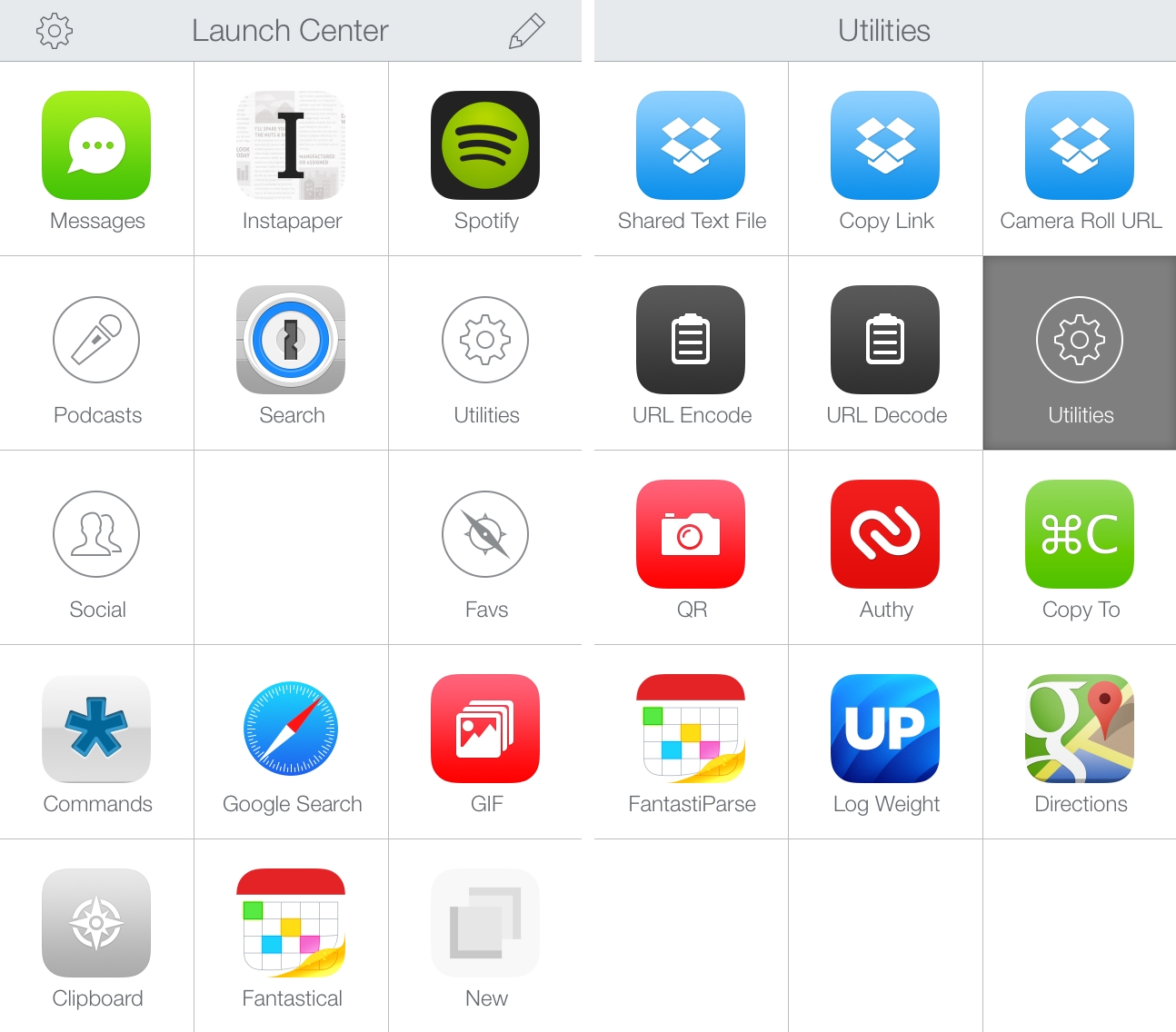
My Launch Center Pro home screen and Utilities folder.

My Launch Center Pro home screen and Utilities folder.

Earlier this month, I wrote that Launch Center Pro 2.3 extended iOS automation by integrating with IFTTT and bridging the gap between iOS apps and web services. Launch Center Pro 2.3.1, released today and seemingly a minor update, is packed with major changes for advanced users who want to build complex URL actions in the app.

If you’ve struggled to build actions that connect multiple apps in Launch Center Pro before, you’ll want to check out the new version and read through the full documentation on Contrast’s website. We’re still working on a big update to our Launch Center Pro guide, but, in the meantime, I’m going to give you an overview of what’s possible to achieve with Launch Center Pro 2.3.1.

Read more


xScope 4.0

Version 4.0 of The Iconfactory’s tool for measuring, inspecting, and testing layouts and graphics on OS X has been released today, adding powerful new features for designers and developers.

We’ve covered xScope on MacStories before, and the new release adds an Overlay feature to check alignments and mockups over a browser (useful when working on responsive designs) and a Text palette to “search, decipher, and reformat text and character glyphs”. xScope works with Retina displays and many of the app’s existing functionalities have been redesigned and updated to have faster performance, more flexibility (just take a look here), and Yosemite support.

I’m no designer, but I’ve used xScope before and I know it’s a solid app; I’ve downloaded the trial from The Iconfactory’s website, and the changes in this version look fantastic. For a limited time, you can get xScope 4.0 at $24.99 (50% off) on the Mac App Store.

Permalink

The Apple QuickTake 100 Turns 20

Stewart Wolpin, writing at Mashable:

Back in Apple’s dark ages — during Steve Jobs’ interregnum in the mid-1990s — the company experimented with some strange products. Everyone remembers the ill-fated Newton PDA, for instance, which was considered ahead of its time. Less memorable was the QuickTake 100, the first mass market color consumer digital camera.

First unveiled at the Tokyo MacWorld Expo on February 17, 1994, the QuickTake 100 went on sale 20 years ago from yesterday — June 20, 1994. It was priced at $749 and initiated the age of consumer digital photography.

The Apple QuickTake 100 was one of the first digital cameras, a market that, in a curious turn of events, has shrunk because of smartphones.

See also: Shrine of Apple’s QuickTake 100 page (and video embedded below).

Permalink

Starting Anew

Angela Ahrendts, Apple’s SVP of Retail, in a post published on LinkedIn:

Also, trust your instincts and emotions. Let them guide you in every situation; they will not fail you. Never will your objectivity be as clear or your instincts sharper than in the first 30-90 days. Cherish this time and fight the urge to overthink. Real human dialogue and interaction where you can feel and be felt will be invaluable as your vision, enabled by your instincts, becomes clearer. In honor of the great American poet Maya Angelou, always remember, “People will forget what you said, people will forget what you did, but people will never forget how you made them feel.” I would argue this is even more important in the early days.

It’s strange (and great) to see an Apple executive sharing this kind of thoughts publicly. The post is beautifully written, especially the last few paragraphs.

Permalink