


Last week, the good folks at Junecloud released a completely rewritten suite of Automator actions aimed at people who work with images and files for the web. The actions are now faster, more flexible, and they work on OS X Mavericks. I’m looking forward to playing with them.
Nintendo Vs. Apple Pundits
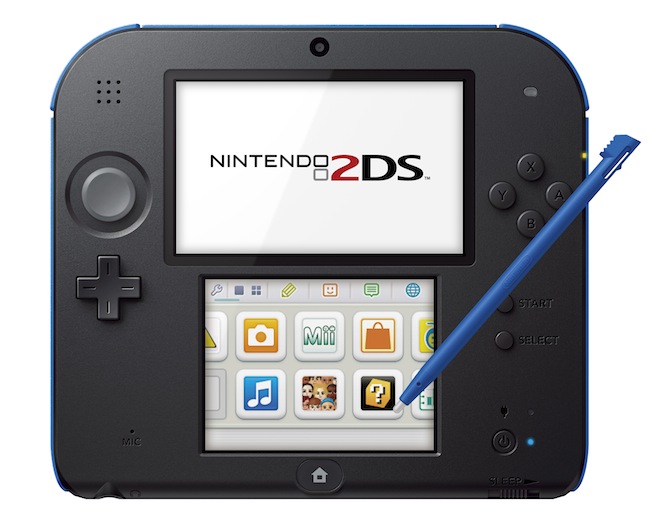
Yesterday, Nintendo announced a new portable console to play 3DS games that doesn’t actually support the 3DS’ 3D effect, a price cut for the Wii U, and various release dates for its upcoming holiday line-up. Unsurprisingly, several Apple-focused writers and bloggers suggested – again – that Nintendo is doomed; that they should start making games for iOS; and that Apple should just outright buy Nintendo.
I believe this notion – that in order to survive, Nintendo has to start making games for the App Store – shows a profound misunderstanding of how Nintendo works, operates, and, generally, plans its long-term future. I have discussed the topic with Myke last night on The Prompt.
Lukas Mathis has published an excellent post that aptly sums up what is wrong with the new “default narrative” about Nintendo:
Mac users should be familiar with the argument against this reasoning. Fantastic games like Super Mario 3DS Land can only exist because Nintendo makes both the hardware and the software. That game simply could not exist on an iPhone.
But there’s an additional problem with this argument: the premise is completely wrong. Nintendo is actually not doing poorly in the portable market. iPhones have not destroyed the market for portable gaming devices. The 3DS is, in fact, doing very well.
Nintendo and Apple may share some similarities (namely, tight integration of hardware and software), but their execution is profoundly different. Following Nintendo’s history and patterns through the years and just looking at the company’s numbers reveals a different approach and strategy.
Again, from Mathis’ piece:
The hypothesis that Nintendo needs to abandon the hardware market because the iPhone destroyed the market for portable gaming just isn’t consistent with reality.
The idea that Nintendo should make games for iOS is fascinating, easy to grasp and follow, but flawed. Nintendo doesn’t work like Apple. And, more importantly, Nintendo can’t – and doesn’t want to – be Apple. Nintendo is a mix of a toy company and a game company: consoles exist to support Nintendo’s crown jewels – the games and first-party franchises.
Nobody is denying that the Wii U is doing poorly: the console needs more quality first and third-party games, a better marketing message (same for the upcoming 2DS), and a clearer position in the market. But the overall numbers paint a different picture than what some Apple pundits are claiming: the Wii U is only slightly behind the point where the GameCube was at the same point in the console’s lifespan – and Nintendo did manage to turn a profit on the GameCube. The Wii remains the top-selling console of the current generation. The first 130 weeks of sales of the 3DS – as Mathis also notes – are comparable to those of the Nintendo DS – the second (soon first?) best-selling console of all time. Again, to understand this all you need to do is look at Nintendo’s numbers.
Mobile “casual” games are selling millions of copies (in many cases, in-app purchases) today, and Nintendo’s portable game sales are healthy, too. Here’s just one data point: Animal Crossing sold 1.54 million copies in the last quarter (a month ago, it was up to 4.5 million copies sold since its original release). Assuming that Nintendo makes around $30 in average revenue on first-party games, that would make for $46 million in revenue, in a single quarter, on a single game. Want more examples? As of March 2013, Luigi’s Mansion sold 1.22 million copies; Super Mario 3D Land moved 8.19 million copies; Monster Hunter 3 – a third-party, four-year old game – sold 2.10 million copies; also as of March 2013, Mario Kart 7 sold 8.08 million copies. Here’s what Nintendo’s upcoming line-up looks like, and add Pokémon X & Y to that (the series’ DS games, Black & White 1/2, sold 23.05 copies combined as of January-March 2013).
The 2DS is controversial and it may seem to lack any sort of practical sense, but it’s actually basic Nintendo 101 (do these other revisions ring a bell?). Except that, this time, the 2DS is aimed at addressing concerns of 3D games for children and the whole point is to sell the 2DS to kids for the holiday season, possibly alongside a copy of Pokémon.
Nintendo’s strength right now is that, once again, they can revolve around the fulcrum of portable hardware and game sales to sustain their operation, turn a profit, and buy more time to fix the mess that was the Wii U launch. Saying that Nintendo should shut everything down, go home, and start making games for iOS is an easy but flawed solution that just isn’t supported by the facts.
Soulver for iPhone Updated with iCloud Syncing, URL Scheme→
Soulver, my favorite iOS calculator app that isn’t really a calculator (I like another app for that), was updated today on the iPhone to support iCloud syncing, sub-folders, and a URL scheme. iCloud syncing was first brought to Soulver for Mac in December 2012, and now the iPhone app (Soulver for iPad hasn’t been updated yet) should be capable of syncing named documents with its Mac counterpart. If you trust iCloud with your Soulver documents, I guess that this will be a handy addition.
The URL scheme is much more interesting for my workflow. According to the release notes on iTunes, there’s now a URL scheme to launch Soulver, create a new document with text, or even to append text to an existing document. I am already thinking about the possibilities opened up by this feature for integration with apps like Launch Center Pro and Drafts – but I can’t find documentation anywhere. The app does support a soulver:// URL scheme, and hopefully more information will soon be posted on Acqualia’s website.
I’m looking forward to playing with Soulver’s URL scheme and updated preferences (not so much with iCloud sync). Soulver for iPhone is $2.99 on the App Store.
Update 9/1: The guys at Acqualia have posted a URL scheme documentation here. I have already set up a Drafts URL action that lets me quickly type a calculation in Drafts – which is my go-to text capturing tool – and append it as a new line to a specific Soulver document I have called “Calculations”. From Drafts:
soulver://new?text=[[draft]]&title=Calculations
I’m already using this action all the time to launch quick currency conversions in Soulver. Open Drafts, type “2 usd in eur”, and boom – Soulver opens, displaying the result. It’s a nice URL scheme.
The Omni Group Releases OmniKeyMaster Mac App Store License Tool→
From The Omni Group’s blog:
OmniKeyMaster is a simple app that finds App Store copies of Omni apps installed on your Mac, then generates equivalent licenses from our store - for free. This gives Mac App Store customers access to discounted pricing when upgrading from the Standard edition to Professional, or when upgrading from one major version to the next. Another benefit: since they don’t have to wait in an approval queue, our direct releases sometimes get earlier access to new features and bug fixes. OmniKeyMaster lets App Store customers access those builds, as well.
Tools like OmniKeyMaster have become quite common lately, as developers of third-party Mac apps keep struggling with the limitations imposed by Apple on the Mac App Store. Having new versions of apps every time a major upgrade is released isn’t an option for many developers, and they are resorting to workarounds like this to have the best of both worlds: the Mac App Store’s purchase system and the control on your own website and app updates. It’s a trade-off, and, in most cases, the process is quite convoluted.
In The Omni Group’s defense, their Mac App Store license tool seems easy to use and clever in how it finds all App Store copies of Omni apps on a Mac. Apple may not be interested in offering upgrade pricing on the Mac App Store, but developers find a way…or at least a viable workaround.
Apple and Education→
Apple recently revamped its Education website with updated sections on iPad and Mac usage in education and a focus on students with special needs and Accessibility. Make sure to check out the Real Stories webpage, which provides several examples of how teachers are using the iPad in the classroom.
AgileBits Teases 1Password 4 For Mac→
Dan Moren, in his preview of 1Password 4 for Mac:
Several of the newest capabilities originated in 1Password 4 for iOS, including the ability to mark your frequently used items as Favorites, support for multiple logins on the same site, and the ability to sync via iCloud. You’ll also find new types of items to supplement existing options, such as driver licenses and reward programs, and you can add custom fields to most items, to store any other information you want. And if you want to share a specific item between the Mac and iOS apps, you can do so by sending it via encrypted iMessage or email.
1Password for Mac received its last big update in 2009 with version 3, and, following the launch of 1Password 4 for iOS, a revamp of the desktop client is long overdue. I’m particularly excited about the Back to the Mac approach – 1Password 4 is one of my favorite and most used iOS apps, and the upcoming Mac app seems to retain much of the mobile counterpart’s functionality, enhancing it with features that make sense on OS X (such as the new browser extension).
Apple will provide its own password generation and sync solution with iCloud Keychain, and that’s great news because it’ll help users have safer logins with minimal effort. However, I want more from my password manager, and I’m looking forward to trying 1Password 4.0.
The Future Of Feed Reading→
And so, could this hypothetical service take all that information, put it into a database, and then find and recommend things for me to read? I think yes. That’d be the easy part. The hard part is if the service could pick out articles for me as well as Pandora can at pick out songs, or as well as Netflix can pick out 4-star movies. Now, wouldn’t that be something?
Services like Feedly, Feedbin, and Feed Wrangler have pretty much nailed the filesystem of news idea of RSS readers (with some unique differences, as Shawn outlines for Feed Wrangler).
The next step is discovery of relevant and personalized news in an RSS-based environment. No one seems to be doing that quite right at this point and there are a lot of services and technologies that may be using RSS in the backend but that are trying different proprietary approaches. Flipboard with magazines and top stories; Zite with algorithms; Feedly with popular feeds; others with lightweight Twitter and Facebook integrations.
My primary concern is that a feature such as the one envisioned by Shawn – which I’d love, by the way – would require a tremendous amount of scale, data, analysis, time, and, ultimately, resources, which I’m not sure an independently developed feed reader could ever have (or pull off properly). But, yes, that sort of news recommendation inside a feed reader would be fantastic.
Rdio For iOS Gets Station Tuning, New Collection Options
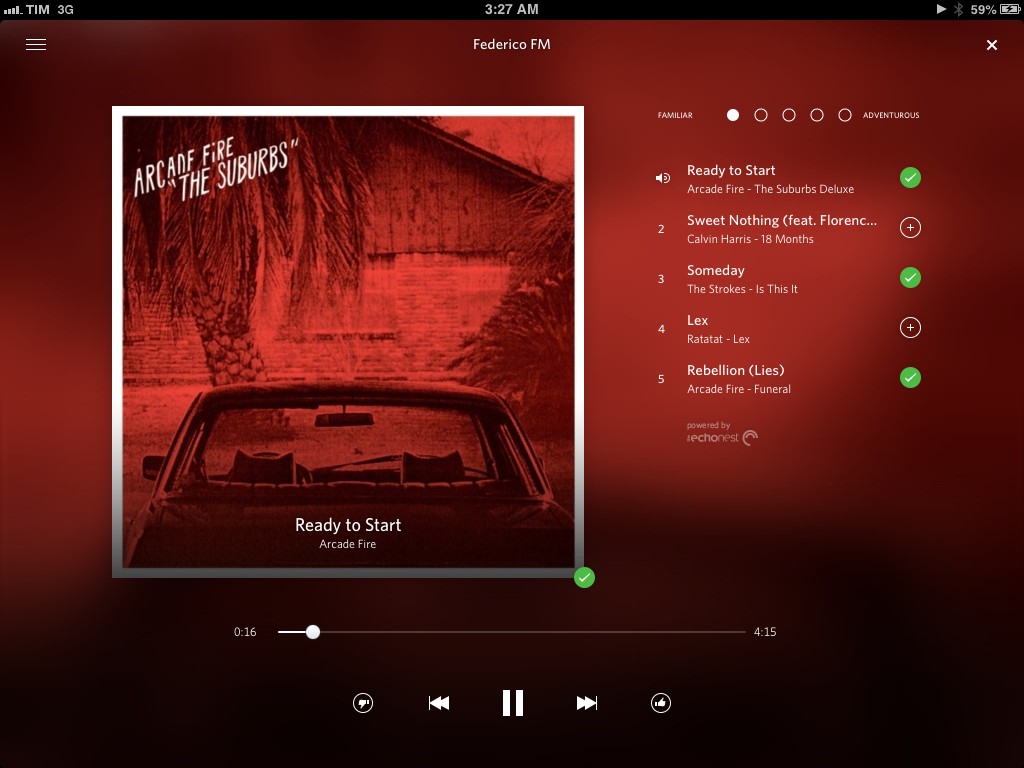
Following the introduction of improved, personalized radio stations in early August, Rdio has today rolled out an update to its iOS app that brings a wider range of controls for stations and Collection views to iPhones and iPads.
In stations, it’s now possible to alter the selection of tracks that the service will automatically pick choosing between “Familiar” and “Adventurous” settings with three additional levels of fine-tuning in the middle. Like Rdio for desktop computers, these settings are displayed as dots in the radio playing view.
Other additions in this update are more subtle, but still noteworthy. In search results, filters allow you to easily view results for artists, albums, songs, playlists, people, or labels – a handy change to simplify the process of finding exactly what you’re looking for. In the Collection view on the iPad, you can browse with a new (and admittedly visually more appealing) album view, and both the iPhone and iPad apps get the ability to sort Collection by Recently Added – useful to get a quick overview of the artists, albums, or songs you’ve been adding to your account lately.1 In the Stations area, Rdio for iOS can now start artist-only stations, just like the Mac app.
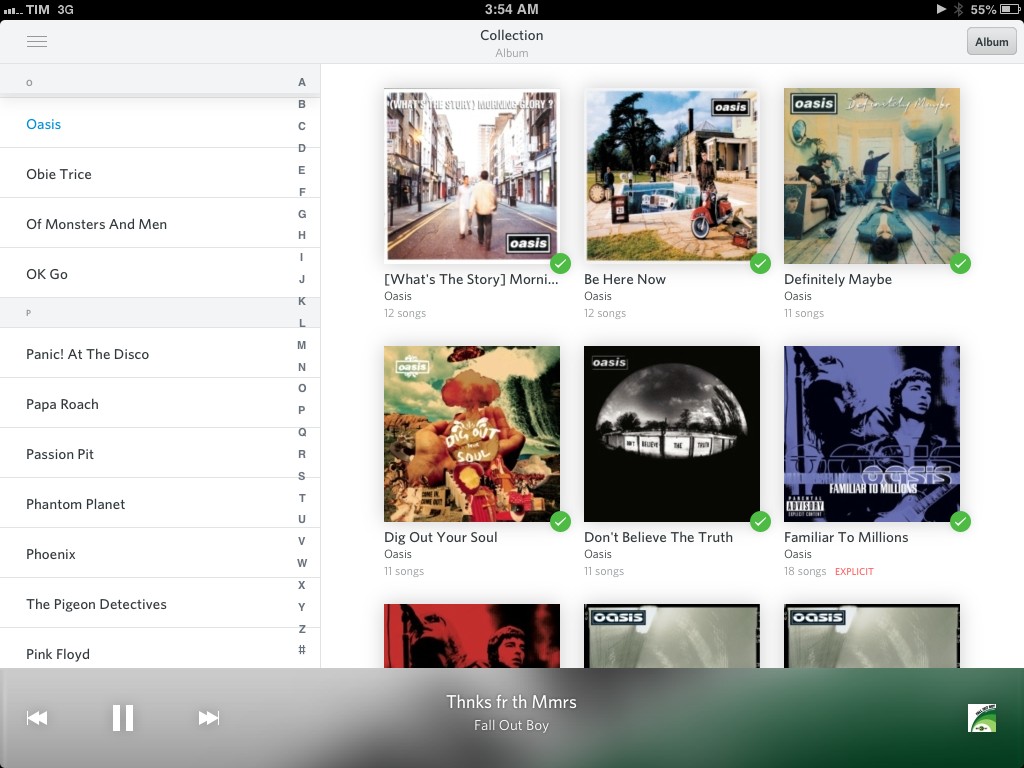
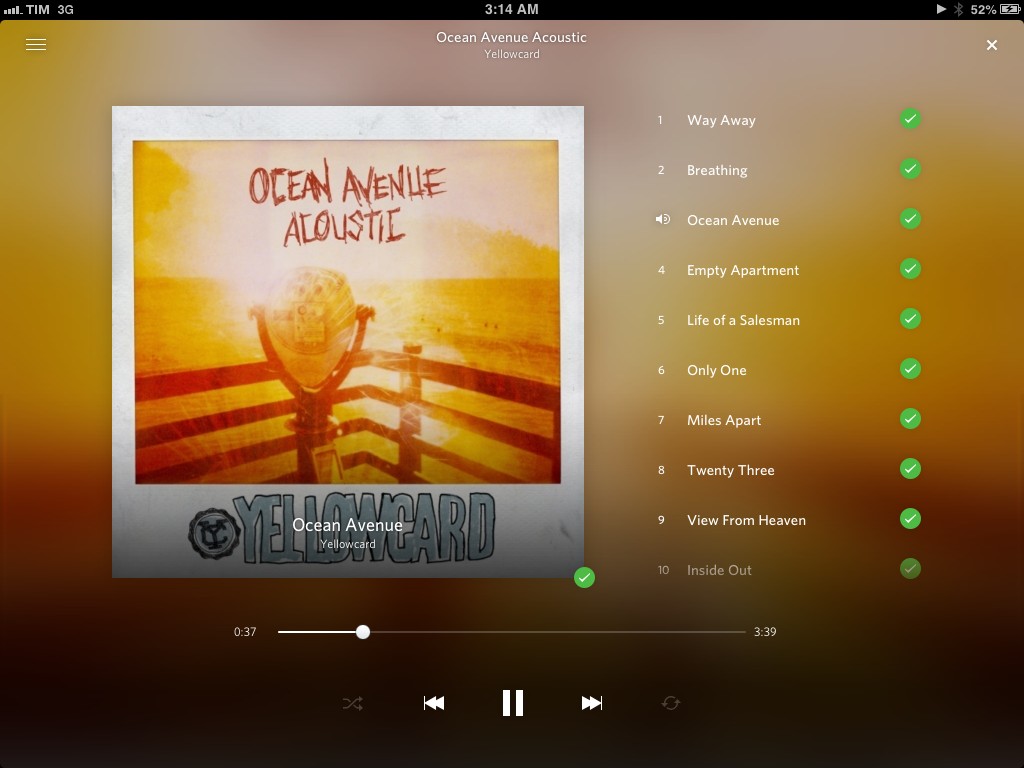
I’m a big fan of Rdio’s recent work on UI design and stations. Rdio has been looking like an iOS 7-ready app for quite a few months now, thanks to a great use of blurs and music artworks as backgrounds – a design choice that is in line with iOS 7’s focus on deference and user content. In Stations, I’m impressed by the accuracy of the “Your FM” algorithm and the way it manages to regularly bring up songs that it knows I’ll like. I can’t wait to see what Rdio will do with the actual iOS 7, and I’m curious to see if they will (finally) bring back standard Recommendations, which briefly showed up for me, but then disappeared.
You can get the latest Rdio for iOS here.
- I personally peruse the History section on a daily basis to quickly re-listen to songs I’m currently addicted to over and over. ↩
New Oceanhorn Trailer→
This is the iOS game I have been excited about for months. Recently, the developers announced Nobuo Uematsu and Kenji Ito are composing music for the game. My expectations are extremely high for Oceanhorn.