Federico Viticci

10804 posts on MacStories since April 2009

Federico is the founder and Editor-in-Chief of MacStories, where he writes about Apple with a focus on apps, developers, iPad, and iOS productivity. He founded MacStories in April 2009 and has been writing about Apple since. Federico is also the co-host of AppStories, a weekly podcast exploring the world of apps, Unwind, a fun exploration of media and more, and NPC: Next Portable Console, a show about portable gaming and the handheld revolution.

iPad mini and Logitech Tablet Keyboard

iPad mini and Logitech Tablet Keyboard

David Chartier has been taking a look at various external keyboard solutions for his iPad mini in the past weeks. I have enjoyed the series and I was looking forward to reading his thoughts on the Logitech Ultrathin Keyboard mini, Logitech’s latest entry in the market of iPad keyboard/case accessories. As I feared, the Ultrathin Keyboard mini is just too cramped to be an acceptable trade-off:

The keys are cramped, even moreso than the 9.7 inch iPad’s on-screen keys in landscape, which I consider “Normal Netbook” and quite typeable if you give yourself time to warm up to them. Logitech made some questionable tradeoffs when combining and shrinking keys; take a close look at my gallery photo to see what I mean.

My theory is simple: if you want to use an external keyboard with the iPad, you’d better have a good reason to do so. And for me, the good reason is very simple: having a real, full-size keyboard – not one that’s “physical” but just as small as the software one. This is the reason why I wasn’t a fan of the Ultrathin Keyboard Cover for the bigger iPad either.

Like David, I have been getting better at touch-typing, but I still think the best solution for the iPad mini is the one I chose for the iPad last year: the Logitech Tablet Keyboard. It’s the same size of Apple’s Bluetooth keyboard, and it’s got iOS-specific keys such as a Home button and a Spotlight shortcut, which I use all the time. Here’s my review from last year, still 100% true for me.

If you use a Logitech keyboard, here’s a handy list of shortcuts (list may vary depending on the keyboard layout you have). Also, iOS supports more “advanced” keyboard shortcuts, but very few people know about them – because they require VoiceOver to be activated. Here’s how you can get more shortcuts to work; I don’t use this method, but I hope Apple will allow third-party developers to have configurable keyboard shortcuts in a future version of iOS.

Permalink

A Better Testing Process for App Store Developers

A Better Testing Process for App Store Developers

The Iconfactory’s Sean Heber, in a radar filed on Open Radar:

Allow developers to add “in development” apps to the App Store. Rather than having them go through review, they simply upload builds like normal but the builds are set as “in development” which then only go to registered testers associated with the app.

In his proposal, Sean goes through the steps a possible “beta portal” for App Store apps may require. While I’m not sure about the idea of putting available development builds in the Purchased section of the App Store (if only for the poor technical performances of that section), I do believe this is a good idea. The lack of any sort of deeper App Store integration is what helped the rise of services like Hockey and TestFlight, and it seems strange that Apple hasn’t done much in the area of testing development builds of apps. I would also add that it’s absolutely anachronistic how Apple is still forcing developers to associate builds with device IDs rather than Apple IDs of testers (device slots are limited, and many testers have multiple devices).

I’m also intrigued by Sean’s other idea – letting users pay for early access to betas:

Bonus points would be to actually allow the developer to put a price on an app - even for testers. Using a mechanism like this, the developer could gather a group of early adopters who are willing to pay for early development access - perhaps to help support the developer in their quest to build the next big game. The goal with this is to provide a way that the next Minecraft could actually happen on iOS. When Minecraft was first beginning, Notch allowed people to pay for beta “lifetime” access up front. Even when the game was barely a game or barely anything at all. That early access generated a lot of buzz and revenue for him allowing him to continue development.

Again, I’m not sure how it would work in practice, but I think the idea is fascinating and worth discussing. Imagine some sort of Kickstarter-like approach for App Store apps, managed and sanctioned by Apple, and directly controlled by the developer. The App Store needs many, more basic improvements, but this is still something Apple should consider.

Permalink

Year Walk Review

Last night, I finished Year Walk – the latest game from Simogo, creators of Bumpy Road and Beat Sneak Bandit – and even if games don’t belong in my usual area of coverage here at MacStories, I think Year Walk deserves a special mention.

Calling Year Walk a “game” is actually reductive. Even though it plays like a game, Year Walk is an experience spanning various aspects of storytelling, Swedish folklore, multitouch interactions, sound, and additional reading material available in a Year Walk Companion app.

Year Walk is the most unique “game” I have played on iOS in years. I’ll try my best to describe its appeal in this post. Read more


Reader X 2.0

ReaderX

ReaderX

MacStories readers know that my favorite Google Reader client these days is Mr. Reader, especially after an update that added a “services menu” to the app, substantially increasing its interoperability with other apps. However, I’ve also been a fan of Reader X as a companion Google Reader app. A year after its original release in February 2012, developer Wolfgang Augustin released Reader X 2.0, which is a solid update that adds several new functionalities while building upon the original concept of the app.

Read more


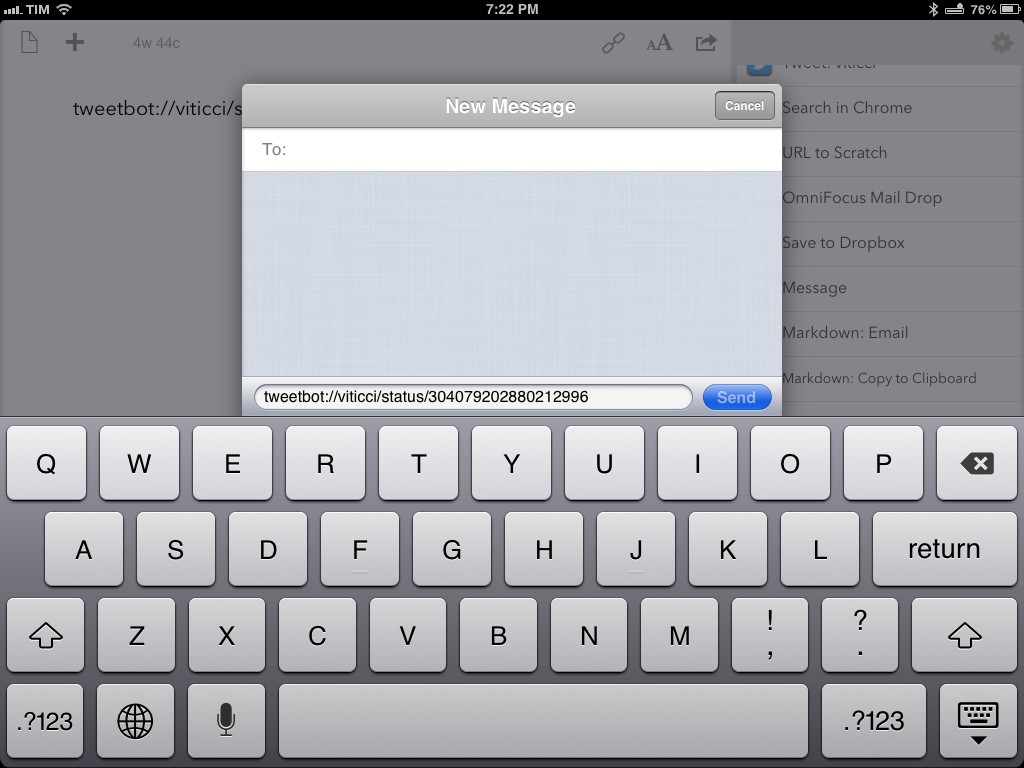
Chaining Tweetbot, Pythonista, Drafts, and iMessage for URLs

DraftsMessages

DraftsMessages

Last night, Tweetbot for iOS was updated with support for the Twitter 1.1 API, which, among various requirements, includes the need of linking a tweet’s timestamp – the date and time when it was sent – to its unique URL on twitter.com. In Tweetbot, you can now open the tweet detail view and tap on the timestamp to automatically open the Twitter website in your default browser; in terms of interaction, I like this change because it lets me open tweets in Google Chrome with just one tap.

In thinking about the update last night, I realized that:

  • My team and I use iMessage for daily communication;
  • The majority of URLs we share are Twitter URLs;
  • We all use Tweetbot on iOS and OS X;
  • Easier browser access means easier bookmarklet triggering;
  • Drafts can access iMessage.

And I concluded that:

  • I could chain every piece of the puzzle together;
  • Hopefully somebody else will find it useful and adapt the workflow to other similar scenarios.

Therefore, I created a browser bookmarklet, a Python script, and a Drafts action to automate the entire process and demonstrate how you can convert Twitter URLs to tweetbot:// URLs and send text from Pythonista to Drafts.

As usual, I am posting the following workflow as a proof of concept that you can modify and adapt to your needs. For instance, you can change the action that is triggered in Drafts, the x-success parameter that will be triggered, or the way Twitter links are converted to Tweetbot-specific URLs.

Read more


Apple Releases iOS 6.1.2 With Exchange Fix

Apple Releases iOS 6.1.2 With Exchange Fix

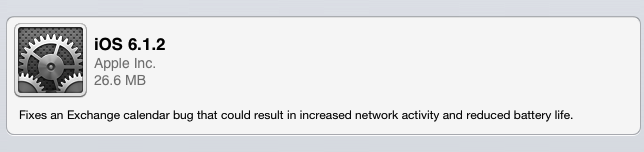
Following various reports from last week, Apple has today released iOS 6.1.2. The software update, available for all devices running iOS 6.1, introduces a fix for Exchange that could have resulted in “increased network activity and reduced battery life”.

The update is now available through iTunes and iOS’ Software Update panel. It’s not mentioned in the release notes, but – based on some first tests I ran on my iPhone 5 – it appears iOS 6.1.2 also fixes the passcode bug that was discovered last week (by following the steps to reproduce the old bug, the iPhone now simply gives a black screen/keypad instead of jumping to Phone/Contacts).

Update: I haven’t been able to reproduce the bug on my iPhone 5, but Ars Technica’s Andrew Cunningham says the bug is still unfixed in iOS 6.1.2.

Permalink

iOS YouTube Downloader with Pythonista

iOS YouTube Downloader with Pythonista

Useful script created by “pudquick” on the Pythonista forums:

Browse to http://m.youtube.com in Mobile Safari, view a video that you like (press Stop if it starts playing, you need to be looking at the page - not the video actually playing), then click on “Bookmarks” and select the bookmarklet that you created.

This will launch my script, which will pull the URL of the page you were looking at as an argument, parse it, figure out the direct download URL for the .mp4 video file, then open iDownloads directly to that URL to start downloading it.

As pudquick says, third-party YouTube clients with a “download” functionality are usually removed from the App Store as Google doesn’t allow downloading video files from the service. However, by using Pythonista to crawl the webpage and find the direct .mp4 link of a video, pudquick managed to put together a handy solution to go from your web browser to Pythonista and then directly to iDownloads to start downloading the .mp4 file.

However, I don’t use iDownloads – I prefer Readdle’s Documents and good.iWare’s GoodReader. Replacing iDownloads with your favorite file manager is very easy: in the penultimate line of the script, replace the iDownloads://URL with the one of the app you want to use (the URL of the .mp4 will be appended to it). Unfortunately, Documents doesn’t seem to be able to download .mp4 files in this way, but I had no problems with GoodReader. Simply use ghttp://to forward the .mp4 file to GoodReader and start downloading it automatically.

Make sure to check out pudquick’s explanation of the script and bookmarklet here. For our previous coverage of Pythonista, check out our tag page and my original review.

Permalink

Sponsor: Smile

My thanks to Smile for sponsoring MacStories this week with TextExpander.

TextExpander is the best utility to save time while typing. Why type the same thing over and over? Your email address, your phone number, your email signature can all be made into snippets and inserted with just a short abbreviation. You can use TextExpander to correct common typos (using autocorrect snippet groups or adding your own corrections to the snippet library), insert the current date in several formats with just a short abbrevation, and even quickly automate the creation of form letters with multiple choice pop-ups, optional fields, and more.

Furthermore, TextExpander is integrated in over 140 iOS apps including Things, iA Writer and others that I personally use every day, like OmniFocus and Day One. TextExpander comes with Dropbox sync, so your snippets will always be in sync across iOS and OS X.

Find out more about TextExpander here.