Federico Viticci

10804 posts on MacStories since April 2009

Federico is the founder and Editor-in-Chief of MacStories, where he writes about Apple with a focus on apps, developers, iPad, and iOS productivity. He founded MacStories in April 2009 and has been writing about Apple since. Federico is also the co-host of AppStories, a weekly podcast exploring the world of apps, Unwind, a fun exploration of media and more, and NPC: Next Portable Console, a show about portable gaming and the handheld revolution.

Photo of Clipless Next-Gen iPod Nano with 1.3 MP Camera Surfaces

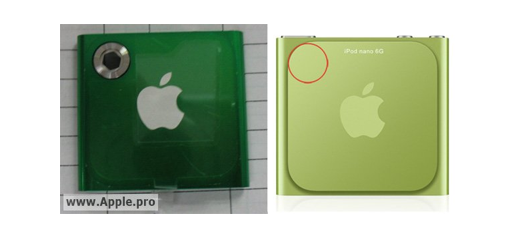
MacRumors points to a photo posted by Taiwanese website Apple.pro [Google Translation] of what they claim to be a seventh generation iPod nano featuring a 1.3 megapixel rear camera. The website, often a reliable source of Apple rumors and product leaks, posted a similar picture of the iPod nano’s case back in early April, but the photo detailed the internals of the device showing a hole for the alleged camera, failing to explain,however, how the camera would be placed externally considering the clip Apple places on the iPod nano’s back. Today’s photo seems to confirm previous speculation that, in order to make room for the camera, Apple would have to ditch the clip entirely, although it doesn’t make much sense considering Apple has been heavily touting the iPod nano as a sport accessory that can easily clip to your shirt or trousers – it’d be a curious choice for the company to revert to a clipless design to make room for a camera on such a small screen.

It’s unclear whether this new photo belongs to an iPod nano prototype Apple has been testing, or the final version of the next-generation model as Apple.pro claims. A 1.3MP lens would make for some decent photography on the nano’s screen, and indeed previous generation models featured a camera for shooting flicks and applying effects – although on a bigger screen and different case design. Since its introduction last year the 6th generation iPod nano has become an incredibly popular accessory thanks to the inclusion of a clip by default, and it’ll be interesting to see if Apple is really going to change the design for a rear camera. An announcement will likely be made in September at Apple’s usual music event, leaving plenty of room to speculation and rumors in the next months.


Carousel Is A Beautiful Instagram Client for Mac

Back in April we covered Instadesk, the first Instagram client for Mac that, through an interface design similar to iTunes and iPhoto, allowed you to browse Instagram photos, users, likes and comments directly from your desktop. The app was one of the thousands of results coming from the launch of the Instagram API, a set of tools that enable third-party developers to plug into your Instagram feed to retrieve photos uploaded by you or relevant to you. Of all the Instagram-connected apps we’ve covered, Instadesk saw a huge success as it was the first one to land on the Mac App Store.

Carousel, however, wants to step the game up by offering a beautiful and slick way to access Instagram from your Mac with a design that’s heavily inspired by iOS, yet runs natively on OS X. I don’t know if the developers are using the Iconfactory’s Chameleon framework for this, but it certainly looks like Carousel has some similarities with Twitterrific – the Twitter client from the Iconfactory that shares it codebase across the Mac, iPhone and iPad. So what’s this all about? First off, Carousel presents a minimal, vertical-oriented interface as if you were looking at your iPhone’s screen in portrait mode while browsing Instagram. The photo stream is embedded directly into the app’s window, with beautiful Instagram photos to flick through as they load. At the bottom, three tabs allow you to switch between your feed, popular photos and your profile. Every photo can be enlarged via Quick Look, saved locally on your Mac, or commented / liked thanks to a wide selection of keyboard shortcuts to choose from.

In Carousel, you can open every user’s profile to check out their photos. You can comment and like pictures, too, with interaction happening inside an iOS-like popover that resembles Twitterrific’s implementation of conversation views and profiles. You can even view if a user’s following you, or if you’re following him. Last, the app can be themed. Carousel’s default theme is already gorgeous in my opinion, but you can switch to a classic Mac or red one from the Settings.

Carousel can be downloaded for free, or you can purchase a license at $4.99 (introductory price) from the developer’s website. More screenshots below. Read more


Apple’s Guy L. “Bud” Tribble Explains Location Tracking at Senate Hearing

At a U.S. Senate hearing this morning entitled “Protecting Mobile Privacy: Your Smartphones, Tablets, Cell Phones and Your Privacy”, Apple’s Vice President of Software Technology Guy L. “Bud” Tribble offered his remarks about Apple’s privacy policy, location tracking system implemented in iOS devices and App Store app control, reiterating many of the points already explained by Apple two weeks ago in the Q&A on Location Data.

As summarized by AppleInsider, Tribble testified before Senate members that Apple doesn’t collect personal information about its users nor does the company share any information with advertisers – rather, the cache file that was discovered by security researchers (which was incorrectly large in size and backed up to a computer during the sync process) is meant to store information about nearby cell towers and WiFi hotspots to enable iPhones and iPads 3G to quickly get signal without having to rely on real-time GPS data all the time. This is a crowd-sourced database that Apple keeps in a small amount on every device as an offline cache – personal data and device identifiers are never sent to Apple, Tribble explained.

Sen. Al Franken also asked both Apple and Google representatives at the hearing whether the two companies could add a fixed privacy policy to their app marketplaces to ensure users always know how their personal data is being treated, and what’s going on behind the scenes of an app. Tribble replied a privacy policy in App Store apps wouldn’t be enough as users are likely to skip that every single time – and that’s why Apple believed that adding actual graphical elements to the user interface would be a better, and more elegant solution to inform users about the usage of Location Services. In iOS, an icon in the status bar indicates when an app is sharing your location; every app must ask a user to share his location through a dialog box; in the Settings, users can revoke location access on app-by-app basis and manage other location preferences as well.

Tribble also went on to explain Apple does random audits on App Store apps and follows the tech press and iOS community to find out which apps are violating the privacy rules:

The Apple executive also detailed how his company conducts random audits on applications to make sure they’re playing by the rules. He admitted that Apple does not audit every single one of its 350,000 iPhone applications, just like it would be impossible for the federal government to audit every single taxpayer. Apple also keeps an eye on blogs and its “active community” of application users for potential violations. If a violation is discovered and the issue cannot be resolved, applications will be removed within 24 hours and the developer will be notified.

In most cases, Tribble said, developers quickly correct the issue, as they want to keep their application available in the App Store.

Tribble was joined today by Google’s Alan Davidson. A video of Senator Franken’s opening statement is embedded after the break. Read more


Apple Patents Detail Web Clip Widgets for iOS, iPad with Extra Connector

According to a series of new patent designs published by Patently Apple, Apple has been experimenting with interesting concepts to let users create web clip widgets on iOS, and have an extra connectivity port on the iPad while in landscape mode.

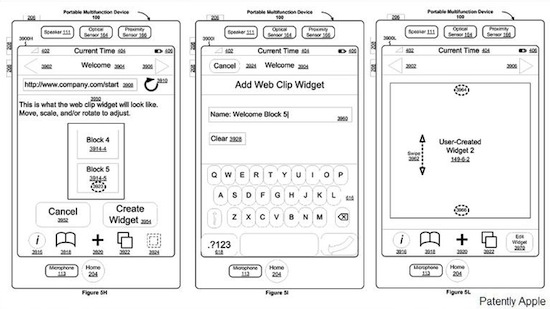
Web clip widgets were first introduced at the WWDC 2006, and through OS X Dashboard integration they allowed users to grab a portion of a webpage, save it as a widget in the Dashboard, and receive live updates when the original webpage changed. The feature came quite in handy for saving weather-related websites, e-commerce pages or blogs, but didn’t work really well with webpages that required a login system. However, it’s still a cool tech that enables users to visually select elements from a webpage to save locally on their Dashboards. Apple has been playing around with the idea of doing the same with iOS’ Safari, apparently, although neither the iPhone or iPad have support for homescreen widgets or Dashboard. The awarded patent design details the process of creating a web clip widget in Safari, with the possibility to “move, scale and/or rotate” content to adjust it to your needs. The menu appears to pop in as an overlay to the current webpage in Safari, but the patent doesn’t explain how a web clip would later be accessible from the Springboard. Current versions of iOS let users bookmark a website to the homescreen, but that’s still visualized as an icon – not a clip preview. Perhaps we’ll know more with iOS 5 at the upcoming WWDC.

The iPad-related patent is not new to the rumor mill, but it seems to confirm the original iPad was being tested in a version that featured an extra connector while in landscape mode.

Apple has been granted a design patent for what appears to be the original iPad Wi-Fi + 3G model that just happened to have a landscape USB slot as is clearly noted below in patent figures 1 and 6. It’s unknown at this time as to why Apple decided to scrap the secondary Landscape USB slot – when consumers clearly wanted such an option.

Apple credits Steve Jobs and Jonathan Ive (alongside other team members) for the invention. Both the original iPad and the iPad 2 come with a single connector below the device’s Home button, but it was rumored before Apple was planning on adding a second port for better landscape usage.


Financial Times Still Negotiating with Apple Ahead of June 30 Deadline

PaidContent reports the Financial Times is still negotiating with Apple over the implementation of iTunes subscriptions in its iPad app, which was generating 20% of the publication’s subscribers and over 1 million in revenue a few months ago.

With a month to go until publishers must either fall in with Apple’s new in-app purchasing terms or quit iOS in June, The Financial Times is not yet amongst the small early group to have consented to the new rules.

“We’re still in discussions with them,” FT producer management head Mary Beth Christie told paidContent:UK at World E-reading Congress in London on Tuesday morning. “We’ll see where they go. But we are fixed on the idea of holding on to our consumer data.

Like Time Inc., it appears that the Financial Times can’t agree on Apple’s subscription terms unveiled last February, which require publishers to give a 30% cut off every transaction to Apple and allow users to choose whether or not they want to share their personal information with a publisher. In the past months, in fact, the Financial Times stated multiple times that the iPad app could go somewhere else, perhaps on other platforms and tablets, as they couldn’t give up on subscribers’ data to stay in the App Store. Indeed, after a five-month trial period, Apple will begin pulling publishing apps that haven’t implemented subscriptions on June 30.

Apple managed to ink deals with several magazines, newspapers and publishers over the past two weeks, such as Hearst and Conde Nast, which began selling a subscription-based version of The New Yorker yesterday.


Rdio Launches API for Mobile Devices

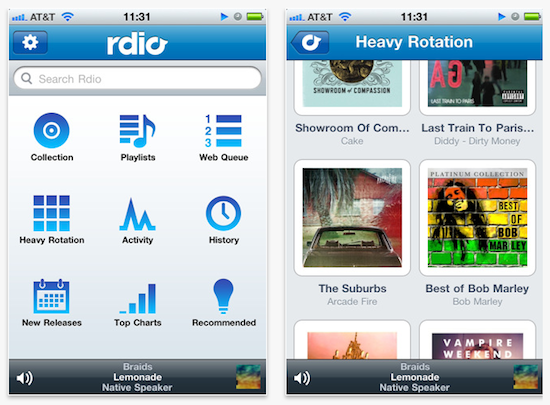
Music streaming service Rdio, quite popular in the US and Canada but currently unavailable due to regional restrictions in the rest of the world, announced yesterday the release of an API for iOS and Android devices that will allow developers to build apps that are integrated with Rdio’s music and social functionalities. The API – documentation available here and here – will let third-party devs build apps that search “all the artists, songs, albums, playlists, and top charts in Rdio’s catalog of over 8.5 million songs.” On top of that, the API will also bring playlist creation and editing outside of the official Rdio app, as well as the possibility to show a user’s Heavy Rotation, collections or follow other people. For a first release, it sounds like a solid API for iOS and Android.

Attending Google I/O 2011? Take a closer look at our Mobile API on Android devices at Rdio’s Developer Sandbox at Moscone Center in San Francisco. If you won’t be there or want to see the API in action yourself, download the Rdio Music Quiz from the iPhone App store.

While our Mobile API doesn’t yet support our affiliate program, it will soon. So make sure to sign up for it now and start building that incredible mobile app you always wanted to make.

The current API and service terms won’t let developers create paid apps that directly plug into Rdio. Still, with Spotify struggling to launch in the US and an impressive userbase and app selection after a few months, Rdio has the chance to maintain a healthy ecosystem for music streaming apps in the US, and take it from there to Europe. Rdio has big plans for sure, and it’ll be interesting to follow its developments in the next months, especially after Apple will unveil its rumored cloud music service with full labels’ support.


Zynga Hires Key Contributors Behind cocos2d for iPhone

After the acquisition of Wonderland Software late in April, gaming giant Zynga (you might remember these folks for Farmville, among other things) announced they hired key contributors of the cocos2d for iPhone framework Ricardo Quesada and Rolando Abarca. The two developers will join Zynga’s team while still maintaining cocos2d for iPhone community and official website – which the company did not acquire. Cocos2d for iPhone, a framework for creating “2D games, demos, and other graphical/interactive applications” used by hundreds of developers including Atari, ngmoco and Zynga itself, is an open-source project that currently supports the iPhone, iPod touch, iPad and Mac. Quesada and Abarca will continue supporting and contributing to cocos2d for iPhone; the “talent acquisition” from Zynga is clearly aimed at enhancing the company’s portfolio in the development field, which ranges from 2D and 3D games to advanced HTML and social experiences. Zynga has a pretty rich catalog of mobile games, too.

Zynga has long been an advocate of the open source community and we are excited to have Ricardo and Rolando continue to support and contribute to cocos2d for iPhone while in their new roles at Zynga. Games and applications will continue to operate on cocos2d for iPhone as they always have. Zynga did not acquire the community site, cocos2d-iphone.org, which will continue to be managed separately by Ricardo along with the other cocos2d for iPhone administrators. We look forward to advancing the cocos2d for iPhone open source project alongside the cocos2d for iPhone developer community.

At this point, we can’t tell how Zynga will use the talent of cocos2d for iPhone’s contributors to enrich their gaming experiences with complex physics engines and integration with other third-party graphic libraries. What’s for sure is that Zynga doesn’t have a problem in opening its wallet to purchase assets and other smaller companies, considering today’s talent and partial asset acquisition is the 13th one in the last 12 months.


Duke Nukem Forever Also Coming To iOS?

As noted by TouchArcade, popular yet never released console and PC game Duke Nukem Forever might be coming to iOS devices, too. Duke Nukem Forever is particularly interesting as a title as it’s become synonym of vaporware online: development started in 1997, but the game never actually came out (in spite of promotional material and screenshots being handed out to the press and fans) due to multiple delays from the original developers, 3D Realms. If you’ve been following Duke Nukem Forever’s history throughout the years, you know that the brand’s userbase came to the point where many lost any kind of hope in seeing the game officially out: that was until 2010, when game studio Gearbox revealed they had picked DNF off 3D Realms’ hands and were busy working on a full adaption and rewrite for current-gen consoles. They announced a release date for May 2010, but the game was delayed again. It should be finally coming out after 14 years on June 9, 2011, and it’s already available for pre-purchase on Steam.

Digging into the game’s manual, a TouchArcade reader found out the developers included “Apple App Store Additional License Terms” – a bunch of legalese that most gamers usually skip, but it’s intended to inform users about licensing terms, agreements, and so forth. This could mean a mobile version of Duke Nukem Forever is also in the works, which wouldn’t be surprise considering the App Store userbase nowadays and the fact that the Unreal Engine runs on iPhones and iPads. Gearbox hasn’t confirmed they’ll use the Unreal Engine in the game, but that’s a possibility if DNF is really being ported to iOS devices. As TouchArcade notes, the license terms might also refer to the Mac App Store, although Gearbox specifically stated there weren’t any announcements related to the Mac or Linux platforms – and the terms clearly mention the iPhone and iPod touch in regards to the software license.

After all these years, it’d be nice to see the Duke on the iPad.


The iPad 2 Could Have Been The World’s Fastest Computer in 1985

The iPad 2 Could Have Been The World’s Fastest Computer in 1985

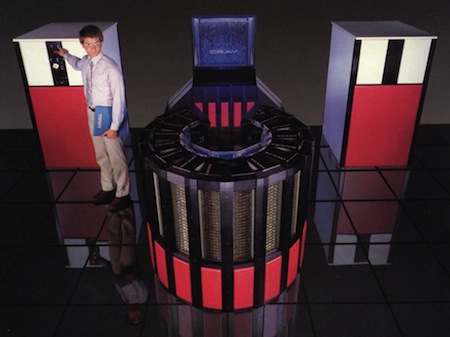
Jack Dongarra, researcher at Oak Ridge National Laboratory, conducted a study to determine the position of the iPad in the list of the world’s 500 fastest computers in history. Using the Linpack computing benchmark, “a linear algebra test that measures  the mathematical capabilities of computers”, he came to the conclusion that the iPad 2 would be the perfect rival for the four-processor version of the Cray 2 supercomputer, an eight-processor machine that was the world’s fastest computer in 1985.

To date, the researchers have run the test on only one of the iPad microprocessor’s two processing cores. When they finish their project, though, Dr. Dongarra estimates that the iPad 2 will have a Linpack benchmark of between 1.5 and 1.65 gigaflops (billions of floating-point, or mathematical, operations per second). That would have insured that the iPad 2 could have stayed on the list of the world’s fastest supercomputers through 1994.

The Cray 2 was an unusual computer even by the standards of its designer, Seymour Cray. About the size of a large washing machine, it was cooled by immersion in a liquid called Flourinert that had been developed by 3M, and that was occasionally used as a human blood substitute during surgery.

The obvious difference is that, whilst the Cray 2 required to be placed in a large room, the iPad 2 fits in your hands, it’s touch-based and runs thousands of different apps. To put things in context, Steve Jobs also left Apple in 1985.

Permalink