Federico Viticci

10804 posts on MacStories since April 2009

Federico is the founder and Editor-in-Chief of MacStories, where he writes about Apple with a focus on apps, developers, iPad, and iOS productivity. He founded MacStories in April 2009 and has been writing about Apple since. Federico is also the co-host of AppStories, a weekly podcast exploring the world of apps, Unwind, a fun exploration of media and more, and NPC: Next Portable Console, a show about portable gaming and the handheld revolution.

Socialcam Aims At Becoming Instagram for Video

There is no doubt  Instagram has changed the way iOS users look at image sharing on their iPhones: with a few taps, you can take a picture with your device, apply some filters to make it “cooler”, send it to the Instagram’s cloud to share it with your friends and everyone else. Instagram’s appeal lies in the simplicity of the concept, and 2 million users in a few months can’t be wrong.

But the App Store image sharing scene isn’t just about Instagram. Service picplz has collected a pretty huge userbase lately as well, making it the direct competitor to Instagram and one of the most popular apps to quickly share photos from an iPhone. Videos, however, have always been one kind of a problem for iOS aficionados: put simply, there is no easy way to share a video with your friends. Email is slow with attachments, Facebook’s video uploading isn’t intuitive at all (and again, uploading is slow), Youtube is more meant for videos that need to be viewed publicly.

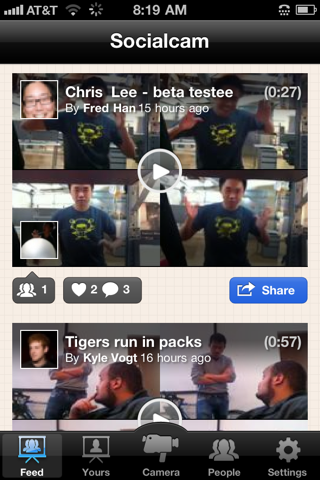
TechCrunch offers a preview of Socialcam, a new iPhone app from the creators of Justin.tv that, like Instagram, will allow users to upload videos with a few taps and share them with their friends using Facebook’s Connect feature. Socialcam, currently in beta and launching in the first weeks of March, has a tabbed interface with a huge “Camera” button in the middle similar to Instagram’s UI and will let you upload, browse videos shared by others, like and comment them.

The app, which will be available for both Android and iPhone, is pretty simple: after firing it up you’re asked to log-in via Facebook Connect, which is currently the only login option. The app presents you with a list of your Facebook friends who are already on Socialcam and asks if you’d like to ‘Follow’ them (Socialcam uses a one-way follower model like Twitter). After that, you’ll spend most of your time looking at the stream of Socialcam videos posted by your friends. Each video is represented by four frame grabs — tapping on one will cause the video player to pop open the clip will start playing immediately. You can leave comments and ‘Like’ each video, and you can also tag your friends in clips. If you tag a friend who isn’t on Socialcam, it will still show up on their Facebook wall (and the video is playable directly from there — you don’t have to click a link).

You can sign up to be notified about Socialcam news here, and hopefully more details will be available in the coming weeks ahead of the app’s launch.

PhotoSync Enables iOS-to-iOS, iOS-to-Computer Photo and Video Sharing

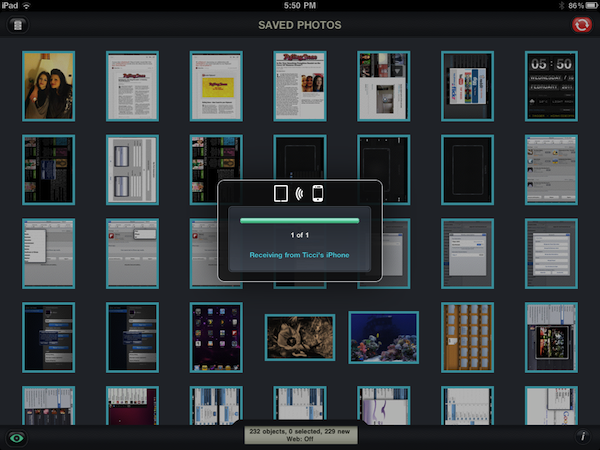
PhotoSync, a universal $1.99 app available in the App Store, has quickly become one of my favorite tools to enhance my iOS devices’ photo and video sharing capabilities. The app, which requires a free Mac companion software to be installed from the developers’ website, allows you to share photos and videos from your iPhone and iPad libraries between computers and other iOS devices running the app. PhotoSync can send multiple photos at once or sync entire libraries with iPhones, iPads and iPod touches, as well as PCs and Macs. Read more


Readability Is The First Victim Of Apple’s New Subscriptions

Three weeks ago, web service Readability launched a completely revamped version of its “read later” platform including support for Instapaper (Marco Arment is an advisor to Arc90, the company behind Readability) and a new subscription system that allows publishers of content consumed through Readability to get 70% of the fees paid by subscribers.

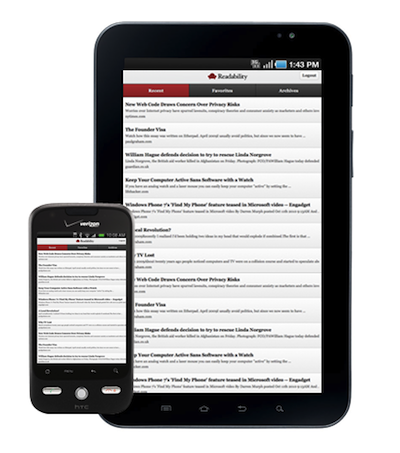
It works like this: you sign up to Readability as a reader paying a $5 monthly fee, but you can decide to pay even more if you’re willing to support the project. Once you’re ready to use the service, you install a bookmarklet in your browser that will save articles for later in an uncluttered view that’s perfect for late-night reading sessions and mobile devices. Yes, it really is similar to Marco Arment’s Instapaper. In fact, the developers announced that the first official Readability iOS app would be heavily based on Instapaper – which also happens to have introduced support for sending logs to Readability a few days ago. Instapaper and Readability thus have become two integrated platforms for reading content and sharing it with your friends – but Readability’s unique twist allows publishers (like MacStories, or any other weblog) to get a kickback for every article saved for later. It’s a genius approach no one ever tried before. Read more


iOS Devices Become Kinect Controllers In Dodgeball Game

In the past, we saw several interesting Kinect hacks making their way to iPads and Macs thanks to the efforts of a vivid developer community willing to get more out of Microsoft’s motion-controlling peripheral than simple Xbox pairing and gaming. In fact, we were able to get our hands (and eyes) on a free Kinect 3D viewer available in the Mac App Store and an iPad playing together with OS X in a cool futuristic experiment. But hackers, as usual, don’t stop at curious experiments that are worth nothing but a quick test.

A group of hackers last week managed to build a custom Kinect setup that allows iOS devices (iPhone and iPad) to fire balls in a dodgeball game playable by a gamer in front of Kinect. The UI design isn’t as beautiful and attractive as Microsoft’s version of the same thing built on top of Windows Phone 7, but as you can see from the video below it definitely seems to be working.

The video is available for your viewing pleasure after the break. Who’s going to build a Kinect Angry Birds with iOS devices as controllers now? [via Engadget] Read more


You Don’t Eat This Angry Birds Cake - You Play With It First

We know people spend an incredible amount of time playing Angry Birds every day, and it shouldn’t come as a surprise that, once the iOS game is done, people keep on thinking about their beloved birds and pigs. Remember the LEGO set, arcade booth and cake? Angry Birds aficionados (dare we say fanboys) don’t just refine their skills on iPhones and iPads: they are truly immersed in the world imagined by Rovio.

So here comes the interactive Angry Birds cake, playable with a real slingshot and, of course, made of chocolate, icing and so forth. It’s a cake made for a boy named Ben. It took 10 hours to make, and only 2 minutes to destroy.

Ah, the kids playing with real-life Angry Birds. I didn’t have the chance to eat a Super Mario when I was a kid. Check out the video below. [Electricpig via Gizmodo] Read more


Apple’s Subscriptions and Consumers

Apple’s Subscriptions and Consumers

This piece by David Carr at The New York Times gets to the main point of subscriptions as seen by Apple, not publishers:

Publishers say their objections are less about the steep revenue split than the lack of data. But publishers who sit out Apple subscriptions will be bypassing a huge embedded base of not only iPad users, but also the very people who have already shown a willingness to pay for content. It’s worth pointing out that publishers are already in the business of selling products to consumers they have no data on: it’s called the newsstand. Cosmopolitan and People know nothing about the millions who buy their magazines at retail stores, and that doesn’t stop their respective publishers from making a ton of money there.

Apple knows many publishers already have digital subscriptions in place on their websites, but they also know many readers would like to jump to digital versions altogether if only the subscription system was simple, integrated in a single place or device. So looking at Apple’s subscriptions from a consumer perspective, here’s what we get:

Keep in mind that consumers could not care less about revenue splits. In pushing through a plan that publishers are unhappy with, Apple is able to position itself as an advocate for consumers, enabling one-touch transactions while keeping their data private from a host of media providers.

Publishers have every right in the world to guard their business model, but it won’t please their potential audiences.

Publishers may pass on this new Apple plan, but consumers will be disappointed to know they can’t have Condè Nast’s publications available through this fancy iTunes payment thing. By playing the “advocate” role, Apple has cleverly implemented a way to rewrite the rules and keep their cut at the same time. Consumers, in the very end, want content and they don’t care about publishers’ issues. They’re just going to say “why can’t I subscribe to Wired here?”.

And if this strategy doesn’t work, you can stay assured Apple will change.

Permalink

‘I Am Number Four’ Director On Hollywood & iPads

‘I Am Number Four’ Director On Hollywood & iPads

(Above: Michael Bay using his iPad on the set of ‘Transformers’)

Film director DJ Caruso describes his experience of using the iPad as a productivity tool while shooting ‘I Am Number Four’:

I got it, I don’t want to say as a toy, but then I realized about a week into prep that my storyboards were coming on it, my previs was on it, my script was on it, I don’t carry my script anymore. I started getting emails from two of my storyboard artists who work in Los Angeles and I have this application where I can mark up the boards – I’m a terrible drawer – and I can mark up the boards and send them back. It just became this amazing production tool.

There’s more than a director discovering this new tablet computer as a useful gadget, though. In fact, DJ Caruso says almost everyone at Hollywood from assistants to actors to directors now has an iPad, and not just to play Angry Birds during breaks. He even tells the story of when he got into an email conversation with Spielberg about the apps they had installed and used for work purposes.

The coolest part, however, is about the supernatural powers of the main character of his movie being controlled by a custom-made iPad app:

Pettyfer’s character John Smith, an alien, discovers during the film he has several supernatural powers. One of those powers is that he can control light through his hands. During filming, Alex wore a flashlight-like contraption wired up through his jacket and it was activated… by an iPad off screen.

It turns out, some people do create content on their iPads. Looks like Hollywood is indeed hooked on iPads. [via TUAW]

Permalink

Are Existing iPhone Owners Buying The Verizon iPhone?

Are Existing iPhone Owners Buying The Verizon iPhone?

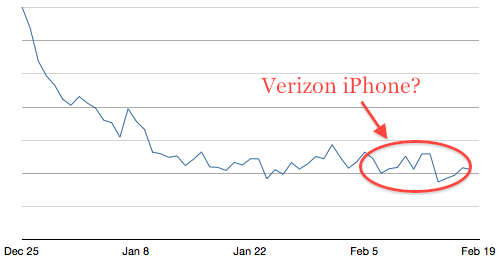
Marco Arment makes the case for non-record initial Verizon iPhone sales due to the fact that the device is mostly selling to existing iPhone owners coming from AT&T. Why the analysis? Because Instapaper’s numbers in the App Store haven’t gone under the usual increase of a new product release / major update / holiday season:

And my sales haven’t noticed. Ranks have held nearly constant, but so have volumes.

Assuming the correlation is approximately sound, this can be explained by three possibilities:

- Very few Verizon iPhones have been sold. I don’t think this is likely.
- Verizon iPhone owners are buying very few apps relative to other iPhone owners. This also seems unlikely.
- Most Verizon iPhones have been sold to existing iPhone or iPod Touch1 owners, who therefore already own most or all of the apps they want. This seems like the most likely explanation by far.

Assuming the analysis is correct, I guess we’ll see a lot of Verizon iPhone sales when contracts are up in June. Also in June: iPhone 5, quite possibly available on Verizon as well. This summer is going to be interesting for U.S. carriers.

Permalink

Last.fm Updates iPhone App with Retina Graphics, Recommendations

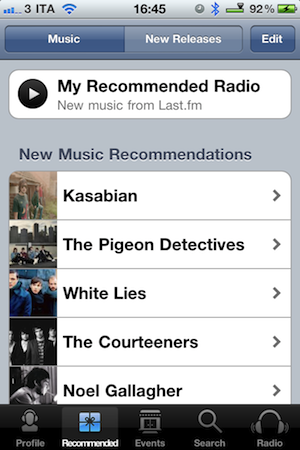
In spite of the lack of appreciation for Apple’s new subscription system from Last.fm’s co-founder Richard Jones, the popular music service released an update to their official iPhone client today – and it’s a rather big update. Version 3.0 of the app, available here, adds the much requested Retina Display graphics with an improved interface design (about time, considering the iPhone 4 was released 8 months ago), Last.fm music recommendations for artists and new albums you might like, possibility to (finally) check your profile on the go, including top charts, friends and recently played tracks.

Last.fm 3.0 for iPhone, however, comes with other features, too. First, a menu to check on concerts available in your area (sadly, no one wants to play here in Viterbo) and the events your friends are attending. This is pretty cool and adds another layer of social interactivity to Last.fm, and it’s also something Apple has been rumored to be willing to implement in iTunes for a long time. You can now listen to two new radio stations or, alternatively, edit existing ones directly from your device to restrict them to a specific tag. Two weeks ago, Last.fm announced the Radio functionality would soon become a subscriber-only feature (thus the issues with Apple’s new policies).

Last.fm 3.0 for iPhone is available for free here.