Federico Viticci

10804 posts on MacStories since April 2009

Federico is the founder and Editor-in-Chief of MacStories, where he writes about Apple with a focus on apps, developers, iPad, and iOS productivity. He founded MacStories in April 2009 and has been writing about Apple since. Federico is also the co-host of AppStories, a weekly podcast exploring the world of apps, Unwind, a fun exploration of media and more, and NPC: Next Portable Console, a show about portable gaming and the handheld revolution.

iPad Vs. Other Tablets Comparison

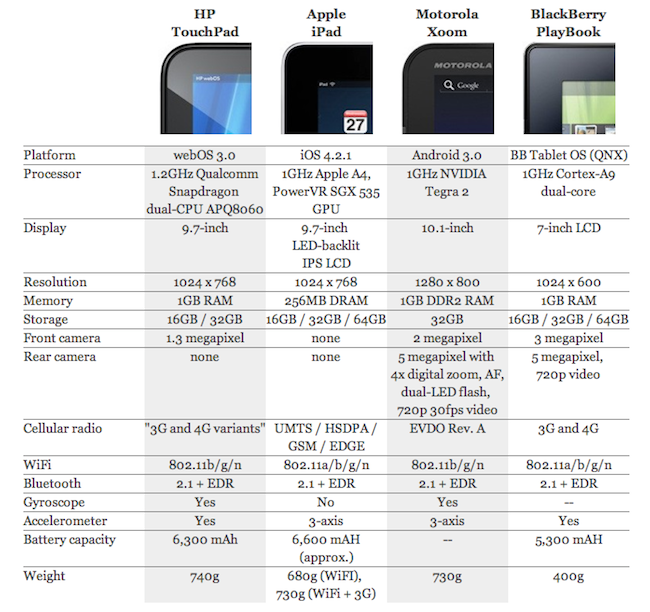
With today’s announcement of the HP TouchPad, we have a new tablet on the horizon. Even though HP says the device has “planned availability this summer”, the un-announced release date and pricing info don’t make the TouchPad any less interesting than it is. Personally, I think webOS was meant for tablets: beautiful and elegant multitasking interface, attention to details, sweet notification system, great photos app with full Facebook integration. And we’ve only seen a demo today. Overall, the TouchPad is promising and - this is the best part in my opinion - it could be the device not from Apple the Apple geeks will love.

In the comparison chart above, Engadget takes a look at the various tablets coming our way soon and the current generation iPad. The original iPad (which at this point should be refreshed very soon) still holds up pretty well, although the Motorola Xoom will sport a higher resolution screen (with 0.3 inches more, though) and the BlackBerry Playbook will have a dual core Cortex A9 processor. The iPad doesn’t have cameras, lacks a gyroscope and has only 256 MB of RAM.

The problem most of these tablets will have to face is the upcoming iPad 2 which is rumored to be faster, lighter, thinner and camera equipped. With iOS 5 also on the horizon for a June release, HP will have to consider both the new Apple hardware and software if they’re really pushing for a mid-summer release of the TouchPad.

iOS and App Backups

iOS and App Backups

Craig Grannell is right about iOS lacking an option to easily restore game backups:

That Apple doesn’t provide a workaround for this is inexcusable now that we’ve reached iOS 4.x. In the days of 10 MB iOS games, it wasn’t a problem: you could stuff dozens on a device without problem. But in this age of Rivens and Puzzle Quest 2s, Apple’s (from a gaming standpoint) fast turning its high-end devices into the equivalent of crappy cartridges without battery back-up. The only difference is that an iOS device can hold a bunch of ‘cartridges’, but when one’s removed, the result is the same: all your progress is lost.

Game Center could have been a solution with cloud-based backups for gamers, but I think this is a wider issue. Apple should provide single backups for any app, not just games. Either cloud-based (tied to your MobileMe account, would be nice) or local, users could restore an app’s library after an OS update in seconds. The problem with the current iTunes backups is that they keep everything in a single package that’s often incompatible with updates / downgrades because, again, apps aren’t separated from system files in the backup file.

A single-app backup method would make everything much easier.

Permalink

iBooks 1.2.1 Now Available

A few minutes ago Apple released an update to iBooks for iPhone and iPad. The new iBooks 1.2.1 doesn’t come with new features over the previous 1.2 version but adds a number of stability and performance improvements. The usual Apple magic recipe for minor updates, we guess.

Go grab it here. [Thanks, Roberto!]


What Happens When Twitter for iPad Meets Youtube? YouPad

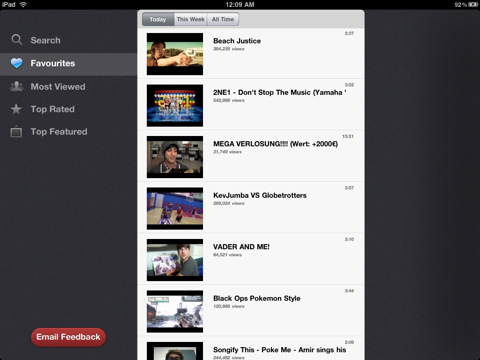
Call it a ripoff or “design inspiration”, an iPad app called YouPad, available in the App Store at $1.99, takes the experience and design elements seen in Twitter’s official iPad client and mixes them with Youtube. The result, as you can see from the screenshots, is quite…curious.

The FalconsApp developers claim that the app has been featured in Apple’s “New & Awesome” category, and while we still have to see such a section show up in the App Store, we do believe them when they say YouPad provides a revolutionary way to browse Youtube. Twitter for iPad was very innovative, too. The app seems to feature the same stacking panels navigation, the same background, the same sidebar with icons to browse different sections of Loren Brichter’s application. We can’t judge on stability and animations, but these developers sure have a thing for this kind of interface.

But hey – perhaps it really is a revolutionary app. If you dare to go ahead and purchase YouPad, it’s only $1.99 in the App Store. If you, however, don’t like Twitter for iPad at all, then you should stay away from this one.


Penultimate for iPad Adds AirPrint Support, Multi-Page Actions

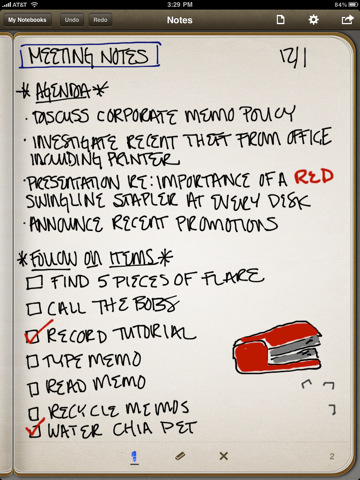
Penultimate is one of the most popular productivity apps for the iPad that was featured by Apple several times in the past (it still holds the #3 position in the Top Paid chart) and we covered as well during its update cycle. When the iPad was released last year, Penultimate was one of the first apps to become really, really popular among early adopters and grant the developers thousands of dollars in revenue.

The latest update to Penultimate, version 2.3, adds full support for AirPrint (iOS 4.2 or later required) and multiple page actions that allow users to email, print or delete different sets of pages within a single notebook. Together with other stability and performance improvements, Penultimate really stands out in the handwriting / sketching panorama of apps for iPad.

Penultimate is available at $0.99 in the App Store.


Verizon iPhone Sales Expected To Top 1 Million In First Week

As reported  by AppleInsider, a note to investors issued by analyst Mike Abramsky with RBC Capital Markets suggests that the Verizon iPhone’s sales might top 1 million in the first week of availability of the device. Basing on estimated numbers from last week’s pre-orders and available inventory at Verizon and Best Buy stores, Abramsky predicts the 8 month old iPhone 4 can sell 1 million units from February 10th to the 17th, quickly go out of stock and then sell between 3 - 4 million units in the first quarter.

For calendar year 2011, Abramsky sees between 9 million and 10 million Verizon iPhones being sold, though he cautioned the number could be conservative. Those sales figures assume smartphone penetration among Verizon’s customer base will grow from 26 percent in 2010 to 40 percent in calendar year 2011.

The analyst also sees Apple surpassing Google Android’s smartphone share on the Verizon network in 2011. He has forecast the iPhone to represent 40 percent of smartphone sales on Verizon, versus 37 percent for Android.

Other numbers shared by Abramsky include 75 million iPhones sold in 2011 with Verizon accounting to 12 - 13 percent of iPhone sales worldwide. Apple and Verizon haven’t disclosed the official numbers of pre-orders for the iPhone 4 yet, but we guess we’ll be hearing about sales soon, probably as soon as next weekend.


Walmart Will Offer Verizon iPhone Starting Tomorrow In 600 Stores

Retail chain Walmart announced this morning that, starting February 10th, they will carry the Verizon iPhone in nearly 600 stores across the United States:

We’re excited to bring iPhone 4 on the Verizon Wireless network, one the most anticipated mobile phone launches in recent history, to Walmart customers,” said Gary Severson, senior vice president, Home Entertainment, Walmart U.S. “As customers continue to embrace smart phone technology, we’ve added nearly 20 smart phone models to our assortment, including the new Verizon Wireless iPhone 4.”

iPhone 4 on the Verizon Wireless network will be available at nearly 600 of the retailer’s in-store wireless areas starting at $199 for the 16GB model.  Walmart will offer a variety of iPhone 4 accessories including cases, car chargers, wraps, and hands free accessories from variety of accessory manufacturers. Walmart currently carries the AT&T iPhone 4 in select stores nationwide.

Walmart joins Apple, Verizon and Best Buy as a distributor of the new device. Orders for the Verizon iPhone went live again last night on Apple’s and Verizon’s websites.


Woz: Putting Color In The Computer Was One Of The Biggest Things Apple Ever Did

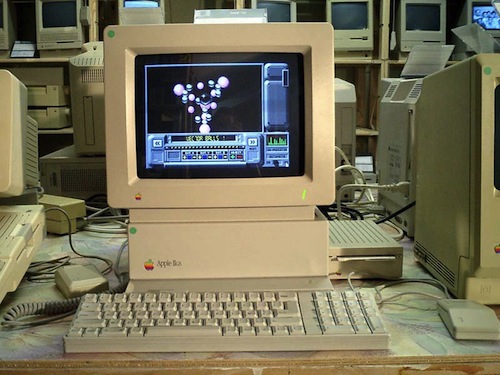
In an interview with FORA.tv called Creativity in the 21st Century, Apple co-founder and entrepreneur Steve Wozniak recalls an interesting moment in Apple’s history: the day when he came up with the idea to put color in a personal computer during a four-day and four-night coding / design session for Atari’s Breakout game.

“Putting color in the computer was probably one of the biggest things Apple ever did”, he says. “Nobody expected color to come into a computer because color machines cost a thousand dollars.” “I figured out a way to do it with one little $1 chip”. The Woz explains in those days he was tired, really tired, and his mind was in a “floating half-asleep state” due to the lack of sleep and too much work. He saw the technique Atari used to simulate colors on its first arcade games, and he thought it would be great to find a way to do real colors with pixels through a chip on a personal computer.

The Wikipedia entry for the Apple II explains:

Color on the Apple II series took advantage of a quirk of the NTSC television signal standard, which made color display relatively easy and inexpensive to implement. The original NTSC television signal specification was black-and-white. Color was tacked on later by adding a 3.58-MHz subcarrier signal that was partially ignored by B&W TV sets. Color is encoded based on the phase of this signal in relation to a reference color burst signal. The result is that the position, size, and intensity of a series of pulses define color information. These pulses can translate into pixels on the computer screen.

The Apple II display provided two pixels per subcarrier cycle. When the color burst reference signal was turned on and the computer attached to a color display, it could display green by showing one alternating pattern of pixels, magenta with an opposite pattern of alternating pixels, and white by placing two pixels next to each other. Later, blue and orange became available by tweaking the offset of the pixels by half a pixel-width in relation to the colorburst signal. The high-resolution display offered more colors simply by compressing more, narrower pixels into each subcarrier cycle. The coarse, low-resolution graphics display mode worked differently, as it could output a short burst of high-frequency signal per pixel to offer more color options.

Listen to the whole story of how color came to be into Apple’s computer below. A few years later, Steve Jobs experienced his first TV interview. Read more


Found Footage: Young Steve Jobs’ First TV Appearance

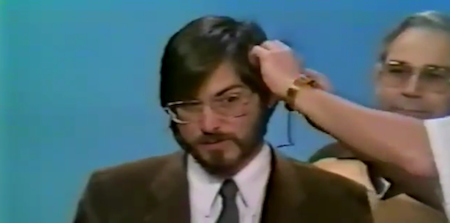
Before the “Stevenotes”, the “magical” and “wonderful” products announced at conferences streamed live worldwide, there was a kid amazed to see himself on a TV monitor for the first time. In the video below, courtesy of Electricpig, you can see Steve Jobs in his twenties getting ready for an interview on national television.

It turns out – surprise – Jobs wasn’t always confident and “arrogant” as you’ve seen him in the past few years. He’s nervous, asks for some water before the show, people adjust his hair and microphone before the interview.

Ah, the good times. Check out the video below. Fascinating. Read more