
Posts in Linked

Apple Announces New App Store Numbers and Milestones

With a press release, Apple today announced new App Store numbers and milestones, as well as updated statistics on job creation in the United States and globally.

From the press release:

Apple today announced that the first week of January set a new record for billings from the App Store with customers around the world spending nearly half a billion dollars on apps and in-app purchases, and New Year’s Day 2015 marked the single biggest day ever in App Store sales history. These milestones follow a record-breaking 2014, in which billings rose 50 percent and apps generated over $10 billion in revenue for developers. To date, App Store developers have earned a cumulative $25 billion from the sale of apps and games. The introduction of iOS 8, the most significant iOS update ever, gave developers the ability to create amazing new apps and offers innovative features which proved wildly popular with App Store customers around the world.

In the press release, Apple announced that 1.4 million apps are now available on the App Store, with 725,000 of them made for iPad. Apple estimates that the “iOS ecosystem” has created 627,000 jobs in the US, and, in an updated job creation webpage, they put that number at slightly over a million for jobs “created or supported” by Apple. The same mini-site includes other numbers related to the company’s future Campus 2, US-based customer support, and more.

The App Store numbers come at an interesting time for Apple – the company has been criticized for some of its App Store practices over the past few months, but the stats shared today appear to paint a more positive picture in terms of overall growth and health of the market. Below, I’ve included some tweets by Horace Dediu for further context and analysis.

Read more


Ten Years of Mac Mini – A Timeline

This weekend marks the ten year anniversary of the first Mac mini. I feel confident in saying that no one has watched this little machine grow more intently than I have watched it. It’s the center of everything I do here at Macminicolo.

Macminicolo’s Brian Stucki has put together a timeline with highlights from the past 10 years of the Mac mini. It’s fun to look back at the original “iHome” rumor and I’m glad the mini (the small but powerful machine that runs this website) is still around today.

Permalink

Connected: 50% My Duty

To ring in 2015, the boys spend some time with weird old browsers, Hackintoshes, the rumored 12-inch MacBook Air and Federico’s attempts to reinvent his nerd life.

This week’s Connected includes notes about my experiments with new apps and services as well as a good discussion about the rumored 12-inch MacBook Air. You can listen to the episode here.

Sponsored by:

  • Hover: Simplified Domain Management. Use code ‘RECONNECTED’ for 10% off your first purchase.
  • Loot Crate: a monthly subscription box service for epic geek and gamer items and pop culture gear. Use code VIRTUAL for 10% off.
Permalink

The 2014 Panic Report

Panic is one of my favorite software companies and I’m happy to see Cabel Sasser posting this today:

Panic is a multi-million dollar business that has turned a profit for 17 years straight.

It just hit me, typing those words, that that’s a pretty insane thing to be able to say. (And, sure, we barely qualify). Believe me, I know it won’t last forever — but wow, what a kind of crazy deal.

All the problems mentioned by Cabel in the post are related to the App Store. If you look closely, the 2014 Panic Report is also a well written summary of areas where Apple’s App Stores (plural, for iOS and Mac) could improve.

Permalink

Improving iOS 8 Keyboards

David Chartier sums up my feelings on custom iOS 8 keyboards so far:

As interesting as iOS keyboards can be, their initial implementation at the OS level is severely flawed. They’re cumbersome to setup, switching between them is needlessly tedious, and limitations make it difficult to teach users about keyboard features. As far as I can tell, all these problems require solutions and improvements from Apple at the OS level.

I only use custom keyboards that solve a specific problem: Clips, for copying multiple bits of text; KuaiBoard, for visual snippets; Emoji++, because it’s better than Apple’s emoji keyboard. Even with these keyboards (which I only activate when I need them – as utilities) I’ve been annoyed by the system’s tediousness in switching between them and lack of consistency.

I haven’t been able to stick with any replacement keyboard as my primary one. In the first version of iOS 8, keyboards were too buggy to be used as daily drivers, but even after fixes I can’t use a non-Apple one on a daily basis. I’d miss the system autocorrection, QuickType, dictation, and shortcuts that I’ve grown to know over the years. Hopefully Apple will soften its stance on what’s off-limits to custom keyboards with iOS 9. Personally, I quite like Apple’s keyboard – I just wish it supported multiple languages at once.

Permalink

Connected: The Illusion of Choice

At the end of 2014, Stephen and Myke reflect on what proved to be a wild year in technology.

I wasn’t available for episode 20 of Connected, but Myke and Stephen did a great job in recapping 2014 and what we saw in technology last year. You can listen to the episode here.

Sponsored by:

  • lynda.com: An easy and affordable way to help individuals and organizations learn. Free 10-day trial.
  • Sketchparty TV: the fun, fast drawing and guessing game for Apple TV.
  • Squarespace: Start Here. Go Anywhere. Use code WORLD for 10% off
Permalink

Virtual: Skipping the Zombie Dinner

This week Federico and Myke share their holiday experiences, before discussing what games are coming in 2015, Federico’s further time with Minecraft and Myke’s impressions of the Wii U.

And if you’re interested in getting started with Minecraft after listening to Virtual, don’t miss episode 20 of Inquisitive with John Moltz, co-author of The Visual Guide to Minecraft. You can listen to the episode here.

Sponsored by:

  • Squarespace: Start Here. Go Anywhere. Use code INSERTCOIN for 10% off
Permalink

Twitter’s Native Video Player

A post on TechCrunch from yesterday claimed to offer details on Twitter’s previously announced native video service for users, but the company refuted the rumor. According to Twitter, the details uncovered on the video.twitter.com website refer to native videos for Twitter Amplify users, another initiative announced in August 2014.

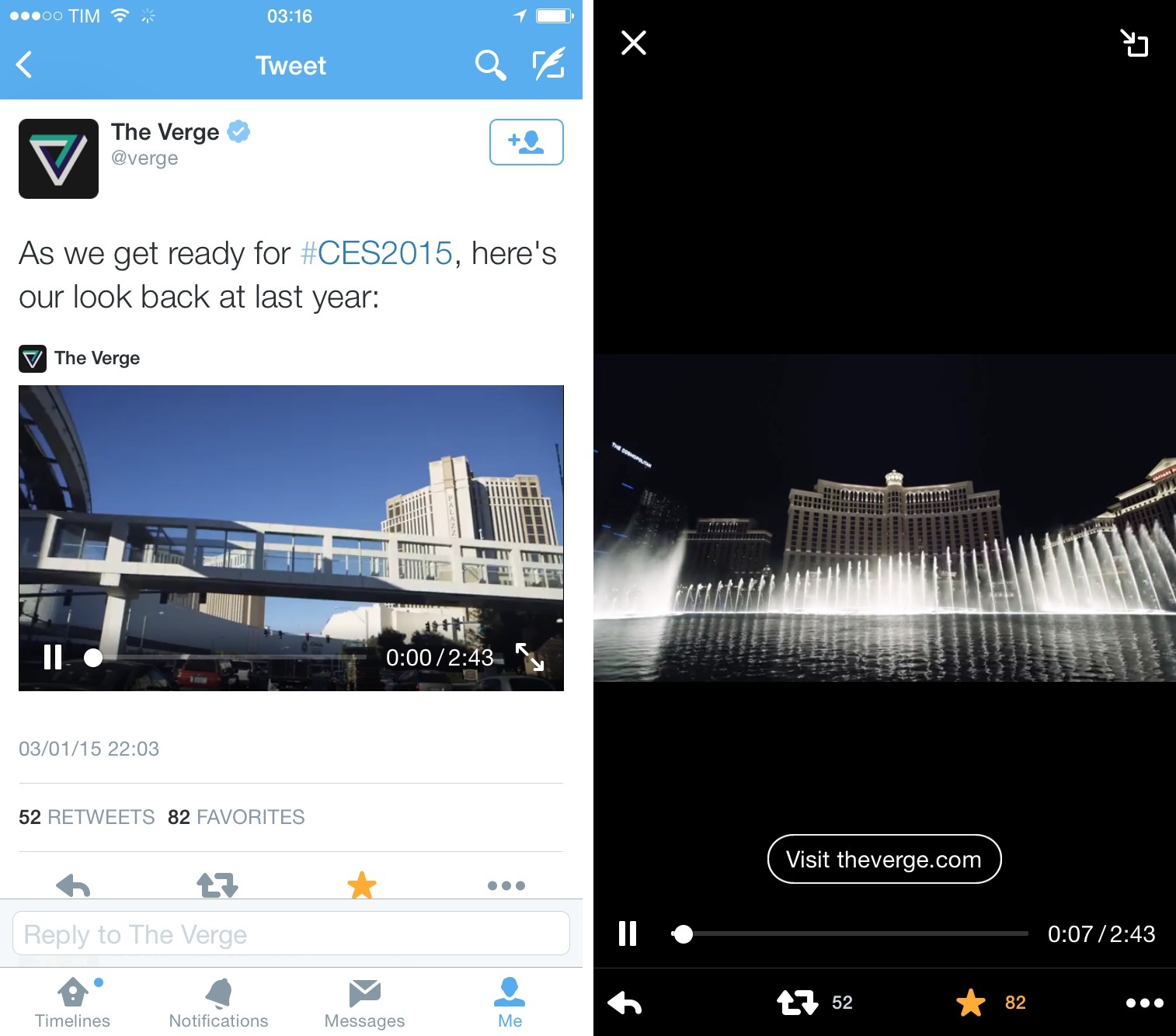
As a user of the Twitter app for iOS, I’ve noticed native Twitter videos (promoted or not) for a while now. They’re actually not terrible: they don’t have all the options of YouTube, but the play inline with a card and have essential playback controls.

This tweet, for example:

Looks like this on the iPhone:

I only noticed today, however, that The Verge’s video has a button to open an associated webpage in Twitter’s inline browser, which was new to me. I also didn’t know that videos could be minimized on the iPad, just like SoundCloud audio cards can be minimized on the iPhone:

Twitter Video is expected to be rolled out in the first half of this year, and I’m curious to see what the company will do with it. As a fan of Twitter’s move towards integrated cards on mobile, I think that native videos (that are longer than Vines) have potential to integrate nicely with other media types in the timeline. It’ll be interesting to see how users and companies that are currently using YouTube will react to native Twitter videos. Considering the impact that Twitter photos had on how content is shared on Twitter, I’d keep an eye on native videos enabled for every user (not just promoted tweets or selected publications).

Permalink

“Fork iOS for iPad”

Khoi Vinh, writing about iOS for iPad:

Unlike the projects above, this one could positively affect Apple’s bottom line: as I wrote in October, I believe that the iPad is at a crossroads. Its growth has stalled, and it’s failed to serve as a launching pad for transformative new software experiences and businesses the way its older sibling the iPhone has. What the iPad needs now is unique reasons for being—something that may be difficult to achieve while it remains in lockstep with the iPhone. Forking the operating system so that a dedicated team can focus exclusively on improvements that benefit the iPad solely could provide the right opportunity to open up new vistas for the device.

Of course, we’ll have to wait and see results for the holiday quarter to assess sales of Apple’s new iPad lineup and there have been major changes in iPad initiatives lately, but Khoi has a point.

I’ve long argued (see: iOS 7) that iOS doesn’t feel truly optimized for the iPad and that several components of the OS are enlarged versions of their iPhone counterparts. Simplicity has always been one of the core tenets of the iPad, but sometimes simplicity works against user experience when functionality is too closely modelled after a smaller display for the sake of consistency or, worse, time constraints. I don’t know if Apple needs to “fork” iOS for iPad and make it a separate entity, but improvements meant solely for iPad software would be great (multitasking, perhaps?).

Permalink