Posts in Linked

The Story Behind “The Song”

Last week, Apple released a holiday commercial called The Song that tells a beautiful and simple story where Apple software and devices aren’t the main characters.

Today, Apple has posted a “behind the scenes” video that shows how the song was recorded with a voice-o-graph and ported to GarageBand.

There’s a few things I like about these two videos. The ad is powerful, and it focuses on what you can do with technology rather than what technology is. That’s a strong message, and it’s carried out subtly and elegantly through the video.

And I like that the Making Of shows Dana Williams’ real dock (with Spotify in it) and the BioShock Infinite vibe of the voice-o-graph. This is a good follow-up to last year’s video.

Permalink

Drafts Gets Its Today Widget Back

From the changelog of Drafts 4.0.6, released today on the App Store:

New: Today widget. Now back with the addition of recent drafts summary. Thanks to the help of some fine folks inside Apple for sorting this out.

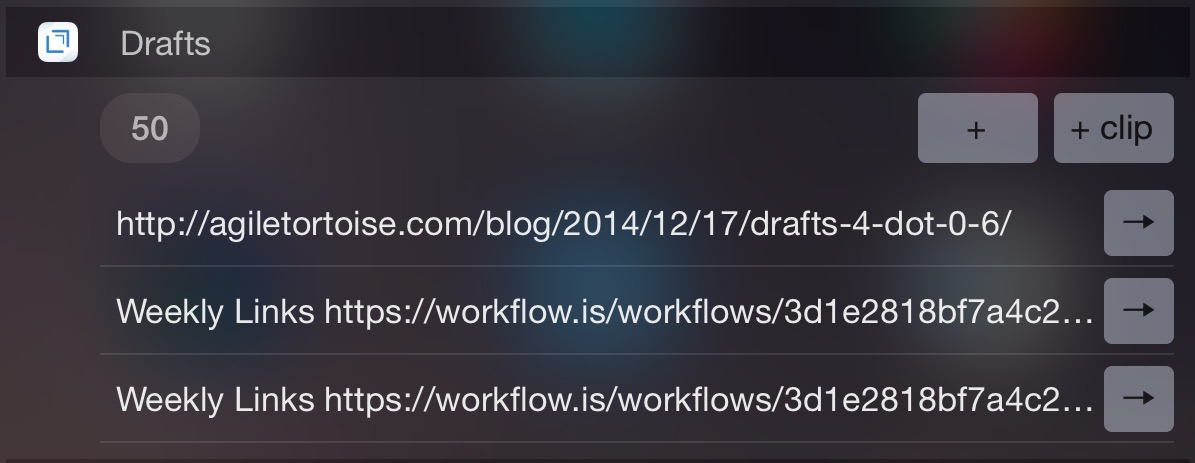
The original Drafts widget was removed from the app after an Apple rejection two weeks ago. As with PCalc and Transmit before, Apple reversed their decision and the widget is back – and it’s even better than before.

The widget shows the total number of drafts in the app and it has buttons to create a new empty draft, a draft from the clipboard, and to open recent drafts, which is new. I wish Agile Tortoise didn’t have to go through this process, but I’m glad the widget is back in Drafts before the holidays.

Permalink

Discovery on the App Store

Gedeon Maheux writes about search on the App Store following a simple experiment: looking at search results for “Twitter”. The outcome is concerning:

The following list was generated by a manual App Store (iPhone) search on Nov 15th, 2014 for the term “Twitter”. To make the list easier to parse, I’ve called out all apps that allow a user to directly read AND post to Twitter in bold. Everything else is either a game, a utility, or some other social network enhancement. The official app from Twitter is naturally the first result, but the next actual Twitter client (Hootsuite) doesn’t appear on the list until #20 and the next one after that comes in at #62. Even the mega-popular Tweetbot isn’t returned in the results until position #81 and even then, the older v2 of Tweetbot (for iOS 6) comes first. Where’s Twitterrific? Although it contains the word “Twitter” in the app’s name, Twitterrific isn’t seen in the list until you scroll all the way down to #100.

App Store search has historically been a black box. The problem isn’t necessarily that it’s getting worse – rather, it’s that it doesn’t appear to be getting better. Every day I search for something on the App Store and, inevitably, I come across unrelated social games, apps to boost your Twitter followers or Instagram likes, and clones of other apps instead of more accurate results.

In spite of Apple’s efforts to put curated lists of apps front and center, people still search for apps the old fashioned way. A mobile take on SEO has become quite popular, studies suggest this, and, anecdotally, the importance of search – inside and outside of the App Store – can be easily measured.

Apple has plenty of room for improvement in App Store search; in the meantime, the upcoming app analytics should hopefully help developers understand how customers are finding (or not finding) their apps through search.

Permalink

Hacking the Tweet Stream

MG Siegler writes about one of the latest trends in changing the way longer messages are shared on Twitter:

More recently, there’s been a trend with a similar goal (to increase the 140-character limit), but immensely better execution and flow: appending screenshots of text to tweets.

In the age of Tweetstorms, I thought I would grow to hate this as well. But I actually quite like it. One big reason: it maintains the flow of the tweet stream. That is, it’s one tweet with a payload, so it both flows in and out of the stream just as quickly as a regular tweet. And, more importantly, it can be retweeted (another one of those early Twitter “hacks” that has since become part of the official canon) and replied to without breaking context.

I’ve seen this as well, and it’s becoming more frequent each week. Since the beginning of mobile Twitter clients, there’s always been a desire from some users to be able to share longer tweets. Twitter never caved in to the pressure and maintained the historic character limitation of tweets, but, as MG notes, screenshots and tweetstorms are clever in that they “hack” the Twitter stream natively through replies and inline previews. An interesting consequence of changing the timeline from a simple list of tweets to something different.

Permalink

A Safari View Controller

Bryan Irace writes about web views in iOS and offers a great idea for the future: a Safari view controller.

But in-app browsers have some pretty massive downsides as well. They can’t access cookies stored by other in-app browsers, nor Safari, requiring the user to repeatedly log in to websites that they should already be authenticated with. iCloud Keychain is great for syncing credentials across devices, but while Safari has access to its data, in-app browsers don’t. This isn’t merely Apple being punitive – it’d be horribly negligent to give third-party applications access to this kind of information.

Essentially, developers would be able to implement a web view based on Safari that offers Safari features to other apps while also isolating code from third-party access. This would be good for security, for example, but also for consistency with extensions and iCloud features.

As I noted earlier this week, implementations of web views can be massively different from app to app. A native Safari view could offer more options than standard web views and secure user data from third-party apps (case in point). It could also provide a solution to this:

You can find Bryan’s suggestion on OpenRadar.

Permalink

Virtual: Weaponized Hashtags

This week Myke and Federico catch up with the current progress in the new Pokemon games, before discussing No Man’s Sky, Zelda Wii U and a tonne of news and announcements from the Video Game awards and the PlayStation Experience Event.

News-packed show on Virtual this week. You can get the episode here.

Sponsored by:

  • Brave Wave: The best independent music label you’ve never heard of. Use code ‘YAYMYKE’ for 20% off in their store.
Permalink

Connected: On Principle, I Shunned These Ideas

This week, Federico, Myke and what’s left of Stephen discuss some Evernote follow-up, recent App Store drama and what’s going on with Twitter clients.

On this week’s Connected, we discuss recent App Store rejections (Transmit’s iCloud Drive feature has been reinstated) and the conclusion of my Twitter article. Get the episode here.

Sponsored by:

  • iStat Menus 5, by Bjango: An advanced system monitor for your Mac’s menubar. Get 25% off with code CONNECTED.
  • Harry’s: An exceptional shave at a fraction of the price. Use code CONNECTEDHOLIDAY for $5 off your first purchase.
  • Iconic: A Photographic Tribute to Apple Innovation. Use Code CONNECTED for 10% off.
Permalink

iCloud Drive Sharing Restored in Transmit

Earlier this week, Panic was forced to remove Transmit’s ability to send files to iCloud Drive following a request by Apple. Fortunately, Apple has reversed their decision (as it happened for the PCalc widget) and a new version of Transmit has been released on the App Store.

As I argued last night on Connected, there could be an issue within Apple that leads to confusion with apps that can be promoted and rejected at the same time. We don’t, however, know the extent of this probable issue, and I don’t think speculating about internal conflicts is worth much (as with most things Apple, speculation isn’t useful).

We can (and should continue to) point out unfair and unreasonable rejections, especially for apps that aren’t made by popular companies such as Panic. Hopefully this latest string of questionable rejections and reversals will allow Apple to improve their internal App Review processes and make sure these cases become less frequent in the future.

Permalink

HockeyApp Acquired by Microsoft

With a blog post, mobile development testing and feedback service HockeyApp has announced they’ve been acquired by Microsoft.

From the HockeyApp blog:

Microsoft has been a HockeyApp customer with many apps since the early days back in 2011, so they were already familiar with the stability and quality of our service. Creating the best developer experience is key to both Microsoft and HockeyApp, this includes delivering industry leading tools for the major mobile platforms: iOS, Android and Windows. We saw the potential of the added abilities and resources of Microsoft to make our platform even better. It may sound cliché, but it really does feel like a match made in heaven.

We want to be very clear about the most important thing: we remain dedicated to our mission of making the best mobile app development feedback and testing distribution platform in the world. Your HockeyApp apps and accounts will continue to work and the team has not stopped working on advancing the platform. Throughout the next few months, we’ll reveal more about our plans with Microsoft.

In a separate blog post, Microsoft has also shared details of what to expect from the near future of HockeyApp:

In the coming months, we will introduce new iOS and Android SDKs for Application Insights based on the features of HockeyApp. Application Insights offers a 360-degree view of application usage, availability, and performance across both client and server/cloud application components. Integrating HockeyApp crash reports with Application Insights usage analytics will extend device support for Application Insights across all major mobile platforms and make application analytics an ambient part of the application development cycle with support for all tiers of a modern “mobile first, cloud first” solution.

It’s not surprising to see HockeyApp becoming part of Microsoft following TestFlight and Crashlytics joining Apple and Twitter, respectively. Mobile development testing has become essential to the app economy, and big companies want to control that part of the stack.

As a user, I always preferred HockeyApp to the original TestFlight. HockeyApp was fast, its Timeline view was excellent (see all beta builds from newest to oldest), and it was always more reliable than the old TestFlight. The new TestFlight, though, is much easier and integrated than third-party beta testing services: developers can add up to 1000 external testers using Apple IDs rather than device UDIDs. That alone has been a massively welcome change: I only need to give my email address to developers, and then I can download an app without going crazy with certificates and UDIDs.

Most of the betas I try for MacStories have switched to the new TestFlight. It’s just too convenient and integrated. I do think, however, that there’s still room for services like HockeyApp, which offers developers more insights, cross-platform support, and the ability to avoid Apple’s often problematic web services. It’ll be interesting to see where Microsoft takes HockeyApp.

Permalink