Posts in Linked


Google Buys Songza

In more music news, Google just announced they’re acquiring Songza, a music streaming and recommendation service available in the US and Canada.

The Verge writes:

Google announced today that it’s acquiring the streaming-music service Songza for an undisclosed sum. Over the coming months it will be integrating the company’s smart playlist creation into Google Play Music and perhaps YouTube. Songza will remain an active and independent app for the time being. The purchase highlights the increasingly competitive landscape emerging around music, as Apple, Amazon, and Google all seek to differentiate their mobile products by offering top-notch streaming services.

Here’s the Google announcement:

They’ve built a great service which uses contextual expert-curated playlists to give you the right music at the right time. We aren’t planning any immediate changes to Songza, so it will continue to work like usual for existing users. Over the coming months, we’ll explore ways to bring what you love about Songza to Google Play Music. We’ll also look for opportunities to bring their great work to the music experience on YouTube and other Google products.

Songza also notes that “no immediate changes” are planned, although that usually means that specific features will be integrated into other Google products or that the acquired app (Songza is available on both iOS and Android) will be removed from sale:

Today, we’re thrilled to announce that we’re becoming part of Google. We can’t think of a better company to join in our quest to provide the perfect soundtrack for everything you do.

Songza went through several iterations, and in 2011 it relaunched to focus on curated music recommendations provided by its own team of music experts; in 2012, the company launched a Concierge feature to recommend music based on situations and moods, with filters to refine selections and vote songs. Here’s a Billboard article with a review of Concierge from March 2012.

There are many parallels with Beats Music, which seems to confirm that human music curation as an aid to algorithms and traditional search matters.

Music curation is one of themes of 2014 at this point – even Spotify revamped their app homepage to prominently feature curated playlists and recommendations based on mood and time of the day. It’ll be interesting to see what Apple and Google will do with their acquisitions.

Permalink

Rdio Acquires TastemakerX

From the Rdio blog:

Today, we’re thrilled to announce that we are growing our team with the acquisition of TastemakerX, a leading music discovery and curation service. Based in San Francisco, TastemakerX was founded in 2011 to help artists connect with fans. TastemakerX enables listeners to discover new music, build and listen to virtual collections, and view artists based on social discovery.

The interesting part, as noted by Brad Hill at RAIN News, is that this acquisition follows the news of Spotify acquiring The Echo Nest (the leading music intelligence company) back in March, when I purposefully included a note on third-party services using it for essential music discovery/recommendation features.

Rdio announced they’d stop using The Echo Nest after the company was acquired (smart and obvious move). Here’s a VentureBeat article from last year with more details on TastemakerX.

Permalink

A Company Made of People

Allen Pike (via Brent Simmons) writes about Tim Cook’s Apple:

Of course, this is a shift, not a revolution. Apple will never get to the point where their culture tolerates, say, employees publicly tweeting that their CEO should step down. Indeed, as a public company with fierce competitors, they’re obligated to maintain decorum and secrecy around things that are materially sensitive.

Still, around the things that aren’t core secrets - developer relations, employee personality, and standing up for their values - Apple is feeling more like a chorus of real people and less like a monolith.

Permalink

Long Live Photos

Joseph Linaschke, who runs ApertureExpert, has a great take on Apple’s decision to discontinue Aperture and focus on a single Photos app:

Before we can look to the future, let’s look at the past. Aperture itself has been around since 2005; nearly a decade. And of course it started being written well before that, so we are talking about 10+ year old code. The cloud, the iPhone, and pocket sized digital cameras that surpass the quality of film not only didn’t exist, but were barely a twinkle in Steve Jobs’ or any technologist’s eye. Aperture is a photo editing and management tool written for users used to an old school workflow. Go on a shoot. Sit down to edit. Share when you’re done. But that’s not the world we live in anymore. Today we want to shoot, share immediately with a cool effect, edit on an iPad, sit down at your 4k display and get serious, pick up the iPad and show off what you’ve done, mix, repeat. We want our devices, our libraries, our experience integrated and seamless. This simply can not happen with Aperture as it is today.

Also, don’t miss his comment follow-up and analysis of the Photos.app screenshot shared by Apple. In short, Joseph argues, Photos 1.0 may not ship with all the features of Aperture as you know it today, but he is confident that Apple will continue to iterate on the product.

Permalink

New Graphics at Apple Retail Stores

ifoAppleStore’s Gary Allen has posted photos of the new back-lit wall graphics Apple has begun installing at selected retail stores, noting the change of mood from previous wall graphics:

The new graphics were photographed like magazine ads, showing the iPad/iPhone being used in actual situations, complete with their surrounding people and places. Their colors, tone and brightness is much richer and darker than the previous graphics, a noticeable difference that’s been the subject of Tweets and other on-line postings by store employees and visitors.

I don’t know if this is one of the first results of Angela Ahrendts’ work, but I like the lifestyle approach. Showing what you can do with a product is, I think, a more powerful (and relatable) message than a product closeup shot, especially when you’re inside an Apple Store and the product is already there on a table.

Permalink

Spotify for iOS Adds Offline Search for Downloaded Music

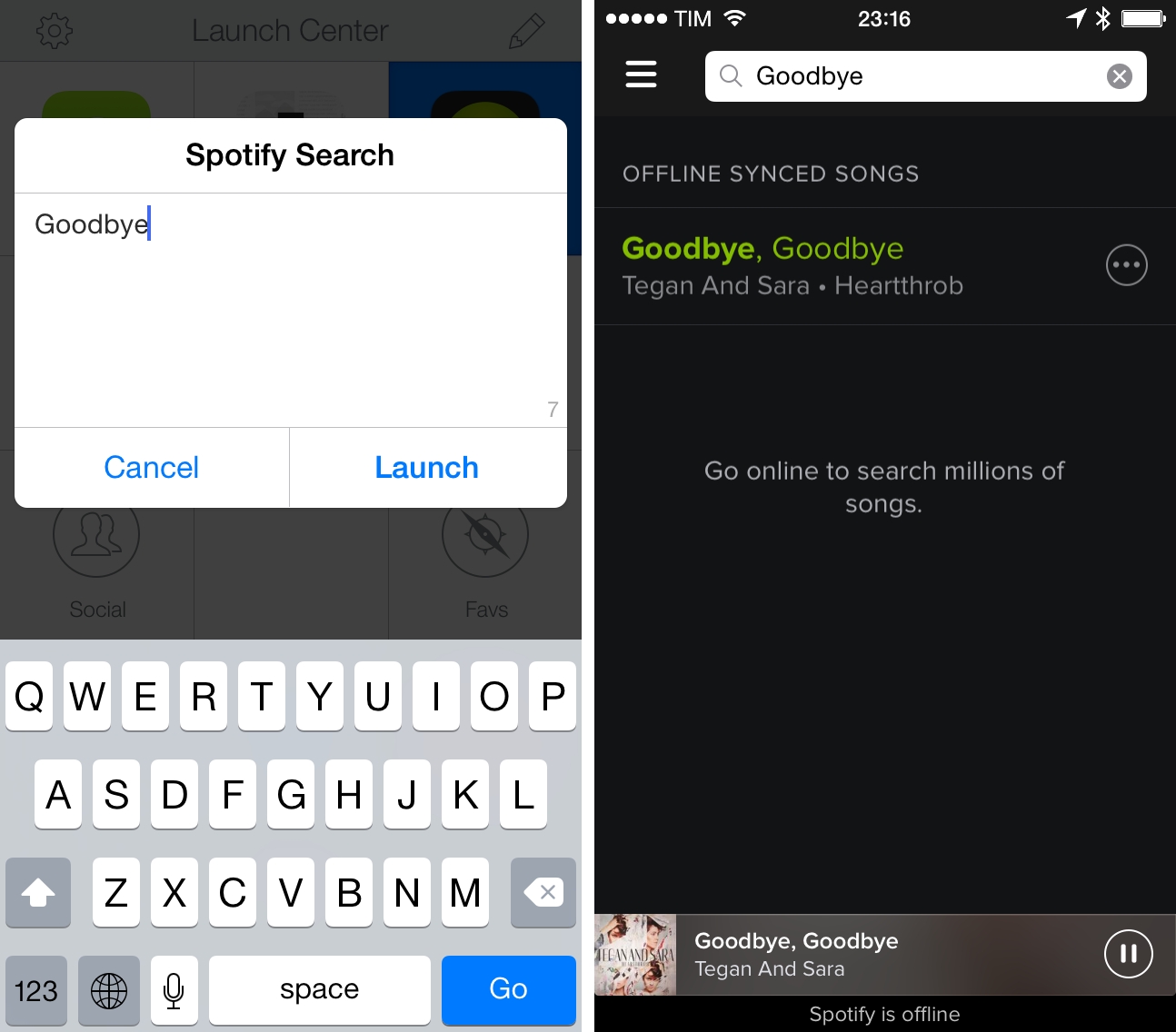
Released today, version 1.3 of Spotify for iOS adds a seemingly obvious feature that, however, was missing from the app: search for downloaded music when in offline mode. Spotify recently revamped their apps to include an iTunes-like organization system called Your Music, and the improved search feature will look for songs cached on your device when the app is offline.

As an aside (and speaking of Launch Center Pro), here’s the action I’ve been using to quickly search for songs on Spotify without navigating to the search screen every time. It’s a huge timesaver and it works with offline search as well.

Permalink

Aptonic - Dropzone 3 [Sponsor]

Dropzone is a productivity tool that enhances drag and drop on your Mac. Drag files onto the menu item and a beautifully designed and animated grid of all your actions opens. Share with services such as AirDrop, Imgur, FTP, Amazon S3, Facebook, Twitter and many others. Move and copy files, launch applications and even develop your own actions using the powerful Ruby based scripting API.

Dropzone 3 is a huge update to the app that takes Dropzone to a whole new level. You can now add actions to your grid faster thanks to the new quick add menu or by dropping folders or apps onto the ‘Add to Grid’ area. Quickly reorganise your actions using drag and drop and delete them by holding the option key. The new in-grid progress bars let you keep track of task progress. Also see how tasks are progressing at a glance in the new animated menu item.

Drop Bar is another great new feature - Drag files you know you’ll need later onto the Drop Bar area of the grid to stash them tempororily. Drag stacks on top of each other to combine them. You can even drag a stack onto another Dropzone action.

In Dropzone 3, the developer API has undergone a major overhaul. You can now duplicate existing actions and tweak them to your liking. A new bundle system lets you distribute needed libraries or tools along with your action. Actions can now be auto-updated as they are improved. With a little Ruby knowledge you’ll be thinking of your own uses in no time - check out the developer documentation here.

Our thanks to Aptonic for sponsoring MacStories this week.

Permalink

Apple and Privacy

Rich Mogull, writing for Macworld, breaks down Apple’s focus on customer privacy:

Corporations generally limit their altruism to charity, not to core product and business decisions. Apple likely sees a competitive advantage in privacy, especially when its biggest direct competition comes from advertising giant Google and the enterprise-friendly Microsoft. Apple believes consumers not only desire privacy, but will increasingly value privacy as a factor in their buying decisions.

As a consumer, I value privacy for the devices I buy and the apps I use. This isn’t limited to Apple: I appreciate DuckDuckGo and its consistent prioritization of privacy and no-tracking features, and I like services based on a business model that’s not selling what I read, click, and type to others.

To some people, this doesn’t matter, and I get it. But personally, I see a customer advantage in choosing apps, hardware, and web services (whenever possible) that I feel comfortable using with clear privacy policies and user controls, and Rich explains Apple’s position well.

Permalink