This Week's Sponsor:

Turbulence Forecast

Know before you go. Get detailed turbulence forecasts for your exact route, now available 5 days in advance.


Posts in links

Siri and iPhone URL Schemes
Siri and iPhone URL Schemes

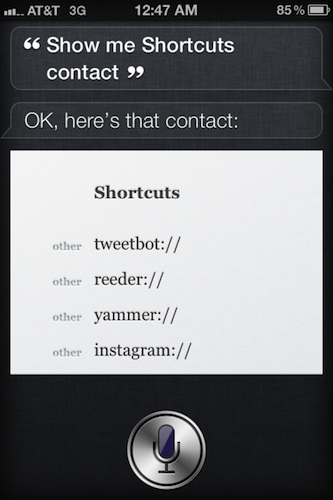
Alex Heath at iDownloadBlog came up with a way to let Siri launch third-party apps on an iPhone. The solution is far from integrated and it requires some tweaking, and it uses an iOS app’s internal URL scheme (example: fb:// for Facebook) and the Address Book to open apps, provided you’ve asked Siri to visualize a “contact card” with some shortcuts in it. You’re basically creating a fake Address Book entry for apps, and assigning a URL scheme to one of the available fields. Tapping on it will open the app or a specific section of the app.

If you have a select number of apps that you’d like to have quick access to with Siri, you could create a “Shortcuts” or “Favorites” contact and add each trigger. Telling Siri to “show shortcuts” would then pull up your list of app shortcuts to open within Siri.

Many have speculated that, in the future, Siri will gain new functionalities including the capability of launching apps directly from its voice-based interface. But wouldn’t it be cool to ask Siri “Open my Facebook messages” rather than just “Open Facebook app”? Or perhaps ask Siri “Go to my OmniFocus Home project” instead of just launching OmniFocus? And what about creating new content from Siri inside a specific section of an app (a new task inside an OmniFocus project), without actually opening it? That’s why I think URL schemes will be worth keeping an eye on – Apple could offer developers a new set of APIs to associate their apps’ sections and menus with Siri actions, and perhaps revamp the URL scheme architecture to include support for Siri and new APIs. This is just speculation on my side, but I think it’d be interesting to see Siri becoming a new, lightweight interface for basic tasks in external apps.

Meanwhile, if you really want to launch apps using Siri and the Address Book, check out iDownloadBlog’s tips here.
Permalink

Apple’s Supply Chain Secrets

Apple’s Supply Chain Secrets

A recurring piece of information throughout this year has been how Apple’s supply chain is so integral to their success in recent years. Bloomberg Businessweek’s article from yesterday is just the latest this year and it chronicles a few stories of Apple’s impressive control over their supply chain and gives some interesting insight to how it works.

Apple has built a closed ecosystem where it exerts control over nearly every piece of the supply chain, from design to retail store. Because of its volume—and its occasional ruthlessness—Apple gets big discounts on parts, manufacturing capacity, and air freight. “Operations expertise is as big an asset for Apple as product innovation or marketing,” says Mike Fawkes, the former supply-chain chief at Hewlett-Packard (HPQ) and now a venture capitalist with VantagePoint Capital Partners. “They’ve taken operational excellence to a level never seen before.”

Included in the article are some fascinating stories from the supply chain - whether it be the hoarding of lasers so that that iSight’s green LED indicator light could be ‘invisible’ when off, to Apple buying up all the available air freight over Christmas of 1998 so it could ship their new translucent blue iMacs and to how Apple keeps its new products secret ahead of a launch.

At least once, the company shipped products in tomato boxes to avoid detection, says the consultant who has worked with Apple. When the iPad 2 debuted, the finished devices were packed in plain boxes and Apple employees monitored every handoff point—loading dock, airport, truck depot, and distribution center—to make sure each unit was accounted for.

Permalink

Revolutionary User Interfaces

Revolutionary User Interfaces

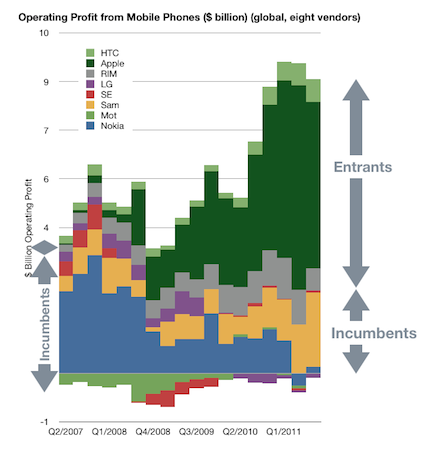
In an article posted this morning on Asymco, Horace Dediu discusses how the revolutionary user interface of the iPhone served to disrupt the mobile market and unseat the incumbents - Nokia, Samsung, LG, Motorola and Sony Ericsson.

In 2007 something happened which changed the industry. It took a few years to even realize it was happening but by the time it was obvious, it had changed to such a degree that huge companies found themselves in financial distress.

Furthermore, Dediu discusses how over time as new input methods have been created, so have new platforms and new business models - as well as hurting the incumbents of the market. A big question that Dediu poses in his article is that with next revolutionary user interface seemingly being created at a faster and more rapid rate (mouse, click wheel and then multi-touch), what will be the next revolutionary user interface? He questions whether in fact it could be Siri.

My disruptive hypothesis for Siri is that it shifts the competition from platforms positioned on a device to a “coupled” super-platform deponent on broadband and infrastructural computing. Just after collecting enough data and observing patterns in it that give us clarity, It looks like things are about to change all over again.

If you’d like to hear more from Horace on this idea of Siri being the next shift in user interfaces, this week’s episode of the Critical Path would also be worth a listen.

Permalink

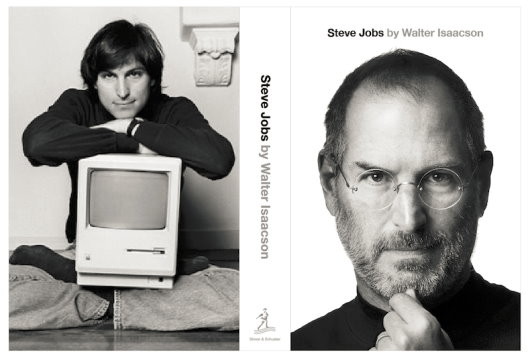
Steve Jobs Biography Sells 379,000 Copies In First Week In The US

Steve Jobs Biography Sells 379,000 Copies In First Week In The US

The Bookseller reports Walter Isaacson’s “Steve Jobs” has sold 379,000 copies in the first week of US availability:

Walter Isaacson’s biography of Apple co-founder Steve Jobs sold 379,000 copies in the US in its first week on bookshop shelves, BookScan US data has revealed.

Walter Isaacson’s 656-page biography scored the biggest week of sales for any book in the US since November last year, when Jeff Kinney’s Diary of a Wimpy Kid: The Ugly Truth (Amulet) and George W Bush’s Decision Points (Crown) both sold more than 430,000 copies at US booksellers in the seven days to 13th November.

The Guardian adds some UK data, reporting that Steve Jobs bio sold 37,000 copies in five days, based on Nielsen BookScan figures, which include physical sales from Amazon but don’t track digital versions of the book, available both on Amazon’s Kindle Store and iBooks.

Walter Isaacson’s critically acclaimed biography, published 19 days after Jobs’s death, sold more than 37,000 copies – more than any other fiction or nonfiction paperback or hardback in its first five days on sale, according to Nielsen Bookscan, the official industry measurement system for retail sales.

It’d be interesting to know the exact figures of digital sales, considering many people opted to download the ebook from Apple’s iBookstore or Amazon’s Kindle Store – where it went on sale soon after midnight on October 24th – rather than wait for a physical copy to ship. “Steve Jobs” by Walter Isaacson is already a best-seller on Amazon and is prominently featured on the iBookstore homepage, gaining interest of Apple fans and people curious to know more about the life and experiences of Apple’s late co-founder, who passed away on October 5th, 2011. [via]

Permalink

A celebration of Steve’s life.

A celebration of Steve’s life.

Steve Jobs

Steve Jobs

Watch the special event, filmed live at the Apple campus in Cupertino, California.

On October 19th, Apple celebrated the life of Steve Jobs in Cupertino as retail stores closed, giving employees around the world the opportunity to partake in the event. Now, everyone can share in the celebration as well. Apple has published a recording of the event that you can watch online.

Airing earlier this evening, CBS News have made available their interview with Walter Isaacson, publishing a written transcript and additional online-only content which you can find on 60 Minutes.

At midnight tonight, Walter Isaacson’s biography of Steve Jobs will be available for download in the iBookstore. You can preorder the book for $16.99 to have it downloaded on your iPhone and iPad when available.


Permalink

iOS 5 Newsstand “Booming” For Magazine Publishers

iOS 5 Newsstand “Booming” For Magazine Publishers

paidContent reports on some initial indications that Newsstand, a new feature in iOS 5, is helping publishers achieve more sales and subscriptions:

Exact Editions, which says it made about 10 percent of the Newsstand app titles on iTunes Store, says downloads of freemium sample editions jumped by 14x in just a few days, whilst some titles’ actual sales have more than doubled.

Consumer magazine publisher Future says free container apps for its titles were downloaded two million times in three days and reports “consumer spending well in excess of normal monthly revenues”. “Future has sold more digital editions in the past four days through Apple’s Newsstand than in a normal month,” says UK CEO Mark Wood.

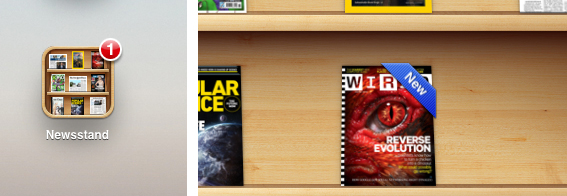
By integrating Newsstand directly into the OS, Apple is not only giving publishers an opportunity to showcase their publications out of the box on every iOS device, to every iOS user interested in reading magazines and newspapers, they’re also giving publishers the tools to make reading and downloading as frictionless as possible. As we detailed in our overview, Newsstand lets you easily subscribe and forget to manually download new content when it’s published. iOS does it for you.

So while geeks may despise the new default icon on the Home screen and the fact that it’s a feature they may never use, the new integrated system – as opposed to single app downloads – makes for a better experience that will encourage readers to subscribe more, manage less, and ultimately read more. I expect Newsstand adoption to grow exponentially in the next months. Looking back, it’s clear iTunes app subscriptions were meant for Newsstand.

Permalink

iPhone 4S Sales Now Reservation-Only At Retail Stores In US and Canada

iPhone 4S Sales Now Reservation-Only At Retail Stores In US and Canada

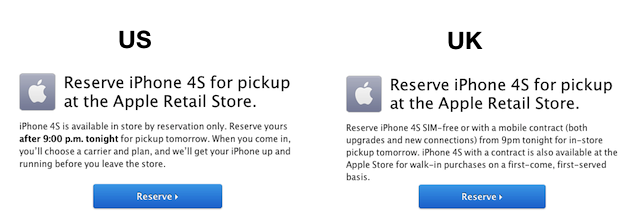
MacRumors reports Apple has updated its website for customers in the US and Canada, noting that the iPhone 4S is only available for in-store reservation. On the other hand, European stores such as the UK one still report walk-in purchases on a first-come, first-served basis are available.

Apple has updated its “how to buy” page for the iPhone 4S to note that Apple retail stores in the United States and Canada are now selling the device on a reservation-only basis. Customers will need to visit Apple’s site after 9:00 PM each evening to reserve a phone for the following day.

In the UK, however, walk-in purchases are available for iPhone 4S on contract, not unlocked devices sold SIM-free. This particular measure has been likely put in place to avoid the long lines of grey market buyers that characterized the iPhone 4 launch last year; in the US and Canada, bigger markets for Apple than other launch countries of the iPhone 4S, reservation-only means Apple is perhaps trying to avoid the long lines and disappointed customers of last year, whilst retaining a retail distribution channel (which grants customers a free Personal Setup session with an Apple employee) at the same time. It’s very likely that this “restriction” will fade alongside Apple’s initial launch window (Apple also had to ramp up production of the 4S for 22 more countries on October 28th) and that remaining stock at the end of the day could be distributed to walk-in purchasers.

Earlier today, Apple announced over 4 million iPhone 4S units were sold during the first weekend, making the iPhone 4S the most successful iPhone launch in Apple’s history.

Permalink

Sprint Reports “Best Ever Day of Sales” with iPhone 4S, iPhone 4 Launch

Sprint Reports “Best Ever Day of Sales” with iPhone 4S, iPhone 4 Launch

Sprint has issued a statement on the first day of iPhone 4S and iPhone 4 sales:

Fared Adib, Sprint Product Chief, issued the following statement:

“Sprint today reported its best ever day of sales in retail, web and telesales for a device family in Sprint history with the launch of iPhone 4S and iPhone 4. We reached this milestone at approximately noon CT/1pm ET. The response to this device by current and new customers has surpassed our expectations and validates our customers’ desire for a truly unlimited data pricing plan.

Sprint started selling the iPhone 4S alongside carriers AT&T and Verizon this morning at 8 am in the United States. Sprint is also selling a new 8 GB version of the iPhone, announced by Apple last week. If pre-orders and lines are of any indication, clearly customers are interested in the new device rather than the cheaper model of the old version – which has been kept around at $99. Last week, Sprint said they were “very pleased” with iPhone 4S pre-orders, which AT&T reported at 200,000 units in the first 12 hours.

Sprint is offering unlimited data plans starting at $79.99, and it’s believed to have struck a $20 billion deal with Apple to sell the iPhone over the next four years.

Permalink

Sony Camera Found In iPhone 4S Teardown

Sony Camera Found In iPhone 4S Teardown

There was much speculation surrounding the supplier of the camera module of the new iPhone prior to the official iPhone 4S announcement, which confirmed the device has an improved 8 MP camera but didn’t give us any details on the manufacturer behind the component. In the months leading up to the iPhone 4S, you may remember Sony CEO Howard Stinger hinted at Sony producing the camera for the next-generation iPhone, though confusion arose as it wasn’t really clear whether he was being sarcastic in his statements or not. A report from June then noted both Sony and OmniVision – Apple’s main camera supplier for the previous iPhones – would supply a new 8 MP camera for the iPhone.

Following iFixit’s teardown of the iPhone 4S, Chipworks has put the camera module under a microscope, and confirmed that their unit has a Sony camera as seen in the die markings from the photos. This still doesn’t completely exclude OmniVision from the list of camera suppliers, but it seems to confirm rumors of a Sony camera were correct.

In order to get our readers the device manufacturer as soon as possible, rather than going through a fuming sulfuric acid chip deprocessing we chose to use our infrared microscope to look through the structure of this image sensor. What you see are the die markings on the base layer of the image sensor. The image isn’t beautiful, but it’s enough to tell us that Sony is in our particular iPhone 4S.

The iPhone 4S’ camera has been known to feature improved optics, allow for 73% more light through the lens and, overall, shoot sharper and crisper images, as well as 1080p HD video. You can check out Chipworks’ teardown and X-ray images here. [via]

Permalink