This Week's Sponsor:

Turbulence Forecast

Know before you go. Get detailed turbulence forecasts for your exact route, now available 5 days in advance.


Posts tagged with "app store"

AppBot Sends Developers A Daily Digest Containing New Reviews Of Their Apps

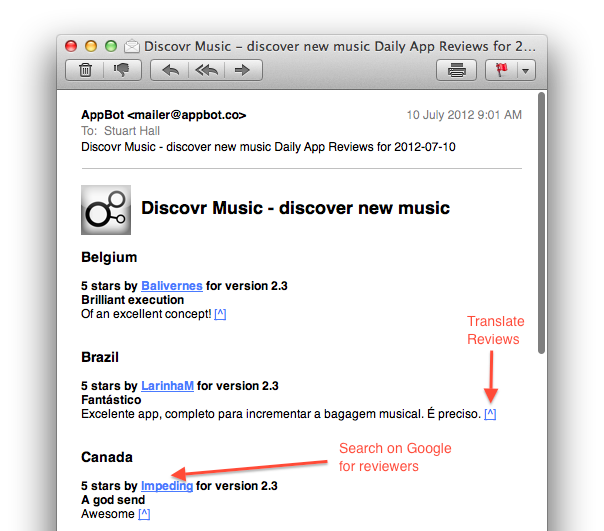
The Filter Squad development team (creators of Discovryesterday launched AppBot, a neat little service that’ll keep track of App Store reviews and email you a daily digest containing the latest reviews of your apps. AppBot was initially an internal tool for the two development teams but is now a free service in beta that’s bound to be helpful to some other developers who are keen to read new feedback from users but don’t want to have to take the effort of finding all the new reviews (in all the various countries).

In a blog post, Discovr’s Stuart Hall writes that despite some “not so amazing” reviews, they are a “good indication of the average user’s feeling towards your app”. By keeping a track of reviews, you can get a “good sentiment of how you are app is being perceived” - a key factor when word of mouth is such a driving factor of success on the App Store.

So the discovr team made AppBot to solve the problem of easily keeping track of new reviews of their apps from multiple countries. It neatly integrates a link to translate reviews from countries that don’t speak English and allows you to Google search the reviewer names. The app will also send you a list of Apple front page features (Editor’s Choice, New & Noteworthy etc.) to you weekly. You can sign up here and it doesn’t require access to your iTunes Connect account, so anyone can technically use AppBot to keep tabs on any new app.


Apple Removes Negative Reviews From Apps Affected By DRM Bug [Updated]

Earlier this week, an error in Apple’s DRM code generation for App Store apps caused a number of app updates to crash on launch. The issue, initially reported by Instapaper developer Marco Arment, began spreading to more than 100 iOS and Mac app updates including GoodReader, Angry Birds HD Free, and The Early Edition. As the bug was causing updated apps to crash immediately after launch without even displaying an error message, several users became upset with the developers of the apps – as they didn’t know the issue was on Apple’s servers – and began leaving negative reviews on the App Store. Developers, on the other hand, had to deal with a issue that they couldn’t fix, while explaining to customers how they should back up their data and wait for a solution.

Last night, Apple officially acknowledged the issue and explained it was associated with DRM code generation on the App Store. Apple said they had fixed the issue, and Macworld reported that, according to their sources, Apple would also remove all negative reviews that had been left during the hours the bug was spreading on various international App Stores.

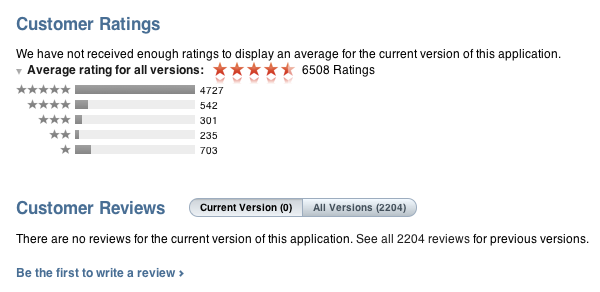
As of this morning, it appears Apple has indeed removed negative reviews from apps affected by the bug. Apps like Instapaper, GoodReader, and The Early Edition are showing no reviews for the latest versions available, which are the ones that were crashing earlier in the week. We haven’t checked on every single app that was affected, but it is safe to assume at this point Apple will remove all reviews (not just negative ones) from any app that received a corrupted update.

Apple hasn’t issued a public apology to developers, but the removal of reviews will definitely help in leaving this issue behind without having to deal with the aftereffects on the App Store as well.

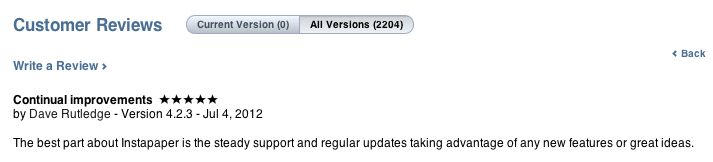
Update: As noted by several readers on Twitter, it appears Apple didn’t completely wipe the old reviews left during the DRM outage – it re-issued app updates for the same version of the app, and moved the “Current Version” reviews to “All Versions”.

In spite of the version being the same – for Instapaper, the affected version was 4.2.3 – the old reviews are not showing up in the Current Version section of the App Store. This helps hiding possible negative reviews from the section that it loaded by default in iTunes.

By re-issuing the old version as an update again, Apple is making sure customers can re-install the fixed version of an app without having to delete it first, as noted by Marco Arment. It is unclear whether the old reviews will still affect overall ranking of an app.


Apple Rectifies Corrupted App Store Downloads, Advises Users to Delete and Reinstall Broken Apps

Late Tuesday evening, Instapaper developer Marco Arment was met with a nasty surprise when some users updating to Instapaper 4.2.3 found that their updated app instantly crashed after opening. Upon investigating and hearing similar reports from other developers, Marco found that the App Store itself was corrupting app updates, leaving users with broken apps and developers with one star reviews from confused and upset customers. Writing at Marco.org, Marco addressed the issue to his audience and began gathering a large list of apps that were also affected, calling on Apple to quickly resolve the problem as developers dealt with the consequences.

On Thursday evening, Apple acknowledged the problem to AllThingsD and Macworld, informing the publications that the issue had been resolved.

Lex Friedman from Macworld writes,

Around 6:00 p.m. PT, Apple acknowledged the problem to Macworld, describing it as “a temporary issue that began yesterday with a server that generated DRM code for some apps being downloaded.” Apple added: “The issue has been rectified and we don’t expect it to occur again.”

Customers with affected applications should be able to delete and reinstall a working application through the App Store.

Additionally from Macworld,

Sources told Macworld that Apple will be removing one-star app reviews developers earned unfairly because of the company’s server issue.

As Matthew Panzarino from The Next Web points out, both Apple customers and developers have little to no recourse when problems like this occur. Developers currently have no way of effectively communicating with customers outside of developer blogs.

When the one-star reviews started rolling in, there was very little that developers could do to notify users of their app that it was an issue with Apple’s packaging of their apps, not the apps themselves. The users just saw that the app was crashing on launch and rated it accordingly.

Reinstalling applications also leads to users possibly losing information — Glasshouse Apps’ is still dealing with the aftereffects as the company prepares an app update and advises users on the best course of action that will keep their news feeds and data intact. The developers of GoodReader have also written a step-by-step guide that helps customers back up, reinstall their app, and restore data onto their devices.

While Apple has acknowledged and fixed the issues disrupting application updates on the App Store, they have not yet issued an apology to developers, nor did they want to themselves acknowledge that they’d be removing one-star app reviews apps received because of the error. If Apple should do anything more, they certainly need to reach out and apologize to developers, who’ve unfortunately had to run damage control to prevent one-star reviews and angry customers.

[Sources: Macworld via AllThingsD]


Some App Updates Resulting In Instant Crashes Due To Presumed Apple CDN Issue

In the last 24 hours or so, a number of apps that have been updated by users have crashed on launch due to a problem presumed to be connected to the App Store’s content distribution network (CDN). A number of popular apps from Instapaper, Readdle Scanner Pro, Angry Birds Space HD Free and CommBank Kaching amongst others have been just some of the affected apps. The issue, not affecting every customer, occurs when a user updates their apps and goes to launch them but instead the app crashes before it can load.

Instapaper was one of the first to be affected by the issue with an update that went live late on July 3rd. Developer Marco Arment was instantly “deluged” by support requests complaining of instant crashes with the latest version. After a bit of digging and looking at his support requests, Marco believes it comes about due to a corrupt version of the updated app being distributed by the App Store CDN in some regions. For Instapaper the issue was resolved (a non-corrupt version propagated to all regions) within two hours but it isn’t known if it was due to Marco’s emails to the App Review team or just an issue resolved with time.

If you’re a developer, and you have a non-critical update pending release, I suggest waiting a few days for this to presumably get sorted out before releasing it. [Marco Arment]

Apple has yet to make any statement on the issue and Marco and the other developers affected by the issue have yet to receive responces from any of the developer relations groups at Apple either. You can view a tentative list of apps affected by the issue over at The Next Web and at Marco’s personal blog which also goes into detail about the issue.

It may be wise to hold off from updating any apps for the time being as well, with the issue affecting people across all regions and all different apps. If you’ve already been affected by the issue, the only real way to fix it is to delete the app and try re-installing the app - but this will only work if the app is no longer corrupted on Apple’s side.

[Sources: Marco.org and The Next Web]


App Store Adding New “Food & Drink” Category

The App Store will soon be updated with a new “Food & Drink” category, according to developers of existing iOS applications who received an email from Apple today about the upcoming change. “In the next few weeks”, applications will be automatically migrated to the new category; currently, the App Store doesn’t provide a specific category for these types of apps, which have been typically listed under Lifestyle by their developers. According to Apple, the new category will include “apps that help users cook and bake, mix drinks, manage recipes, find new restaurants and bars, and learn what their friends like to eat and drink”. Food & Drink won’t include diet, grocery shopping, coupon clipping, or food-related game apps.

The new category is another change coming to the App Store, which Apple has been tweaking and revamping with new features lately. Ahead of a major redesign coming with iOS 6, Apple re-organized its selection of Editor’s Choice apps and App of the Week selections, providing a standalone category with weekly updates. Recently, Apple also started grouping previous game bundles into a macro category accessible from the App Store’s homepage.

The dedicated Food & Drink category comes after thousands of apps have been successful in using iOS devices as tools to manage recipes and find local restaurants. Notably, iOS 6 will also feature Yelp check-ins in the new Maps applications – a renewed focus on this area that will surely benefit from a new category on the App Store.

Currently, Apple only offers a custom Cooking section to showcase handpicked app selections for recipes, drinks, shopping, and reference material.

Update: the new category will appear “in the next few weeks” according to Apple.


Review of WTHR - A Simpler, More Beautiful Weather App

I admit it, I have a bit of a fetish for weather apps. My taste in them is a bit different than all the other categories because I am a data geek when it comes to what’s happening outside. Apps like WeatherSnitch do a great job showing you a lot of info on a small screen but many don’t present them to the user very effectively. Until Dark Sky for iPhone came out, I didn’t think I could use a weather app that focused on the important details instead of all of them. Since then I have changed the way I use weather apps and rely on Dark Sky for short forecasts / radar and iOS’ built-in Weather app for extended forecasts until today.

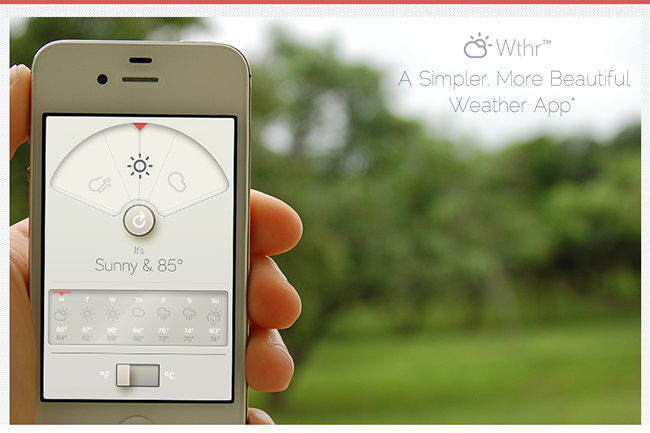
WTHR is a brand new weather app from David Elgena. He wanted to build a weather app based on Dieter Rams’ 10 principles of design so the user could stop wasting time staring at weather radars and atmospheric pressure readings and spend more time enjoying what’s happening outside. WTHR started as a mockup on Dribbble about a month ago and received a lot of attention there. More mockups and a programmer later, WTHR was submitted to Apple and is available today.

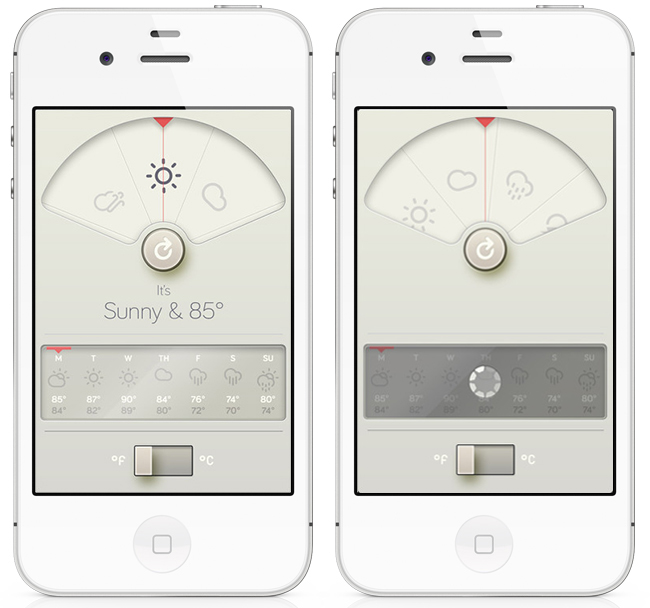
WTHR is one of the best looking weather apps available — I love the style and simplicity of it. I appreciate that it hides the status bar to give your entire iPhone the look of being a handheld weather device with zero distraction. Launch the app, watch the animations, get your forecast and go. Some people may not like the color scheme but if you know Dieter Rams’ designs you understand where the colors come from. When you launch the app, it asks for your location then the UI presents the weather data in a retro-futuristic style. There’s only 2 buttons to interact with, one to refresh the forecast and the other to flip from Celcius to Fahrenheit. The refresh animation is great and the spinning notification in the 7-day forecast almost looks like a Rams dial. Underneath the current forecast is a 7 day extended forecast. All the weather icons are Adam Whitcroft’s wonderful Climacons which look perfect to the stylings of WTHR.

David Elgena told me that they are already working on future updates to include, but not complicate, more features and data like multiple locations and a dark mode. “My intentions with WTHR was really to create something as beautiful as the device that hosts them… and I do believe that even UI designers and app developers could gain inspiration from Dieter Ram’s product designs. Too often we load digital products with features and hidden or hard to use interfaces because we are suddenly given this almost infinitely layered product, the real discipline is control. There is no difference from when Dieter Rams was designing his first clock face…to an app on the iPhone. I look forward to creating more apps in the future…and continually improving upon WTHR.”

The lack of contrast in the 7-day forecast can make you squint a bit — an option to switch to a 5-day forecast could help. I’m glad the app icon wasn’t designed with the same skeuomorphism in mind, as I am not a fan of doing this in iOS because it clashes too much with most other icons. International iOS users – don’t worry, WTHR uses a global geo-location weather API so no one is exempt from using this great app. The weather data is a little different than what iOS uses but only a few degrees at times as Federico noticed in Italy. WTHR has gained a spot on my home screen with its beautiful, focused purpose. WTHR is available for 99¢ via the App Store.


App Store “Game Collections” Gathers All Previous Game Bundles

In our story about the first four years of App Store, we noted how Apple had been collecting apps and games in custom “sections” that, unfortunately, are often rarely updated and hard to find in the App Store once they are removed from the homepage.

For years now, Apple has been refreshing the App Store on a weekly basis to include custom “sections” showcasing hand-picked apps and games. These sections typically come with rotating banners and smaller “mini-banners” on the App Store’s homepage, and are later grouped into an “App Store Essentials” macro-section that includes several of past sections and recommendations.

Custom sections provide a decent solution to browse titles Apple has previously “curated”; however, these sections aren’t usually updated as often as they are created — N.O.V.A. 3, a new shooter game by Gameloft, still isn’t listed under Benchmark Games: Stunning Graphics, whilst the majority of reviewers and publications have outlined the game’s remarkable graphic capabilities.

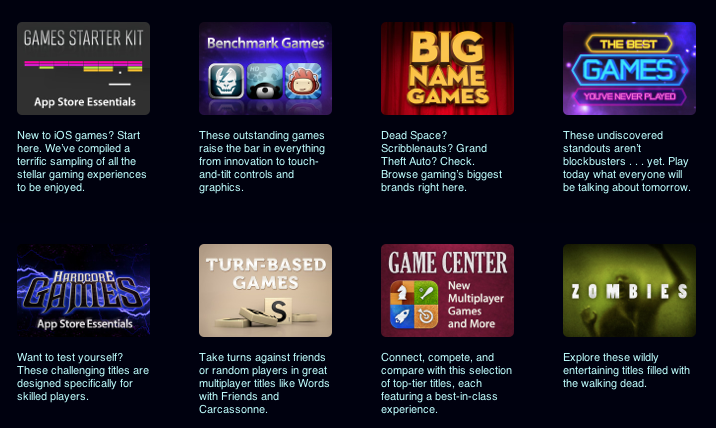
With today’s weekly refresh of the App Store’s homepage, it appears Apple has started taking some first steps into a new direction – grouping all previous game bundles into a bigger “collection”. Aptly named Game Collections and linked from the App Store’s homepage, the section offers a roundup of every selection Apple offered to date.

Game Collections includes:

Previously only available through the App Store’s homepage or partially through the dedicated Games category page, the new Game Collections feature brings some much needed organization to the custom sections Apple has been “curating” over the years. They are now accessible from a single place, and Apple notes how they will be “updated on a regular basis”.

As of today, “regular” apps still aren’t being organized into a unified collection. Right now, the App Store Essentials page is the best way to browse previously featured selections, but it also still mixes games and apps, and doesn’t provide the same elegant and simple layout of Game Collections. Hopefully Apple will provide an “App Collections” page as well, bringing past handpicked app selections and features in a single page.

Apple has been making a series of improvements to the App Store’s navigation lately. Aside from the complete App Store revamp coming in iOS 6, Apple redesigned the App of the Week section and renamed it to Editor’s Choice, leaving the former “App of the Week” to free app promotions.

App Store navigation and curation has long been an issue for third-party developers, with Apple’s Phil Schiller recently weighing in, too, noting how “you can still get discovered and get a hit overnight”.


Why Apple Is Making The Mac Harder To Use

Why Apple Is Making The Mac Harder To Use

Michael Schechter weighs in on today’s news that TextExpander 4 couldn’t be released through the Mac App Store due to Sandboxing restrictions:

I know I’m not the average Mac user, but I’m far from the geekiest. While there will always be things that need to exist outside of the Mac App Store for the geeky amongst us, the exclusion of something as useful and harmless as TextExpander shows the flaws in the current execution of App Sandboxing. The idea of protecting users from harm makes sense; the execution of protecting users from conveniently installing and maintaining useful software makes none.

This morning, Macdrifter brought a reasonable explanation as to why Apple’s Sandboxing is, ultimately, benefitting the average Mac user who doesn’t use apps like TextExpander, but wants a Mac to be secure and “safe”:

New Mac owners lose the fear that Windows has instilled. I’ve seen it happen over and over. Ever so slowly, they begin to realize that installing software doesn’t have to be scary. Everything on the App Store is “safe” because Apple is moderating the content.

We actually saw this coming. Back in October 2011, when Sandboxing was still on track to become effective in November, I commented on two pieces by Andy Ihnatko and Jason Snell, noting how the concept of “app” – software that “does one thing well” – coupled with enhanced security for Mac users allowed Apple to position Sandboxing as a powerful technology for the new App Store market.

As a security measure, Sandboxing is a good thing for the user. It forces apps to access only the system resources they need, and, generally, it reinforces the belief that Apple-vetted apps are safer than software downloaded from the Internet. But like I said, the real problem – and I guess the reason why people like Michael and I don’t appreciate the consequences of this change – is that developers of existing apps sold on the Store are being forced out of the door. I also wrote:

The problem with Sandboxing, I believe, is that it introduced a change that is forcing developers of existing apps to reconsider functionalities that are not compatible with the Mac App Store anymore. If this will lead to serious fragmentation of Mac software with a proliferation of deeply different Mac App Store and “website versions” of the same apps, we’ll see.

And we did see the first result with TextExpander 4. It’s still too early to judge, but if these first signs are of any indication, then we should be thanking whoever thought of Gatekeeper at Apple, as it will bring some security to software downloaded outside of the Mac App Store. Similarly, we should appreciate the efforts of developers like ManyTricks and Smile, who are thinking of clever ways to offer upgrades without “officially” using the Mac App Store.

There is an argument to be made about Apple not particularly “liking” apps that change system behavior, like TextExpander. If that’s the case, why approving them for Store sale in the first place? I understand that plans evolve and things can take unexpected turns; however, today’s TextExpander update unarguably shows that this isn’t the top notch user experience Apple typically shoots for.

Geeks will always know how to get around the Mac App Store’s limitations; Sandboxing is showing its first trade-offs, including “harder” upgrades and fragmented applications, but we’ll have to wait more to understand its long-term impact.

Permalink

Why Upgrade Pricing Isn’t Coming To The App Store

The 2012 WWDC keynote has come and gone, and we now know which of the many rumored announcements turned out to be true and which turned out to be false. But there was one unrumored announcement many developers were hoping would be true that failed to materialize altogether: the option to offer paid upgrades and true demo versions for their apps.

Demos and paid upgrades are something that App Store developers (where “App Store” encompasses both iOS and Mac) have long since wanted, as Wil Shipley explained in his blog post “The Mac App Store Needs Paid Upgrades” and as John Gruber and Cabel Sasser discussed on episode 5 of The Talk Show. No doubt there are many Apple users, especially longstanding Mac fans, who would be happy for the opportunity to support their favorite developers and be rewarded with lower prices for new versions of their favorite apps as well (the “99¢ IS TOO EXPENSIVE” crowd need not apply). As Shipley’s post lays out, it would seem there are many good reasons for Apple to implement these. So why haven’t they?

I think it comes down to one of Apple’s core values: simplicity.

The fact that Apple chose to name their online retail presence the “App Store” is, I think, telling. Remember that Apple aims squarely for the mass market (much to the consternation of some advanced and pro users) and remember what shopping at a real life store is like for that market.

When most people go to a store, they don’t expect to take home products that catch their eye and try them out for a limited time. They don’t expect to get reduced prices on the latest version of a product they’ve paid for before. The retail model of a typical store from a consumer’s point of view is simple. You walk in, look for something you want, pay for it, and walk out. This is exactly how Apple’s physical stores work, and it is how their digital stores are designed to work as well.

Whether this is the way digital stores should work is another discussion, and one that is certainly well worth having. But if we assume that this is how Apple wants their stores to work, their policies for not allowing demos and upgrades make sense. In Apple’s physical stores, and indeed nearly all retail establishments, take-home trials and upgrade pricing is nearly unheard of. At best they offer demo units of products you can try, but only ones they choose and only while you remain at the store. Try insisting on half-price for the next-gen MacBook Pro with Retina display because you bought a 13” MacBook Air two years ago and see how far you get before you’re asked to leave.

Developers and longtime computer users may be used to the shareware, time trial, pay-full-price-once-upgrade-cheaply-forever model of buying and selling software, but regular people, the mass market that Apple continues to court first and foremost, aren’t. Adding demos (“I thought this app was free, but now it’s telling me I have to pay to keep using it? What a ripoff!”) and paid upgrades (“Wait, I bought this app last year and now I have to pay again to keep using it? Screw that!”) would introduce a layer of confusion and make buying an app a more arduous process, which would result in people buying fewer apps.

At least, that’s the rationale behind Apple’s decision not to implement them. To be clear: what I just wrote is not my opinion of how things should be. This is only my guess at Apple’s reasoning.

So if Apple is basing their digital stores on their physical ones, how should developers like Wil Shipley and Cabel Sasser handle the problem of making enough money from past and future customers in order to eat and make more cool software? I think Apple thinks they should take cues from how Apple handles their own software transitions: no upgrade pricing, just one reasonable price that is palatable to its target audience. Make your software great and easy to buy, and more people will buy it.

Yes, there are edge cases where some unlucky customers will fall through the cracks (those who bought your old app right before the new one came out) and those who won’t be happy to pay again for the “same” app regardless of how much time has passed (two words: “Tweetie 2”). And it would be great for customers and developers alike if Apple implemented a way to stop selling an old app but still let devs provide bug fixes. But Apple knows that while you can’t please everyone, you can make good money by pleasing the majority. And as long as the majority likes affordable, straightforward app-buying, that’s what they’ll continue to offer.