This Week's Sponsor:

Turbulence Forecast

Know before you go. Get detailed turbulence forecasts for your exact route, now available 5 days in advance.


Posts tagged with "app store"

Firemint to be Acquired by EA

All of your favorite titles such as Real Racing and Flight Control are about to be snatched up by EA as independent mobile studio Firemint will be acquired by the game giant within the next four weeks. EA announced this morning that they’ll likely close the deal soon, but aren’t yet releasing any financial details on the acquisition.

“The Firemint team is remarkable for its critical and commercial success,” said Barry Cottle, Executive Vice President and General Manger of EA Interactive. “Having them as part of EAi will accelerate our position as worldwide leader in game development for mobile devices and online gaming platforms.”

The agreement follows EA’s recent acquisition of Mobile Post Production Inc. (MPP), the worldwide leader in high quality cross-platform development and porting of games for smartphones.

Firement recently released Real Racing 2 HD for iPad, delivering a 1080p racing experience straight to your television set via the Digital AV Adapter. Whether the trend of great mobile apps from the Firemint team at EA or elsewhere is unknown, but we sure hope the same great group of game developers can continue to deliver top notch experiences to the iPad outside of EA’s usual slew of cookie-cutter titles.

[via EA]


Apple: Apps Downloaded Using A Promo Code Can’t Be Reviewed Anymore

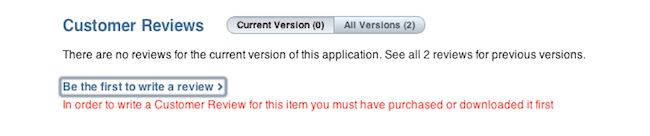
As noted by forum poster Therealtrebitsch on TouchArcade, Apple recently tweaked the App Store system to prevent users who downloaded apps using a developer’s promo code from leaving a review or rating. The change comes as an unexpected move as it basically doesn’t count promo code-based downloads as regular purchases anymore, but it’s in line with Apple’s latest efforts to modify the App Store’s ranking algorithm to showcase apps based on quality, rather than raw download numbers.

Hi,

Anand here again from iTunes Store Customer Support. Thanks for writing back and letting me know your concern. I understand that you are still not able to write a review. I know how disappointing it can be when things don't work out the way they should.

I am sorry to inform that it is no longer possible to rate or review an app if it was downloaded using a developer’s promotional code.

However, I took the liberty of submitting your feedback to Apple on your behalf. Please know that Apple takes the feedback from our customers very seriously. This is the reason for our feedback page - to create a forum where our users can vent, praise or share whatever feelings they have to allow us to meet your needs, and grow as a company. I suggest that you use the link in order to share your feedback with us. I would also encourage you to share this link with all of your friends and family who wish to submit the feedback, and have them all submit the same request.”

—–

It is no longer possible to rate or review an app if it was downloaded using a developer’s promotional code.

You can review this app by purchasing it on a different iTunes account using something other than a developer’s promotional code, such as a Gift Card, Gift Certificate, or other payment options.

Two weeks ago, several reports indicated Apple had tweaked its App Store algorithm to better promote apps in the Top Free charts based on “ratings and active usage”, rather than download numbers, which could be easily altered by developers using techniques like pay-per-install networks (which Apple doesn’t accept anymore) and promo codes. It was a common practice, in fact, among many developers to give away promo codes (which are limited in the iTunes Connect developer portal and can’t be generated over and over) hoping that customers who got the app for free would leave a positive review or rating. Clearly Apple must have thought that this was another practice to alter the App Store’s ranking system, and introduced a new rule to prevent apps downloaded through a promo code from being reviewed.

I have tested this personally and, sure enough, an app I downloaded last week with a promo code can’t be reviewed or rated in iTunes. An app I downloaded with a promo code last year, however, can still be reviewed. Same applies for a Mac App Store app I redeemed two months ago. It’s unclear how this new system works (Apple hasn’t posted an update in iTunes Connect yet), but we speculate apps recently downloaded with a promo code can’t be reviewed – quite possibly going back until two weeks ago when the rumors about a new algorithm started.


Kalimat, The Refreshed Word Game We’re Giving Away

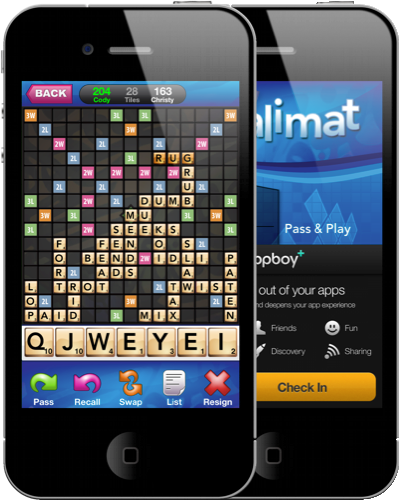
Do we need another Words with Friends or Scrabble? I don’t know about you, but if I have a chance to unhinge the competition because I’m smart and fast, or if I have the opportunity to find the hidden Ali Baba, be warned that I’m going to juggle some really long words if I can. Sure, I might add those two letters to your eight as a cheap way to get some bonus points, but think about it! Corners are often havens for power-plays. Kalimat changes pace from traditional word games by offering some original gameplay in the form of Remix mode and Jeopardy-style rewards where you could land on those ever useful bonus points (which could change the tide of the game). Don’t get too comfortable: Remix mode prevents your opponent from checking answers on Google (Boo!) by rewarding players for thinking on your toes. The faster you get a word out, the more you’ll be rewarded. With OpenFeint integration it’s really easy to create an anonymous online identity so you can get paired with new players wanting to duel you for word cred (read up on those dictionaries), and you can trash talk or make friends with the built in chat tool. Available for $2.99 in the App Store, we’re giving away five copies of Kalimat to our lucky readers looking to stretch their brains over the latest word craze. Check past the break for the rules.

Read more


Epic Games’ Mike Capps: “Dollar Apps Are Killing Us”

Epic Games’ Mike Capps: “Dollar Apps Are Killing Us”

If there’s anything that’s killing us [in the traditional games business] it’s dollar apps,” he lamented. “How do you sell someone a $60 game that’s really worth it … They’re used to 99 cents. As I said, it’s an uncertain time in the industry. But it’s an exciting time for whoever picks the right path and wins.

I think that there’s a fundamental difference between gamers who want to spend $60 on the next Mass Effect or Gear of War, and casual users who are looking forward to the next Angry Birds update. I used to play a lot of console games, but now I’m one of those addicted to the .99 cent apps. On the other hand, a friend of mine who didn’t abandon console gaming bought an iPad last year and now he plays both the latest Xbox hits and Angry Birds.

I think Capps he’s right when he says apps have changed the market, but I disagree with him as far as “killing” games goes. It’s all about value: those who care about high-profile console games will keep buying them. Let’s face it: there’s no Mass Effect or Halo on iOS devices. Those people who don’t recognize the value of console – or simply don’t have the time and resources for another device in their lives – will be just fine with Angry Birds and Cut the Rope.

I think the real problem for game developers like Capps is that the number of these users who prefer quick, mobile gaming has turned out to be larger than expected. For the same reason why I disagree with Nintendo about the culture of disposability, I believe the issue is not the association of portable games with low prices: it’s about the time users are ready to invest on a platform.

I’m one of those who think console games won’t go away anytime soon. But at the same time, I wonder: what’s going to happen when the iPad will be capable of running Metal Gear Solid 4?

Permalink

Apple Showcases Subscription-based Magazines In The App Store’s Homepage

Since the launch of iTunes subscriptions for apps in February, adoption of the new service from magazine and newspaper publishers has been growing at a somewhat slow rate. Following the controversy that sparkled after launch – which was quickly dismissed by Steve Jobs himself in an (alleged) email that confirmed subscription were meant for “publishing apps” – only a handful of publishers decided to implement the system which, as you may remember, requires publishers to give up a 30% of revenue off every subscription sold in-app, through iTunes. Those who implemented subscriptions in their apps, however, posted some interesting results: Popular Science, for example, sold roughly 10,000 subscriptions in 6 weeks. On the other end of the spectrum, though, many speculated that the highly promoted, long anticipated The Daily – a joint collaboration of Murdoch’s News Corp. and Apple – saw a decline in sales and user engagement, although we (and many others) assume that’s because of some poor editorial choices and the very nature of the app, rather than a flaw in Apple’s system. Overall, iTunes subscriptions seem to be working for those that chose to test them: the problem is trying to convince publishers to test them. And as the iPad keeps selling well and the App Store userbase grows, there’s no doubt Apple wants to get more publishers on board. Perhaps a lot will come by June. We’ll see.

In the meantime, Apple also wants to let iOS users know about subscriptions, and the magazines that allow them to subscribe with just one click, with their iTunes accounts. That’s exactly what they’re doing with their latest App Store homepage refresh: in a new section called “Magazines - Subscribe to your Favorites”, Apple is showcasing apps that are powered by subscriptions. This section includes – you guessed it – The Daily, alongside Bloomberg Businessweek (they’re very “pleased” with Apple’s terms), Popular Science, SPIN Play, Popular Photography, Elle, and Nylon. Seven apps aren’t much, but Apple’s goal is different here: they’re not betting on numbers, they want people to know about their “favorite magazines” that now come with the best way to subscribe to digital content. You can check out the App Store section here.

Of course, there are some big names missing from the list. Businessweek is there, but the Financial Times refused to accept Apple’s subscription terms. The Daily provides fresh, downloadable content on a daily basis, but The New York Times still has to flip the switch on Apple’s in-app subscriptions (but, eventually, they will). And so does the Wall Street Journal, which keeps on relying on embedded browser sessions to let users log in & subscribe.

A new version of iOS is expected to be previewed at the WWDC in June, and publishers will be forced to update their existing iOS applications with Apple’s subscriptions by June 30. If the rumors are true and iOS 5 will really feature a completely new notification system, Apple could come up with some intriguing ways to let magazine apps download content in the background, automatically, all day, and let users know about news and fresh content through the new notifications. I’m just speculating here, but a new OS (with betas during summer, and a planned launch in September) might be a great way to tell publishers that iOS is the platform to invest on. Or, Apple could bundle iOS 5 and the new Xcode 4.1 with new tools for publishers to design and develop magazines and newspapers for the iPad. They did it for advertisers. As it stands now, Apple cares about letting people know that magical subscriptions exist. The next step is tell every publisher that iTunes is the only way to go in the digital newsstand era.



Our Choice, Proving Push Pop Press Will Revolutionize Digital Publishing

When Co-Founders Mike Matas and Kimon Tsinteris set out to change the world of digital publishing, not many would have guessed that Al Gore would be at the forefront of their first title until Our Choice was demoed as a TED Talk, where the workings and interactions of the first title built using the new platform were revealed. Today, Our Choice is available at an introductory $4.99 on the App Store for the iPhone and the iPad, delivering rich interactive content via a completely custom app built on a native backbone. The Push Pop Press platform is seeking to revolutionize how content is published and made interactive, and my initial impressions with Our Choice can validate that cause. What’s at stake isn’t just the future of the new digital platform, but a complete rethinking of the traditional digital magazine or newspaper. The App Store is flooded with projects traditionally based on Adobe technologies, and while it was a good first attempt, the content we view needs to be intuitive, interactive, but most importantly fluid and un-static. Push Pop Press is the ideal platform to revolutionize how we think of traditional media, and Our Choice is the launch title proving that this new vision for content is a clear winner.

Read more


Instapaper Developer Explains Why Free Version Is “Taking A Vacation”

Instapaper Developer Explains Why Free Version Is “Taking A Vacation”

In an Apple store, it’s nearly impossible to spend less than $30 on anything. Apple’s stance is clear: “This is how much our stuff costs. If you don’t like our prices, that’s fine. We don’t need everyone to buy our stuff.”

That’s roughly the stance I’ve chosen to take. My app costs $5. I understand that not everyone will like my price, and that’s fine. I don’t need every iOS-device owner to buy my app — I’d do quite well even if only 1% of them did.

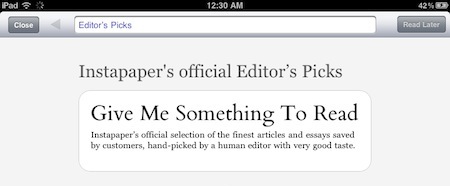
Instapaper developer Marco Arment has published an interesting article explaining why he removed the free version of Instapaper for iPhone from the App Store, and he’s not planning on making it available again anytime soon. There are thousands of free applications in the App Store: most of them are games from huge companies backed by multi-million investments and funding rounds, some of them are “lite” versions of less popular apps with limited functionalities. For an indie developer like Marco – remember, he left his position at Tumblr to focus on Instapaper – choosing to offer different versions of the same app is a difficult decision: what are the features that need to be exclusive to the paid app? And what’s a customer supposed to think when he only sees the limited feature set of the lite / free version? More importantly, how many App Store users are going to choose the paid app as the first option when a free counterpart is available?

These are risks only developers who truly believe in their work are willing to take. Marco does, and he’s decided to bet on his $5 piece of software because he knows it’s a great product that doesn’t deserve to be crippled by a free version with less features and ads. Go read the full article here.

Permalink

Amazon.com tries to toss Apple ‘app store’ trademark suit

Amazon.com tries to toss Apple ‘app store’ trademark suit, cites Steve Jobs in its own defense

Amazon.com today responded in court to Apple’s lawsuit over the name of its Android Appstore — calling the iPhone maker’s claim to the “App Store” trademark baseless, and pointing to a statement from Apple CEO Steve Jobs as one piece of evidence in its favor.

“So there will be at least four app stores on Android, which customers must search among to find the app they want and developers will need to work with to distribute their apps and get paid. This is going to be a mess for both users and developers. Contrast this with Apple’s integrated App Store, which offers users the easiest-to-use largest app store in the world, preloaded on every iPhone.”

Amazon’s argument is if App Store is specific to Apple, why did Steve Jobs generically refer to the Android Marketplace as an “app store?” The argument is that he voided his own definition of what he considers the App Store to really be. If you ask me, I’d say Apple probably won’t secure the App Store branding as it is too generic. You can get away with specifically calling it the iOS App Store, the Mac App Store, and the iTunes Store, but calling it the App Store as one inclusive generic entity is a stretch don’t you think? As with everything else, Apple may have been better off appending an “i” in front of the name and calling it day. Amazon’s Appstore stands a fair chance of keeping its name, no matter Apple’s requests to speed up the process.

Permalink

Following Apple’s Rejections, Tapjoy Caps Pay-Per-Install App Downloads

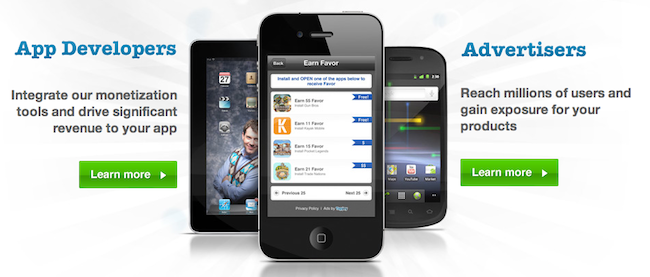
Last week, a number of reports suggested Apple had silently tweaked its algorithm that handles ranking of App Store applications, giving more importance to the quality and usage stats of an app rather than simple download numbers. The tweaked system, never confirmed by Apple but noticed by several third-party App Store ranking engines and advertising agencies, had its effect mostly on free apps in the Social Networking and Games categories, with the Facebook iPhone app quickly climbing to the first spots of the charts after months of sitting in the 10-20 positions. At the same time, Apple also began rejecting updates to applications that implemented “pay-per-install” methods – a system that, especially in iPhone games, allows you to earn virtual goods and currencies by downloading another app from the Store. As noted by pay-per-install and advertising network Tapjoy, the rejections came as Apple apparently started enforcing section 3.10 of the App Store Review Guidelines, which doesn’t accept developers who “attempt to manipulate or cheat” the App Store’s user reviews and charts. In this case, apps powered by pay-per-install options manipulate the charts as users go download additional software not for quality or particular interest, but just because they want to unlock the virtual goods.

At the VentureBeat Mobile Summit, Tapjoy CEO Mihir Shah said the company rolled out last week a cap on how many times an application can be downloaded through Tapjoy’s programs. Details on the cap aren’t clear, but it sounds like the new strategy is aimed at complying with Apple’s rules in a way these “offerwall” programs don’t manipulate the charting algorithm of the App Store, yet providing some exposure for Tapjoy’s advertisers. Admittedly, whilst advertising has always been a part of the Internet and it doesn’t surprise anyone that a company pays money to get exposure, having certain apps ranking higher in the App Store only because they invested more in pay-per-install methods doesn’t exactly sound great. If Apple wants to promote quality rather than download numbers, they have every right to rebuild their garden’s walls – as I stated previously. Tapjoy is yet another third-party company that had to change its service to keep up with Apple and the App Review Team. mocoNews concludes its article on Tapjoy with this quote from the company’s CEO:

Still, app developers should have some flexibility to market their applications within other applications, Shah said. “There has got to be a number of very creative long-term ideas that impresses a balance between marketing spend and organic rankings,” he said.

Creative ideas, as Shah calls them, clearly can’t come from paying money to gain visibility in the App Store. Rather, I believe Apple would see developers investing more in iAd for apps, or clever techniques to team up with fellow developers and promote iOS apps together. But right now, pay-per-install networks have to change.