This Week's Sponsor:

Turbulence Forecast

Know before you go. Get detailed turbulence forecasts for your exact route, now available 5 days in advance.


Posts tagged with "apple"

Apple Q2 2013 Results: $43.6 Billion Revenue, 37.4 Million iPhones, 19.5 Million iPads Sold

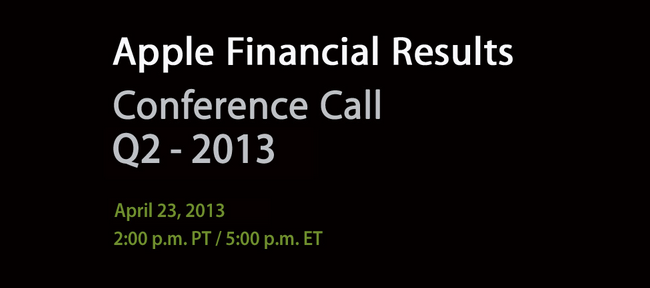
Apple has published their Q2 2013 financial results for the quarter that ended on March 31st, 2013. The company posted revenue of $43.6 billion. The company sold 19.5 million iPads, 37.4 million iPhones, and  “just under” 4 million Macs, earning a quarterly net profit of $9.5 billion.

We are pleased to report record March quarter revenue thanks to continued strong performance of iPhone and iPad,” said Tim Cook, Apple’s CEO. “Our teams are hard at work on some amazing new hardware, software and services, and we are very excited about the products in our pipeline.

Apple added $12.5 billion in cash flow “from operations during the quarter”, ending the quarter with a cash balance of $145 billion.

Today, Apple has also announced they have doubled the capital return program:

 The Company expects to utilize a total of $100 billion of cash under the expanded program by the end of calendar 2015. This represents a $55 billion increase to the program announced last year and translates to an average rate of $30 billion per year from the time of the first dividend payment in August 2012 through December 2015.

Read more


A Preview of the Apple Pop-Up Museum

Stephen Hackett has a nice overview of the Apple Pop-Up Museum, “an exclusive collection of Apple products to be shown in Atlanta”:

At the end of the first hall, there’s a room that stands out. While the hallway is bright and colorful, this room is dark, with the entrance painted black. In sparse white letters above the door, it reads “The Wilderness.”

The Apple Pop-Up Museum will be exhibiting on April 20 and April 21. Admission is only $10 per day and $15 for both days. My only experience with exhibitions of old Apple computers was an Apple I that was put on display in my town last summer. If I lived near Atlanta, I wouldn’t think twice about buying a ticket.

Permalink

Required Reading On App Store Pricing For Developers

Required Reading On App Store Pricing For Developers


The development of an app no doubt involves many tough decisions and trade-offs that you have to make, and one of the biggest will be at what price to sell your app for. To help clarify the important lessons and issues to consider when pricing an app, Michael Jurewitz has posted a five-part series based on his Çingleton and NSConference talks on ‘Understanding App Store Pricing’.

I’ve included below a brief summary of each article by Michael, but it’s really no substitution for reading the entire series yourself. It’s well written and although at times it covers some moderately complex microeconomic theories, it is broken down in easy to understand language with helpful diagrams and practical examples.

Permalink

Quantifying The Australian “Apple Tax”

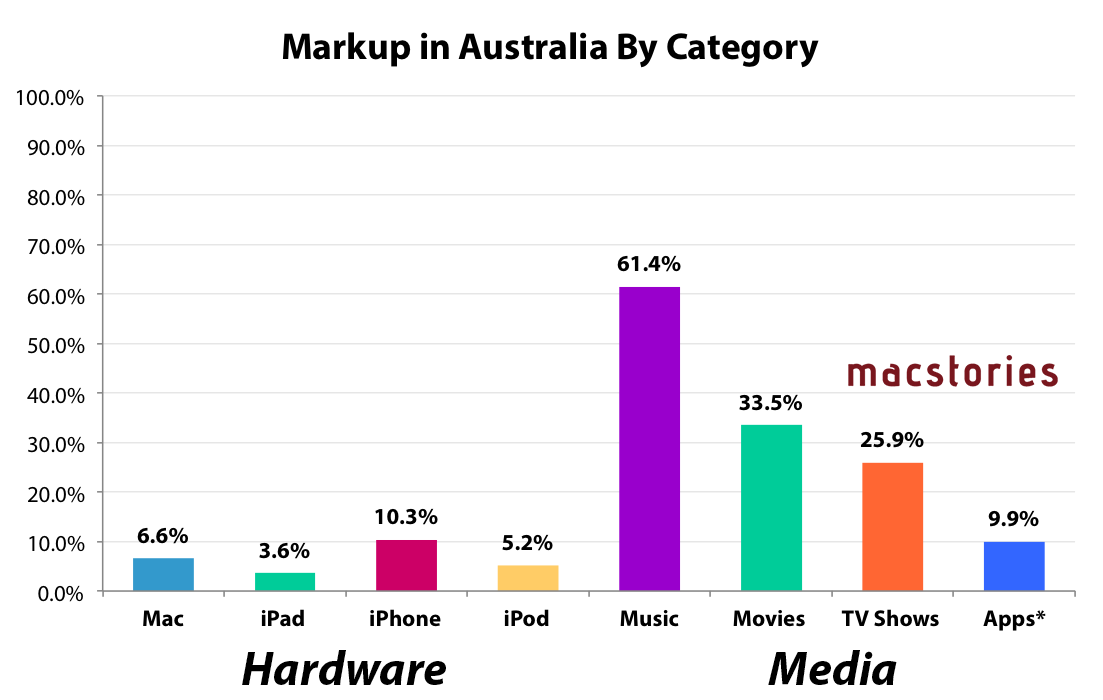
On Friday, Apple (along with Microsoft and Adobe) will front the Federal Australian Parliament’s inquiry into IT Pricing. You may recall that after failing to voluntarily appear, the committee in February of this year summonsed the three, effectively forcing them to appear. Given Apple’s appearance, I wanted to take a closer look to see what Apple actually charges for their products (both hardware and media from their iTunes and App Stores) and see how it compares to the US.

Methodology

Doing this kind of analysis can be fairly contentious given there are a few ways to do it, various assumptions you have to make, and different ways of presenting the information. To be clear, here is how I have constructed the data presented in the graphs in this article.

  • I collected from Apple’s website, the Australian and US prices of all their key products and main models (but not built-to-order models).
  • GST is removed from Australian price: The Australian price includes a 10% GST (goods and services tax), so I removed that from the Australian price because US prices do not include a sales tax, that is added at checkout based on which US state the customer is from (sales taxes varies across US states).
  • Now that both prices don’t include sales taxes, I convert the Australian price from Australian dollars (AUD) to US dollars (USD). I use a 3 month average of the exchange rate. The 3 month average smoothes out any temporary peaks or troughs in the exchange rate and gives Apple a fairly lengthy period of time to alter prices if there was a significant change in the exchange rate.
  • This now gives me the price of the Australian good in USD and without GST, a figure that can now be compared with the US price. So I calculate the percentage markup of the Australian price based on the original US price.
  • NOTE: Methodology for the Media calculations do vary a bit, read the notes I include with them.
  • I encourage you to scrutinise my calculations by taking a look at the Excel document I created, linked below.

Acknowledging The Threat Of Samsung


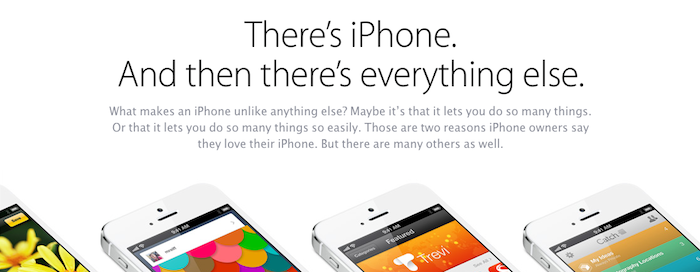
In the past week Apple’s marketing chief, Phil Schiller, gave three interviews and the company sent out a new “Why iPhone” email campaign - both timed perfectly around the announcement of Samsung’s new flagship smartphone, the Galaxy S4. Some have called it out as Apple going on the defensive, others have said it’s Apple on the offensive. I’m not sure that you can categorically say it’s one or the other – it doesn’t really matter much.

Read more


Apple Airs New iPhone Commercials: “Brilliant” and “Discover”

Earlier today, Apple aired two new iPhone commercials called Brilliant and Discover. The videos are available both on Apple’s website and YouTube channel.

Like Apple’s latest iPad ad campaign, the iPhone commercials focus on third-party apps with no narration, and just a series of words quickly shown on screen alongside apps/media available on iTunes. For “Brilliant”, the words are “sweet”, “rise” and “brilliant” and content includes Apple’s Cards app, UP, Passbook, MyScript Calculator, and Philips’ hue (Philips announced an SDK today as well). For “Discover” the words are “rock”, “sharp”, and “discover” and content includes GarageBand, Maps, Infinity Blade II, Cleartune, Solar Walk, Yelp, and Shazam.

You can watch the ads below. Read more


Textual Siri

Textual Siri

NotSiri

NotSiri

Here’s a good article by Rene Ritchie from June 2012 about a textual interface for Siri:

If Spotlight could access Siri’s contextually aware response engine, the same great results could be delivered back, using the same great widget system that already has buttons to touch-confirm or cancel, etc.

I completely agree. Spotlight lets you find apps and data to launch on your device; aside from its “assistant” functionality, Siri lets you search for specific information (either on your device or the web). There’s no reason find and search shouldn’t be together. Siri gained app-launching capabilities, but Spotlight still can’t accept Siri-like text input.

The truth is, I think using Siri in public is still awkward. My main use of Siri is adding calendar events or quick alarms when I’m a) cooking or b) driving my car. When I’m working in front of an iPad, I just don’t see the point of using voice input when I have a keyboard and the speech recognition software is still failing at recognizing moderately complex Italian queries. When I’m waiting for my doctor or in line at the grocery store, I just don’t want to be that guy who pulls out his phone and starts talking with a robotic assistant. Ten years after my first smartphone, I still prefer avoiding phone calls in public because a) other people don’t need to know my business and b) I was taught that talking on the phone in public can be rude. How am I supposed to tell Siri to “read me” my schedule when I have 10 people around me?

I think a textual Siri, capable of accepting written input instead of spoken commands, would provide a great middle ground for those situations when you don’t want to/can’t talk in public. Like Rene, I think putting the functionality in Spotlight would be a fine choice; apps like Fantastical have shown that “natural language input” with text can still be a modern, useful addition to our devices.

Text input brings different challenges: how would Siri handle typos? Would it wait until you’ve finished writing a sentence or refresh with results as-you-type? Would Siri lose its “conversational” approach, or provide butttons to reply with “Yes” or “No” to its further questions?

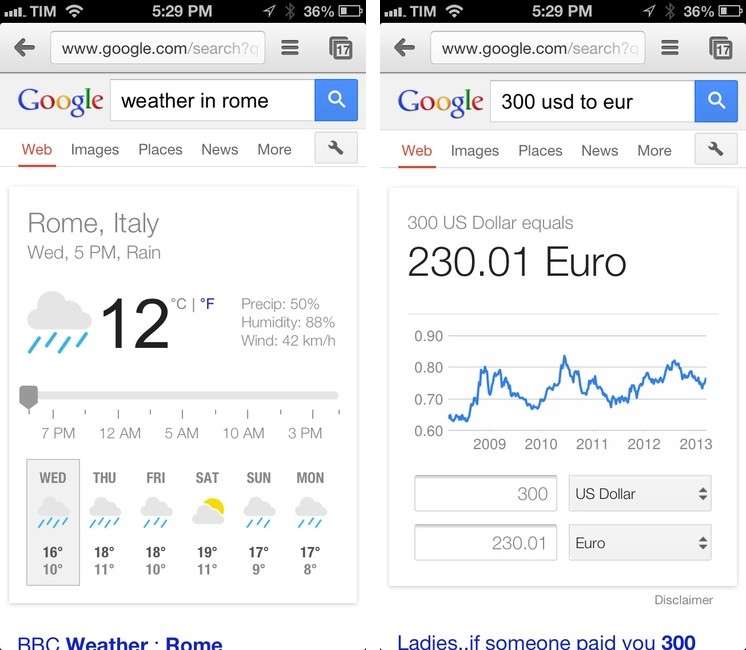
Text, however, has also its advantages: text is universal, free of voice alterations (think accents and dialects), independent from surrounding noise and/or microphone proximity. With a textual Siri, Apple could keep its users within its control by letting them ask for restaurant suggestions, weather information, unit conversions, or sports results without having to open other apps and/or launch Google.

It’s just absurd to think semantic search integration can only be applied to voice recognition, especially in the current version of Siri. I agree with Kontra: Siri isn’t really about voice.

More importantly: if Google can do it, why can’t Apple?

Permalink

Bad Piggies Update Brings New Levels, Attacking Angry Birds

Rovio today released the second major update to its Angry Birds spin-off game, Bad Piggies. The big new addition to the 1.2 update are the 30 new ‘Flight in the Night’ levels, with some of them requiring you to “sneak past the napping Angry Birds” - making too much noise will wake the birds up who will attack to try and sabotage you.

In this massive update to IGN’s 2012 game of the year, the Bad Piggies are on the move, and they’ve managed to hang on to the eggs so far! But watch out - you need to sneak past the napping Angry Birds, and they’re sleeping with one eye open! Navigate through 30 new Flight in the Night Levels but don’t make too much noise, or you’ll wake up some seriously furious birds! Also make sure to check out the new “Road Hogs” time trials: can you beat the clock (and your friends) with your crazy contraption?

Also included are 6 ‘Road Hogs’ levels which are time trial levels, another new sandbox and six new achievements. The teaser video of the update which highlights some of the new features is embedded below.

Download Bad Piggies: iPhone, iPad, Mac, Android

Read more


A Look Back At Instagram’s Growth As It Hits 100 Million Monthly Active Users

Instagram today announced that it has over 100 million monthly active users, an increase of 10 million since they announced in early January that they had passed 90 million monthly active users. In a lengthy blog post, Instagram co-founder Kevin Systrom shares a story from the early days of Instagram and highlights a few Instagram users that have inspired him and highlight the power of Instagram.

Images have the ability to connect people from all backgrounds, languages and cultures. They connect us to aid workers halfway across the world in Sudan, to entrepreneurs in San Francisco and even to events in our own backyards. Instagram, as a tool to inspire and connect, is only as powerful as the community it is made of. For this reason, we feel extremely lucky to have the chance to build this with all of you. So from our team to the hundred million people who call Instagram home, we say thank you. Thank you for sharing your world and inspiring us all to do the same.

Given the news I thought I would go back and create an updated version of our Instagram users graph which you can see above: it plots all of Instagram’s publically released user statistics since its release in October 2010 (click it to view a larger version). Note that the last two data points are ‘Monthly Active Users’ rather than total number of signed up Instagram users. Nonetheless, it hasn’t taken too long for the Monthly Active Users catch up and hit the 100 million users mark.