This Week's Sponsor:

Turbulence Forecast

Know before you go. Get detailed turbulence forecasts for your exact route, now available 5 days in advance.


Posts tagged with "apple"

App Store Volume Purchasing Program Coming To Businesses Soon

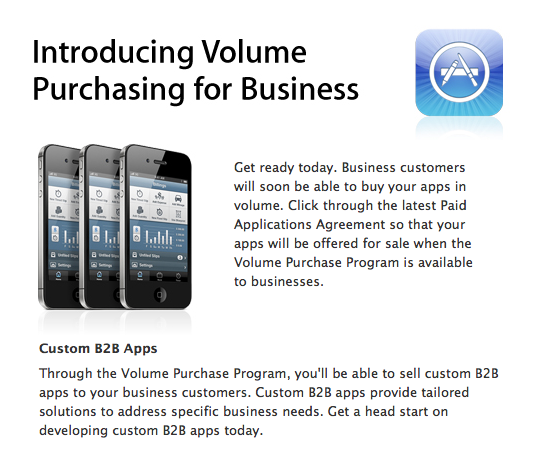
In an email to developers, Apple has revealed that it is implementing an App Store Volume Purchasing Program (ASVPP) for Businesses, following a similar system that has existed for educational institutions. This system, which Apple claims is “coming soon” will vastly simplify the process in which businesses can offer their employees the apps they need. The program will initially be US-only and will require a valid Dun & Bradstreet Number (D-U-N-S) and a valid physical address.

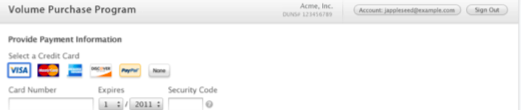
Once enrolled, the ASVPP can be accessed from the Apple website. This website is where businesses can purchase their apps in volume. The following screenshots highlight the process of doing so, which includes: searching for the app, setting the quantity and completing the transaction with either a corporate credit card, PCard or PayPal.

All volume purchases will result in an email from Apple and they are then added to a particular institutions purchase history which is located on the ASVPP website. Once purchased, an institution gets a redemption code for each app.

The program website delivers these redemption codes in a spreadsheet format that contains multiple codes, one for each app in the quantity purchased. Each time a code is redeemed, the spreadsheet is updated on the program website so you can track the number of codes that have been redeemed by your users.

Apple offers three ways in which institutions can quickly and easily distribute the app to their employees/users. The first is just a simple redemption URL which includes redemption code so that users do need to manually enter it into iTunes. Secondly they suggest posting the codes or URLs to a company portal or intranet page. The third option is to use a “third-party Mobile Device Management (MDM) solution” which offers an easily manageable system of centrally managing and distributing the apps.

Read more


Apple Updates Prices Of International iTunes Stores

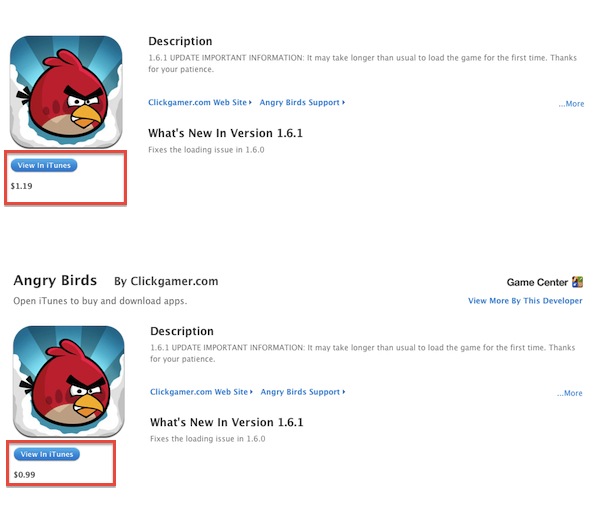
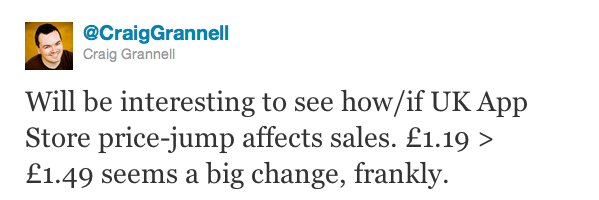
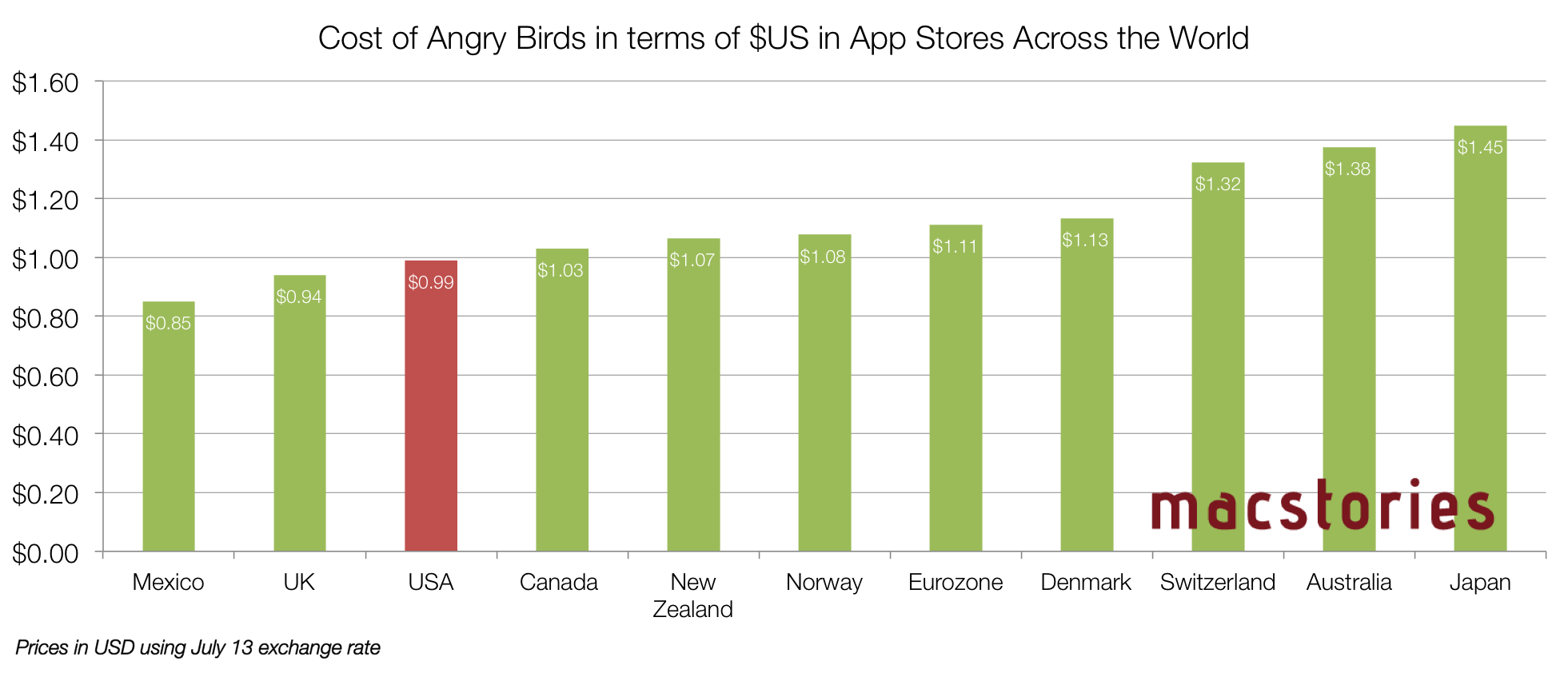
As we reported earlier today, the downtime of the iTunes Store last night and iTunes Connect today seems to be bringing along some interesting price changes for apps and other material available in the iTunes Store worldwide. Whilst we’re still examining the changes (which are rolling out as we speak), we’re getting the first reports of increased prices in the UK for apps (from £0.59 to £0.69 for apps sold at $0.99 in the United States) and lower prices in the Australian iTunes Store. The change for UK customers is a rather important one, raising prices for “cheap apps” – it’ll be interesting to notice how this will affect sales, as writer Craig Grannel points out.

Read more


iTunes Connect Maintenance Could Mean Apple Is Eventually Recalibrating International iTunes Prices

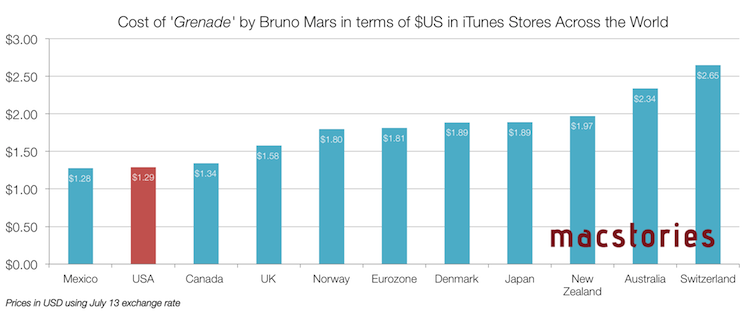
We reported earlier today on news that Apple is preparing to undertake maintenance work on iTunes Connect today from 9am to 4pm PDT. Although we cannot confirm anything, we think there is (strong) reason to believe that this maintenance is being undertaken to rebalance iTunes prices internationally which over the past year have (to be quite honest) spiralled out of control. The above diagram illustrates this fact quite clearly and it also exists for Apps and other iTunes content. Yes, that’s right, there is an 81% surcharge for an Australian buying the same song as an American and those in Switzerland have to pay more than double at a 105% surcharge.

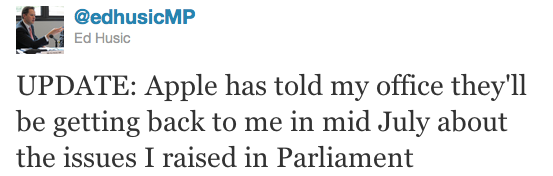
My thinking of this occurring started last Friday when Australian politician, Ed Husic, tweeted that Apple will “be getting back to me in mid July” regarding issues he had raised about (Australian) Apple pricing in Federal Parliament back in March. Now whilst he did (mostly) focus on hardware disparities in his speech, I still felt (on Friday) that Apple’s response could be about “re-calibrating” the iTunes ‘exchange-rate’ - mostly because the Australian dollar has been sitting around US$1.03 whereas the iTunes ‘exchange-rate’ expects it to average at US$0.60.

Fast-forward to today’s news that iTunes Connect is facing maintenance. If you read the notice, it makes it clear that something is happening to the price mechanism, as the letter reads: “pricing changes made between 9 a.m. and 4 p.m. PDT will cause the app to become unavailable for purchase until maintenance is complete”.

Whilst that alone doesn’t suggest much, the fact that the notice explicitly mentions that customers may not be able to purchase content from iTunes if in Mexico, U.K., Australia, Switzerland, Japan or Norway really stood out to me. Because (with the exception of Mexico), those mentioned are (mostly) the worst affected regions of the iTunes price disparity - just look at the above or below graphs. Whilst Mexico is the opposite, they have actually been able to purchase content at cheaper than US customers.

To be absolutely clear, I re-iterate that we have no inside knowledge that this is the definite reason for the maintenance today. But the dots (if you will) just all connect: disparity has gotten ridiculous, Ed Husic’s tweet, it being mid-July, the affected portions of iTunes Connect and the regions affected. Nonetheless if by the end of today there isn’t a change, I think it’s still safe to say that Apple will inevitably act and I think that will be sooner than later.

You can read more about this global iTunes price disparity in this article we published in January.


Mac Mini And MacBook To Receive A Refresh In The Very Near Future?

Clarifying a report from two days ago, 9to5 Mac is today claiming that the part numbers posted are not for new Mac Pros but rather refreshed MacBook and Mac Mini models. They still believe that the MacBook Air part numbers are correct. They think it is likely that these new models will be launched soon and the Mac Pro to follow in a few more weeks time.

The “MC914LL/A – J59, BEST – USA” part number is presumed to be for the refreshed MacBook with what one can only assume would come with a Thunderbolt port and a spec bump.

Meanwhile, the following three part numbers are thought to be for refreshed Mac Mini models with similar improvements to that expected of the MacBook and MacBook Air. One being a standard configuration, another being the server version and a third which is likely for the built-to-order Mac Mini.

MC936LL/A – J40, ULTIMATE – USA – Mac mini Server

MC815LL/A – J40I, BETTER – USA – Mac mini standard configuration

MC816LL/A – J40, BEST – USA Faster Mac mini (likely BTO)

[Via 9to5 Mac]


iTunes Connect Undergoing Maintenance Today, Purchasing Apps May Fail In Some Regions


Today from 9am to 4pm PDT, iTunes Connect will be undergoing “scheduled maintenance”. Whilst the developer portal will remain available, an Apple email detailing the outage explains that if a pricing change is made between that maintenance window, it will cause the app to become unavailable for purchase.

Furthermore, customers in the regions of Mexico, U.K., Australia, Switzerland, Japan and Norway may not be able to purchase apps during this maintenance window.

It is not known whether this maintenance is related to yesterday’s connectivity problems, in anticipation of the impending release of Lion or someother change to the backend of iTunes Connect. Jump the break to see the full email from Apple to developers regarding the maintenance.

[Via MacRumors] Read more


Ahead Of Next Week’s Earnings Call, Analysts Predict High Mac, iPhone And iPad Sales

Ahead of next week’s earning call, there are two reports out today by analysts that paint a rosy picture of Mac, iPhone and iPad sales. The first report by Barclays Capital anaylst Ben Reitzes, claims that Apple is likely to exceed 22% growth in Mac computer shipments during the June quarter. This is despite US market data that has been less optimistic, but Reitzes suggests that overseas sales may compensate for the “somewhat muted” US sales due to the fact that many consumers are waiting for new MacBook Air models.

The second report from Brian White of Ticonderoga Securities included some revised figures and claims that Apple is likely to have sold a record of 8.5 million iPads and an impressive 17.53 million iPhones in the June quarter.

After our recent trip to Asia, we indicated that we felt our iPhone estimates for the June quarter were overly conservative, while our iPad projections were achievable and well above the Street.

Apple’s previous record for iPad sales was last years holiday quarter where they sold 7.3 million units. The iPhone sales according to White would be less than last-quarter’s record 18.65 units but still more than double the 8.4 million units Apple sold in the same quarter last year.

While many larger tech companies rely on more cyclical trends to grow sales, we believe Apple enjoys the tailwind of strong secular industry trends, hot new products and market share gain opportunities

[Via Barrons, AppleInsider]


Former Pixar Animator And Moonbot Studios Create Surreal iPad Storybook

The Fantastic Flying Books of Mr. Morris Lessmore is a fascinating new ‘iPad Storybook’ that recently hit the App Store. Developed by Moonbot Studios and lead by an ex-Pixar animator, William Joyce, the book is an intriguing mix of book, animation and game.

Put yourself in Morris’ shoes as you dive into the story of Mr. Lessmore and his flying friends through Moonbot Studios’ first Interactive Storybook. In this reinvention of digital storytelling you can repair books, tumble through a storm, learn the piano and even get “lost in a book,” flying through a magical world of words, giving you a dynamic journey through the story.

Available on the iPad App Store for $4.99, the book contains sequences where you have to interact with the iPad app in order to progress through the story. It includes such activities such as drawing, playing a piano, playing with food and a number of mini-games. It looks like a tonne of fun, jump the break for a beautiful trailer of the interactive Storybook.

[Via The Next Web]

Read more


TV Forecast HD Is A Beautifully Refined iPad App That Keeps Track Of Your Favourite TV Shows

If you are anything like me, you probably don’t watch much live TV anymore; instead just watching a few shows a week on TV and the rest via an online catch-up service. If that sounds like you as well, you may be interested in a new iPad app that makes it easier to track when your favorite shows are airing on TV. The app, TV Forecast HD, is developed by Big Bucket Software (also the developer behind The Incident) and is an entirely redesigned version of TV Forecast, which is currently available for the iPhone. Jump the break for the full review of TV Forecast HD, which has just been made available today.

Read more


Apple users buying 61% more apps, paying 14% more per app

Apple users buying 61% more apps, paying 14% more per app

The average iOS device owner will download 83 apps in 2011 vs. 51 in 2010, a 61% increase year over year. “Smartphone users are showing an increasing appetite to use apps to add features to their phones,” Munster writes,” and iOS has the leading app ecosystem.”

While the title is somewhat misleading (are we comparing iOS against Android again?), Piper Jaffray’s Gene Munster looks at the at the trend of app sales and ‘average selling price’ per app since September 2008, charting a nice graph that shows the App Store’s steady increase in downloads for free and paid applications. So far in 2011, the average selling price per app is up 14% year-over-year, versus a decrease of 18% in 2010. “After the initial race to the bottom in App Store pricing, we are seeing users pay up to add features and games to their iOS devices”, Munster writes.

I think we can attribute the recent uptick to in-app subscriptions. Magazines and newspaper subscriptions sold in the App Store can cost anywhere from $20 to $60 a year, and Apple has been aggressive in advertising digital publications via ‘featured’ and ‘what’s hot’ banners. Too, there’s been a recent trend with games like Tiny Tower that can rack up a lot of money by selling in-game currency which vastly improves the experience once players are hooked. The in-app purchase and subscription models are working out very well for developers that implement them.

Philip Elmer-DeWitt writes,

82% of the apps in Apple’s store are free. The 18% that users have to pay for have an ASP of $1.44. According to Munster, the increase in ASP is driven by the more-expensive iPad apps that represent a growing percentage of app downloads.

Again, a lot of these new iPad apps are digital magazines. While we have seen some great apps hit the App Store for $19.99 (OmniOutliner for iPad) and $9.99 (The Hit List for iPhone), unfortunately I think developers that are willing to price their apps high are still few and far between. I must admit, however, that I have seen more $2.99 and $3.99 dollar apps this year than the $.99 and $1.99 I’ve seen in the past. Then again, perhaps my inbox is just being pitched with more expensive apps than usual. Regardless, selling apps at higher price (more representative of an app’s value) is a good thing for developers, and it’s especially important on the iPad where quality software dictates how well it can replace a laptop. With iOS 5 around the corner, I wonder if users would be willing to spend more if the iPad was their only computer?

The App Store still has some kinks to work out, but it’s currently looking pretty healthy. Consumers are buying lots of apps (and in-app purchases), while developers are raking in just a little more money than before if we’re to believe Munster’s findings.

Permalink