This Week's Sponsor:

Turbulence Forecast

Know before you go. Get detailed turbulence forecasts for your exact route, now available 5 days in advance.


Posts tagged with "apple"

Apple Takes Down Order Status Page Ahead of May 22 Retail Meeting

As a latest piece to the retail meeting puzzle the tech press has been trying to put together in the past week, Apple has taken down the online status order webpage (where users can check on their Apple store orders, make changes, and track shipments) until Sunday, May 22. Other pages of store.apple.com seem to be up at the moment, as the order status page is the only one that reports systems are being upgraded.

Apple’s retail meetings on May 22 have been initially rumored to be focused on a product launch or 10th anniversary celebration of retail, though recent speculation indicated employees might be simply trained on new internal systems such as RetailMe installed on staff-only iPads, new Concierge and other overhauled internal services.

[Thanks, Jonathan]


Apple Investigating Explosion at Foxconn iPad Factory

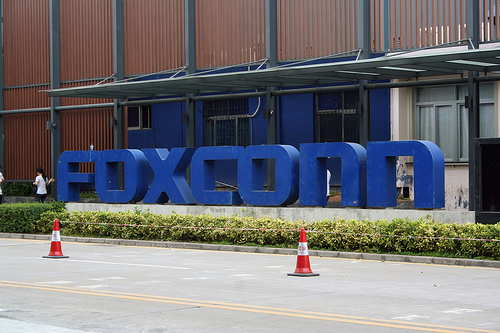
An explosion in a Foxconn facility in Chengdu, China, that killed 2 and injured at least 16 earlier today is currently under investigation from Apple and Foxconn, as well as local officials. The blast, reported by several news outlets this afternoon, took place in the factory where Foxconn makes iPads for Apple, the WSJ said. In Fried at All Things Digital posted an official statement from an Apple spokesperson:

We are deeply saddened by the tragedy at Foxconn’s plant in Chengdu, and our hearts go out to the victims and their families,” Apple said in a statement provided to All Things D. “We are working closely with Foxconn to understand what caused this terrible event.

Whilst speculation is running wild as to whether the damages to the facility will affect the iPad’s production chain, our thoughts and prayers go the victims of this terrible tragedy.


EFF Calls On Apple to Protect iOS Developers

EFF Calls On Apple to Protect iOS Developers

This is a problem that lawyers call a misallocation of burden. The law generally works to ensure that the party in the best position to address an issue bears the responsibility of handling that issue. In the copyright context, for example, the default assumption is that the copyright owners are best positioned to identify potential infringement. This is because, among other reasons, copyright owners know what content they own and which of their works have been licensed. Here, absent protection from Apple, developers hoping to avoid a legal dispute must investigate each of the technologies that Apple provides to make sure none of them is patent-infringing. For many small developers, this requirement, combined with a 30 percent fee to Apple, is an unacceptable cost. Even careful developers who hire lawyers to do full-scale patent searches on potential apps surely would not expect to investigate the technology that Apple provides. Instead, they would expect (with good reason) that Apple wouldn’t provide technologies in its App Store that open its developers up to liability – and/or would at least agree to defend them when a troll like Lodsys comes along.

The Electronic Frontier Foundation (EFF) thinks Apple should stand up for its developers and protect them from patent trolls like Lodsys, who are asking for licensing fees on a technology provided by Apple itself to developers through the SDK. We’ve been following the debate surrounding Lodsys for over a week now, and whilst The Guardian reported Apple would issue an official response this week, nothing has come out of Apple’s legal department yet – though Apple is well known for taking its time before addressing issues publicly. Several bloggers in the past days have suggested Apple may use the WWDC stage to speak directly to developers and explain the situation with in-app purchases, patents and Lodsys, even if the company previously announced that the WWDC would simply offer a preview of the future of iOS and OS X.

The EFF’s letter to Apple resonates with a common sentiment among developers and the tech press – Apple should defend developers and the iOS ecosystem from being threatened by trolls and patent infringement claims.

Permalink

Apple Also Negotiating with Music Publishers for Cloud Service

Following last night’s report on Apple signing a deal with the third music label, Sony, over the launch of the rumored iTunes cloud service after inking similar agreements with EMI and Warner Music Group, Peter Kafka at All Things Digital reports negotiations won’t be over once Apple also signs Universal, the biggest music label in the United States; whilst Apple is clearly in advantage when compared to Google and Amazon thanks to its music deals, the company still has to finalize agreements with music publishers, which own different rights on songs and albums than labels. As Kafka explains, publishers are different entities, usually shared within the same label but still residing in separate buildings, that own rights to the songs’ compositions, as opposed to the labels who own rights to the recordings. Once music is distributed either physically or online, both get paid with different fees and terms; once example is the Beatles music catalogue, with recordings owned by EMI and compositions by publisher Sony/ATV.

Kafka claims Apple simply started negotiating with the labels first, and deals with publishers are currently being worked on ahead of a rumored WWDC launch.

While Apple came to terms with Warner Music and EMI Music weeks ago, and has now struck a deal with Sony Music, industry sources tell me the company doesn’t have agreements with labels’ associated publishing companies — Warner/Chappell, EMI Music Publishing and Sony/ATV. The deal Apple is about to sign with Universal, also won’t include publishing, I’m told.

Music industry sources I talk to think Apple wants to launch, or at least announce, the cloud service at its developers’ conference in early June. And if the hang-up is truly just about money, then that still gives dealmakers time to hammer things out. But remember that this is the music business, and simple things always take longer than they should.

As reported several times in the past few weeks, Apple’s upcoming cloud-based music service is rumored to offer both uploads of a user’s music collection and access to songs not previously purchased, but available for streaming through a subscription system.



Intel: Apple Transferring Thunderbolt Trademark To Us

In recent days there has been confusion over who exactly owns the trademark to the Thunderbolt brand – it had been revealed that Apple had sent trademark requests for the Thunderbolt name despite Intel developing most of the I/O technology. Intel had developed what was formally known as Light Peak, a technology that would allow high-speed connectivity of up to 100Gbps using an optical cable. Apple had then suggested to Intel in 2009 to add the capability of 10 Watts of power and construct the cable out of copper instead.

The fact that Intel did not have ownership of the Thunderbolt brand trademark caused confusion amongst many, as a result, Bright Side of the News contacted Intel and asked them about the situation. The Senior Communications Manager at Intel, Dave Salvator responded and said

As part of our collaboration with Apple, they did some of the initial trademark filings.  Intel has full rights to the Thunderbolt trademark now and into the future. The Thunderbolt name will be used going forward on all platforms, irrespective of operating system.

Effectively what this means is that Apple did the original trademark work but will be transferring it back to Intel. But Apple won’t be leaving empty handed, they get in return unrestricted use of the technology. Others, such as Sony, which are planning to implement the Thunderbolt technology into their own upcoming laptops (using a USB-style port) will still have to resolve trademark disputes with Intel. Salvator also provided some clarification on the future of Thunderbolt moving towards the originally planned optical technology. He said that Intel is working now on the design of the optical version and that

The (Thunderbolt optical) cable could carry power in the same cable (running next to optical part of cable), but exact product plans are still to be announced.

[Via Bright Side of the News]


Apple Reaches Deal with Sony Over Cloud Music

As work on the rumored cloud music service nears finalization for an official WWDC announcement, Bloomberg reported last night Apple has reached a deal with Sony Music Entertainment, following reports that the company managed to sign the Warner Music Group and EMI. This leaves Universal, the biggest label of all four in the United States, out of the equation, but according to the rumors Apple’s Eddy Cue is actively focused on closing all the remaining paperwork with music labels by next week.

Apple has reached licensing accords with Sony Corp. (6758)’s music division, EMI Group and Warner Music Group, the people said. Universal Music Group, the largest recording company, is close to a deal, another person said. The company also would need to reach agreements with music publishers, which control different rights than the labels.

Apple’s cloud music service is said to be part of a major MobileMe revamp the company has been working on for the past two years, which will include several new functionalities and a new price point with basic features offered for free. As for the music service, it’s unclear whether Apple will adopt an upload system like Google and Amazon or a subscription-based delivery with songs coming from the iTunes Store, but a patent surfaced yesterday seems to suggest Apple’s implementation will go as far as allowing users to upload their own songs, and stream others they don’t own from a larger “content source” like the iTunes Store.


Dual-Mode Verizon iPhone 4S to be Released With AT&T Version

Verizon has been a leaky faucet lately, with our first real bit of insight into Apple’s strategy coming in April where CFO Fran Shammo spoke about a global iPhone hitting shelves at the same time as their competitors. The idea of a dual-mode phone was “reiterated” again by Shammo at Reteurs’ technology summits: to be clear, the idea that Verizon would launch a dual-mode, GSM/CDMA capable model alongside AT&T would give it equal footing when customers decide on a carrier. Shammo offered further clarity that the iPhone probably won’t be an LTE device, noting, “It’s a bigger issue for Apple than it is for us.” Apple is focused on providing an iPhone that works globally at the moment, rather than focusing on LTE technologies. Verizon themselves aren’t concerned about the lack of LTE on the next iPhone, given that they already have a slew of Android devices that offer their functionality if consumers desire it.

Along with iPhone plans, Shammo also said family plans would get shared data plans after the switch to tiered pricing. An end to unlimited on-device data plans was still on track for the summer, but he said it was sure Verizon would have “mega-plans” where a certain number of devices had a larger pool of data.

If you’re planning on getting an unlimited plan under Verizon, your switch from AT&T to the big red may not matter once Verizon adopts tiered pricing. Likely to be competitive with AT&T who’re currently offering 2GB of data for $25 a month, Verizon may also offer customers buying multiple phones a discount, and that mega-plans may offer incentives such as the ability to ‘borrow’ plans from other 3G devices (read: free tethering).

The next iPhone is rumored to be on track for an improved camera, bigger display, and an A5 processor. Apple should currently be in the process of ramping down iPhone 4 shipments (expecting to ship 2 million less in Q2) as the new batch of next generation iPhones are scheduled to begin production in August. The next iPhone will also likely feature an 8 MP Sony camera, as well as sporting a new design with relocated flash. All of us are going to be incredibly anxious as it’s unlikely Apple will launch a new iPhone in June or July, but I’m guessing September is looking like it’ll be bigger than we expected.

[Reuters via Electronista]


Could Aperture Be Coming to iOS?

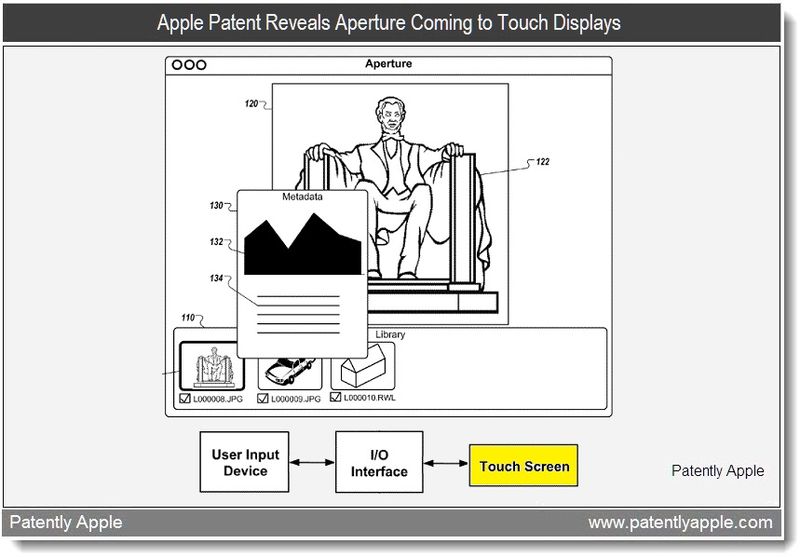
This would be a photographers dream come true wouldn’t it? Even if you prefer Adobe’s Lightroom to Apple’s Aperture, I’d love to have the iPad play a larger role in field editing for photographers. The Photos app included on the iPad isn’t exactly prime for professional work (it’s great for displaying and browsing the end result), but Aperture on the iPad would give photographers an intuitive touch interface to edit photos in a library that’s perhaps separate from Photo’s library. Patently Apple reports that Aperture could well be on its way towards touchscreen devices such as the iPad (and maybe that touchscreen iMac we’ve heard about).

It’s the latter that’s interesting in light of Apple’s latest patent revelation that Aperture is coming to touch displays including handhelds like the iPad. It may even come to future desktops and laptops that offer touch displays, according to Apple. An advanced graphics pen would be great for fast photo touch-ups and appreciated by photographers using Aperture on-the-go.

The patent covers various means of interacting with Aperture, from touch input to pen input, and the descriptions of various GUI elements that can provide authors with an easy toolset at the ready for image editing. The authors are intrigued with the idea that Apple may be moving towards various forms of alternate input, such a smart light pen, that could aid future Apple device owners in precision editing.

[via Patently Apple]


Internal AppleCare Document Directs Employees Not To Help With Malware Removal

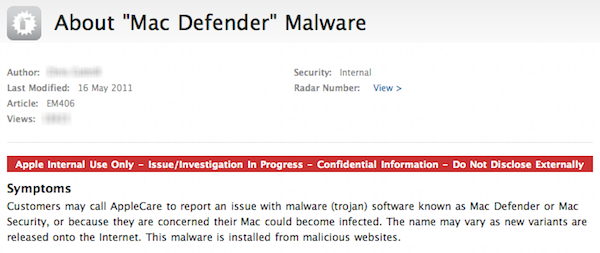
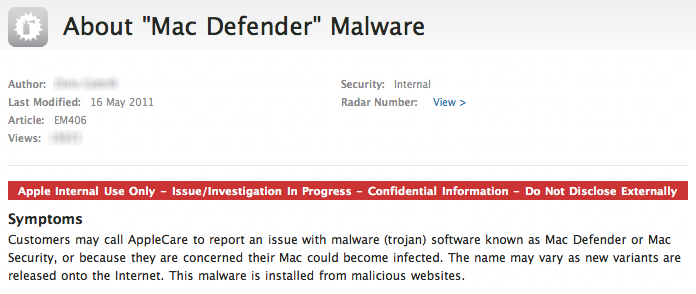
An internal AppleCare document posted earlier this week reveals that Apple is investigating ‘Mac Defender’ – a recently unleashed malicious application that pretends to be an anti-virus application when users download it. The document, which Apple clearly notes is for internal use only, tells its employees not to confirm or deny whether the application has been installed on a users computer, not to attempt to remove it or escalate the issue.

The bizarre document, which is posted in full after the break, seems to be instructing Apple employees to take no part in resolving malware issues on a users computer.

AppleCare does not provide support for removal of the malware. You should not confirm or deny whether the customer’s Mac is infected or not.

However, the document does tell employees to instruct customers that if the Mac Defender installer pops up on their screen, to cancel the installer and delete the installer immediately. Whilst if the application is already installed they are told to tell the customer to make sure all security updates have been installed with Software Update and then direct them to the “What is Malware?” document. But the document is clear in saying that Apple doesn’t deal with malware – even recommending anti-virus software in the Mac App Store.

Explain that Apple does not make recommendations for specific software to assist in removing malware. The customer can be directed to the Apple Online Store and the Mac App Store for antivirus software options.

[Via ZDNet]

Read more