This Week's Sponsor:

Turbulence Forecast

Know before you go. Get detailed turbulence forecasts for your exact route, now available 5 days in advance.


Posts tagged with "apple"

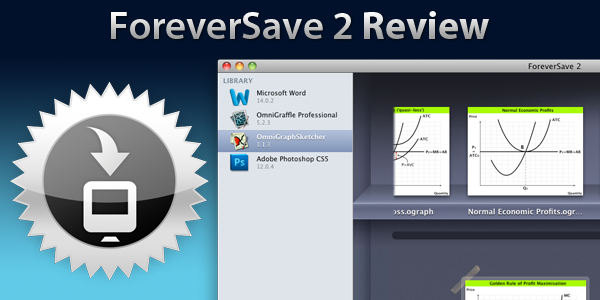
ForeverSave 2 Review: Universal Auto-Save And Versioning On Your Mac

Everybody dreads it, the moment you realize that the document you had been working on for an hour is lost, all because you hadn’t saved it and there had been a power outage or the program crashed! It seems absurd that, in 2011, so few apps have implemented an auto-save feature that saves your document periodically as you work on it. A few apps do have an auto-save feature, including the Microsoft Office suite (saving me more than a few times) – but the vast majority don’t.

For those applications that don’t feature auto-saving there may be a reasonable solution that requires very little hassle from you. Tool Force bills their recently released version 2 of ForeverSave as enabling “universal auto-save and backup versioning for all documents”. I gave the application a go for the past week so jump the break for a full review and see whether it pans out as a feasible solution.

Read more


Today Marks Ten Years Of Apple Retail Stores

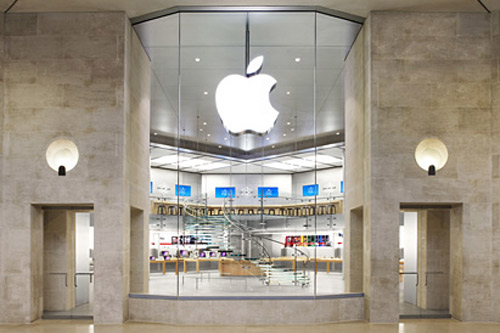
On May 19 2001, Apple opened the first of its many retail Apple Stores; the Tysons Corner and Glendale stores. Ten years on, Apple’s retail ambitions have proven incredibly successful with over 300 stores in more than 10 countries.Along the way there have been some stunning stores, including the Regent street store in London (also the largest), the glass cube Fifth Avenue store in New York, the Paris Carrousel du Louvre Store and Pundong store in Shanghai.

As always, Wikipedia has some in-depth history and facts about the Apple Stores, as does ifoAppleStore which has an awesome list of unique factoids - did you know that the Bondi store has trees inside the store or that the Regent Street store has the longest Genius Bar at 46 feet? There have also been rumors in the past few days that Apple is planning to launch Apple Stores 2.0 - a relaunch of the stores with a shift in focus to ‘Personal Setups’, revamp of the actual stores with larger displays and deployment of iPad 2s for signatures being the key rumored changes.

Jump the break for pictures of these and other stunning stores, as well as a video of Jobs introducing that first Tysons Corner store - and see how much they’ve changed since!

Update: Added some pictures of the Tysons Corner store as it was on launch day (click on them for larger size), the original style of Apple Stores.

Read more


China Mobile Claims It Reached A Consensus With Apple Over A 4G iPhone

In a report on MarketWatch, China Mobile states that it has reached a consensus with Apple regarding the use of 4G technology on future iPhones. The iPhone 4 currently uses 3G technology, 4G is the ‘next-generation’ technology for mobile data which promises even faster speeds.

Wang Jianzhou, China Mobile’s Chairman, didn’t specify many details about the agreement but says that they will be beginning 4G trials in China beginning next year and that discussions with Apple are continuing. Bloomberg today also got some additional details from Jianzhou, but in that report, the consensus with Apple was not mentioned.

The company may also be able to offer Apple Inc. (AAPL)s iPhone with the shift to TD-LTE, Wang said. While Apple has decided not to make a version of the phone for the third-generation TD-SCDMA system that is used only by China Mobile, the Cupertino, California-based company may produce one for the TD-LTE system, he said.

It follows yesterday’s report from DigiTimes that this year’s iPhone was originally meant to have LTE capability (a 4G technology) but was scrapped after it was discovered Qualcomm was having problems producing chips in large enough quantities. In that report it was said that China Mobile was expected to reach a deal with Apple soon to offer the next iPhone on it’s network this year – contradicting the Bloomberg report.

[Via MacRumors]


Survey Reveals 63 Million iOS Gamers Download 5 Million Games Per Day

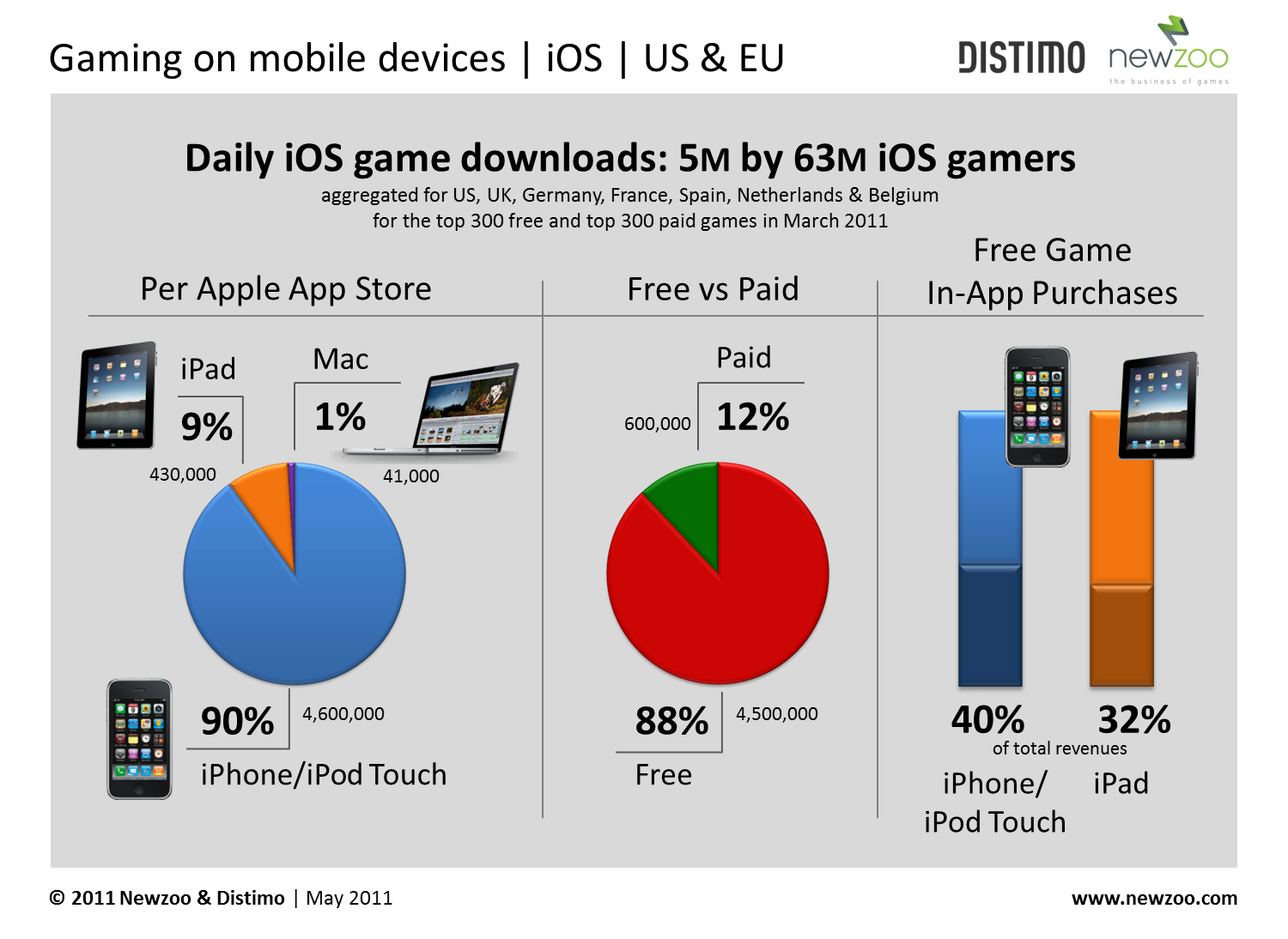
The National Gamers Survey, compiled by research firms Distimo and Newzoo from March data has revealed that there are roughly 63 million gamers on the iOS ecosystem who (individually) download, on average, 2.5 games per month. Games represent half of all apps downloaded across the iOS and Mac App Stores with more than 5 million games downloaded per day – based on the survey that included the US, UK and five other European countries. A clear majority of 4.6 million are downloaded for the iPhone or iPod Touch whilst just over 400,000 are for the iPad and just a sliver for the Mac with 41,000 per day.

The survey also revealed that in-app purchases within games is becoming an increasingly common feature found in games with revenue from in-app purchases also representing a large proportion of total revenues. 88% of the top 300 games on iOS are free, but across and free and paid games, two fifths of the revenue is now coming from in-app purchases. On the iPhone and iPod touch it represented 40% of gross revenue and 32% for the iPad. These high figures may give reason to why Lodsys has recently started to target developers that implement in-app purchases; it would certainly raise a lot of revenue if they received license fees from even just a portion of developers.

Some more statistical data about the spread of iOS devices was also revealed, noting that across some of the countries surveyed, including the US, UK, France and Germany, between 6% and 7% of the online population have an iPhone. Whilst of those iPhone users, between 50% and 75% play games. As for the iPad, the report claims 15 million Americans actively play games on it, whilst 7 million Europeans do so – exceeding the number of people using Sony’s PSP.

[Via RazorianFly]


Apple Inks Deal with EMI, Cloud Music Almost Finalized

Cnet reports tonight Apple has inked a deal with EMI over the upcoming launch of the rumored cloud music service that is expected to be unveiled at the WWDC in June. Cnet also claims the last two remaining deals with Sony and Music Entertainment and Universal Music Group (Warner Music Group reportedly signed a deal last month) could be signed as early as next week.

Apple has signed a cloud-music licensing agreement with EMI Music and is very near to completing deals with Universal Music Group and Sony Music Entertainment, multiple music industry sources told CNET.

The negotiations between Sony Music Group and Universal Music Group could be wrapped up as early as next week, the sources said. What this means is that signed contracts with all four of the top four record companies will be in Apple’s hip pocket on June 6 when Apple kicks off the company’s Worldwide Developers Conference. The sources who spoke with CNET did not know when Apple would announce the deals or roll out the cloud service.

With Apple signing the four major music labels in the United States, the cloud music service the company has been working on might include a subscription-based system where users simply stream music they don’t actually own (like in Spotify), the possibility to automatically beam to the cloud purchases from the iTunes Store or then again, as many suggest, Apple may be simply looking to having full support from the music industry in order to avoid possible lawsuits and debates surrounding cloud products from Google and Amazon, also recently launched.

Cloud is rumored to be a big part of iOS 5 and OS X Lion, set to be previewed on June 6 at the WWDC.


Apple Opening A New Data Center in Silicon Valley

Data Center Knowledge reports Apple is adding a new data center in Silicon Valley, set to open in the third quarter of 2011 to provide “additional IT capacity” to Apple’s rumored new cloud services that include music, video, storage, and more. The new space, commissioned to DuPont Fabros Technology, is located in Santa Clara, California, and it’s smaller than the massive data center Apple has been building in Maiden, North Carolina, throughout 2010 and 2011.

Apple is expanding its Internet infrastructure with a new data center in Silicon Valley, as it prepares to bring additional server and storage capacity online later this year. The new server space, housed in a third-party facility, will be smaller than the huge iDataCenter that Apple has built in North Carolina.

DuPont Fabros disclosed the Santa Clara lease in its first quarter earnings, but did not reveal the name of the tenant, which is consistent with its policies. In a conference call with analysts, company executives described the tenant as a “Fortune 50 technology company with excellent credit.” But multiple industry sources have since confirmed that the tenant is Apple.

The website suggests that the wholesale data center space model might be convenient for Apple if they’re looking to deploy a new facility quickly in the next few months, “as wholesale space can be delivered more rapidly than building a new data center.” According to Data Center Knowledge, this new lease refers to a 11,000 square feet space, compared to the 500,000 square feet facility in North Carolina, which had been rumored to be set for an expansion at 1 million square feet as well.

DFT’s Santa Clara site will be built in two phases, each with 18.2 megawatts of capacity. When it is completed, the building will span 360,000 square feet, with a total of 176,000 square feet of space on a 42-inch raised floor, which allows cooling capacity for high-density server installations.

It’s not clear whether Apple has any expansion options for additional space at the facility. But many of DuPont Fabros’ largest tenants follow a pattern in which they lease space in the first phase of a data center, and later take additional space once the second phase is available.

It’s not clear at this point how the new data center is going to be used and if Apple is already planning an expansion by ordering more space; more details about DuPont Fabros and the Santa Clara facility can be found in the original report here.

In the past months, speculation had pegged Apple’s data center plans to be focused on a major MobileMe revamp, dubbed iCloud, to be announced at the upcoming WWDC as part of the next version of iOS and Mac OS X Lion. The North Carolina data center powering iTunes and MobileMe services was rumored to be ready for launch this Spring, but no additional details were provided by Apple on the facility’s official opening, leading many to believe work hasn’t been finalized yet. Back in April, a report also claimed Apple had ordered 12 petabytes of storage for iTunes video content, without mentioning, however, whether such a massive storage would be destined to streaming, or the existing iTunes Store infrastructure.


Apple Equipping Stores with iPads Running New RetailMe?

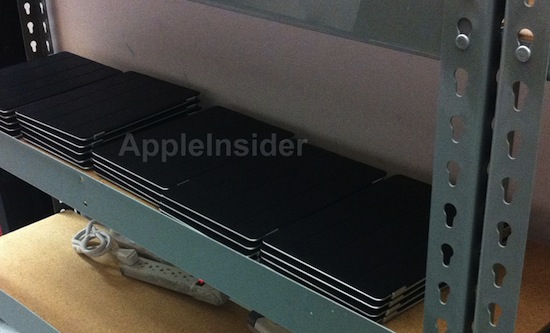
Amidst all the speculation surrounding Apple’s all-hands meetings for retail employees and store leaders set for Sunday, May 22, AppleInsider reports this weekend’s retail plans might not be about a new product launch, 10th anniversary celebration or NFC payments, as the rumors suggested, but rather a series of trainings for employees using iPads running the new custom RetailMe software. According to AppleInsider, retail stores have been receiving stockpiles of iPad 2 featuring black leather Smart Covers, with these iPads being meant for on-the-job use by retail specialists.

People familiar with Apple’s retail operations revealed that stores across the U.S. have been stocked with dozens of iPads that are being prepared for use by employees. Training and utilization of the hardware could begin as soon as this weekend.

It’s not clear whether the iPads are destined to replace Apple’s current in-store payment system based on EasyPay and the iPod touch, but it’s likely that they will be used alongside the portable POS system to better showcase products and features to customers. Apple deployed the iPad 1 in its retail operations last year to allow employees to manage and schedule appointments for people waiting at the Genius Bar (I saw one myself at Rome Apple Store); the new iPad 2 shipments, though, might be linked to the internal release of an updated RetailMe software.

The delivery of iPads to stores around the country comes as Apple is apparently prepared to release an iPad version of its proprietary in-house communications client known as RetailMe. The RetailMe service offers information about products and training videos for retail employees.

One person privy to the workings of Apple’s brick-and-mortar stores suggested that the RetailMe software for iPad could turn out to be the be the password protected gigabytes of corporate training data that employees were recently issued. Still, as usual, employees have been kept in the dark, leaving them to put pieces together and draw conclusions based on the available evidence.

Indeed, BGR reported a few days ago employees were asked to download from Apple’s corporate servers a folder called “training” containing GBs worth of information and material. AppleInsider also reported last night this weekend’s meeting could be used to launch the 2011 Back to School program.


Apple Temporarily Freezing In-App Purchase Approvals?

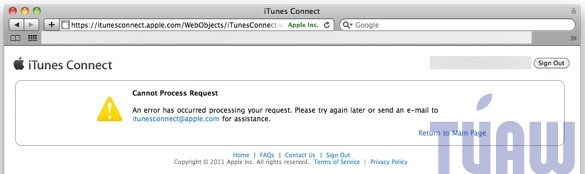
TUAW reports a number of iOS developers have been unable for over a week now to get their in-app purchase content approved by Apple, as the company requires in the iTunes Connect developer portal to test IAP with a test user account, but this account has been offline with no explanation from Apple.

As a matter of policy, Apple requires developers to test in-app purchases (IAP) with a test user account before the application in question can be approved. Unfortunately, this test account has been offline for a week now with no word as to why. If you are a developer, you can see the relevant thread on Apple’s own developer forums here.

Whilst the impossibility to test in-app purchases and thus get the additional content approved may simply be a technical error on Apple’s side, it looks rather curious considering the recent debate surrounding Lodsys and its patent infringement claims against independent iOS developers. As TUAW notes, this can be a simple coincidence that has nothing to do with Lodsys, but The Guardian reported yesterday Apple was “actively investigating” the claims that hit iOS devs, so there’s a chance Apple might have suspended IAP approvals before a decision is made.

If you’re a developer and have encountered a similar error, let us know in the comments. More information is available on the Dev Forums.

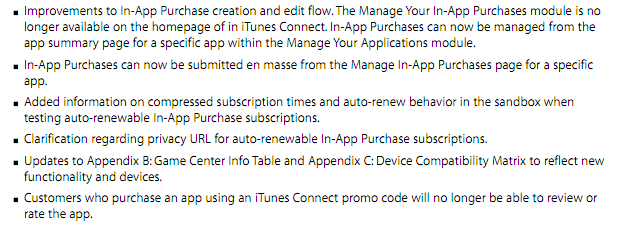
Update: the iTunes Connect Developer Guide was updated on 5/11 including some changes to in-app purchases, but we can’t confirm whether these changes are related to the inability of testing in-app purchases with a test user account. The ITC Developer Guide can be found here.

Improvements to In-App Purchase creation and edit flow. The Manage Your In-App Purchases module is no longer available on the homepage of in iTunes Connect. In-App Purchases can now be managed from the app summary page for a specific app within the Manage Your Applications module.

[Thanks, Jason]

Update #2: TUAW reports the issue seems to be resolved.


Parallels Transporter Makes PC to Mac Migration Dead Simple

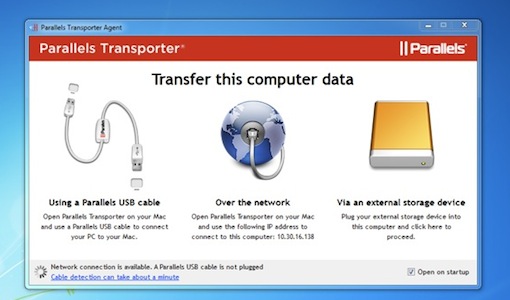
Parallels, probably best known for its popular virtualization software, has today released a new product that lets you make migration from Windows to OS X dead simple. The product, Parallels Transporter is being offered at a special introductory price of $0.99 on the Mac App Store (it’s regular price will be a rather expensive $39.99) and allows users to automatically transfer music, pictures, documents and more from a Windows computer to a Mac.

Using an external hard drive, wireless network or a Parallels USB transfer cable, Transporter will automatically transfer the data to the appropriate locations the Mac. Whether it is documents in the home directory or bookmarks for browsers, Transporter will do all the work in correctly transferring the users files.

We created Parallels Transporter to be the simplest, most efficient way to transfer everything you need from your old PC to your Mac in just a few easy steps. Now you can move to a Mac without the time-consuming chore of manually moving files and without the expense of hiring somebody to do it for you.

Transporter will even transfer over Windows applications and other files into a virtual machine on the Mac so that if you end up using Parallels Desktop, everything will be set up and ready to go for you – although note that this does require the purchase of Parallels Desktop which isn’t included in Transporter.