This Week's Sponsor:

Turbulence Forecast

Know before you go. Get detailed turbulence forecasts for your exact route, now available 5 days in advance.


Posts tagged with "apple"

Apple’s Guy L. “Bud” Tribble Explains Location Tracking at Senate Hearing

At a U.S. Senate hearing this morning entitled “Protecting Mobile Privacy: Your Smartphones, Tablets, Cell Phones and Your Privacy”, Apple’s Vice President of Software Technology Guy L. “Bud” Tribble offered his remarks about Apple’s privacy policy, location tracking system implemented in iOS devices and App Store app control, reiterating many of the points already explained by Apple two weeks ago in the Q&A on Location Data.

As summarized by AppleInsider, Tribble testified before Senate members that Apple doesn’t collect personal information about its users nor does the company share any information with advertisers – rather, the cache file that was discovered by security researchers (which was incorrectly large in size and backed up to a computer during the sync process) is meant to store information about nearby cell towers and WiFi hotspots to enable iPhones and iPads 3G to quickly get signal without having to rely on real-time GPS data all the time. This is a crowd-sourced database that Apple keeps in a small amount on every device as an offline cache – personal data and device identifiers are never sent to Apple, Tribble explained.

Sen. Al Franken also asked both Apple and Google representatives at the hearing whether the two companies could add a fixed privacy policy to their app marketplaces to ensure users always know how their personal data is being treated, and what’s going on behind the scenes of an app. Tribble replied a privacy policy in App Store apps wouldn’t be enough as users are likely to skip that every single time – and that’s why Apple believed that adding actual graphical elements to the user interface would be a better, and more elegant solution to inform users about the usage of Location Services. In iOS, an icon in the status bar indicates when an app is sharing your location; every app must ask a user to share his location through a dialog box; in the Settings, users can revoke location access on app-by-app basis and manage other location preferences as well.

Tribble also went on to explain Apple does random audits on App Store apps and follows the tech press and iOS community to find out which apps are violating the privacy rules:

The Apple executive also detailed how his company conducts random audits on applications to make sure they’re playing by the rules. He admitted that Apple does not audit every single one of its 350,000 iPhone applications, just like it would be impossible for the federal government to audit every single taxpayer. Apple also keeps an eye on blogs and its “active community” of application users for potential violations. If a violation is discovered and the issue cannot be resolved, applications will be removed within 24 hours and the developer will be notified.

In most cases, Tribble said, developers quickly correct the issue, as they want to keep their application available in the App Store.

Tribble was joined today by Google’s Alan Davidson. A video of Senator Franken’s opening statement is embedded after the break. Read more


Adobe Finally Releases Its Photoshop Touch SDK iPad Apps

It was supposed to happen last week, but today Adobe finally released its three iPad apps that use the Photoshop Touch SDK. The three apps, including Adobe Eazel, Adobe Nav, Adobe Color Lava, were built be Adobe to demonstrate the potential of the Photoshop SDK for creating powerful companion apps for mobile devices from the iPad and iPhone to Android and BlackBerry. See below for brief descriptions of each of the three apps and if you want more information be sure to check out our original coverage of the apps and the Photoshop Touch SDK. Screenshots are included after the break.

Adobe Color Lava ($2.99) is a simple utility that allows you to mix colors, organize and save palettes and color groups to send to Photoshop wirelessly. Upon sending a palette to Photoshop, you’ll be able to see details on the colors you mixed, and send via email to someone else if you don’t want to share colors with your local Photoshop installation. The colors will appear in the Swatches panel of desktop Photoshop.

Adobe Eazel ($4.99) is perhaps the most innovative app of the initial rollout, as it features some interesting multitouch controls and menu choices I haven’t seen in any other iPad app before. Eazel is a drawing app, but instead of placing controls for brush sizes, colors, or opacity in dedicated toolbars, Adobe decided to develop a “five-finger touch UI” that takes a bit of learning, but it’s actually pretty clever once you get used to it. Basically, controls are placed above each finger, through a series of overlays that you can interact with using your fingertips after selecting an item. Sounds more complex than it really is, at least after some practice. When you’re done painting, you can send your creation to Photoshop and keep editing or refining there.

Last, Adobe Nav ($1.99) is the app we believe will be most successful among Photoshop users, as it drives the application’s UI remotely and allows you to see open documents on the iPad’s screen. Most of Photoshop’s tools and palettes are displayed on the iPad’s screen as bigger buttons meant for touch interactions, enabling you to select and modify the controls that you see on the desktop. There’s no doubt Nav will be tested by many as a complete replacement for Photoshop’s on-screen controls, which may get a little obtrusive on smaller portable computers. Alternatively, you can also browse open documents in Nav and instantly change the file you’re working with in Photoshop for Mac or Windows.

Adobe’s new iPad apps are available for download on the company’s App Store developer page. Check out the official promo videos and screenshots after the break.
Read more


Mobile Devices Claim Largest Share Of Digital Game Downloads

Digital game downloads have been on the rise in recent years and according to the latest NPD report, a large portion of that increase can be attributed to mobile devices which count for nearly half of all video game downloads. The report, which focused solely on full game downloads (not micro-transactions, add-ons or previously purchased games), notes that even those who owned a console would generally download more games to their mobile devices.

Following mobile devices were personal computers as the second most common platform for downloading games, no doubt driven primarily by Steam, then consoles and finally portable gaming devices (Nintendo DS, Sony PSP). Obviously it should be pointed out that, typically, a full game download for a mobile device is priced far lower than a game for consoles and even computers. Nonetheless, Anita Frazier notes in the report “Mobile gaming represents one of the fastest growing segments of the digital games market, and potential for future growth remains strong.”

Interestingly, of those that have purchased a mobile game in the past three months, a surprising 60% said they still spend the same amount on console or portable gaming device games. The report also revealed that if a game was available in physical and digital form at the same time, at the same price, 75% would buy a physical copy because they liked to own a “real” copy – the remaining 25% mainly cited convenience as their reason.

[Via TUAW]


Queen Of England Demands An iPad

The Queen of England has apparently ordered her staff to buy her an iPad after the newly married Prince Will and his brother Prince Harry showed off theirs to her on a recent gathering at Buckingham Palace.

The Princes, the Queen’s grandsons, gave her a demo of how the iPad worked which, as a royal insider told The Sun, led her to be impressed and “particularly taken with how easy it was to use, the large screen and how light it was” The insider also notes that the Queen is fairly “switched on” for an 85 year old woman, saying “It was only a matter of time before she asked someone to go and get her one.”

“The Queen has a mobile phone as well as the iPods, so an iPad is the logical progression. She thinks it will be great to keep her entertained on all the long trips she has to make.”

The same royal insider says that the Princes think her reaction is hilarious, but also “love the fact that their gran wants an iPad and think she’s really cool”. The iPad won’t be the first Apple product that the Queen owns either, she previously bought a £169 silver iPod in 2005 and was given a new iPod by Barack Obama in 2009, which was loaded up with happy snaps from the Queen’s US visit in 2008.

[Via The Sun]


Flipboard Triples Usage and Doubles Users In Two Months

Flipboard, an iPad app that aggregates content from your social networks, has in the last two months seen close to a tripling in daily usage. An average day will now bring between 8 and 9 million “flips” compared to what was 3 to 4 million flips just two months ago – flips roughly equating to page views for a website.

The CEO, Mike McCue, revealed the information in a chat last week and pointed to a number of factors that he believes contributed to the increase in popularity. Foremost in his mind is the release of version 1.2 of Flipboard on March 10th which greatly improved speed and brought other general improvements to the app. Then, of course, was the release of the iPad 2 which not only brought more users but has also made Flipboard even faster with its improved A5 processor.

McCue did also mention that the number of users has doubled – likely for the same reasons, although he declined to comment on how many users they now have in total. Meanwhile, Flipboard is continuing their work on a Flipboard iPhone app which is slated for release sometime this summer. Quizzed on how the iPhone app might work by AllThingsD, McCue said that it is being designed as more of a “weekday tool” catered towards power users that will more directly utilise real-time news and conversations.

[Via AllThingsD]


The Pix And Stix Project Will Let You Rock Out On GarageBand “For Real”

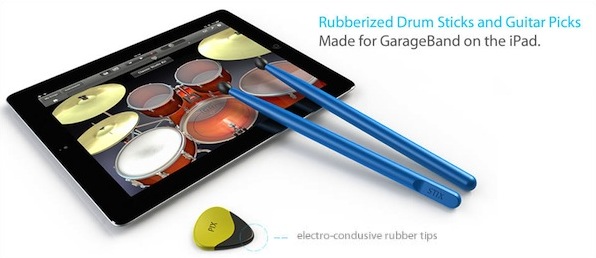
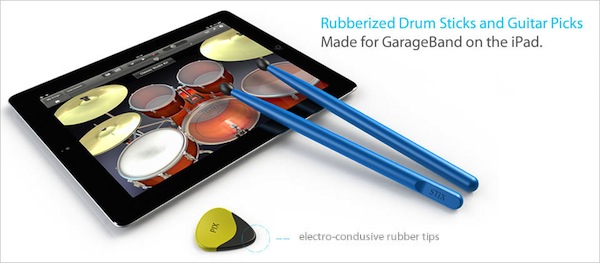
GarageBand is an app that everyone who owns an iPad should at least try out, regardless of your musical talent, it’s just a superb example of an app that is brilliantly designed and built for a touch screen. Yet for those that do end up using it for more than just the occasional mess around, you may find that although the iPad’s touchscreen is better than a mouse for playing the drums or guitar, it is still a little bit lacking for what you want.

Well luckily for those of you who do find that, some clever folks have decided to start manufacturing rubberized drumsticks and guitar picks for GarageBand on the iPad. They’ve been designed to work on the iPad’s touchscreen by implementing electro-conductive rubber tips, which will also mean it should be perfectly fine to use without smashing the iPad’s nice glass screen!

The designers of the Pix and Stix are running a Kickstarter-esque funding round, where they are selling a pair of drumsticks and a pick for $14.95 in order to reach a funding goal of around $8000. Just like Kickstarter, if they don’t get the required funding, you can also rest assured you won’t end up paying for them.  At this stage they think they will be selling the drumsticks and picks in the three colors of black, blue or gold metallic paint, although they note that these colors are subject to change.

If you recall the Wallee, which we discussed as one way to elevate your iPad last year, the Pix & Stix project is coming from those same people. So if you’re interested in helping these guys fund their newest project and get your own Pix and Stix, head over to the Pix and Stix website.

[Via Gizmodo]


Apple Overtakes Google And Becomes World’s Most Valuable Brand

A new survey on the value of brands has placed Apple as the world’s most valuable brand, ending Google’s four-year reign at the top of the list. The ‘Brandz’ survey, done by global brands agency Millward Brown, found that the Apple brand is worth an estimated $153 billion, which was an 84% increase from last years survey.

Global brands director of Millward Brown, Peter Walshe, said that Apple’s pointed to a number of factors that has led to Apple’s rapid rise in brand valuation. He said that their meticulous attention detail and presence in corporate environment were two of the reasons that they have behaved differently to other consumer electronics manufacturers and went on to say:

Apple is breaking the rules in terms of its pricing model. It’s doing what luxury brands do, where the higher price the brand is, the more it seems to underpin and reinforce the desire. Obviously, it has to be allied to great products and a great experience, and Apple has nurtured that.

Technology and telecommunications companies generally dominated the list, with Apple (1), Google (2), IBM (3), Microsoft (5), AT&T (7) and China Mobile (9) holding six of the top 10 spots, sharing it with the old-heavyweight brands of Coca-Cola (6) and McDonalds (4). Meanwhile Facebook entered the top 100 at number 35 this year, with a valuation of $19.1 billion.

The survey is done by Millward Brown essentially observing the value that the companies put on their own brands in their earnings reports and analysing it in conjunction with the results of a survey of more than 2 million consumers.

[Via Reuters]


Apple Moves From #59 to #4 In Barron’s 500

In its annual Top 500 list of American companies that have generated “the most revenue growth and cash returns”, Barron’s outlines how Apple has jumped from the 59th position to #4 thanks to strong sales of iPhones, iPads and iPods, as well as revenue coming from the classic line of desktop and portable Macs. And whilst the Barron’s 500 list “honors companies for past success”, but doesn’t guarantee profitable success, high demand for the recently released iPad 2 (defined “staggering” by Apple COO Tim Cook at the company’s Q2 2011 earnings call) and the updated MacBook Air line (rumored to go under a refresh in a few weeks to feature Thunderbolt and Sandy Bridge processors) seems to suggest that Apple’s 2011 is off to go a very profitable start.

Apple, ranked No. 4 this year, has done all that to perfection. It has generated stellar sales growth and handsome profits from the iPod, iPhone and related products, and its shares have rallied 321%, to 347, since the stock market bottomed in March 2009. Yet the stock, which trades for only 12.2 times next year’s expected earnings, still isn’t richly valued. Other tech stocks, including Western Digital, Research In Motion, Broadcom and EMC, also rank among this year’s top 20.

Last week, Apple ranked 35th in Fortune 500 list of top American companies, surpassing both Microsoft and Boeing, ranked at 38th and 36th, respectively. Ranking #1 in Barron’s 500 is Oshkosh, a truck maker, with packaged food maker J.M. Smucker hitting the #2 spot.


“Inside Apple” Reveals Steve Jobs Anecdotes, Apple’s Little Known Facts

In Adam Lashinsky’s latest feature story on Fortune magazine’s new issue – available now on the iPad at $4.99 as single in-app purchase, and free for Fortune subscribers – the author reveals several unknown anecdotes about the company, internal management, and Steve Jobs. The story is full of interesting details for Apple fans and journalists, as well as little known facts about the personality of the CEO, Steve Jobs.

Lashinsky, for example, tells the story of the 2008 launch of the iPhone 3G and MobileMe, which didn’t go exactly well for Apple. MobileMe – a rebranded version of iTools and the .Mac service – promised to offer continuous web access to mail and calendars, as well as sync options for iPhones and iPod touches. The initial rollout, however, was affected by slow loading times and servers constantly down, which lead to speculation as to whether MobileMe was really ready for public release, with many questioning the premium fee Apple was asking for one-year usage of the service. In Fortune’s story, Lashinsky says Steve Jobs summoned the entire MobileMe team for a meeting at the company’s on-campus Town Hall, accusing everyone of “tarnishing Apple’s reputation.” He told the members of the team they “should hate each other for having let each other down”, and went on to name new executives on the spot to run the MobileMe team. A few excerpts from the article:

Can anyone tell me what MobileMe is supposed to do?” Having received a satisfactory answer, he continues, “So why the f*** doesn’t it do that?

Jobs was also particularly angry about the Wall Street Journal’s Walt Mossberg not liking MobileMe:

Mossberg, our friend, is no longer writing good things about us.

MobileMe went under major design changes in the past years, reliability improved and the service is now rumored to go under a complete facelift by the launch of iOS 5 with a new name, iCloud. Read more