Posts tagged with "apple"

Apple Responds To Location Log Scrutiny With Extensive Q&A Response

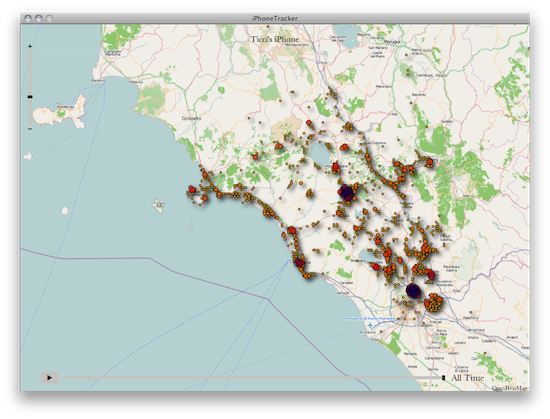
Apple has today responded to the intense media scrutiny over the iPhone and 3G iPad location log that researchers claimed logged extensive data, by posting a lengthy Q&A response. Jump the break for the full Q&A.

In its response Apple categorically states that “Apple is not tracking the location of your iPhone” and differentiates that the location log exists as a database to of Wi-Fi hotspots and cell towers around your current location so that when requested, current location data can be given quickly without waiting on the GPS which can take “up to several minutes” to calculate. By leveraging on Wi-Fi hotspots the iPhone can triangulate its location “within seconds”, these calculations are done with a crowd-sourced database of Wi-Fi hotspots and cell tower data that is “generated by tens of millions of iPhones sending geo-tagged locations of nearby Wi-Fi hotspots and cell towers in an anonymous and encrypted form to Apple.”

A portion of the crowd-sourced data (relevant to your location) is downloaded to the iPhone, and is left unencrypted - this is what the researchers discovered. “The location data that researchers are seeing on the iPhone is not the past or present location of the iPhone, but rather the locations of Wi-Fi hotspots and cell towers surrounding the iPhone’s location, which can be more than one hundred miles away from the iPhone”.

However Apple notes there are several issues that they plan to address in a coming software update in the coming weeks. These include ceasing the practice of syncing that location cache to a computer, reduce the size of the crowd-sourced Wi-Fi hotspot and cell tower data stored on the iPhone and delete the cache when Location services is turned off. The cache will also be encrypted on the iPhone in the software update.

Apple also addresses related privacy concerns, noting that “Apple will continue to be one of the leaders in strengthening personal information security and privacy.”. In particular it states that it does build a crowd-sourced traffic database but this is anonymised, as is everything else sent to Apple and as such can not be used to identify individual users. Furthermore third parties gain access to crash logs (which are anonymised) and the iAds system can use location to target specific ads, but this information is not sent to advertisers.

Jump the break for the full Q&A.
Read more


Zite Receives Update, CEO Discusses What’s Next

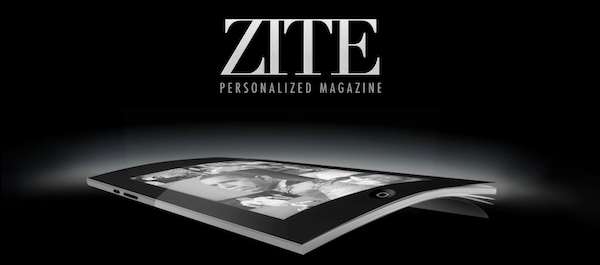
Zite, one of those ‘personal iPad magazines’ like Flipboard or the newer News.me, received an update yesterday that adds an in-app browser, better clipboard support and some much appreciated performance improvements.

TUAW spoke to the new Zite CEO, Mark Johnson, who used to work at Microsoft. He said that they were pleased with the success of the app, with positive reviews and over 100,000 downloads since launching. Customization, he says, is an oft-cited request by users and he said they are working towards adding more options and flexibility to the news sections. Interestingly, the Zite team is also working on a web version, improving the offline reading abilities and reducing the incidence of duplicate articles in the news stream.

In its initial launch, Zite received some cease and desists from various publishers around the web because of Zite’s ad removal. They have since accommodated the publishers concerns by adding a direct link and Johnson has said that this has quelled publisher’s concerns. You can download Zite from the iPad App Store for free.

[Via TUAW]


Pioneer AppRadio To Bring Apps And Deep iOS Integration To The Car

A new Pioneer car audio system is set to feature its own app system that also ties in with iOS devices and put it all on a very stylish iPad-eque front panel. The official FCC filing and a leak to CrunchGear reveals the Pioneer AppRadio, with a 6.1” display and an iOS-style home button in the center, will be loaded with specialised apps from Pandora Radio and iHeartRadio to GPS mapping software and traditional AM/FM radio.

In what is surely a sign of the times, Pioneer will not be including any optical drive in the device, opting instead for USB, RCA and S-Video inputs. CrunchGear contends in its report that the audio system will likely talk to iPhones and iPods through the USB interface for music as well as contacts and even some apps. The device also doesn’t have any internet access on its own and will likely rely on smartphones such as an iPhone to provide mobile connectivity for some of the internet apps such as Pandora.

To avoid problems surrounding distracted driving, the Pioneer AppRadio will also come with a steering wheel-mounted remote control as an option. Based on the FCC filing and the rumor, the AppRadio is believed to be “about ready” but no specific release date or pricing is yet known.

[Via Electronista]


Rumor: Apple’s Cloud Music Service Won’t Be Free

A new report by Cnet today claims Apple will charge users a fee for its rumored cloud-based music service, although no exact details on pricing have been provided. Citing “music industry insiders”, Cnet says Apple could offer the service free of charge initially as a promotion, but eventually they’ll have to charge users to keep the service running and pay music labels. It’s unclear whether the new cloud service will offer different kinds of monthly and annual subscriptions, although Cnet points to an old report that suggested Apple could go for a $20/year fee.

Don’t expect Apple’s cloud-music service to come free of charge, at least not forever.

Apple plans to eventually charge for its cloud music service, sources told CNET. Users would be able to store their digital media on the company’s servers.

Music industry insiders told me that Apple has indicated it could offer the service free of charge initially but that company will eventually require a fee. Google is also expected to charge for a similar service.

Several reports in the past weeks indicated Apple was working on a complete MobileMe revamp featuring new cloud-based music functionalities, social and location features, as well as a new price point to make basic parts of the service (such as syncing options) free for all iOS and Mac users. Last week, it was reported work on Apple’s new music service had been finalized, with the company seeking to close deals with music labels to push ahead the release of its new iTunes-in-the-cloud offering. Cnet also claimed Apple had signed a deal with the Warner Music Group, whilst Peter Kafka at MediaMemo said Apple had already closed deals with at least two of the four major music labels, with Apple’s Eddy Cue visiting New York City to ink the remaining deals.


No Revenue? No Problem. Apple Could Survive On Cash Reserves ‘Til 2018

No Revenue? No Problem. Apple Could Survive On Cash Reserves ‘Til 2018

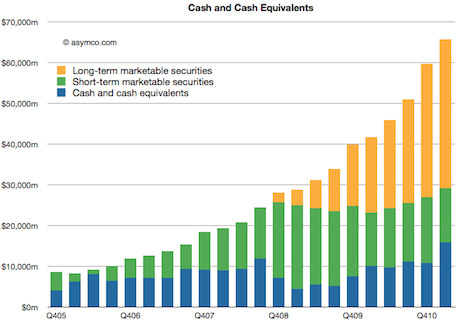
At the Q2 2011 earnings call, Apple announced its cash stockpile had increased by $6.1 billion, totaling $65.8 billion by the end of the March quarter. Asymco’s Horace Dediu decided to take a look at these numbers to put things in perspective, and came out with some interesting facts about Apple’s current cash. For instance, if Apple’s revenue stopped completely, its cash would keep operations going for at least 7 years until mid-2018 – that is, if Apple suddenly stopped generating any kind of revenue. If you consider, though, that Apple will keep selling millions of products in the next months, and that the cash pile will continue growing bigger, you get an idea of how cash allows the company to invest in pre-payment deals, or research & development for new breakthrough devices like the iPad. Other tidbits from Asymco’s research:

The funds are big enough to place Apple’s CFO office in the top 100 largest fund managers in the world and larger than any hedge fund manager.

Current cash is worth more than Nokia, RIM and Motorola Mobility’s market caps, put together.

Apple’s cash is worth half of Google’s enterprise value.

With the release of the white iPhone 4, more iPad 2 shipments and rumored iMac and MacBook Air updates on their way, we wonder what the chart above will look like after Apple’s Q3 2011 results. [via GigaOM]

Permalink

iPhone 6 To Use Next-Gen Thinner Displays from Sharp?

Japanese newspaper Nikkan is today reporting that Apple may have made a display component deal with Sharp for the display of the sixth-generation iPhone. It is based on reports that Sharp has begun preparation for the start of manufacturing in Spring next year at its Kameyama plant in Japan for an iPhone display using next-generation technologies.

Sharp will reportedly be producing “low temperature poly-silicon technology” displays, a next generation technology that will allow displays to be thinner and lighter whilst consuming less power than a current LCD display. The key component of these new displays is the polycrystalline silicon, which enables display drivers to be mounted directly onto the glass and thus have a thinner display. Other advantages of the technology include displaying a more vivid image and enhanced durability because of a reduced number of connecting pins.

Previous rumors had circulated that Apple had sided with Toshiba for future display manufacturing – but a Sharp representative disputed this at the time. In a similar vein, Tim Cook commented in January at the Q1 earnings call that Apple had entered a $3.9 billion component supply deal. He didn’t specify what component it was for, but it was speculated that it was for high-resolution displays and that the deal was between Toshiba, Sharp and a third manufacturer. Sharp was also at the center of another display rumor back in January in which they were supposedly preparing to manufacture glasses-free 3D displays for the iPod Touch.

[Nikkan [Google Translate] via AppleInsider]


Android Strides Ahead In US Smartphone Market Share

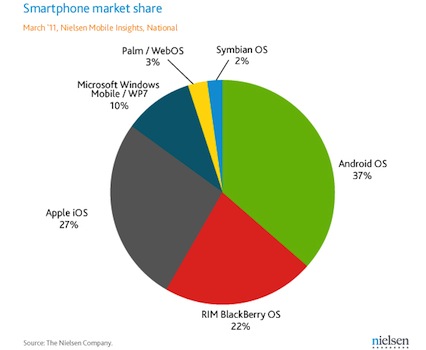
A new market survey by Nielson in the United States has shown Android drive ahead and gain 37% of the smartphone market share, a strong 10% margin over Apple and the iPhone which sits in second place at 27%. The figures show a significant change since the last Nielson survey, done in October that had the iPhone with the largest smartphone market share at 27.9% and BlackBerry in second place at 27.4%. Android has largely absorbed the 5.4% market share BlackBerry lost as well as the decreasing share of Symbian and older Windows Mobile devices to go from 22.7% in October to its 37% market share in March.

The survey also revealed that Android is now the most desired smartphone operating system for consumers, with 31.1% of consumers surveyed saying they would choose an Android phone compared with 30% who would go with an iPhone. In both the market share and desired operating system, Android is showing significant increases whilst Apple is seeing minor reductions compared to others such as BlackBerry or Symbian.

A final aspect of the survey was what recent smartphone acquisitions were and it reveals that 50% of all new smartphones purchased were running Android, whilst 25% were iPhones and 15% were BlackBerry phones. It is worth noting that this survey was solely focused on smartphones and as such did not include reference to the other iOS devices such as the iPod Touch or iPad. Jump the break for two more graphs.

[Via AllThingsD]

Read more


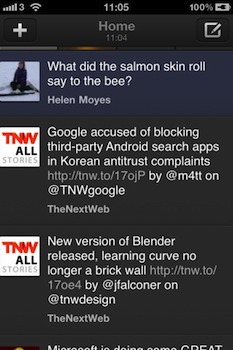
The “Re-Imagined” TweetDeck 2.0 iPhone App Hits The App Store

TweetDeck has today released its completely new 2.0 iPhone app that has received a “Hollywood re-imagining”, being rebuilt from the ground up to be “fast, flexibe and full-on powerful.” The update, which has been a long time coming, adds a number of new features and improvements whilst retaining the “guiding principles” of the original.

One of TweetDeck’s new and innovative features is the use of pinching on a column to access the columns’ settings so that any combinations of Twitter timelines, mentions, DMs, Facebook feeds and so on can be merged into one customized column. The whole user interface has also been redesigned, following the direction that their Android and Chrome apps have gone in, and of course it now takes advantage of the Retina display.

Also improved is multiple account handling and gestures, which although not extensive as those present in Tweetbot, are greatly improved adding the ‘pull to refresh’ and pinch for column settings gestures and general improvements in swiping through your various feeds. Finally there is built-in Deck.ly support, letting you write those longer messages on Twitter without hassle.

The 2.0 version comes after “several months of feverish work” and a promised iPad revamp of the app is also coming in a Universal binary “in the next couple of weeks”. In fact technically TweetDeck 2.0 is not an update and the old versions of the app have been temporarily removed from the App Store to avoid confusion. So don’t go to the updates tab of the App Store, it won’t appear there, you’ll have to download the new TweetDeck app from the actual store.

Jump the break for some more screenshots of the new update.

[Via TechCrunch]

Read more


Evernote’s Most Valuable Users Are On Apple Platforms

There has been some discussion in recent times about whether iOS users are more valuable to a company than Android users may be. Evernote CEO Phil Libin weighed into the debate yesterday and talked about how their revenue varied from platform to platform. Libin used three metrics in evaluating each platform; revenue, users gained and revenue per developer. In all three, iOS was the leading platform with nearly a third of all Evernote’s revenue coming from that platform. It’s where Evernote has gained a large chunk of its users and is perhaps one of the best success stories of the iOS app platform.

Evernote is also a big fan of its Mac users who generate more revenue growth than their Windows counterparts and also stick with the service for longer – although Windows still currently brings in 24% of revenue compared to the Mac’s 20%. Libin is unsure of why Apple users are more willing to pay for their service and additionally notes that the desktop should not be ignored, reflecting upon the fact it still brings in 44% of Evernote’s revenue.

In Libin’s speech at VentureBeat’s Mobile Summit he also noted that most users of his service don’t return after a short period of using the service, but those that do bring in a lot of revenue to Evernote. For example of the 31,334 users who registered in March 2008 only 11,000 remained three months later. In that month those users only brought in $700 to Evernote but by January of 2011 they ended up bringing in over $10,000. Libin attributes this to the fact that as users stick with the service they find it more valuable and end up subscribing for the premium features.

[Via VentureBeat]