This Week's Sponsor:

LookAway

It helps you take regular breaks from your Mac to rest your eyes, without breaking your flow.


Posts tagged with "developers"

Dissecting The iOS 6 App Store→

Dissecting The iOS 6 App Store

Justine Pratt has published (via TUAW) a very thorough overview of the new App Store in iOS 6.

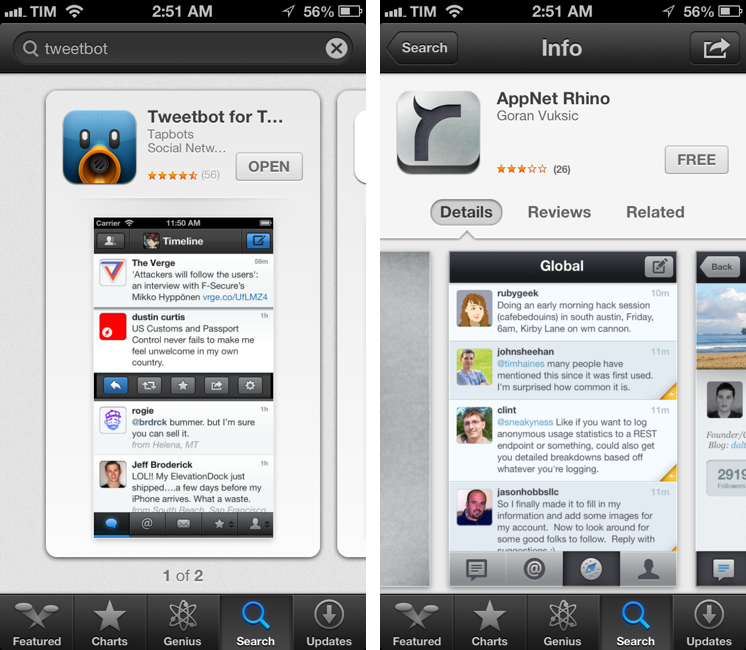
The new AppStore, especially the cards, was really designed for the iPad and the faster processor of the iPhone5. Finally the stores on both devices are common, which should help increase the familiarity when browsing both stores. On older devices, the icons and graphics are slow to load and the cards are slow to scroll on the iPhone. This situation is only temporary, as new devices are released and adopted.

In my iOS 6 review, I took an extensive look at the App Store, its new features, and its most apparent shortcomings; Justine does a much better job at carefully analyzing every single section and change in App Store layout and category organization. I also learned a few tidbits from her overview, such as the new positioning of the “App Support” button next to reviews.

Interestingly, we both came to the conclusion that the new App Store seems to really be optimized for the iPad in terms of layout. In the past few weeks, following the release of iOS 6, I’ve heard quite a few people saying that the opposite was true – that the cards layout was meant for the iPhone first, and eventually brought to the iPad with a larger UI design.

Overall, the App Store still has several visible and deeply annoying bugs that hinder the performance of search, Genius, and Purchased History. Apple still hasn’t fixed many of these, and the improved speed of the iPhone 5 only partially contributes to making the browsing experience slightly better.

As I wrote in my review, there are still some noteworthy additions and changes for developers in the new App Store, so make sure to check out Justine’s article for a detailed analysis.

Permalink

iOS 6 and Developers→

iOS 6 and Developers

Over at TidBITS, Matt Neuburg has posted a clear and concise overview of what iOS 6 means for third-party developers. Among the mentioned technical changes, he talks about UICollectionView:

The major new widget that will have the biggest impact on app interfaces is the collection view. A collection view is like a table view on steroids. A table view is the scrolling column of cells commonly seen in any master–detail app where a list must be displayed; Settings, Mail, and Music are familiar examples. A collection view breaks the bonds of the single vertically scrolling column, so you can expect, in short order, to see horizontally scrollable rows of data, multicolumn tables, and grids of information.

While web-based, some of the conventions of the new App Store in iOS 6 (horizontal-scrolling lists, grids) could be replicated with UICollectionView. I’d argue that many of the changes brought to the App Store are actually making some parts of search and discovery worse, but that’s not the point.

What matters is that, with each new version of iOS, developers are given more powerful tools to build new apps and refine existing ones. As I wrote in my piece about iOS 6, Apple understands “the importance of a healthy developer ecosystem that sets iOS apart from the competition”.

To get a good overview of the changes for developers in iOS 6, I recommend reading Matt’s article.

Permalink

Droplr, Mac App Store, and Sandboxing→

Droplr, Mac App Store, and Sandboxing

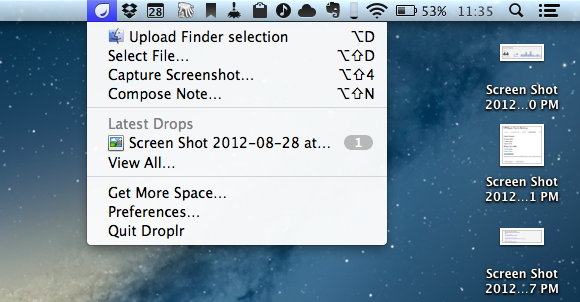
The developers of Droplr, a sharing utility for OS X, have announced that in order to release version 3.0 of their app on the Mac App Store, they will have to tweak the app’s “upload from Finder” functionality to comply with Apple’s rules.

The primary difference will be in the use of the global hotkey (opt+d by default) to share the currently selected item(s) in the Finder. The standalone version will continue to work as it always has, simply select something in the Finder, use the key combination, and that item will be uploaded to Droplr. For the Mac App Store version, when the key combination is triggered with the Finder active, instead of uploading the currently selected items, it will present you with an “open file” dialog where you’ll need to navigate to the item(s) you’d like to share and select them. We don’t believe this provides the best experience, but we do believe it’s an acceptable tradeoff to be able to remain in the Mac App Store, especially given many of our users don’t use the key combination as a primary method of sharing with Droplr.

This update from the Droplr team is particularly interesting as, back in May, speculation arose as to whether Apple would start rejecting any app with “global hotkey functionality” on June 1, when the company began enforcing its new Sandboxing policies for Mac App Store apps. As it turned out, the rumor didn’t specify which kind of apps would fall under Apple’s ban, but several third-party developers confirmed their applications carrying similar functionality went through Apple’s approval process.

However, it appears the “issue” with Droplr 3.0 and the Mac App Store is simply related to standard Sandboxing practices, not strictly hotkeys. It is safe to assume that, per Apple’s Sandboxing implementation, an app like Droplr can’t benefit from unrestricted access to the Finder to automatically upload a file in the background. Several developers I have contacted about this issue confirmed that it’s not a surprise Apple is requiring an Open dialog to access a file outside of the Sandbox, and that this would have been true even if Droplr wasn’t combining the feature with a global hotkey. So while a calendar app can show itself with a hotkey, or a todo app can display a systemwide quick-entry panel, Sandboxing requires an app that accesses files directly (like Droplr does) to go through an Open dialog.

Read Droplr’s blog post here, and our report from May on Mac App Store apps and global hotkey functionality here.

Permalink

Mac App Store: “Not Too Soon To Be Concerned”→

Mac App Store: “Not Too Soon To Be Concerned”

Following Marco Arment’s recent thoughts on the Mac App Store and the consequent debates on the future of Apple’s storefront, Macworld’s Lex Friedman talked to some third-party developers to have a better understanding of the issue.

On one hand, Arment says:

The iOS App Store’s restrictions work (“for the most part”), Arment says, “because the platform has grown around them. They mostly don’t get in the way. But on the Mac, the App Store policies are being retrofitted into a well-established environment that they’re fairly incompatible with.

I agree. As I’ve written before, the problem is that Apple let certain apps into the Mac App Store, and is now forcing developers to rethink their strategies. This has effects on those developers’ business, and the customers.

On the other hand, though, it’s important to keep in mind the advantages of the Mac App Store. James Thomson from TLA Systems says:

We’ve had PCalc in the Mac App Store since it opened, and we’ve seen noticeably higher sales from the App Store than through other channels. So, from a visibility and ease of purchase point of view, it would seem that [the Mac App Store is] a success.

Visibility and higher sales are often mentioned by developers as the reasons behind the need to stay on the App Store. But customers, too, like some aspects of the Mac App Store and, it turns out, Sandboxing. As written by Joe Macirowski:

When you think about it, the apps that don’t get along with sandboxing are doing things I now realize I don’t want my apps doing.

Ultimately, it comes down to trusting the developers you install apps from. Maybe Joe doesn’t like the fact that, theoretically, TextExpander could log every keystroke; personally, I trust the guys at Smile to be providers of a great tool for productivity, and not criminals.

As Neven Mrgan wrote, “it’s good for us Mac users that we don’t have to limit ourselves to apps from the Mac App Store”. However, it’s not good for developers that the Mac App Store can’t be trusted for the long term, and that’s not good for Apple either.

Clark is proposing an interesting solution for the future: subscriptions.

It’s becoming clear that the Mac App Store (MAS) is targeting casual software the way the iOS store (IAS) does. This means that, much like traditional pop music through the end of the 20th century, you’ll have a few hits that make most of the money. The problem is how to make money outside of that pop software market.

For my thoughts on Apple, the Mac App Store, and third-party software, read the “Mountain Lion and the Power User” section in my Mountain Lion Review.

It’s too early to tell how the issues mentioned above (sandboxing restrictions, Gatekeeper’s existence, Mac App Store vs. third-party sources) will play out in the long term. We shouldn’t ignore them either: some developers are currently struggling to keep their apps on the Mac App Store, and others are figuring out their own solutions to implement features that Apple demands remain exclusive to it. While the power user will always know how to work around Apple’s default settings, ignoring the complaints and doubts from the developer community would still be shortsighted. Instead, we should consider these issues, reflect on the questions developers pose, and hope that Apple is listening.

As usual, I prefer to wait and see what happens.

Permalink

AppBot Sends Developers A Daily Digest Containing New Reviews Of Their Apps

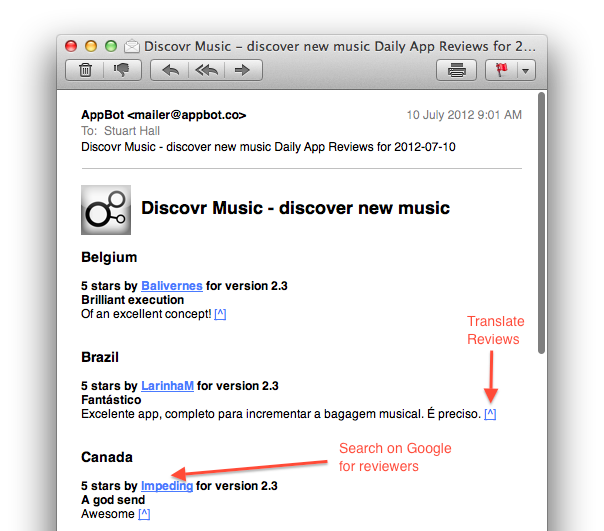
The Filter Squad development team (creators of Discovr) yesterday launched AppBot, a neat little service that’ll keep track of App Store reviews and email you a daily digest containing the latest reviews of your apps. AppBot was initially an internal tool for the two development teams but is now a free service in beta that’s bound to be helpful to some other developers who are keen to read new feedback from users but don’t want to have to take the effort of finding all the new reviews (in all the various countries).

In a blog post, Discovr’s Stuart Hall writes that despite some “not so amazing” reviews, they are a “good indication of the average user’s feeling towards your app”. By keeping a track of reviews, you can get a “good sentiment of how you are app is being perceived” - a key factor when word of mouth is such a driving factor of success on the App Store.

So the discovr team made AppBot to solve the problem of easily keeping track of new reviews of their apps from multiple countries. It neatly integrates a link to translate reviews from countries that don’t speak English and allows you to Google search the reviewer names. The app will also send you a list of Apple front page features (Editor’s Choice, New & Noteworthy etc.) to you weekly. You can sign up here and it doesn’t require access to your iTunes Connect account, so anyone can technically use AppBot to keep tabs on any new app.


Apple Cracking Down On Sites Selling Access To iOS Betas

Last month, Andy Baio wrote a story for Wired detailing the world of selling access to Apple beta software to non-developers. Specifically, Baio’s piece focused on sites that, for a price, allowed regular people to have their UDID (unique device identifier) activated for installation of iOS betas, which Apple makes available for developers only. To install an iOS beta, a developer has to register his/her account with Apple, which costs $99 per year and allows for the configuration of 100 devices in the so-called “Provisioning Portal” through the aforementioned UDID.

While becoming a registered developer costs $99, sites selling UDID activation did so for a low price, usually within the range of $10. Baio wrote:

For a small developer, unauthorized activations are a lucrative business that’s likely worth the risks. UDID Activation publishes their order queue on their official site, which shows more than 2,300 devices activated in the last week alone. At $8.99 for each activation, that’s more than $20,600 in revenue, with $2,277 paid to Apple for the 23 developer accounts. Their homepage claims that more than 19,000 devices were activated so far, and that’s only one of several services. And since device activations only last for a year, each service can reuse their expired slots with no additional cost.

After noticing several of the sites mentioned in Baio’s article had become unavailable in recent weeks (activatemyios.com, iosudidregistrations.com, activatemyudid.com, udidregistration.com, instantudidactivation.com), we reached out to some of them asking whether Apple was behind the takedown of their “services”, which infringed on Apple’s developer agreement. While most of our emails bounced, we heard back from one of the site owners (who asked to remain anonymous), who confirmed his hosting provider took down the site after a complaint for copyright infringement by Apple. Similarly, the CEO of Fused tweeted in a reply to Andy Baio that Apple had been “fairly heavy-handed” with DMCA requests to UDID-selling sites hosted on their network.

In the email, the site owner said that their website made $75,000 since last June, when Apple released the first beta of iOS 6 to developers. “We do not believe our service was infringing and our services did not violate their guidelines for iOS 6”, the site owner commented, adding that they will soon launch another similar site, “with better and more secure data lines to handle Apple”.

The owner of another site replied to our emails with a “no comment”. According to him, “the Wired article has caused all these sites to go down”.

Indeed, it appears Apple has started taking action against these sites recently, and more precisely after Wired ran the story on UDID activation. Last year, Apple reportedly closed developer accounts of people who sold their available UDID slots to other users; this year, it appears Apple has chosen the more direct path of shutting down websites and their services by filing DMCA requests to their hosting providers.

When Wired published its story, Apple added that “unauthorized distribution is prohibited, and may be subject to both civil and criminal liability”. It is unclear whether Apple terminated memberships to the Developer Program this year as well.

Surprisingly, one of the most popular sites selling access to iOS betas, udidactivation.com, is still online. However, their “UDID order queue” – a webpage displaying the amount of total sales – fails to load, and the same page on their “backup site”, udidactivation.us, displays the latest sales as being from June 28.

Apple seems to have taken action against sites selling access to OS X beta downloads, as well. A popular one, iMZDL.com, put a notice on their website saying “we will no longer be putting up downloads on iMZDL.com for Apple Betas”. Their website is still up, and rather than hosting the download links themselves, they have now switched to torrents for sharing links to iOS and OS X betas.

As we previously wrote, access to Apple beta software should be restricted to developers, as they know how to provide meaningful feedback and report bugs to Apple.

Apple Removes Negative Reviews From Apps Affected By DRM Bug [Updated]

Earlier this week, an error in Apple’s DRM code generation for App Store apps caused a number of app updates to crash on launch. The issue, initially reported by Instapaper developer Marco Arment, began spreading to more than 100 iOS and Mac app updates including GoodReader, Angry Birds HD Free, and The Early Edition. As the bug was causing updated apps to crash immediately after launch without even displaying an error message, several users became upset with the developers of the apps – as they didn’t know the issue was on Apple’s servers – and began leaving negative reviews on the App Store. Developers, on the other hand, had to deal with a issue that they couldn’t fix, while explaining to customers how they should back up their data and wait for a solution.

Last night, Apple officially acknowledged the issue and explained it was associated with DRM code generation on the App Store. Apple said they had fixed the issue, and Macworld reported that, according to their sources, Apple would also remove all negative reviews that had been left during the hours the bug was spreading on various international App Stores.

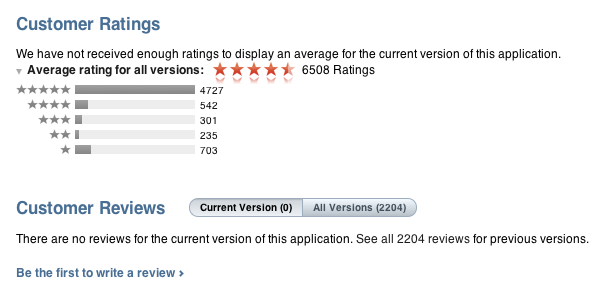
As of this morning, it appears Apple has indeed removed negative reviews from apps affected by the bug. Apps like Instapaper, GoodReader, and The Early Edition are showing no reviews for the latest versions available, which are the ones that were crashing earlier in the week. We haven’t checked on every single app that was affected, but it is safe to assume at this point Apple will remove all reviews (not just negative ones) from any app that received a corrupted update.

Apple hasn’t issued a public apology to developers, but the removal of reviews will definitely help in leaving this issue behind without having to deal with the aftereffects on the App Store as well.

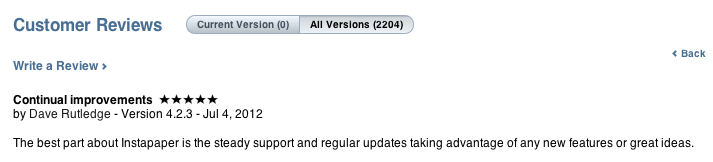
Update: As noted by several readers on Twitter, it appears Apple didn’t completely wipe the old reviews left during the DRM outage – it re-issued app updates for the same version of the app, and moved the “Current Version” reviews to “All Versions”.

In spite of the version being the same – for Instapaper, the affected version was 4.2.3 – the old reviews are not showing up in the Current Version section of the App Store. This helps hiding possible negative reviews from the section that it loaded by default in iTunes.

By re-issuing the old version as an update again, Apple is making sure customers can re-install the fixed version of an app without having to delete it first, as noted by Marco Arment. It is unclear whether the old reviews will still affect overall ranking of an app.


App Store Adding New “Food & Drink” Category

The App Store will soon be updated with a new “Food & Drink” category, according to developers of existing iOS applications who received an email from Apple today about the upcoming change. “In the next few weeks”, applications will be automatically migrated to the new category; currently, the App Store doesn’t provide a specific category for these types of apps, which have been typically listed under Lifestyle by their developers. According to Apple, the new category will include “apps that help users cook and bake, mix drinks, manage recipes, find new restaurants and bars, and learn what their friends like to eat and drink”. Food & Drink won’t include diet, grocery shopping, coupon clipping, or food-related game apps.

The new category is another change coming to the App Store, which Apple has been tweaking and revamping with new features lately. Ahead of a major redesign coming with iOS 6, Apple re-organized its selection of Editor’s Choice apps and App of the Week selections, providing a standalone category with weekly updates. Recently, Apple also started grouping previous game bundles into a macro category accessible from the App Store’s homepage.

The dedicated Food & Drink category comes after thousands of apps have been successful in using iOS devices as tools to manage recipes and find local restaurants. Notably, iOS 6 will also feature Yelp check-ins in the new Maps applications – a renewed focus on this area that will surely benefit from a new category on the App Store.

Currently, Apple only offers a custom Cooking section to showcase handpicked app selections for recipes, drinks, shopping, and reference material.

Update: the new category will appear “in the next few weeks” according to Apple.


The World Of Selling Access To iOS Betas→

The World Of Selling Access To iOS Betas

Andy Baio reports on the not-so-underground world of selling access to iOS betas to people who are not developers, but are simply interested in trying the latest OSes during their beta stages.

For a small developer, unauthorized activations are a lucrative business that’s likely worth the risks. UDID Activation publishes their order queue on their official site, which shows more than 2,300 devices activated in the last week alone. At $8.99 for each activation, that’s more than $20,600 in revenue, with $2,277 paid to Apple for the 23 developer accounts. Their homepage claims that more than 19,000 devices were activated so far, and that’s only one of several services. And since device activations only last for a year, each service can reuse their expired slots with no additional cost.

Without having to read the warnings that Apple puts on the Developer Center (and that, as Baio details, appear to be completely ineffective against sellers of paid activations), it’s important to remember that betas need to be tested by developers because only people with a technical knowledge can report bugs, send feedback, and lead to a better final product. The iOS beta isn’t meant for the general public: it is a an ongoing collection of changes, updated APIs, and visual refinements that only a developer can properly evaluate, understand, and criticize.

That’s not to say regular users shouldn’t be interested in trying the latest toys before they are released because Apple’s site says so. We at MacStories, too, have access to iOS betas but we are not developers ourselves; however, that access is necessary to have a better understanding of things to come (without breaking the NDA). The negative side-effect of spreading iOS betas to users who aren’t willing to treat them for what they are – betas – is, instead, a worrying amount of iTunes reviews for apps that can’t be updated for iOS 6 yet. We have written about this last year, and Rene Ritchie recently posted his thoughts on the matter as well.

It’s okay to be curious about the future. But the proliferation of “UDID Activation” websites has generated a number of repercussions on third-party developers, and that’s a problem Apple needs to fix.

Permalink