This Week's Sponsor:

Turbulence Forecast

Know before you go. Get detailed turbulence forecasts for your exact route, now available 5 days in advance.


Posts tagged with "iPhone"

Should Tech Giants Take Greater Measures Against Smartphone Theft?

Brian X. Chen of the New York Times writes:

In San Francisco last year, nearly half of all robberies involved a cellphone, up from 36 percent the year before; in Washington, cellphones were taken in 42 percent of robberies, a record. In New York, theft of iPhones and iPads last year accounted for 14 percent of all crimes.

Some compare the epidemic of phone theft to car theft, which was a rampant problem more than a decade ago until auto manufacturers improved antitheft technology.

Michael Bloomberg has blamed Apple products for growing crime rates in New York City before, noting that the devices are the preference of thieves looking to make a quick buck. The New York Times has been increasingly and consistently publishing coverage on growing concerns over the theft of personal devices, and now several news organizations have referred to the act of snatching an iPhone away as “Apple Picking.”

 Josh Harkinson of Mother Jones slammed wireless carriers for not doing enough to prevent smartphone thefts, asking why the phones couldn’t be tracked once they reach secondhand markets. Brian X. Chen does the same, but additionally asks why tech giants such as Apple aren’t doing more to curb thefts. San Francisco’s district attorney, George Gascón, says, “Unlike other types of crimes, this is a crime that could be easily fixed with a technological solution.”

Finding the specific accounts and highlighting individuals on Twitter would be invasive, but I do recall clear cases where those I’ve followed have had iPhones snatched out of their hands while simply leaving a bar. My campus email address is occasionally sent incident reports of parking lot thefts where iPhones are stolen from students after being confronted. It’s a real issue that’s not just happening in major metropolitan tech hubs. While carriers are jointly working together to track smartphone thefts with a national database, the IMEI (International Mobile Station Equipment Identity) number that identifies specific phones can be easily spoofed.

Many of those I follow have echoed requests for basic security precautions against thefts like this, such as requiring a password to power off iPhones so that features like Find My iPhone aren’t as easily combated by thieves. I think something as simple as that is smart, even if it’s a minor inconvenience for people who need to do so. We can argue that it is sole the responsibility of owners to hide their iPhones or be more discrete, but I do think tech giants should find ways make these kinds of thefts less lucrative. Thefts like this cost both consumers and local government — the NYPD even has their own division for responding to smartphone thefts. And no one should have to feel unsafe for taking a call or finding their way around town with their phones.

Permalink

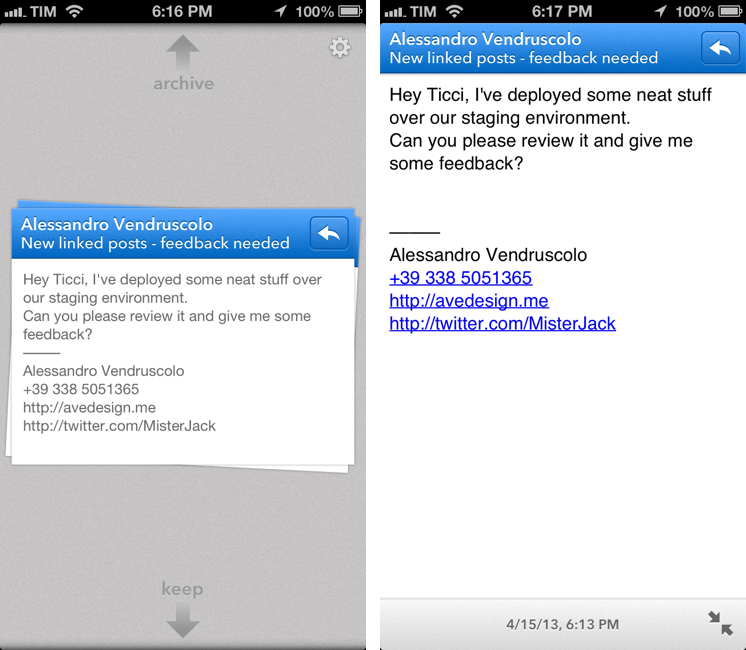
Triage: My New Favorite Email App for iPhone

Triage is my new favorite email app for iPhone.

I’ve always had a tumultuous relationship with email clients on iOS. It used to be that Apple didn’t like third-party email clients on the App Store, until Sparrow came around. With its superior support for Gmail accounts and a faster workflow for managing the inbox on a daily basis, Sparrow convinced me – in spite of iOS’ limitations – to move away from Apple’s Mail, both on the Mac and iPhone. Until Google bought Sparrow, effectively stalling development on the iPhone and Mac and halting the iPad version’s release altogether. While Sparrow still works, I don’t feel comfortable relying on a product – for a key task such as email – that I know is going to be abandoned eventually. I stopped using Sparrow after it was acquired by Google.

I was back to Mail, and I wasn’t too thrilled about it. After upgrading to iOS 6 last year, I lamented numerous times how switching between Edge and 3G networks was worse than iOS 5, and how that behavior affected my Mail workflow due to another ridiculous change Apple made in iOS 6. Mail was my go-to client again, but I often ended up saving emails for later because I didn’t trust iOS 6 to correctly send my messages.

And then Google brought Gmail 2.0 to iOS, a much better version than the original app released in late 2011. I was eager to try out the new universal app with push notifications, once again moving with all my accounts from Apple Mail into a new home, cautiously hoping that would be the last time.

I’m still using Gmail for iOS, but there are some things I don’t like about it. Push notifications are useful, but I can’t stand the daily awkwardness with scrolling and funky text selections caused by Google’s reliance on embedded web views. Support for Gmail is solid and improving, but I miss the butter-smooth animations of Sparrow or, despite its flaws, Mail’s fluidity and native feel. I like Gmail for iOS, but I don’t love it.

Last month, I was sent a beta of Triage for iPhone, and a few hours into using it I knew that was it. That was the email app – not a client – that could allieviate my Gmail sorrows while showing a new way to process my inbox on an iPhone. Read more



Context

The iPhone does not know enough. Proper context will require data in many more dimensions, dimensions which can define the user and his state. Their sheer number will placate strenuous constraints on their size and energy consumption but demand ever more accurate data. It is not difficult to realize that sensors will ride the next wave of innovation in computing. These minuscule and sophisticated apparatus will usher in the age of personal data.

Great post by Amit Jain.

More sensors and new algorithms will make our devices more personal, context-aware, and versatile. Let’s keep in mind that, however, more always-on sensors will require Apple to make significant strides in another area.

Permalink

Apple Airs New iPhone Commercials: “Brilliant” and “Discover”

Earlier today, Apple aired two new iPhone commercials called Brilliant and Discover. The videos are available both on Apple’s website and YouTube channel.

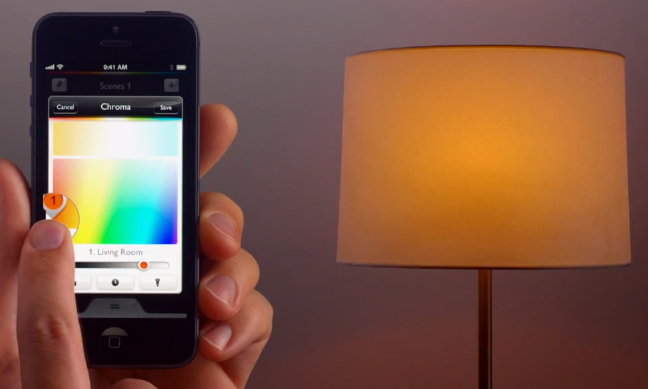
Like Apple’s latest iPad ad campaign, the iPhone commercials focus on third-party apps with no narration, and just a series of words quickly shown on screen alongside apps/media available on iTunes. For “Brilliant”, the words are “sweet”, “rise” and “brilliant” and content includes Apple’s Cards app, UP, Passbook, MyScript Calculator, and Philips’ hue (Philips announced an SDK today as well). For “Discover” the words are “rock”, “sharp”, and “discover” and content includes GarageBand, Maps, Infinity Blade II, Cleartune, Solar Walk, Yelp, and Shazam.

You can watch the ads below. Read more


Kickstarter: Thermodo by Robocat - The Tiny Thermometer for Mobile Devices

Robocat, a Danish software studio co-founded by Michael Flarup and Willi Wu, has been building unique digital products out of Copenhagen for the last 3 years. They’ve created several weather-related apps like Outside, Ultraviolet, Thermo and Haze, which was featured by Apple as Editor’s Choice a few weeks ago.

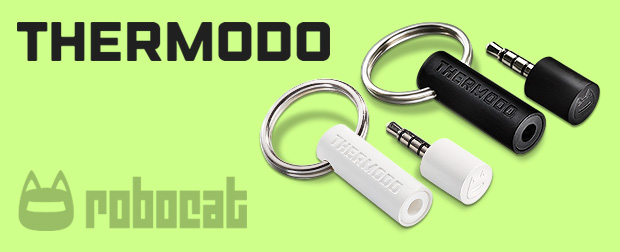
Today, Robocat launched a Kickstarter project based on weather – but this time as hardware, not software. It’s called Thermodo. Thermodo is a tiny electrical thermometer that lets you measure the temperature in the exact location where you are by using a piece of hardware that connects to the headphone jack on your mobile device. It’s for iPhone, iPad, Android & more. They’re looking to get $35,000 in 33 days to pay for the further development of Thermodo.

Thermodo consists of a passive temperature sensor built into a standard 4 pole audio jack enclosed by a sturdy housing. This allows your mobile device to read Thermodo’s temperature straight from the audio input. Thermodo sends an audio signal through the temperature sensor. This sensor will then attenuate the signal amplitude depending on the actual temperature. This attenuation can now be detected on the microphone input and through software we calculate the corresponding temperature. Easy peasy! We call this the Thermodo Principle™. Simply plug Thermodo into your device and start the companion app or any other Thermodo enabled apps of your choice. The temperature reading takes place instantly. Thermodo is powered by your device. No external power is required, it can even run in the background while you do important stuff.

You can measure the temperature indoors as well as outdoors. Track the temperature and see how it rises after you turned on the radiator or check how the temperature drops during a summer night. No network connection required. Thermodo comes with a neat little keyring so you’ll always have it with you.

Video and more after the break. Read more


Twelve South Releases SurfacePad for iPhone, with Smart Cover-like Protection

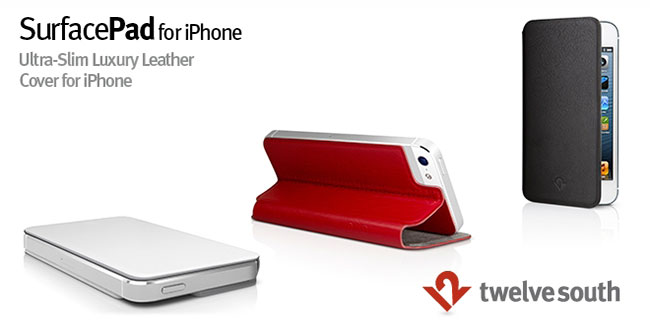
Twelve South, makers of excellent Mac and iOS device accessories, have announced today the latest product in their family of accessories for the iPhone: the SurfacePad. Made of Napa leather and weighing less than an ounce, the SurfacePad is a modern, minimal design that beautifully complements the stylish design of iPhone.

What makes SurfacePad special is what it’s not: a military-style rubber grenade for your iPhone. SurfacePad is an ultra-thin, luxury leather cover that shields iPhone 5 or 4/4S from the more typical hazards of life, like the change in your pocket, jump drive in your backpack or the nail file in your purse. It allows you to set your iPhone down on rough spots like a concrete bench or stone tabletop without worrying about scratching the sleek surface of your iPhone.

Check out more photos of the SurfacePad here, and a video below. Read more


Measuring iPhone 5 vs. iPhone 4S availability

Measuring iPhone 5 vs. iPhone 4S availability

Horace Dediu of Asymco today wrote and shared data on the availability of the iPhone 5 and iPhone 4S by potential buyers - measured by the subscriber counts of the carriers that sell the iPhone. It’s an important and valuable extension of an article I wrote last week, discussing the international rollout of each generation of iPhone and iPad. That analysis had a weakness in that I treated all countries as equal which isn’t necessarily true (depending on why you’re looking at the data).

Announcing availability in Mauritius is not nearly as important as announcing Madagascar. A better measure would be to track the countries’ populations being added, or, better still, the populations which subscribe to operators who have a distribution contract with Apple.

So instead, Dediu looked at which carriers held the iPhone in each country and what their approximate subscriber count was. By calculating the availability this way, you can now see the potential number of iPhone buyers, as seen in Horace’s graph here.

That’s a handy measure: the iPhone 5 was 30% more available than the iPhone 4S. The big contribution was having China and Indonesia available during the fourth quarter rather than in January 2011.

Make sure to head over to Asymco to read the full article and all of Horace’s observations, it’s an interesting read. If you didn’t catch my article last week, it’s also available to read here. Just note that if you are trying to compare Dediu’s graph with the one in my article (shown here), Dediu went with actual dates whereas I went with relative time. This is because I wanted to look at the first 110 days of every iPhone, Dediu was specifically looking at the fourth quarter availability.

Permalink

Could Apple Be Moving To Twice-Yearly iPhone & iPad Releases?

Just over a month ago, Horace Dediu of Asymco penned an article entitled ‘Does S stand for Spring’ in which he hypothesised that perhaps Apple might be moving to a biannual (twice-yearly) release cycle for the iPhone and iPad. Over the past month I’ve gone back to read Dediu’s hypothesis as news articles and analyst opinions surfaced and I did some analysis of Apple myself. It’s got to the point that I really think Dediu’s hypothesis has got real potential to become reality. So I decided to take some time to present Dediu’s evidence in a slightly different way, elaborating on some of his evidence and hopefully add to the discussion. But if you haven’t read the Asymco article yet, I’d highly recommend you do so before proceeding:

‘Does S stand for Spring?’ - Asymco

Read more


Mapping Apple’s International iPhone & iPad Rollouts

Apple has on three seperate occasions announced that the iPhone 5 will have the fastest international rollout of any iPhone ever - at the announcement keynote, during the Q4 earnings call, and in their press release announcing opening weekend sales of the iPhone 5 in China. The claim was, no doubt, meant to impress investors, press and the general public, but I was curious as to how fast it really was compared to previous iPhone rollouts. So I decided to track down the launch schedules of all the iPhones to date and then again with the iPad. In the end I found a few trends, some oddities and that Apple’s claim was (mostly) true.

iPhone 5 will be available in more than 100 countries by the end of December, making it the fastest iPhone rollout ever.

- Apple Press Release

Read more