John Voorhees

5429 posts on MacStories since November 2015

John is MacStories' Managing Editor, has been writing about Apple and apps since joining the team in 2015, and today, runs the site alongside Federico. John also co-hosts four MacStories podcasts: AppStories, which covers the world of apps, MacStories Unwind, which explores the fun differences between American and Italian culture and recommends media to listeners, Ruminate, a show about the weird web and unusual snacks, and NPC: Next Portable Console, a show about the games we take with us.

Apple Vision Pro Entertainment Apps

AppStories+ Deeper into the world of apps

AppStories Episode 372 - Apple Vision Pro Entertainment Apps

0:00
33:26

AppStories+ Deeper into the world of apps

This week, Federico and John share some of their favorite visionOS entertainment apps.

Read more


MacStories Unwind: Ripping CDs for a Living

This week on MacStories Unwind, I share my tech discoveries during a visit to a classical music radio station, Federico finally goes for a spider-style gaming Wi-Fi router, and I recommend Criminal Record on Apple TV+.




This episode is sponsored by:

  • Paste – Endless Clipboard for Mac and iOS Devices

Unplugged

  • Radio station tech

Picks


MacStories Unwind+

We deliver MacStories Unwind+ to Club MacStories subscribers ad-free and early with high bitrate audio every week.

To learn more about the benefits of a Club MacStories subscription, visit our Plans page.

Read more


Automation Academy: My Collection of Advanced Shortcuts for Things

Earlier today, Federico released a series of seven advanced shortcuts for the task manager Things as part of his Automation Academy column, an exclusive perk of Club MacStories+ and Club Premier.

Federico explains in the introduction of the story why he returned to Things a few months ago and has been happy with the decision:

not only does the design of the Things app create a more relaxed environment for me to manage my responsibilities, but Cultured Code’s embrace of Shortcuts automation has allowed me to create dozens of custom enhancements for Things.

It’s the flexibility that Things’ Shortcuts actions offer that allows for such deep customization. The shortcuts shared today include automations to:

  • Automatically move tasks scheduled for a certain time to Things’ Evening section
  • Postponing evening tasks
  • Rescheduling tasks to the next evening
  • Tag selected tasks as active
  • Pin tasks
  • Select from a menu of Things shortcuts
  • Create tasks, an updated version of a previously-shared shortcut

All of the shortcuts are ready to be used immediately and are accompanied by a detailed walk-through of the techniques used to build them and an explanation of how Federico is using them.

Discounts are just one of the many Club MacStories perks.

Discounts are just one of the many Club MacStories perks.

Automation Academy is just one of many perks that Club MacStories+ and Club Premier members enjoy including:

  • Weekly and monthly newsletters 
  • A sophisticated web app with search and filtering tools to navigate eight years of content
  • Customizable RSS feeds
  • Bonus columns
  • An early and ad-free version of our Internet culture and media podcast, MacStories Unwind
  • A vibrant Discord community of smart app and automation fans who trade a wealth of tips and discoveries every day
  • Live Discord audio events after Apple events and at other times of the year

On top of that, Club Premier members get AppStories+, an extended, ad-free version of our flagship podcast that we deliver early every week in high-bitrate audio.

Use the buttons below to learn more and sign up for Club MacStories+ or Club Premier.

Join Club MacStories+:

Join Club Premier:

Permalink

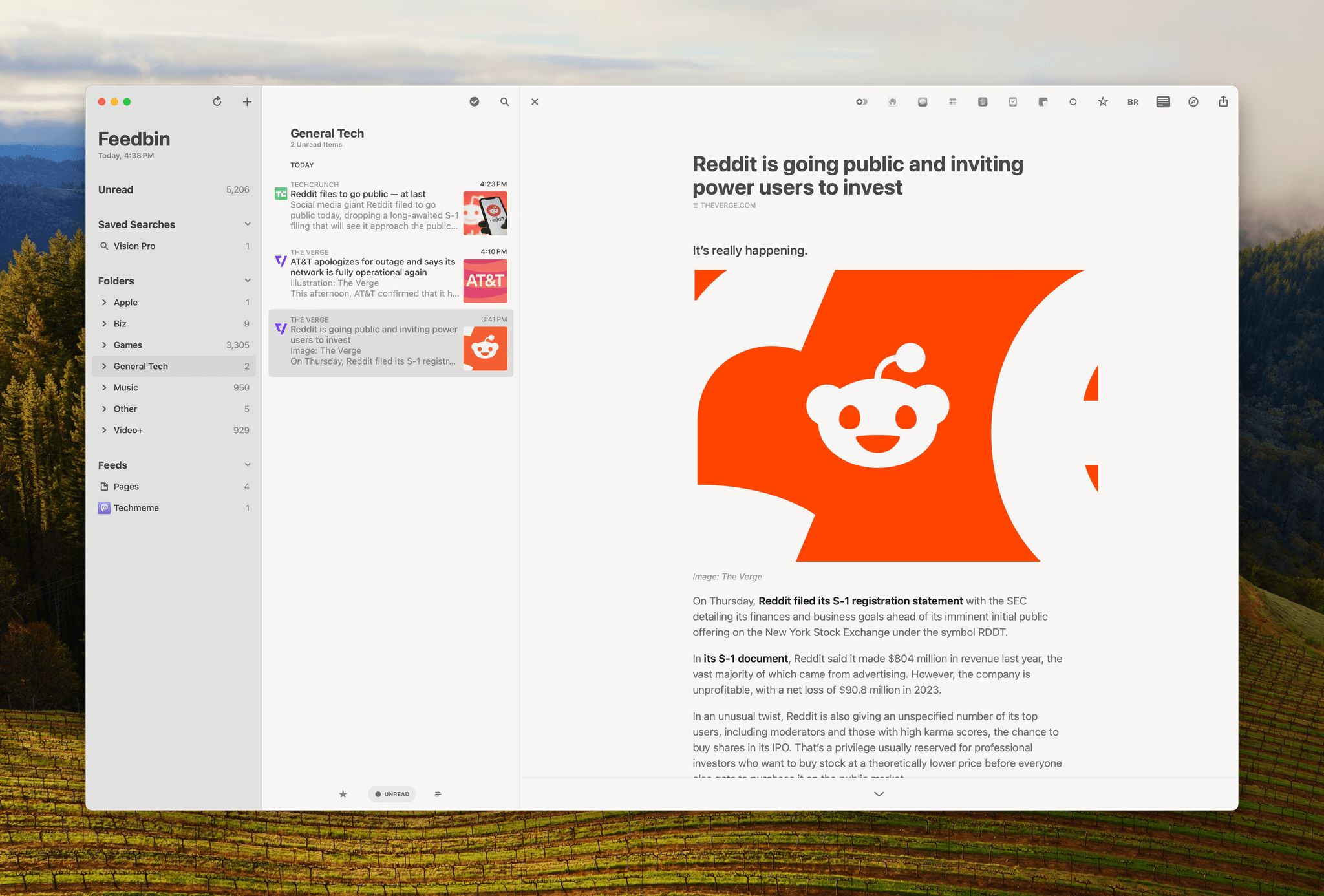
The Fastest Way to Save RSS Articles to A Read-Later App

Skimming through the day's tech headlines in Reeder.

Skimming through the day’s tech headlines in Reeder.

I follow about 180 RSS feeds, and I skim through all of my tech feeds every day, looking for interesting news, angles, opinions, and inspiration. A lot of what I see is repetitive, but I’ve gotten very good over the years at speed-reading snippets of stories and homing in on the interesting ones. Some stories get read right away because they’re time-sensitive in some way. However, I have other things to do besides read the web, so I rely heavily on read-later apps to save many of my finds.

That context is important because although some of what I save is what I’d classify as ‘leisure reading,’ most of it isn’t. It’s information processing, and given my other obligations, speed is important. As a result, what I value most are:

  • The design of my RSS reader
  • The speed with which I can save stories for later
  • Access to my saved articles for anywhere
  • The tools available in my read-later app for organizing everything

Read more


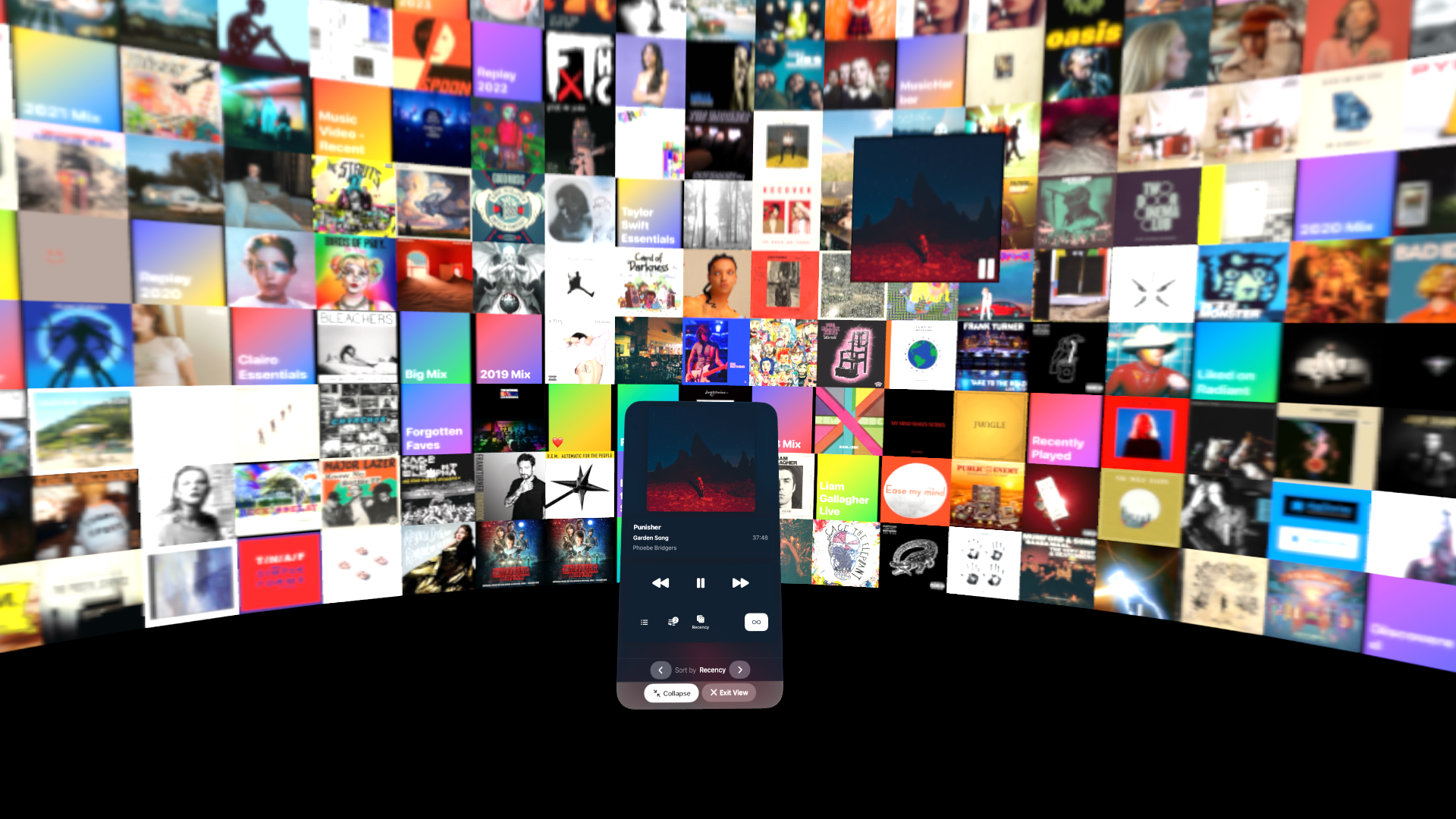
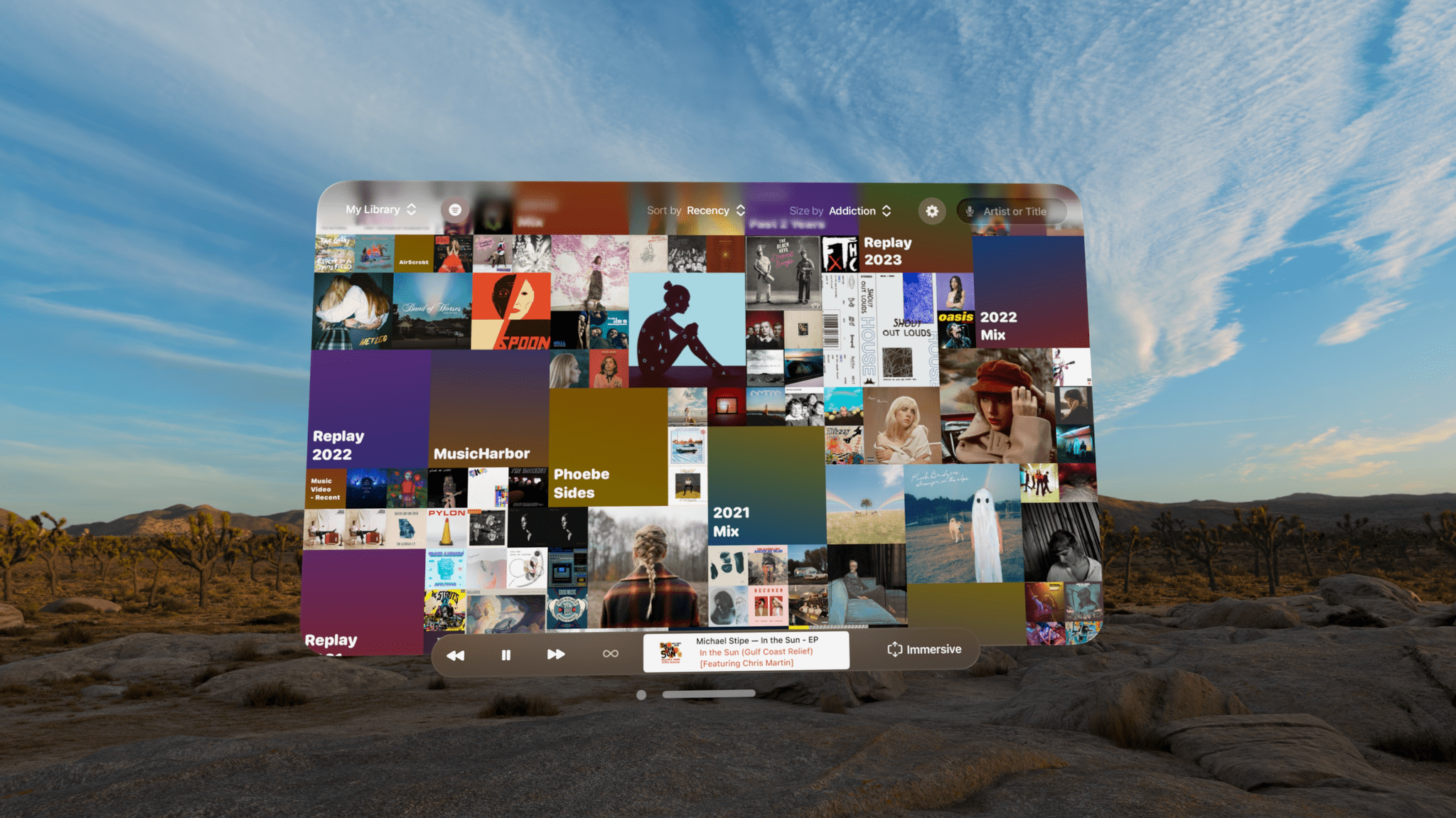
Vision Pro App Spotlight: Longplay Adds Immersive Album Listening

The music experience on the Apple Vision Pro is excellent. It starts with the device’s built-in headphones and spatial audio, which work hand-in-hand with the visual components of spatial computing. Apple has already shown off the potential for immersive experiences like Alicia Keys: Rehearsal Room, but the music experience goes deeper than that, thanks to third-party developers.

I’ve already covered Juno, Christian Selig’s YouTube player app, which is great for watching music videos and other content, and NowPlaying, which supplements Apple Music with editorial content, lyrics, and more. Today, though, I want to focus on Longplay, Adrian Schönig’s album-oriented playback app for Apple Music.

Longplay 2.0 was released last August. It was a big update that I reviewed at the time and have been enjoying ever since. The app is available on the Vision Pro now too, complete with an immersive mode that I love.


Read more


iMessage Is Preparing for a Post-Quantum Computing World

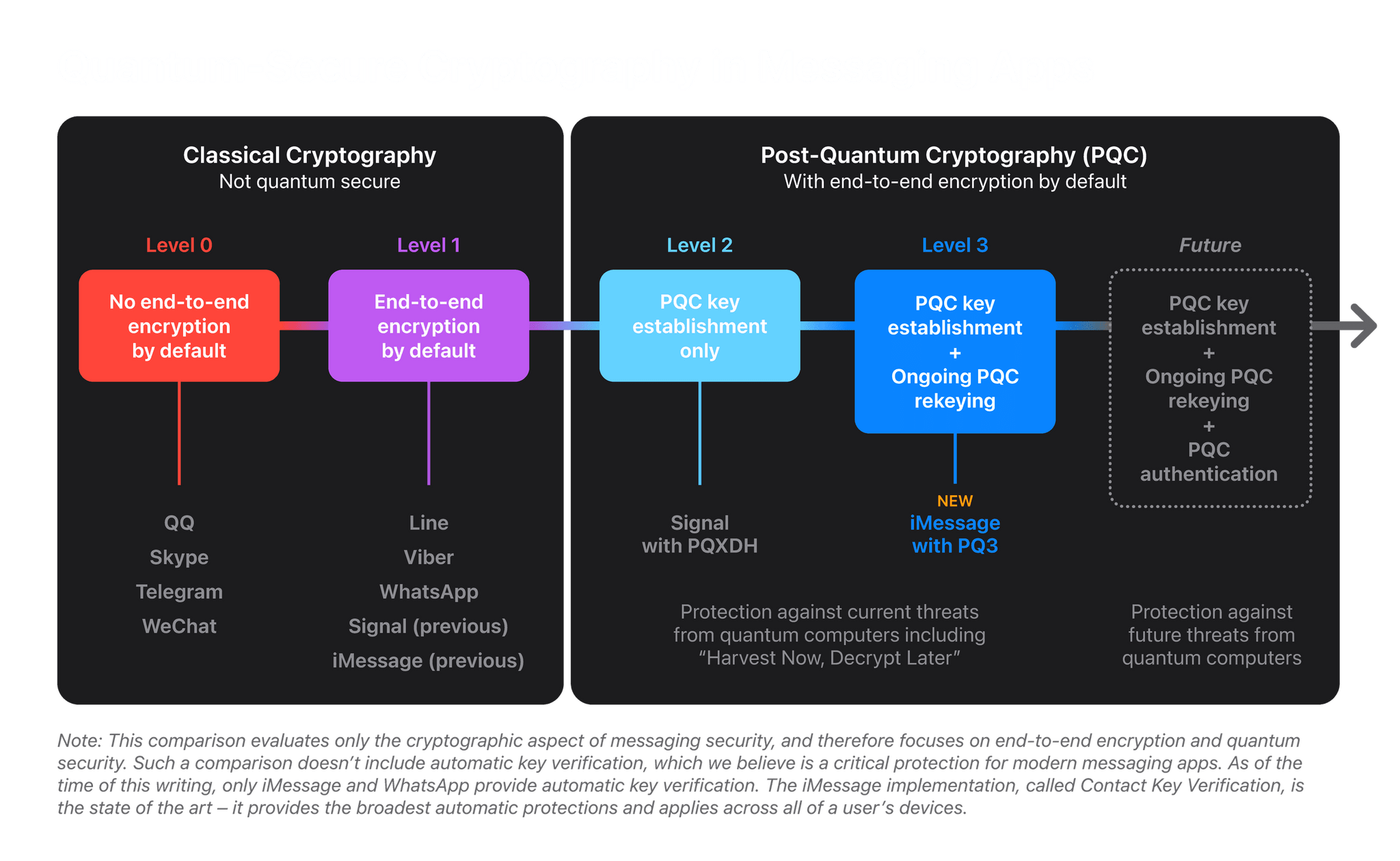
Yesterday, Apple’s Security Research website published a report on a cryptographic security upgrade coming to iMessage with the release of iOS 17.4, iPadOS 17.4, macOS 14.4, and watchOS 10.4 called PQ3. It’s a forward-looking, preemptive upgrade that anticipates a future where quantum computers will be able to defeat today’s cryptographic security with ease. That day isn’t here yet, but PQ3 is rolling out with the next series of Apple’s OS updates to protect against a scenario known as Harvest Now, Decrypt Later where bad actors collect vast amounts of encrypted data today, anticipating a future where it can be decrypted by quantum computers.

Source: Apple.

Source: Apple.

If you’ve heard the term quantum computing thrown around in the past and don’t know what it is, I highly recommend a couple of explainer articles by the MIT Technology Review that cover both quantum computers and post-quantum cryptography.1 But if the details don’t interest you, the bottom line is that PQ3 is being added to iMessage today in anticipation of a day in the future where today’s end-to-end encryption techniques don’t work anymore. Here’s how Apple’s paper explains it:

Historically, messaging platforms have used classical public key cryptography, such as RSA, Elliptic Curve signatures, and Diffie-Hellman key exchange, to establish secure end-to-end encrypted connections between devices. All these algorithms are based on difficult mathematical problems that have long been considered too computationally intensive for computers to solve, even when accounting for Moore’s law. However, the rise of quantum computing threatens to change the equation. A sufficiently powerful quantum computer could solve these classical mathematical problems in fundamentally different ways, and therefore — in theory — do so fast enough to threaten the security of end-to-end encrypted communications.

Although quantum computers with this capability don’t exist yet, extremely well-resourced attackers can already prepare for their possible arrival by taking advantage of the steep decrease in modern data storage costs. The premise is simple: such attackers can collect large amounts of today’s encrypted data and file it all away for future reference. Even though they can’t decrypt any of this data today, they can retain it until they acquire a quantum computer that can decrypt it in the future, an attack scenario known as Harvest Now, Decrypt Later.

PQ3 protects against a post-quantum world by setting up an iMessage conversation with a new post-quantum public key system and then periodically updating the keys so that if the keys are compromised, it won’t compromise the entire conversation. The system also uses existing cryptographic algorithms for portions of the encryption process that aren’t vulnerable to a Harvest Now, Decrypt Later scenario.

There is a lot of additional detail in Apple’s report, as you can imagine, including information about the review process that the new system has undergone and the way it is applied to iMessage in particular, which explains the design considerations that were necessary to apply these cryptographic techniques at the scale of iMessage in a way that doesn’t compromise users’ experience.

There’s more to be done to ramp up iMessage’s security even further as we approach a world where quantum computers are a threat to traditional cryptography. However, as Apple’s report concludes, with the imminent OS updates, iMessage will be “the global state of the art for protecting messages against Harvest Now, Decrypt Later attacks and future quantum computers.”

I’ve heard iMessage security get thrown under the bus a lot lately as an excuse Apple uses to protect its market dominance. There’s no reason that protecting customer communications and market-share can’t both be true. However, I think you’d be hard-pressed to read a report like this one and not come away believing that customer privacy and security are also a sincere goals at Apple.


  1. Yes, these are the sorts of articles I save in my read-later app. It’s a fascinating topic that also helps me fall asleep at night, so it’s a win all around. 
Permalink