John Voorhees

5429 posts on MacStories since November 2015

John is MacStories' Managing Editor, has been writing about Apple and apps since joining the team in 2015, and today, runs the site alongside Federico. John also co-hosts four MacStories podcasts: AppStories, which covers the world of apps, MacStories Unwind, which explores the fun differences between American and Italian culture and recommends media to listeners, Ruminate, a show about the weird web and unusual snacks, and NPC: Next Portable Console, a show about the games we take with us.

Obsidian In-Depth: More Third-Party Plugins (Part 4)

AppStories+ Deeper into the world of apps

AppStories Episode 256 - Obsidian In-Depth: More Third-Party Plugins (Part 4)

0:00
40:32

AppStories+ Deeper into the world of apps

Federico and John continue their coverage of third-party Obsidian plugins and how they use them to customize the app’s functionality.

if [appstories]
On AppStories+, John lays out the signs that change is afoot for Apple’s Music app for Federico and they consider what might be next for the app on the iPhone, iPad, and Mac.

Read more


Wordle! Developer to Donate Game Proceeds to Charity

Wordle is the web-only daily word game that has taken the Internet by storm. The simple, free game by Josh Wardle struck a nerve, quickly spreading thanks to its social-media-friendly score sharing and a New York Times profile of the game’s backstory.

The game also spawned a legion of rip-off versions that appeared on the App Store and were ultimately taken down by Apple. However, one of the App Store apps that saw a spike in downloads last week wasn’t a Wordle clone. It was an entirely different game called Wordle! that was first published five years ago by Steven Cravotta.

Emma Roth, writing for The Verge reports that Cravotta has decided to donate the proceeds of Wordle! to charity at the end of January. According to Roth:

Cravotta says that downloads for Wordle! slowed to around one to two per day, but when the browser-based Wordle started taking off, so did his app. The app racked up 200,000 downloads in a single week, albeit from confused users who mistook it for the browser-based Wordle. Cravotta reached out to Wordle app developer, Josh Wardle, and let him know about his plans to donate the proceeds from his app to charity — Wardle sent out a tweet of his own to acknowledge the gesture.

Cravotta told The Verge that the earnings from Wordle!, which stand at just over $2,000 so far, will be donated to BoostOakland, a charity that supports tutoring and mentoring young people in Oakland, California. After the gleeful tweets by one Wordle clone developer, it’s refreshing to read about Cravotta’s plans for the windfall he received from the similarity between his game and Wardle’s.

If you’re a Wordle fan, be sure to check out WordleBot, Federico’s shortcut inspired by Wordle’s score sharing feature. The shortcut preserves the game’s iconic score-sharing graphic but adds text labels to each row to improve the accessibility of scores on services like Twitter and provide additional context to the results.

Permalink


MacStories Unwind: Gossip Girl and Hawkeye

AppStories+ Deeper into the world of apps
0:00
26:59

AppStories+ Deeper into the world of apps


This week on MacStories Unwind, Federico watches the HBO Max reboot of Gossip Girl while John enjoys Hawkeye on Disney+, plus a recap of the past week on MacStories.

Federico’s Pick:

John’s Pick:

MacStories Rewind


Dropbox Releases Apple Silicon Version of Its App to Beta Testers

Last fall, Dropbox caused a stir when one of its employees suggested on a company forum that the cloud service’s Mac app wouldn’t be updated for Apple’s M1 architecture until customers demanded it. The response from customers was immediate and vocal, prompting Dropbox CEO Drew Houston to publicly state that an M1 version of the app would be released in 2022.

The existing Dropbox app uses Apple’s Rosetta translation layer, which is fast but can’t match a native Apple silicon app. The app also uses more power and other system resources than a native version would, and for an app that constantly runs in the background, that was a constant source of irritation for users.

The first sign of an Apple silicon version of Dropbox emerged late yesterday. As reported by 9to5Mac, Dropbox released a native M1-based version of its app to beta testers, which can be downloaded here. The new version of the app, which was noticed by a user in the Dropbox forums, was later confirmed by a Dropbox community manager, as reported by The Verge. Dropbox is very late in updating its app to offer native Apple silicon support, especially given that the service is so widely used, but it’s good to see the company following through with last fall’s promise.

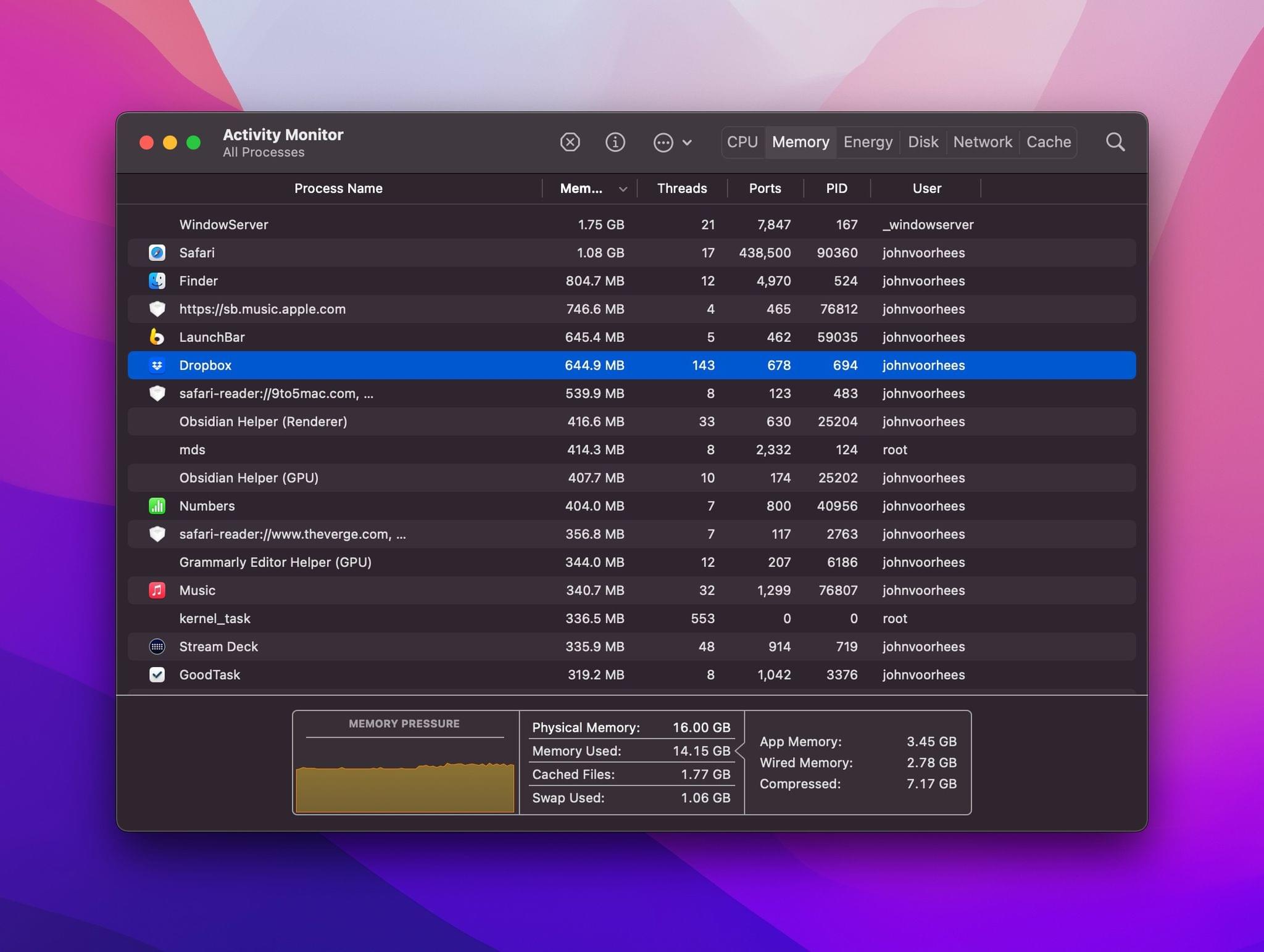
Betas that affect important cloud-based files should be approached with caution, but in my limited testing so far, the M1 version of Dropbox makes a noticeable difference in the app’s resource usage. Before installing the beta, I took a look at its memory usage, which stood at just above 4 GB, a substantial portion of the 16 GB available on my MacBook Air. Immediately after installing the Dropbox beta, memory usage dropped to a much more reasonable 645 MB. That’s a substantial improvement, which coupled with lower power usage and improved speed, should greatly improve the experience of using the cloud service, especially on Apple laptops.