Interesting Links
...

 Interesting Links
App Debuts
Smart Siri: One Brick at a Time
Interesting Links
App Debuts
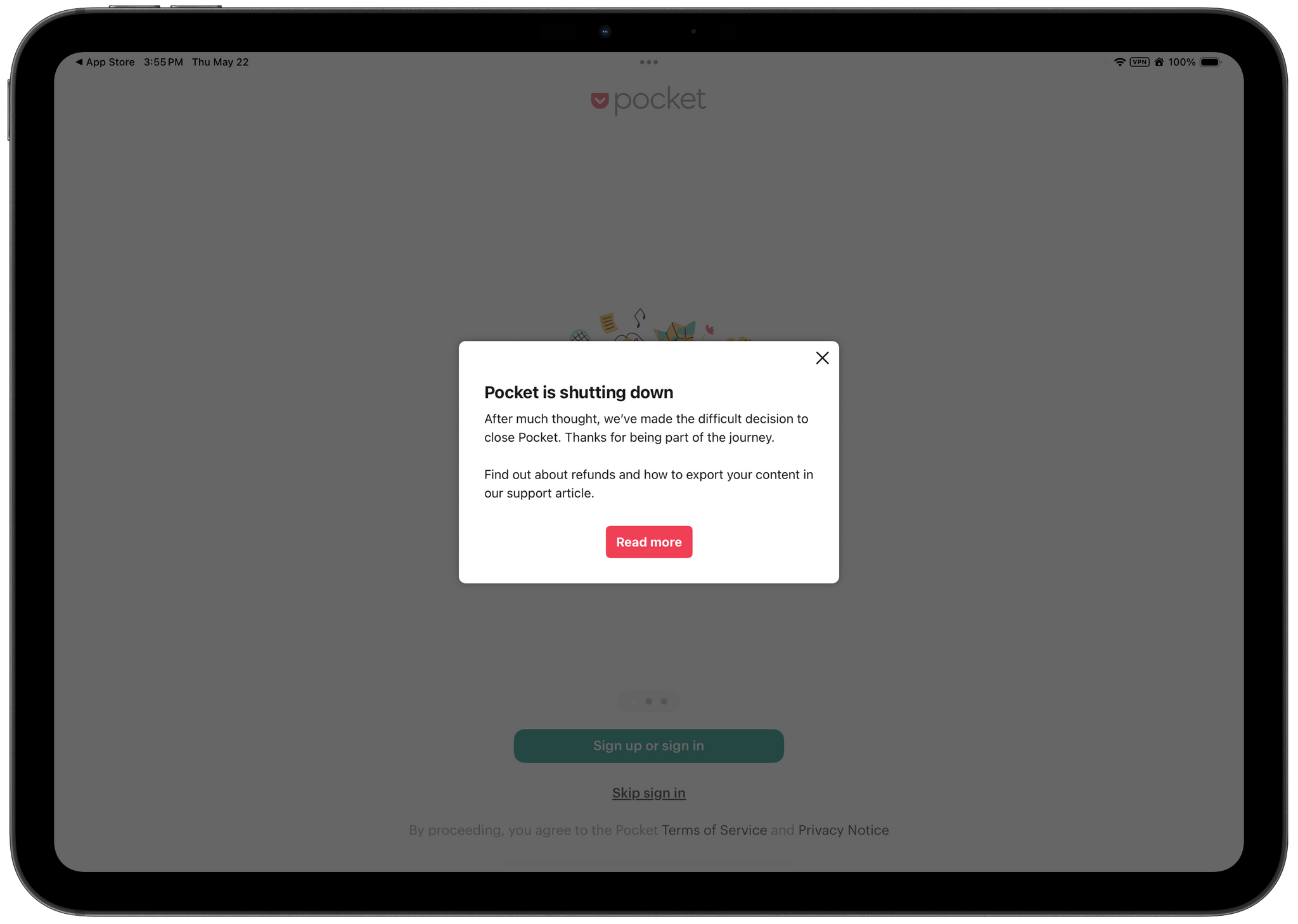
Smart Siri: One Brick at a Time Today, Mozilla announced in a support document that it will soon end development of Pocket, its read-later app that’s been around since the early days of the App Store:
We’ve made the difficult decision to shut down Pocket on July 8, 2025. Thank you for being part of our journey over the years—we’re proud of the impact Pocket has had for our users and communities.
I never like to see an app that people rely on go, but I’m not surprised that Mozilla has pulled its support for Pocket either. The app evolved rapidly in the early days when it was called Read It Later and competing fiercely with Instapaper. But that rivalry burned itself out years ago, and after Mozilla purchased Pocket, it seemed adrift.
Recently, Mozilla laid off 30% of its workforce and Pocket faced new competition from the likes of Matter and Readwise Reader, which entered the fray with new ideas about what a read-later app could be. As I wrote in my first review of Matter:
Apps like Instapaper and Read It Later, which became Pocket, pioneered saving web articles for later. The original iPhone ran on AT&T’s EDGE mobile network in the U.S. and coverage was spotty. Read-later apps saved stripped-down versions of articles from the web that could be downloaded quickly and read offline when EDGE was unavailable. The need to save content offline because of slow and unreliable mobile networks is far less pressing today, but collecting links and time-shifting reading remains popular.
Today, read-later apps like Readwise are more focused on research, integrating with note-taking systems, and leveraging AI. There’s still a place for simpler solutions such as GoodLinks, which is one of my personal favorites, but given the existential threat Mozilla currently faces, ending Pocket was probably the right choice.
Since covering Mercury Weather 2.0 and its launch on the Vision Pro here on MacStories, I’ve been keeping up with the weather app on Club MacStories. It’s one of my favorite Mac menu bar apps, it has held a spot on my default Apple Watch face since its launch, and last fall, it added severe weather notifications.
I love the app’s design and focus as much today as I did when I wrote about its debut in 2023. Today, though, Mercury Weather is a more well-rounded app than ever before. Through regular updates, the app has filled in a lot of the holes in its feature set that may have turned off some users two years ago.
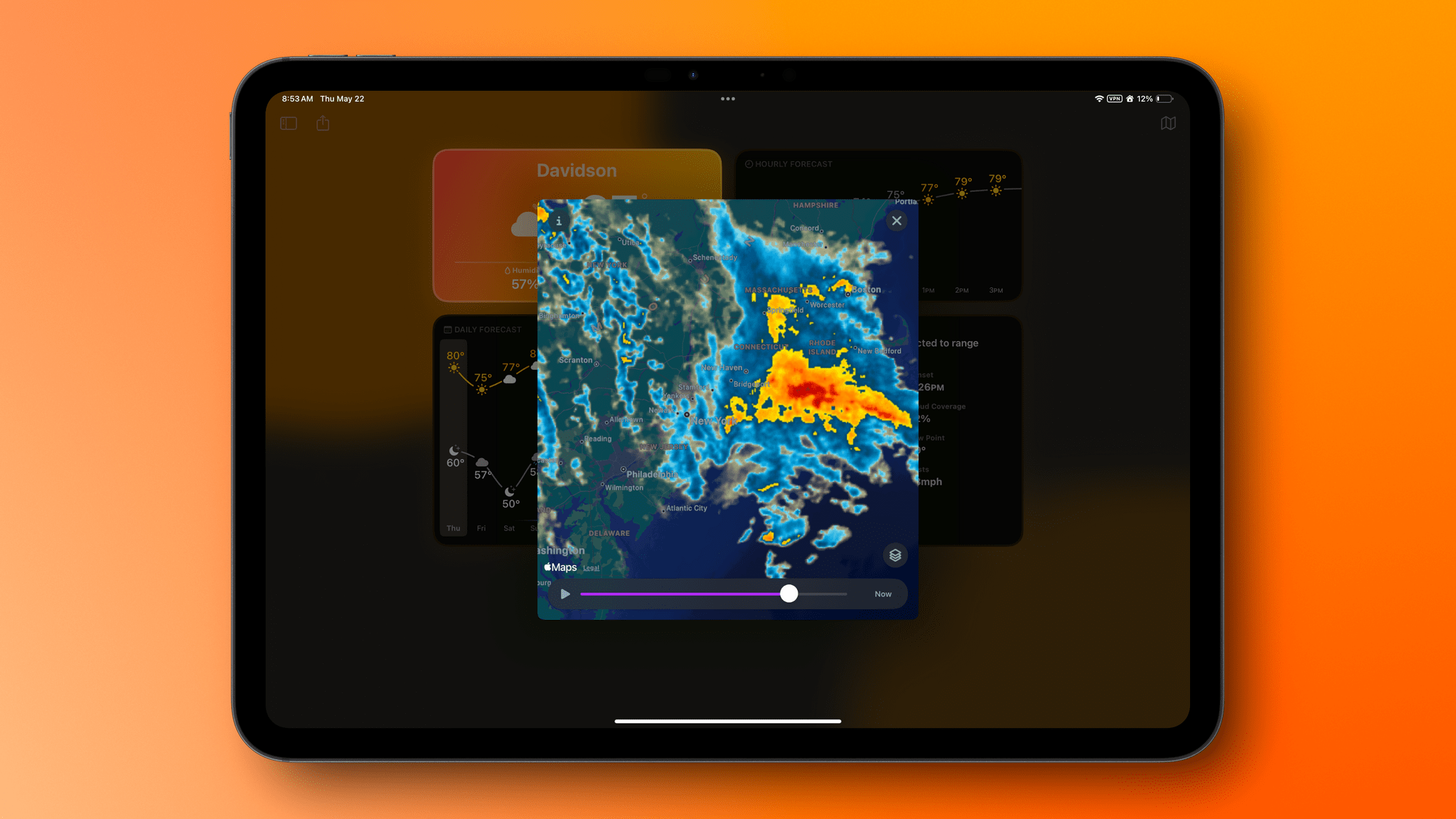
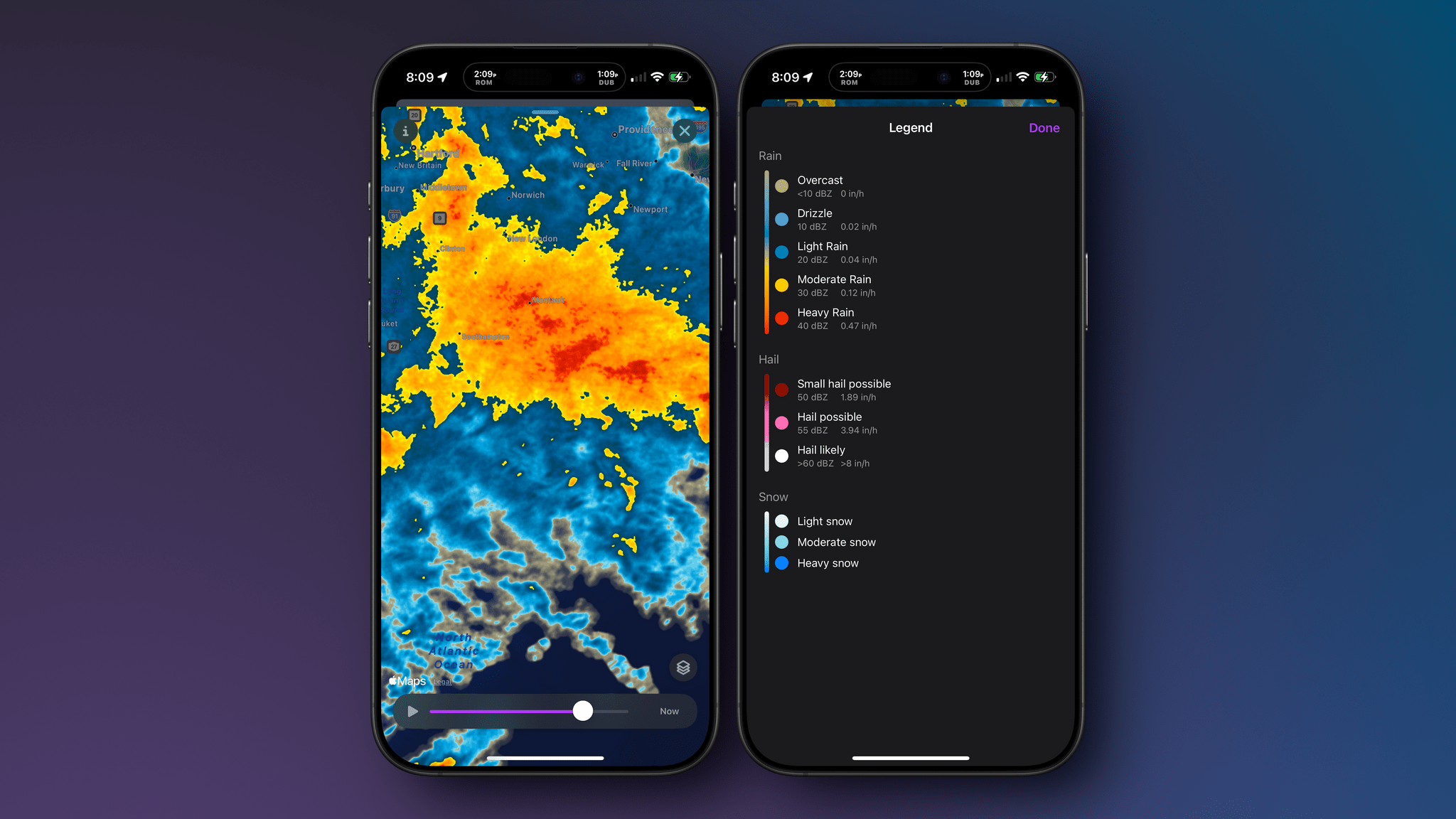
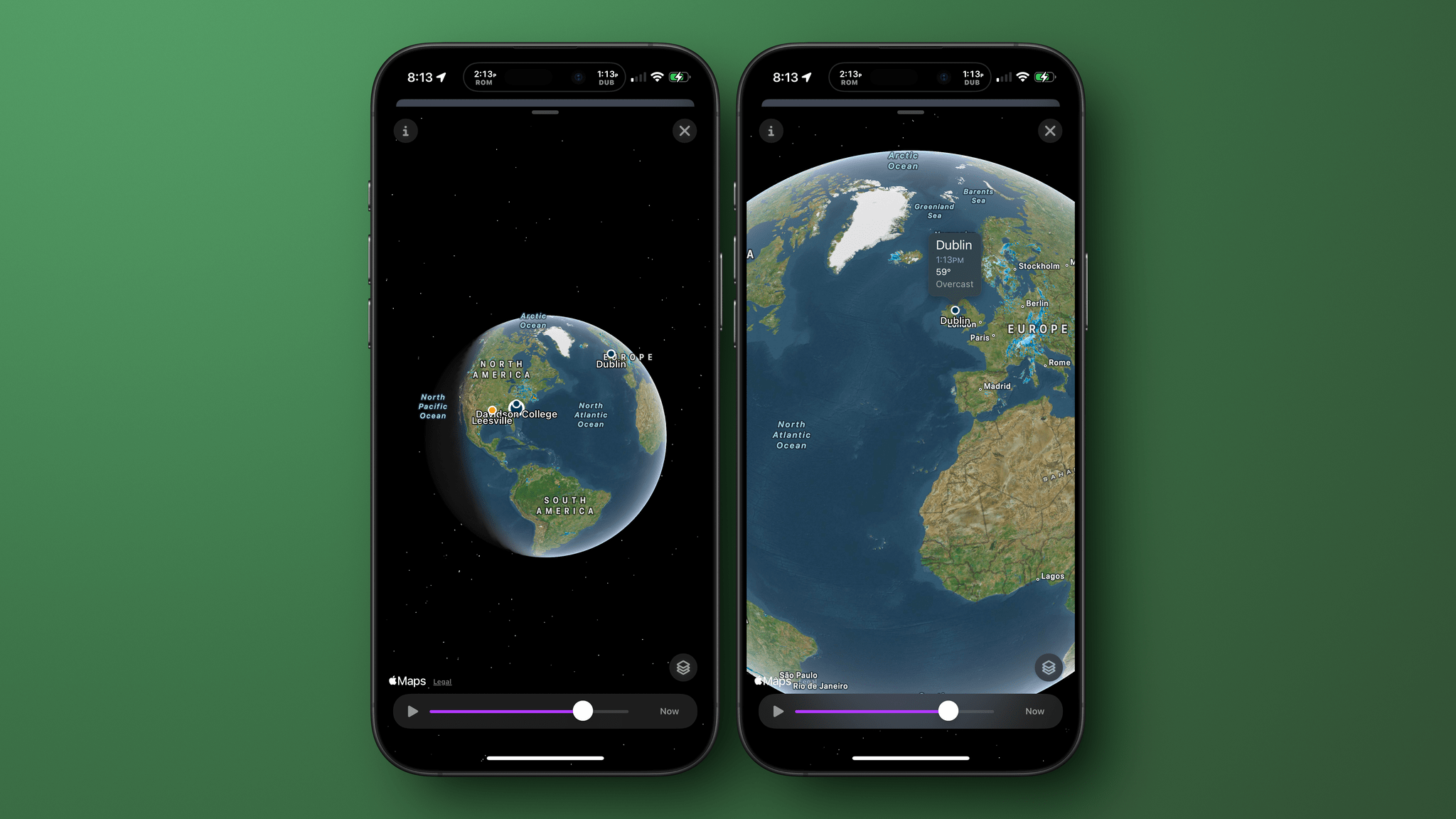
Today, Mercury Weather adds weather radar maps, which was one of the features I missed most from other weather apps, along with the severe weather notifications that were added late last year. It’s a welcome addition that means the next time a storm is bearing down on my neighborhood, I won’t have to switch to a different app to see what’s coming my way.
Radar maps are available on the iPhone, iPad, and Mac versions of Mercury Weather; they offer a couple of different map styles and a legend that explains what each color on the map means. If you zoom out, you can get a global view of Earth with your favorite locations noted on the map. Tap one, and you’ll get the current conditions for that spot. Mercury Weather already had an extensive set of widgets for the iPhone, iPad, and Mac, but this update adds small, medium, and large widgets for the radar map, too.
With a long list of updates since launch, Mercury Weather is worth another look if you passed on it before because it was missing features you wanted. The app is available on the App Store as a free download. Certain features require a subscription or lifetime purchase via an in-app purchase.
In the wake of U.S. District Judge Yvonne Gonzalez Rogers’ decision in Epic Games’ litigation against Apple, I commented on NPC: Next Portable Console that I expected Microsoft to enter the fray with its own web store soon. As reported by Tom Warren at The Verge, it looks like that’s exactly what Microsoft intends to do. Commenting on Judge Gonzalez Rogers’ contempt order in the context of Epic’s recent motion to return Fortnite to the App Store, Warren notes:
It’s a key ruling that has already allowed Fortnite to return to the App Store in the US, complete with the ability for Epic Games to link out to its own payment system inside the game. Microsoft has wanted to offer a similar experience for its Xbox mobile store prior to the ruling, but it says its solution “has been stymied by Apple.”
Ultimately, Microsoft wants its customers to be able to purchase and play its games from inside the Xbox app:
Microsoft started rolling out the ability to purchase games and DLC inside the Xbox mobile app last month, but it had to remove the remote play option to adhere to Apple’s App Store policies. You can’t currently buy an Xbox game in the Xbox mobile app on iOS and then stream it inside that same app. You have to manually navigate to the Xbox Cloud Gaming mobile website on a browser to get access to cloud gaming.
Developers continue to add options to link out to the web to purchase content, but as Microsoft’s court filing shows, the biggest players on the App Store are weighing the cost of setting up their own storefronts against the risk that Judge Gonzalez Rogers’ decision will be reversed on appeal.
Jony Ive’s stealth AI company known as io is being acquired by OpenAI for $6.5 billion in a deal that is expected to close this summer subject to regulatory approvals. According to reporting by Mark Gurman and Shirin Ghaffary of Bloomberg:
The purchase — the largest in OpenAI’s history — will provide the company with a dedicated unit for developing AI-powered devices. Acquiring the secretive startup, named io, also will secure the services of Ive and other former Apple designers who were behind iconic products such as the iPhone.
The partnership builds on a 23% stake in io that OpenAI purchased at the end of last year and comes with what Bloomberg describes as 55 hardware engineers, software developers, and manufacturing experts, plus a cast of accomplished designers.
Ive had this to say about the purportedly novel products he and OpenAI CEO Sam Altman are planning:
“People have an appetite for something new, which is a reflection on a sort of an unease with where we currently are,” Ive said, referring to products available today. Ive and Altman’s first devices are slated to debut in 2026.
Bloomberg also notes that Ive and his team of designers will be taking over all design at OpenAI, including software design like ChatGPT.
For now, the products OpenAI is working on remain a mystery, but given the purchase price and io’s willingness to take its first steps into the spotlight, I expect we’ll be hearing more about this historic collaboration in the months to come.
On Sunday, Bloomberg’s Mark Gurman published a comprehensive recap of Apple’s AI troubles. There wasn’t much new in Gurman’s story, except quotes from unnamed sources that added to the sense of conflict playing out inside the company. That said, it’s perfect if you haven’t been paying close attention since Apple Intelligence was first announced last June.
What’s troubling about Apple’s predicament isn’t that Apple’s super mom and other AI illustrations looks like they were generated in 2022, a lifetime ago in the world of AI. The trouble is what the company’s struggles mean for next-generation interactions with devices and productivity apps. The promise of natural language requests made to Siri that combine personal context with App Intents is exciting, but it’s mired in multiple layers of technical issues that need to be solved starting, as Gurman reported, with Siri.
The mess is so profound that it raises the question of whether Apple has the institutional capabilities to fix it. As M.G. Siegler wrote yesterday on Spyglass:
Apple, as an organization, simply doesn’t seem built correctly to operate in the age of AI. This technology, even more so than the web, moves insanely fast and is all about iteration. Apple likes to move slowly, measuring a million times and cutting once. Shipping polished jewels. That’s just not going to cut it with AI.
Having studied the fierce competition among AI companies for months, I agree with Siegler. This isn’t like hardware where Apple has successfully entered a category late and dominated it. Hardware plays to Apple’s design and supply chain strengths. In contrast, the rapid iteration of AI models and apps is the antithesis of Apple’s annual OS cycle. It’s a fundamentally different approach driven by intense competition and fueled by billions of dollars of cash.
I tend to agree with Siegler that given where things stand, Apple should replace a lot of Siri’s capabilities with a third-party chatbot and in the longer-term make an acquisition to shake up how it approaches AI. However, I also think the chances of either of those things happening are unlikely given Apple’s historical focus on internally developed solutions.
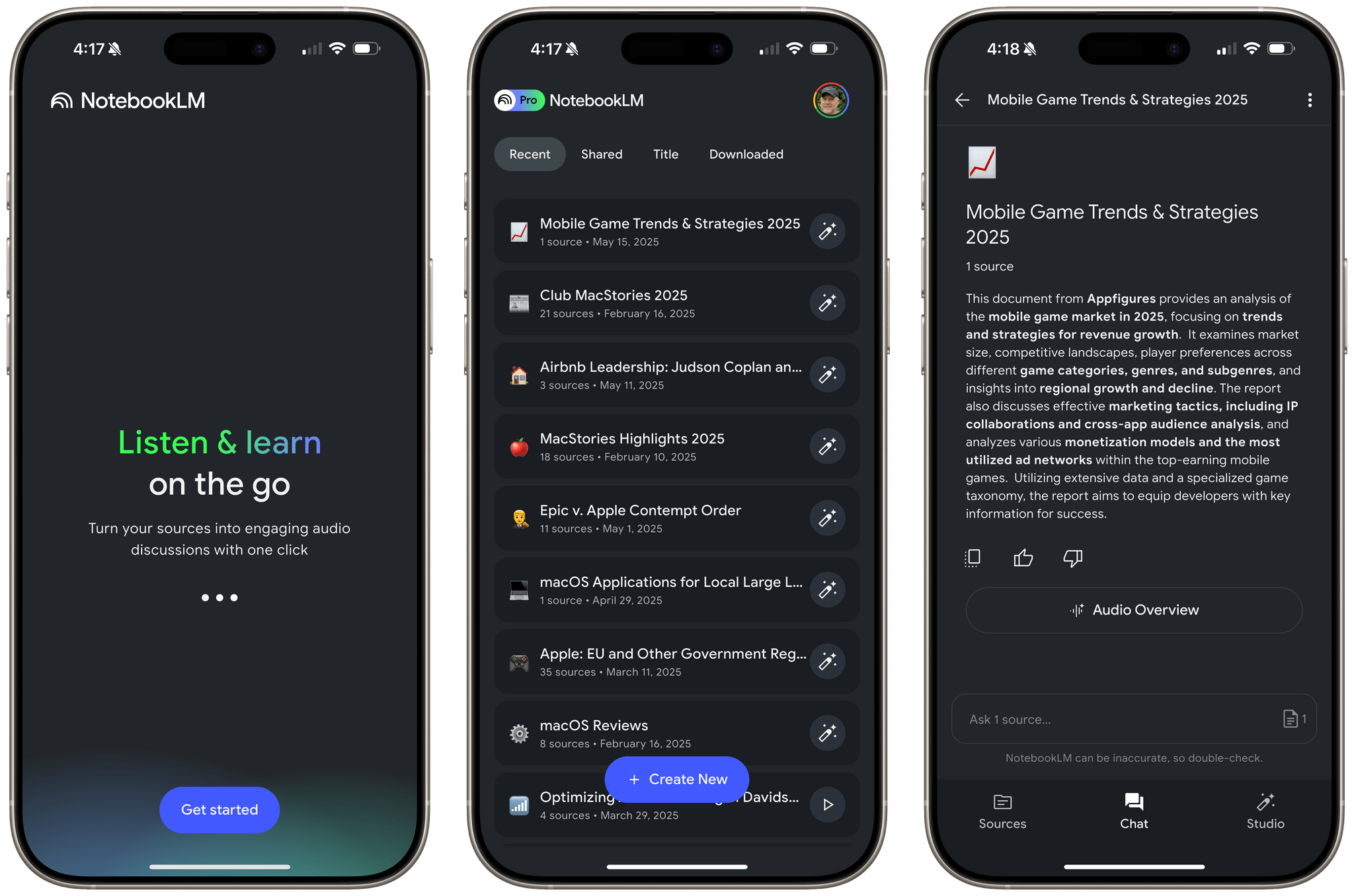
Google’s AI research tool NotebookLM dropped on the App Store for iOS and iPadOS a day earlier than expected. If you haven’t used NotebookLM before, it’s Google’s AI research tool. You feed it source materials like PDFs, text files, MP3s, and more. Once your sources are uploaded, you can use Google’s AI to query the sources, asking questions and creating materials that draw on your sources.
Of all the AI tools I’ve tried, NotebookLM’s web app is one of the best I’ve used, which is why I was excited to try it on the iPhone and iPad. I’ve only played with it for a short time, but so far, I like it a lot.
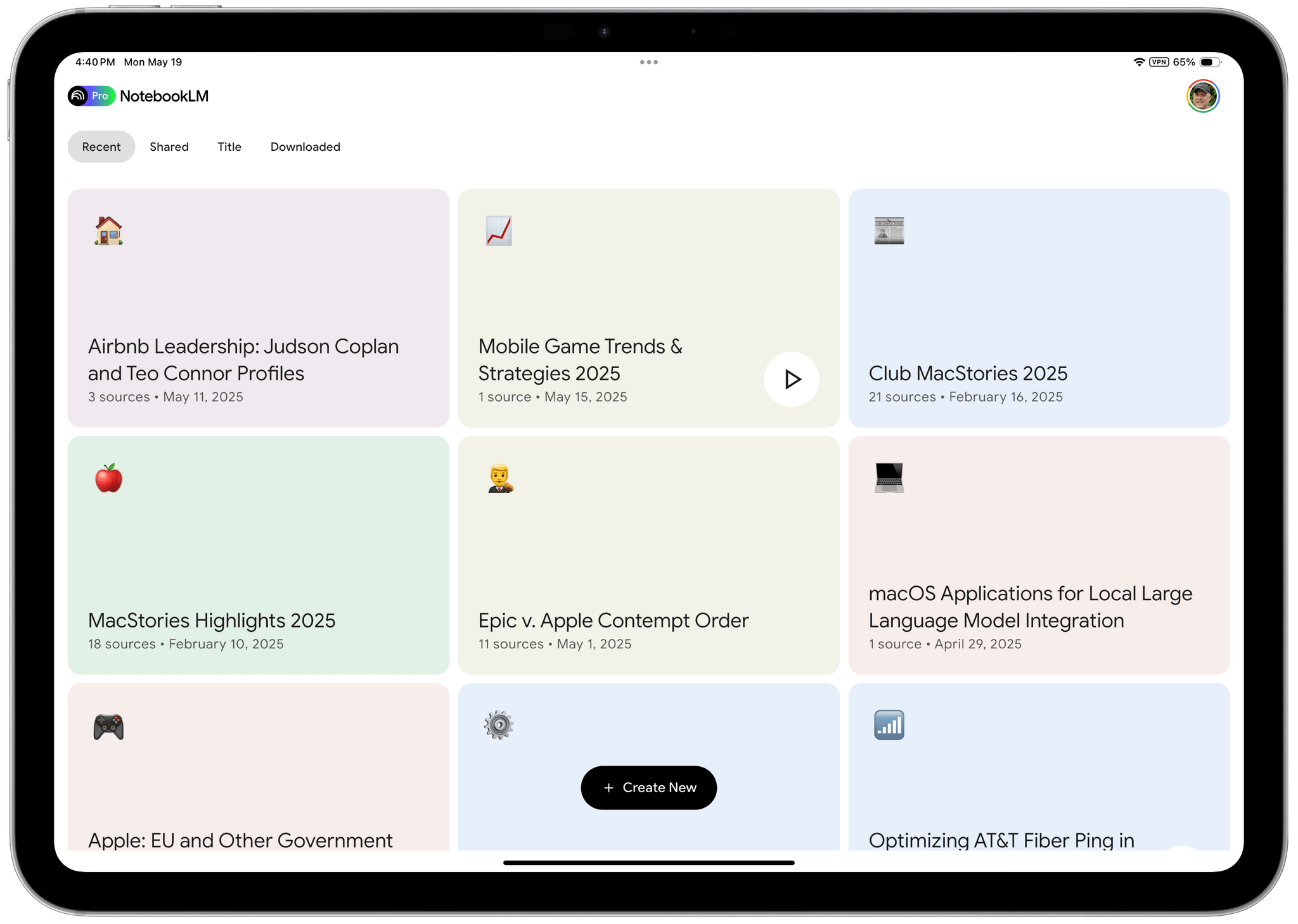
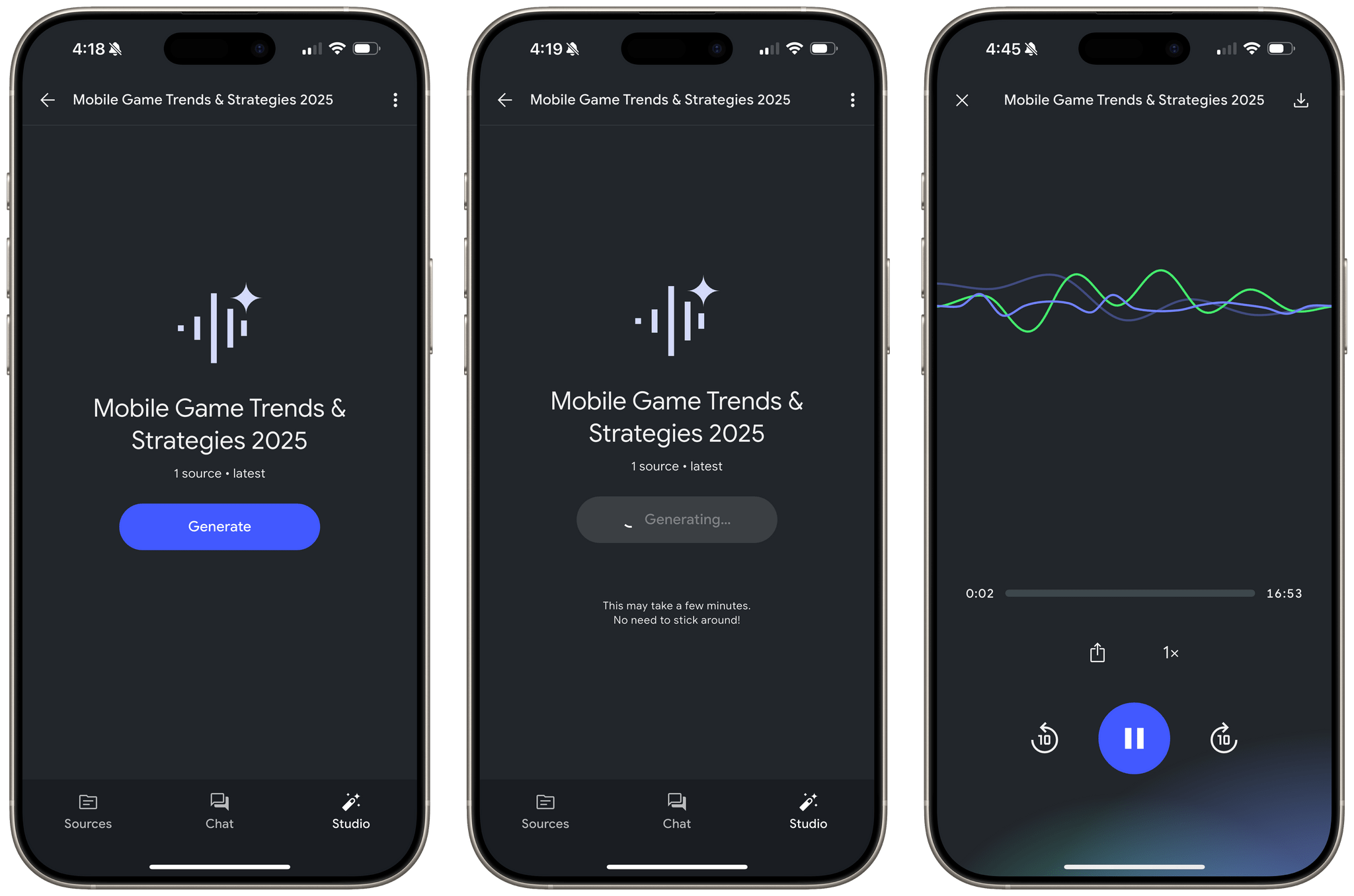
Just like the web app, you can create, edit and delete notebooks, add new sources using the native file picker, view existing sources, chat with your sources, create summaries, timelines, and use the Studio tab to generate a faux podcast of the materials you’ve added to the app. Notebooks can also be filtered and sorted by Recent, Shared, Title, and Downloaded. Unlike the web app, you won’t see predefined prompts for things like a study guide, a briefing document, or FAQs, but you can still generate those materials by asking for them from the Chat tab.
NotebookLM’s native iOS and iPadOS app is primarily focused on audio. The app lets you generate audio overviews from the Chats tab and ‘deep dive’ podcast-style conversations that draw from your sources. Also, the audio generated can be downloaded locally, allowing you to listen later whether or not you have an Internet connection. Playback controls are basic and include buttons to play and pause, skip forward and back by 10 seconds at a time, control playback speed, and share the audio with others.
What you won’t find is any integration with features tied to App Intents. That means notebooks don’t show up in Spotlight Search, and there are no widgets, Control Center controls, or Shortcuts actions. Still, for a 1.0, NotebookLM is an excellent addition to Google’s AI tools for the iPhone and iPad.
NotebookLM is available to download from the App Store for free. Some NotebookLM features are free, while others require a subscription that can be purchased as an In-App Purchase in the App Store or from Google directly. You can learn more about the differences between the free and paid versions of NotebookLM on Google’s blog.