Federico Viticci

906 posts on MacStories since April 2009

Federico is the founder and Editor-in-Chief of MacStories, where he writes about Apple with a focus on apps, developers, iPad, and iOS productivity. He founded MacStories in April 2009 and has been writing about Apple since. Federico is also the co-host of AppStories, a weekly podcast exploring the world of apps, Unwind, a fun exploration of media and more, and NPC: Next Portable Console, a show about portable gaming and the handheld revolution.

This Week's Sponsor:

Turbulence Forecast

Know before you go. Get detailed turbulence forecasts for your exact route, now available 5 days in advance.


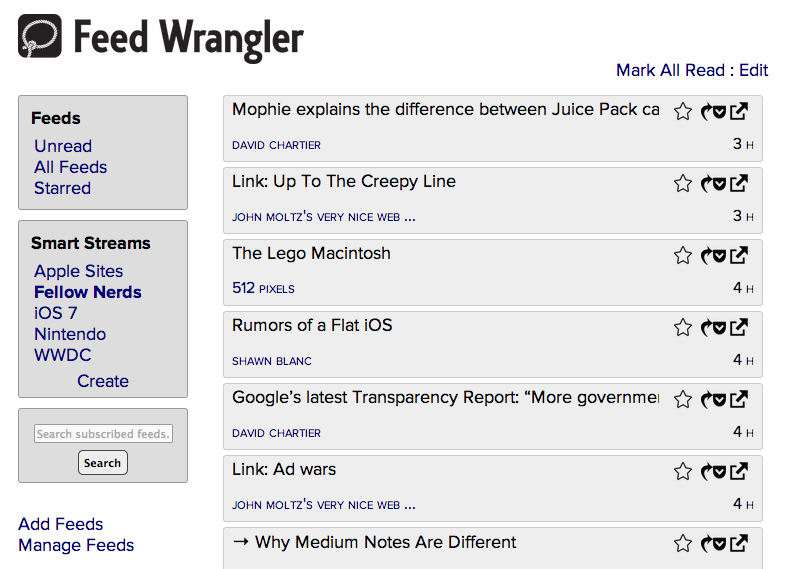
Feed Wrangler: A New RSS Reader With Smart Streams, Filters, Read Later Integration

Feed Wrangler

Feed Wrangler

“I wanted to take a slightly different take on the concept of what an RSS platform should do”, David Smith, independent developer and podcaster, told me about his new product, Feed Wrangler.

Soon after Google revealed they would discontinue their RSS service Reader this July, a slew of companies were quick to announce their existing news reading apps would either support “importing” features to let Google Reader users quickly migrate or, in some cases, be updated with APIs cloning the unofficial Reader one, allowing other developers to tweak their RSS clients for new API endpoints. This is what apps and services like Flipboard, Zite, Digg, and Feedly are doing. Instead, David Smith did something different: he announced he’d be launching an entirely new RSS syncing service, called Feed Wrangler, for an annual fee:

I believe the reason that Google turned its back on Reader and left its users hanging is that they were users not customers. I’m not interested in building a platform designed to attract as many users as possible and then work out how to sustain it later. I want to instead build something that is sustainable from Day 1. I want my customers to feel confident that they can expect this to be around long into the future. I want to build a relationship with them and make something they really, really love.

Feed Wrangler, open to the public today, comes with a website, a suite of native apps, and a $19 annual subscription. Read more


RSS.app

RSS.app

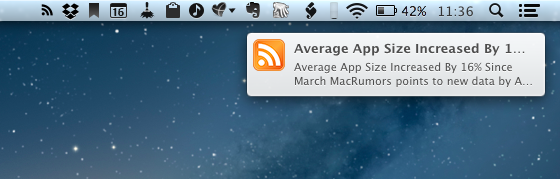
RSS.app is a very simple Mac app developed by Joost Schuttelaar following the removal of RSS feeds from Mail and Safari in Mountain Lion. RSS.app sits in the menubar, and checks for updates to your feeds every few minutes or hours. It then displays new article alerts using Notification Center.

The app is almost invisible: It is embedded in the status menu and uses Mountain Lion’s Notification Center to alert you of new posts. You can use RSS.app to import your existing list of RSS feeds from Apple Mail — even after you’ve updated to Mountain Lion.

The list of feeds to check can be configured in the app’s preferences, and you can import feeds from Mail even if you’ve already upgraded to Mountain Lion. The app is extremely simple: it’s got no keyboard shortcuts, menus, or distracting interface elements – it’s just a menubar checker for RSS feeds. Clicking on a notification will take you to the article using your default browser, and that’s it.

As Michael Tsai noted, the app has been rejected by Apple because of rule 2.8, which says “Apps that are not very useful or do not provide any lasting entertainment value may be rejected”.

If you think RSS.app can be useful to you, download it here.

Permalink

Apple “Discussing” TV Subscription Service with “New Technology To Deliver Video”

As reported by The Wall Street Journal in an article detailing some of the challenges Apple’s new CEO Tim Cook will have to face in the post-Jobs era and many of the achievements of the company’s former chief executive, Apple is allegedly working on a new technology to deliver video to televisions:

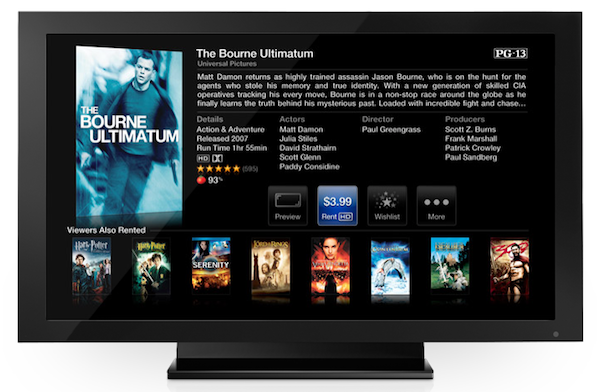
An immediate challenge for Mr. Cook will be to advance Apple’s plans in what is expected to be a key market for growth: digital video. Apple is working on new technology to deliver video to televisions, and has been discussing whether to try to launch a subscription TV service, according to people familiar with the matter. Unlike the iPod and music, where Apple has a commanding position, the battle to rule online video remains wide open and the company faces fierce competition.

No additional details are provided in the report, although speculation of new TV products from Apple has increasingly suggested in the past months that, just like with the iPod, iPhone and iPad before, the company is now aiming to disrupt another market that’s long been dominated by services, corporations and standards that don’t make it easy for consumers to have an optimal user experience. Specifically, rumors of an HDTV from Apple have been circulating for years, pinpointing what turned out to be incorrect release dates, tech specs, and prices. However, these rumors have a reason to exist, as they’ve been subtly backed by Steve Jobs’ public criticism towards the current TV business model and cable companies, described as clumsy, complicated, and ultimately bad for consumers. At the D8 conference last year, when asked about whether Apple could get into the television business, Jobs replied:

The television industry fundamentally has a subsidized business model that gives everybody a set-top box for free, or for $10 a month, and that pretty much squashes any opportunity for innovation, because nobody’s willing to buy a set-top box. Ask TiVo, ask ReplayTV, ask Roku, ask Vudu, ask Google in a few months. So all you can do is add a box onto the TV system. […] The only way that’s ever going to change is if you can really go back to square one and tear up the set-top box, and redesign it from scratch with a consistent UI, across all these different functions, and get it to the consumer in a way that they’re willing to pay for it. Right now there’s no way to do that. So that’s the problem with the TV market.

The Wall Street Journal’s report doesn’t mention any new hardware from Apple, focusing on subscription services and technologies to stream video to televisions. However, as Apple is known for driving innovation by integrating software with their own hardware, it’s likely that when the company will find it “viable” to get into the TV market, they’ll do so by releasing their own hardware tightly integrated with a “new technology” and “subscription TV service”. Apple currently sells the Apple TV 2nd-gen – described multiple times by Jobs and Cook as a “hobby” – that runs a modified version of iOS and comes with a native Netflix app for instant movie streaming; recently the company added the possibility to stream any previously purchased content from the iTunes Store to the Apple Tv through their new iCloud platform. It was reported back in April that Apple added 12 petabytes of storage to their server farms for serving iTunes Store video, and a separate report mentioned Apple could soon launch a service similar to Netflix to stream movies and TV shows for a monthly fee.


WSJ Starts Selling Single-Issues Using In-App Purchases

As reported last night, the Wall Street Journal has updated its official iPad application to include the possibility for readers to buy single issues for a specific day. These single-issues downloads are available as $1.99 in-app purchases, whilst “regular” WSJ monthly and weekly subscriptions are still being sold through a website – which is embedded into the WSJ app for login and purchasing option. At this point, it seems that the WSJ is slowly complying to Apple’s in-app purchase and subscription policies but it’s not quite there yet. Recently, Apple started enforcing a rule that requires developers to implement in-app purchases as an option by default in iOS apps that come with extra, purchasable content.

Single issues (up to a week) can be viewed in the “start screen”. Here, you can choose to buy one or subscribe to the WSJ. iPad subscribers also get free unlimited access to WSJ.com, iPhone and Blackberry apps. Single issues don’t carry any kind of additional benefit as they’re simply tied to an iTunes account.

The WSJ app for iPad is free, and it’s available here. Read more


Choosy: Choosing the Right Browser for You Since 2008

Though a few months ago I wrote a huge roundup about the ultimate list of browsers for Mac which featured more than 40 of them, there are actually 4 main browers: Safari, Firefox, Opera and Chrome. The rest is either made of variations / beta versions or just shit. That said, if you’re a designer or a developer it’s very likely that you need to test the websites you’re creating under different rendering engines. But what a pain can be to manually open overtime a different link in a different browser? A huge pain.

Here’s where Choosy comes in.

Read more


Designing Fontcase

As a part of the MacStories Apps Tree event (where you’ll find a huge giveaway worth $10.000 of 300 Mac and iPhone apps licenses), I thought it would be nice to hear the voice of Mac developers about the steps that go into desigining and developing an application for Mac OS X.

This is the first guest post by Pieter Omvlee, developer of Fontcase. Fontcase is a beautiful font manager that enables the users to manage a font library with elegance. Read my review if you missed it.

Enjoy!

Read more


Designing a Tablet Newspaper Application

This is one of the most interesting “I would make the Apple Tablet like this” post I’ve recently stumbled upon. Kyle Baxter from TightWind shares his thoughts about what he would like to see most in the tablet: newspapers. But instead of just converting the current newspapers layouts to the tablet screen, Kyle designed two mockups which show a revamped interface for the NYT, made of a top toolbar for easy navigation and a very few UI elements. I personally don’t think the Apple Tablet will be exclusively focused on saving the press industry, I believe there will be a built-in News.app, which will actually save both the press and RSS industry.

And if there’ll be a News app, I’d like to see a similar interface.

Read more


Billings Touch Sneak Peek

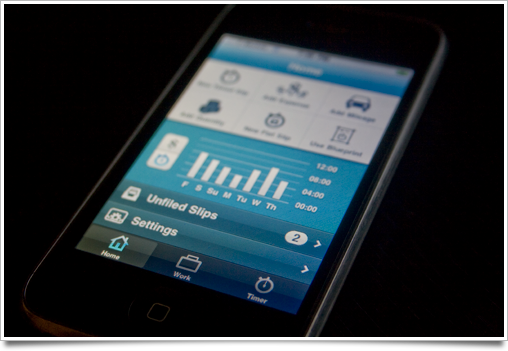
Sebastian de With of Cocoia has just posted an exclusive sneak peek of the upcoming Billings Touch for iPhone.

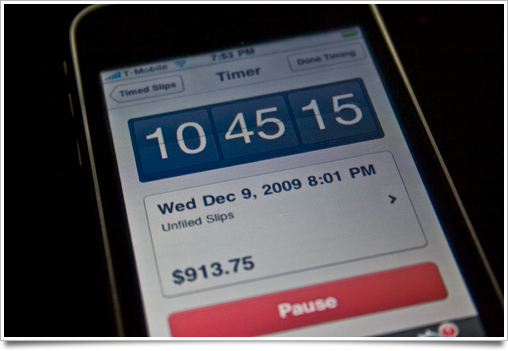
Here are some screenshots from his blog:

And a brief description:

“I can’t divulge much about it yet, but the app does pretty much everything I ever dreamed of having in my pocket for my on-the-go demands. I’ve even come to use its timer as a punch clock next to my computer so I can even more effortlessly pause or resume my time tracking when I go off to brew a nice cappuccino.

In short: the app syncs with your Mac database of Billings (and vice-versa, new slips and invoices you created and tick off on your iPhone get synced back to your Mac over the air), and every single nook and cranny is wonderfully designed, as I’ve come to expect from Marketcircle.

It also works great without the desktop app: as a standalone app, it’s already a very powerful set of tools to add to your workflow.”

It’s looking great.