Federico Viticci

10804 posts on MacStories since April 2009

Federico is the founder and Editor-in-Chief of MacStories, where he writes about Apple with a focus on apps, developers, iPad, and iOS productivity. He founded MacStories in April 2009 and has been writing about Apple since. Federico is also the co-host of AppStories, a weekly podcast exploring the world of apps, Unwind, a fun exploration of media and more, and NPC: Next Portable Console, a show about portable gaming and the handheld revolution.

An iPad Gesture Dilemma

Tom Warren, writing for The Verge, poses an interesting question: if Apple is going to release a Home button-free iPad, are they going to implement the same Home gesture as the iPhone X?

At its launch back in 2010, the iPad was heavily criticized for being a big iPhone. iOS 11 and the iPad Pro proved that wasn’t the case. Things further diverged with the introduction of the iPhone X, which has led to some confusion for anyone who regularly uses an iPad. I’ve been using an iPhone X and iPad Pro together for nearly six months now, and I often feel lost when moving back and forth between the devices — one with a physical home button, the other with webOS-like gestures. The result is a vastly different user experience, even though they run the same version of iOS on large rectangles of glass.

Now, Apple is rumored to be ditching the home button on the iPad Pro in favor of Face ID. It’s a move that makes sense, and it will present Apple with an opportunity to more closely align its tablet with the iPhone X gestures or to further differentiate the iPad as an entirely different computing platform (one that’s wholly separate from the iPhone, in the same way that the iPhone is distinct from the Mac, Apple TV, and Apple Watch). Either way, Apple is facing an iPad gesture dilemma.

I’m not sure if Apple should strive for gesture consistency between the iPad and iPhone at all costs (personally, I don’t find switching between my iPhone X and iPad Pro confusing), but this becomes a fascinating design discussion if the iPad is indeed abandoning the physical Home button.

Assuming Apple uses the same Home button indicator at the bottom of the screen (you can’t use the side on an iPad, as that’s dedicated to Slide Over), how is the dock going to coexist with a vertical swipe gesture to go back Home? Should you perhaps be able to swipe on the indicator to exit apps, and around it to quickly reveal the dock? Alternatively, what if the half-step swipe gesture to open multitasking on the iPhone X becomes the new way to show the dock on both the iPhone and iPad? If the rumor is true, I’m extremely curious to see what Apple does with gestures on the new iPad.

Permalink

Scotty Allen: “How I Upgraded My iPhone Memory 800%”

You may remember Scotty Allen and his excellent YouTube channel Strange Parts (one of the best recent additions to my subscription list) for a video he shared in September about adding a headphone jack to the iPhone 7. After modding his iPhone with a custom case and backlit logo, Allen is back with the “ultimate” upgrade: after many failed attempts, he was able to replace his iPhone’s built-in storage, expanding it to 128 GB (up from 16 GB).

As with his headphone jack video, this is not a process that most people can try: it involves soldering, obtaining a compatible iPhone flash storage unit, and a device to manipulate data directly on the chip. However, this is a fascinating look into the world of spare iPhone parts available in Shenzhen, and I highly recommend watching the video below.

Permalink

TMI: Managing the Information Firehose

AppStories+ Deeper into the world of apps

AppStories Episode 50 - TMI: Managing the Information Firehose

0:00
31:03

AppStories+ Deeper into the world of apps

In part one of a two-part topic, Federico and John explore the apps they use to manage information overload and interruptions.

Read more


Finances for iOS Adds Invoice Scanning Powered by iOS 11’s Vision Framework

Matthias Hochgatterer, in a blog post detailing the invoice scanning feature he brought to Finances for iOS with an update released today:

I’ve just recently worked on invoice scanning for Finances. It lets you scan invoices on iPhone or iPad and add them as a PDF document to transactions. In this post I will show you how I’ve implemented that feature using the frameworks available on iOS.

Let’s start by looking at the final result. You can see the invoice scanning in the Finances trailer. The user interface looks very similar to the document scanning UI in Apple’s Notes app on iOS 11. That’s not a coincident. I’ve reimplemented the exact same user interface, because most iOS users are already familiar with it. Also I found it an interesting challenge to implement it myself.

I’ve been considering Finances (which is available both on Mac and iOS and is on sale for both platforms today) as a replacement for the system I built in Numbers last year, which isn’t scaling anymore (my accountant now wants me to upload PDF receipts to a Trello board, and traditional spreadsheets do not support inline file attachments). I’m intrigued by the cross-platform nature of Finances, its double-entry bookkeeping system, and this new Notes-like scanning mode built using Vision technologies in iOS 11. I haven’t seen other apps publicly advertise scanning functionalities built using Vision and the implementation in Finances looks extremely well done.

I will be playing around with Finances over the weekend (I know; usually, this isn’t what I do with my weekends but I also need to keep my accountant happy). You can take a look at Finances’ new trailer below.

Permalink

Connected, Episode 187: On the Edge

This week, the trio ponder the future of Apple’s Mac and iOS platforms and explore what merging them may look like before talking about a recent Apple hire.

This week’s episode of Connected is a good one: following rumors of Apple developing their own ARM chips to use in future Macs, we discuss the potential of a single unified Apple platform to supersede both iOS and macOS. You can listen here.

Sponsored by:

  • Squarespace: Make your next move. Enter offer code CONNECTED at checkout to get 10% off your first purchase.
  • Pingdom: Start monitoring your websites and servers today. Use offer code CONNECTED to get 30% off.
  • Freshbooks: Online invoicing made easy.
Permalink

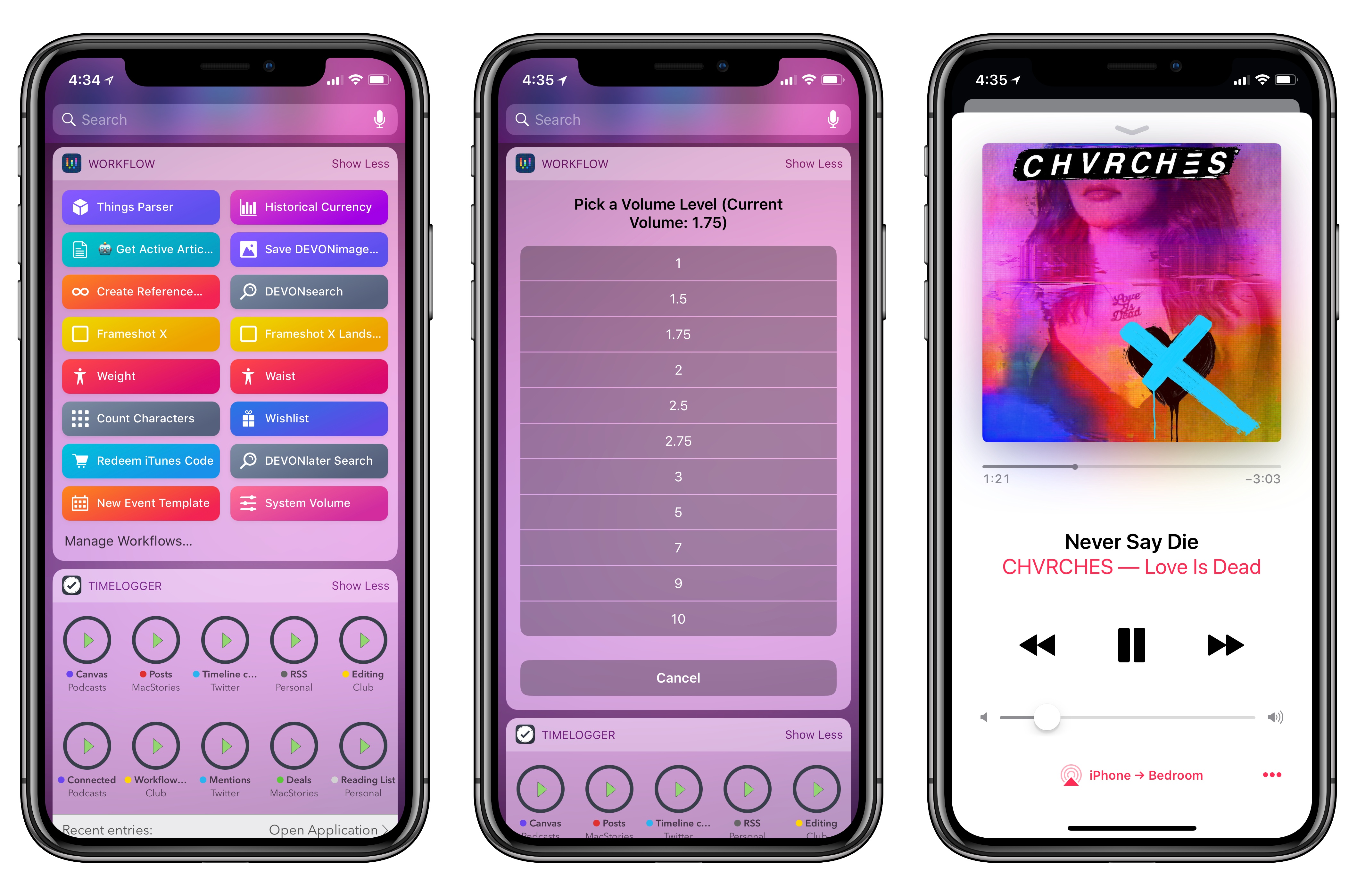
How to Adjust iOS’ Volume via Workflow When Streaming Audio to HomePod

One of Workflow’s least known functionalities is its ability to get details about the hardware it’s running on and control some system features. Among these, Workflow can both retrieve an iOS device’s current volume level and set the volume. A few days ago, I realized I could make a workflow to quickly adjust my iPhone’s volume when streaming music to one of our HomePods. Unlike other automations I’ve crafted over the years, this workflow was quite a success in our household and I felt like it was worth sharing with the wider MacStories audience.

Read more


iOS 11.3 and HomeKit’s Software Authentication

Mikah Sargent, writing for iMore, on the importance of software-based authentication for HomeKit devices that Apple officially rolled out with iOS 11.3 last week:

Up to this point, commercial accessories were also required to incorporate Apple’s hardware-based Authentication Coprocessor in order to obtain HomeKit certification. The coprocessor handled Apple’s strict rules for encryption and security for HomeKit-enabled accessories. Apple takes HomeKit security seriously — the company says all HomeKit sessions are end-to-end encrypted and mutually authenticated (authenticated by all parties). Each communication session also includes something called “perfect forward secrecy,” meaning that encryption keys aren’t reused — a new key is generated for every session.

These strict rules meant most companies had to build accessories specifically with Apple’s HomeKit requirements in mind. It was a beneficial rule for consumers in terms of privacy and security, but it also meant — at least at the beginning — fewer available HomeKit-enabled accessories. Companies who already had smart home products on the market would need to rethink their products if they wanted to offer HomeKit-enabled accessories. That changes as of iOS 11.3.

I was under the assumption that HomeKit software authentication was already available since Apple announced it at WWDC ‘17 (in fact, I covered it in my iOS 11 review here). As Sargent notes on Twitter, however, accessory makers only received support for software authentication with iOS 11.3, which explains why we haven’t heard of major “HomeKit software updates” yet. Assuming that Apple’s certification process for HomeKit accessories is still going to take weeks, I’m curious to see if software authentication will at least make it easier for third-party manufacturers to consider HomeKit integration.

Permalink

Progressive Web Apps on iOS 11.3

Great overview by Maximiliano Firtman on progressive web apps, which are now supported on iOS 11.3 thanks to new web technologies Apple adopted in Safari 11.1.

I wouldn’t call progressive web apps a “replacement” for native software from the App Store (just read the list of technical limitations from Firtman’s article), but they are indeed a remarkable improvement over how Safari used to save web apps to the Home screen. I recommend checking out these two lists to try some progressive web apps and see how they work on iOS. I spent way too much time playing around with Web Flap, a Flappy Bird clone that runs as a progressive web app and even supports offline mode on iOS 11.3.

Permalink