
Federico Viticci

10804 posts on MacStories since April 2009

Federico is the founder and Editor-in-Chief of MacStories, where he writes about Apple with a focus on apps, developers, iPad, and iOS productivity. He founded MacStories in April 2009 and has been writing about Apple since. Federico is also the co-host of AppStories, a weekly podcast exploring the world of apps, Unwind, a fun exploration of media and more, and NPC: Next Portable Console, a show about portable gaming and the handheld revolution.

Amazon Expands Echo Line

Amazon announced two additions to the Echo family this morning – the portable Tap and the Chromecast-like Dot. Dan Moren has a breakdown of the announcement and details.

I’m relatively new to the Amazon Echo (I shared the story of how and why I bought one on Connected), but, like many others, I’m liking it a lot. In my three weeks with the Echo, the ability to play music, set timers, and turn my lights and espresso maker on and off from anywhere around the kitchen without having to wait for Siri is starting to become second nature.

(In theory, this is exactly what Siri on the Apple Watch should do. Realistically, though, the Watch is simply too slow and HomeKit commands fail too often.)

Amazon is doing good work with expanding the Echo’s list of supported third-party services (unlike Apple). I’m intrigued by the Dot.
Permalink

Life and Death in the App Store

Casey Newton has a must-read story on the struggles of Pixite (makers of Pigment, among other apps) and the modern app economy:

For a time, Pixite was a shining example of the businesses made possible by the app economy. Like thousands of other developers, Pixite’s founders took what had been a side project and turned it into a full-fledged career. But the company’s recent financial problems illustrate a series of powerful shifts in the industry toward consolidation and corporatization.

For all but a few developers, the App Store itself now resembles a lottery: for every breakout hit like Candy Crush, hundreds or even thousands of apps languish in obscurity. Certain segments of the app economy remain vibrant — ludicrously profitable, even. Apps for massive social networks, on-demand services like Uber, and subscription businesses like Netflix and Spotify remain in high demand. Then there’s gaming: Last year, 85 percent of all app revenues went to games, according to App Annie. Supercell, the top-grossing developer of Clash of Clans, reported revenue of $1.7 billion in 2014. (It spent $440 million on marketing.)

The folks at Pixite have made some mistakes along the way, but the general shift on the App Store is undeniable.

Permalink

Slack’s 2016 Roadmap

Josh Constine, reporting on Slack’s plans to roll out voice and video chat this year:

The imminent release of voice and video chat could make offices noisier, but it will certainly make Slack more of a comprehensive communication solution rather than a tool plugged into a suite of other products. That might convince companies Slack is worth paying for.

Given Slack’s focus on making work searchable, it’s easy to imagine that years down the line, Slack could use voice recognition to create transcripts of your voice or video meetings.

Here’s what I wrote when Slack acquired Screenhero in January 2015:

We use Slack at Relay, and, like many others, I like its integration with other services and apps. I always wondered if Slack would ever take on Skype, and I’m curious to see if what they’re building could be a possible solution for podcasters who are forced to use Skype today.

More than a year later, we use Slack intensively every day, and Skype is only being used to hold audio conversations with multiple people. If Slack’s take on voice chat supports channels and group calls and is sleek and stable enough, I think podcasters may want to keep an eye on it.

(Would Ecamm make a Slack Call Recorder, though? Would Slack consider automatically archiving those voice chats?)

Permalink


Where Cards Fall

Andrew Webster, writing on the upcoming game by my friend Sam Rosenthal, who’s collaborating with Ryan Cash and Snowman (makers of Alto’s Adventure):

When he was still a student at the University of Southern California, Sam Rosenthal started working on a game about building a house of cards. It was inspired in part by the Radiohead song “House of Cards,” which Rosenthal felt sounded “like a gentle plea to knock down a structure in favor of something new.” The game let you create structures, then break them down so that you could rebuild them in different ways. Rosenthal wanted the deconstruction and reconstruction to gradually tell a coming of age story about the wistfulness of adolescence, and the way important, sometimes devastating events can impact your life. “The longer the idea sat with me,” he says, “the more it became a lens that I use to see the world.”

After graduation, he worked various industry jobs, designing puzzles for Disney’s mobile hit Where’s My Water? and characters for Activision’s ubiquitous Skylanders series. The idea from school stuck with him, and in his spare time, he continued to tinker with it. A few years later, in 2013, Rosenthal met up with budding game designer Ryan Cash, and the two shared the projects they were working on. Cash had an early version of a snowboarding game, which would go on to become mobile hit Alto’s Adventure. Rosenthal revealed an early version of Where Cards Fall.

No gameplay images or videos yet, but I can already tell this will be worth paying attention to.

Permalink

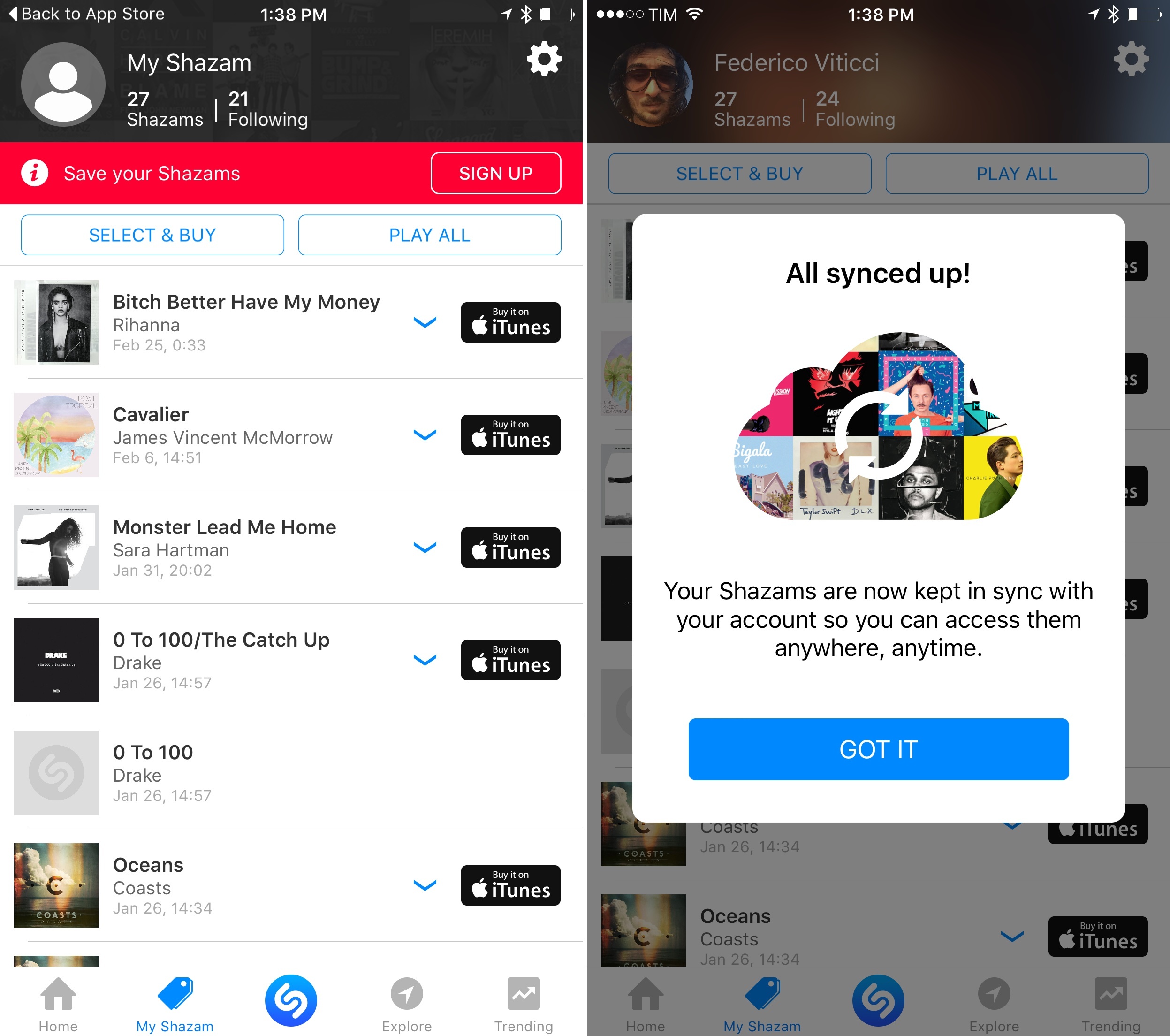
Shazam Adds Sync

I’ve long been a fan of Shazam – I use it daily to discover songs I hear on movies and TV shows. Version 9.4, just released on the App Store, finally brings a way to keep recognized songs available on all devices through a Shazam account.

Over the years, I’ve lost hundreds of tagged songs between clean installs of iOS and Shazam. It’s good to know this will no longer be a problem. Version 9.4 has currently rolled out for Shazam Encore only, but I assume the free Shazam app is getting an update shortly as well.

Permalink

Google Maps for iPhone Adds Pit Stops

Aditya Dhanrajani, writing on the Google Maps blog:

Life is full of the unexpected—things that send us scrambling for a gas station in the middle of nowhere, looking up a florist on our way home from work or searching for a restaurant as we tour the back roads of our latest vacation destination. Finding and navigating to these last-minute pit stops used to force you out of navigation mode in Google Maps—and away from the traffic updates, turn-by-turn directions and map you rely on to stay on track.

That changed last October with an update to Google Maps for Android that lets you add detours to your route, without ever leaving navigation mode. And starting today, this feature will start rolling out on iOS as well, in any country where we offer navigation—more than 100 worldwide. So no matter where you’re from, where you are, or whether you use Android or iPhone, making a pit stop is now a breeze.

This is going to be useful in Rome (which I don’t know well enough) and it’s another differentiator from Apple Maps. I also like that they added the ability to 3D Touch the app icon and start navigation to your Home address.

Permalink

Apple Music Connect, Seven Months Later

Dave Wiskus has been trying Connect, the social feature of Apple Music, for seven months. He now reports back on how the experiment has been going:

Imagine a social network where you can’t see how many followers you have, can’t contact any of them directly, can’t tell how effective your posts are, can’t easily follow others, and can’t even change your avatar.

Welcome to Apple Music Connect.

I first wrote about my experiences with Connect last year:

Someone asked why I believed that Connect would ever be better than Ping, Apple’s previous attempt at socialifying iTunes. Ping’s mistake was that it tried to connect listeners to each other, as a way of discovering new music. Apple Music has re-thought that problem in some very interesting ways, and early indications are that the new approach works. For the social component, Connect wants to be about connecting artists with their listeners, but at the moment, it falls short.

These are early days, and there’s hope.

The morning after I posted this I awoke to an email from Trent Reznor. He had spoken to Eddy Cue and the team about my concerns, and wanted to assure me that they were being addressed.

Apple has had seven months to get their s*** together. Have they?

The whole post is damning. I hate to say this, but so far those people who originally made fun of Connect as another Ping have a point.

Permalink

Sam Beckett’s Advanced Control Center Concept

Control Center was introduced with iOS 7 in 2013, since then, it has benefited from minor visual tweaks and the recent inclusion of a Night Shift toggle with iOS 9.3. In future updates, it would be great to see Control Center gain more hardware and system toggles, along with the ability for users to customise which toggles they require and where they are positioned. An enhanced Control Center could also add support for 3D Touch for additional options and introduce a new system-wide dark mode.

I don’t typically publish iOS concepts on MacStories, but Sam Beckett’s latest video is so close to my idea for a customizable Control Center (see last year), I just couldn’t resist. Tasteful, well researched, and with some great ideas for integrating 3D Touch, too.

Permalink