iOS and iPadOS 17 Review Stats, Plus Two New Obsidian Plugins
...

 iOS and iPadOS 17 Review Stats, Plus Two New Obsidian Plugins
 Apple published an extensive support document about the USB-C connector on the new iPhone 15 lineup (we should be receiving our new iPhones later this week at MacStories, so stay tuned for our coverage), and a few details about compatibility with external displays caught my attention.
For starters, yes – Apple implemented DisplayPort connections over USB-C just like on the iPad Pro. The iPhone, however, is limited to a lower resolution:
iPhone uses the DisplayPort protocol to support connections to USB-C displays at up to 4K resolution and 60Hz.
Note that the latest iPad Pros support connections up to 6K, allowing you to connect an iPad Pro to a Pro Display XDR if you hate your wallet. You can try this with an iPhone 15 too, but display resolution is going to be limited to 4K. The Studio Display will be supported too, obviously.
Another tidbit from Apple’s support document:
You can connect your iPhone to an HDMI display or TV with a USB-C to HDMI adapter or cable. Adapters and cables that support HDMI 2.0 can output video from your iPhone at 4K resolution and 60Hz.
The Apple USB-C Digital AV Multiport Adapter is compatible with iPhone. This adapter can output video from iPhone at up to 4K resolution and 60Hz, including content in HDR10 or Dolby Vision if your display or TV supports HDR.
If my theory is correct, we should soon be able to connect an iPhone to an HDMI capture card (such as the ones I covered in my iPadOS 17 review) via Apple’s adapter and an HDMI cable, connect the capture card to an iPad, and use a compatible app to see the iPhone’s display on your iPad. That could be used for screencasts, playing videos from an iPhone on the iPad’s display, or, better yet, play a videogame from the iPhone in a Stage Manager window on the iPad.
The iPhone itself doesn’t support Stage Manager, so, unlike Samsung phones, it can’t be turned into a desktop workstation when plugged into an external monitor (I hope this happens down the road though). However, I do believe we’re going to start seeing some interesting experiments with iPhones being used as handheld gaming consoles with external monitors. Whether you’ll be using a capture card to turn an iPad into an external monitor for an iPhone using apps like Orion1 or Genki Studio2 or connect it to a portable OLED display, I think this newfound hardware modularity is going to be fascinating to observe.
 iOS and iPadOS 17: The MacStories Review
In the year when the vision is elsewhere, what do you get the OS that has everything?
Well, last year was weird.
For the first time since I started writing annual reviews of Apple’s two mobile operating systems – iOS and iPadOS – I published a review without the iPad part. Or rather: I had to publish it a month later given the mess Apple found itself in with Stage Manager for iPadOS 16 and its half-baked, embarrassing debut.
I don’t want to go over the specifics of that entire saga again and how we got to a shipping version of Stage Manager for iPadOS 16 that didn’t meet my expectations. Spoiler alert: as we’ll see later in this review, Apple listened to feedback and fixed the most glaring issues of Stage Manager in iPadOS 17, striking the balance between “guided multitasking” and freeform window placement that was missing from last year’s debut. Stage Manager for iPadOS 16 will remain another blip in the iPad’s long and storied history of ill-fated multitasking features. There’s no need to talk about it again.
I want to explain, however, why the past 12 months have been different than usual in iOS and iPadOS land beyond the fact that I couldn’t work on my iPad Pro for the first half of 2023.1
Following the launch of iOS 16 with its Lock Screen widgets and after Apple wrapped up work on the last big-ticket item on the iOS 16 roadmap (Live Activities for the Lock Screen and Dynamic Island, which launched in late October), it felt like the entire Apple community only started thinking about one product for the next six months: the headset. What would later be known as the Vision Pro and visionOS platform became the topic of conversation in Apple-related publications, podcasts, and YouTube channels. Leading up to WWDC 2023, anticipation surrounding the upcoming headset eclipsed anything related to other platforms.
And rightfully so. As I explained in the story that I wrote after I was able to try a Vision Pro at Apple Park, the excitement was justified. It’s always a rare occurrence for Apple to introduce a new hardware product with associated software platform; but to do so with a mind-blowing experience unlike anything I ever tried before in my life is truly something special. Apple had been working on visionOS and Vision Pro for years, and we were all thinking about it and waiting for it at WWDC. And the company delivered.
This context is necessary because the visionOS/Vision Pro development timeline explains what’s going on with iOS and iPadOS 17 this year. Both OSes are grab-bag style updates with a collection of welcome enhancements to different areas of experience. I quipped years ago that modern iOS updates need to have a little bit of everything for everyone; that has never been more true than with iOS 17, albeit for a different reason this time: most likely, because Apple didn’t have time to also deliver big, vision-altering upgrades on the iPhone this year.
iOS and iPadOS take a bit of a secondary role in 2023, happily conceding the spotlight to a new software platform that hasn’t launched yet, but which developers around the world are already testing in person.
To be clear, I am not complaining. iOS and iPadOS 17 may not have an industry-defining, obvious tentpole feature, but in their approach to offering miscellaneous improvements, they’re fun and interesting to cover. Of the two, iPadOS is the one that suffered from lack of development resources the most and whose strategy could be easily summed up as “it’s iPadOS 16, but we fixed Stage Manager”. Which, again, given the circumstances, is absolutely fine with me.
While Apple was busy with visionOS this summer, I was having fun exploring iOS 17’s collection of app updates and, as we’ll see in this review, extensive upgrades to one system feature: widgets.
As always every year: let’s dive in.
Apple’s 2023 Watch and iPhone Event 
This week, Federico and John are joined by Alex live in the Club MacStories+ Discord community for a special episode covering their initial impressions of Apple’s Wonderlust media event, which introduced new iPhones, Apple Watches, and more.
A major change introduced by iPadOS 17 that is going to make video creators and gamers happy is support for UVC (USB Video Class) devices, which means an iPad can now recognize external webcams, cameras, video acquisition cards, and other devices connected over USB-C. I started testing iPadOS 17 thinking this would be a boring addition I’d never use; as it turns out, it’s where I had the most fun tinkering with different pieces of hardware this summer.
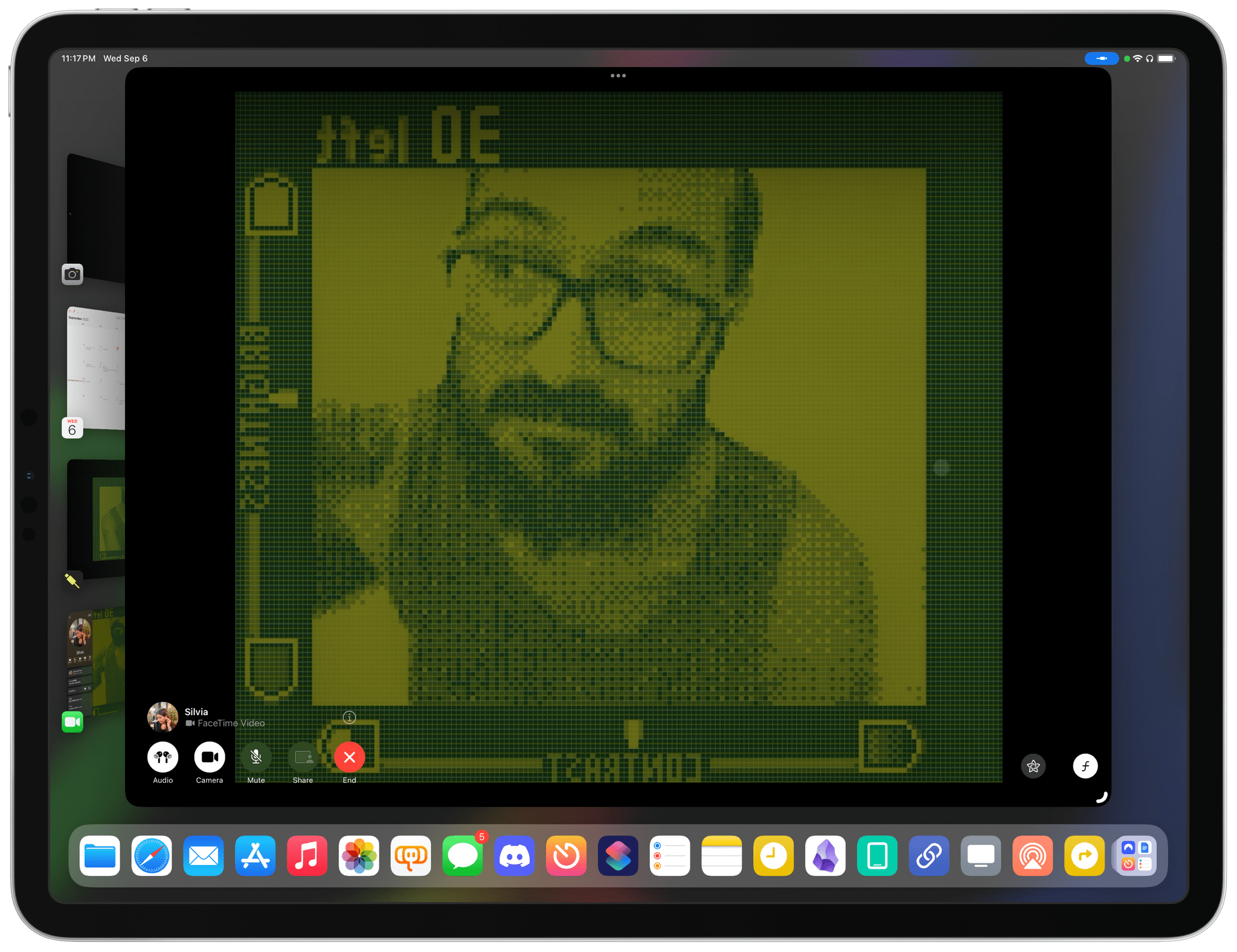
Most of all, however, I did not anticipate I’d end up doing FaceTime calls with a Game Boy Camera as my iPad Pro’s webcam.
I’m in the process of writing my annual iOS and iPadOS review, and in the story I’ll have plenty more details about the changes to iPadOS 17’s Stage Manager and how I’m taking advantage of UVC support to play Nintendo Switch and Steam Deck games on my iPad’s display. But in the meantime, I wanted to share this Game Boy Camera story because it’s wild, ridiculous, and I love it.
Bookmarking Apps Revisited
This week, Federico and John look at the history of bookmarking apps, their relationship to read-later apps, how their use of bookmarking apps has changed, and their favorite modern bookmarking apps.
Two Stage Manager Tips for iPadOS 17
Four Smaller Features from iOS 17  John
John