
Federico Viticci

10804 posts on MacStories since April 2009

Federico is the founder and Editor-in-Chief of MacStories, where he writes about Apple with a focus on apps, developers, iPad, and iOS productivity. He founded MacStories in April 2009 and has been writing about Apple since. Federico is also the co-host of AppStories, a weekly podcast exploring the world of apps, Unwind, a fun exploration of media and more, and NPC: Next Portable Console, a show about portable gaming and the handheld revolution.

App Stores and Discovery

Benedict Evans:

After the web directory the next stage was the ‘portal’ - a page with someone’s ideas of what might be useful. This is what Yahoo became, and it’s also what the front page of the iOS or Android app stores look like now. The purpose of these screens is not to allow people to discover your app or service - they cannot hope to be comprehensive in that way. The front pages of an app store do not exist to help developers - they can’t. Rather, they exist to help the users - to ease them into the idea of apps. But they can only scratch the surface of ‘discovery’.

Curation by the App Store’s editorial team can’t be enough if it’s not backed by robust search and discovery algorithms that can provide better search results and personalized recommendations. These are topics that I explored in July for the fifth anniversary of the App Store – and, to an extent, they can be applied to other content sold by Apple, like books and video.

Some may argue that Apple’s recent acquisition of Matcha.tv may signal an increased interest in content recommendation algorithms. While I have no doubt that Apple is working on this, it’s important to remember that the same was said for Chomp last year, and that didn’t result in an improved App Store search or recommendation experience on iOS 6. Maybe Matcha’s algorithm is truly different though, and Apple will find a way to use it to improve discovery on iTunes/App Store – but I wouldn’t expect improvements to become apparent any time soon.

Permalink


Macworld’s Review of “Jobs”

Philip Michaels reviews “Jobs” (opening in US theaters today):

But the script abandons these elements almost as soon as they appear, and the movie makers’ focus returns to marking off spaces on the Steve Jobs biography bingo card. Jobs sitting enraptured during a class about fonts? Check. Jobs tricking Woz out of his share of a bonus for developing Atari’s Breakout? Check. Jobs showing off the “1984” Macintosh commercial in its entirety? Check and mate. “This is like a video Wikipedia entry,” my colleague Armando Rodriguez told me after we finished screening the movie. That’s a harsh but not entirely inaccurate critique.

This is a common critique I’ve read in other reviews of Jobs as well. It would have been great to have something more than a documentary of Steve’s life and mannerisms starring Kutcher. I’ll still watch the movie, but I’m hoping Sorkin’s take will be something different and deeper.

Permalink

Reinventing iOS Automation: Editorial Review

Editorial for iPad

Editorial for iPad

Update: I have turned this review into an interactive book with additional & exclusive content. You can find it on iTunes, on sale for a limited time. More information is available here.

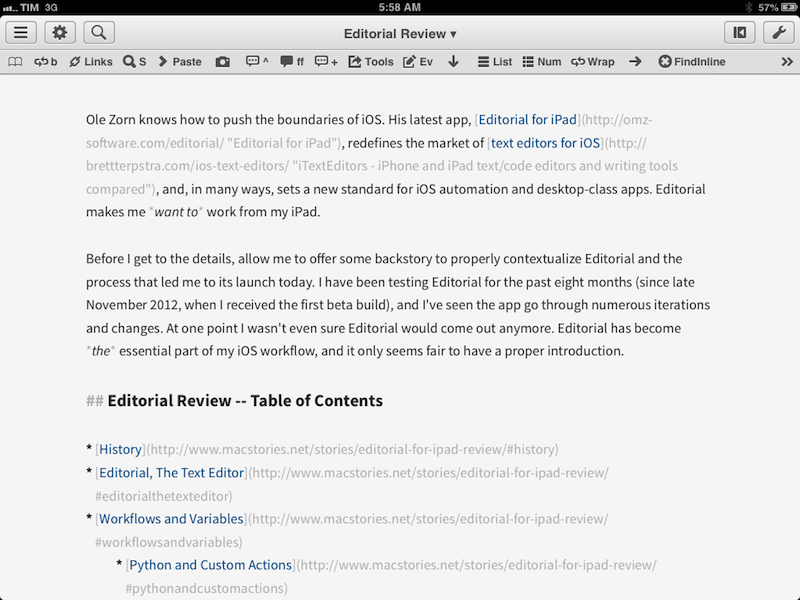
Ole Zorn knows how to push the boundaries of iOS. His latest app, Editorial for iPad, redefines the market of text editors for iOS, and, in many ways, sets a new standard for iOS automation and desktop-class apps. Editorial makes me want to work from my iPad.

Before I get to the details, allow me to offer some backstory to properly contextualize Editorial and the process that led me to its launch today. I have been testing Editorial for the past eight months (since late November 2012, when I received the first beta build), and I’ve seen the app go through numerous iterations and changes. At one point I wasn’t even sure Editorial would come out anymore. Editorial has become the essential part of my iOS workflow, and it only seems fair to have a proper introduction.

Read more


iOS 7 Apps and Aggressive Adoption

David Smith, on deciding to go iOS 7-only for his next app updates:

Today, I’ve reverted my position again. I am going to be aggressively adopting iOS 7 exclusively in my apps.

This change is mostly a result not so much of the technical or business implications of supporting legacy versions but of quality assurance needs. I have been able to manage working out the technical needs of supporting both versions but I have found that the time and energy required to test and validate the applications on both is becoming too much of a burden.

Aside from a technological standpoint, I think the most important factor to consider is that users can’t wait to get their hands on iOS 7. The new version is a major change, and – at least based on my survey of non-geeky friends – I suspect that more people will upgrade more quickly than last year (the launch of iOS 6 surely wasn’t helped by doubts surrounding Maps).

With users being so excited for iOS 7, the decision of going iOS 7-only makes sense. At least, it’s a common pattern that I’m observing this summer.

Permalink

AllThingsD: Apple Announcing New iPhone On September 10

According to Ina Fried at AllThingsD, Apple will announce a new iPhone at a media event on September 10:

Apple is expected to unveil its next iPhone at a special event on Sept. 10, sources told AllThingsD.

The launch comes at an important time for Apple, which continues to make a lot of money from the iPhone but has seen its global market share dip amid a growing wave of lower-cost Android devices as well as an intense battle with archrival Samsung.

AllThingsD has a solid track record with previous Apple event predictions, and it seems safe to assume this rumor will soon be backed by other well-connected sources.

If true, this could set Apple’s pattern history to repeat itself with new phones being released with iOS 7 pre-installed, and the new OS on track for a release 7-10 after the media event. A Golden Master seed of iOS 7 could be released to developers on the day of the event, with Apple asking developers to start submitting iOS 7 apps to the App Store on the same day. In 2011, Apple released the GM seed of iOS 5 on October 4 and asked developers to start submitting apps on the same day; last year, Apple held a media event, released a GM build of iOS 6, and emailed developers on September 12.

New iOS versions are typically released on Wednesdays (iOS 5 was released on October 12, 2011, and iOS 6 on September 19, 2012 – both Wednesdays), which could mean a release of iOS 7 on September 18 (alongside iTunes 11.1, in beta right now) with the new iPhone to follow on September 20 in a few initial markets (new iPhones are usually released on Fridays).

There are differences between this year and 2011/2012 for Apple – most notably, the fact that iOS 7 is a major rethink of iOS that may require more than a week between a GM build and the public release. But there are several minor differences as well: a Dev Center outage that lasted three weeks; a rumor that claimed Apple was forced to “pull away” resources from the iPad team earlier this year to focus on iOS 7 for the iPhone; the fact that iOS 7 beta for iPad was, indeed, released two weeks after the iPhone beta, with recent reports suggesting that the iPad build still isn’t nearly as fast and stable as the iPhone one. And, besides iOS 7, this year’s most prominent rumor – a low-cost iPhone that may or may not see Apple more aggressively entering new international markets. But how many at launch? Will Apple keep growing the list of initial launch countries? Will the low-cost iPhone be introduced on September 10 as well? Will the successor to the iPhone 5 be called iPhone 5S?

We’ll find out, if Ina Fried is right, on September 10.


The Boy Who Beat Ocarina of Time in 22 Minutes

This link isn’t strictly about Cosmo Wright’s Ocarina of Time speedrun – which, by the way, is incredible to watch. Make sure to read Computer and Video Games’ feature on it as well.

Rather, I’d like to point out these two tweets by Sonny Fazio in response to Peter Hajas, who originally shared the link to Cosmo Wright’s speedrun last night:

This is an interesting side effect of the App Store that I didn’t think about. Speedruns are an extremely fun-to-watch, but niche use case that, as Fazio notes, are generally facilitated by glitches and bugs in the source code of games. This goes beyond the App Store and extends to games sold on online platforms like Steam and PlayStation Network as well. Because of updates and patches, will it become increasingly difficult – if not impossible – for speedrunners to analyze and play through games in their original form decades from now?

In the video I linked above, for instance, Cosmo explains that a major glitch in Ocarina of Time took 13 years to be discovered and used. That was only possible thanks to the fact that a) Nintendo 64 cartridges are still physically available today and b) Nintendo’s conversion for the Wii’s Virtual Console is a 1:1 port of the original – bugs and glitches included. Can you imagine someone still playing an iOS game in 13 years?

Twenty or thirty years from now, will we see speedruns for iOS, PS3, or Xbox 360 games? Sadly, I think that a mix of retrocompatibility issues, OS and app updates, and lack of physical access to games will hinder speedrunning. Not to mention Apple’s current state of affairs with games and the gaming community.

Overall, Digital preservation is the bigger topic we should be discussing.

Permalink

The Anti-Apple

Horace Dediu has a great take on the reputed differences and actual similarities between Apple and Amazon:

What I take issue with is the premise that Amazon is the “anti-Apple” in its hunger for growth and patience for profits. Apple has its own “Amazon-like-business”: iTunes has been growing at a steady 25% or more and it also has its ancillary zero-profit hardware analogue to the Kindle called Apple TV. iTunes is a great business in the Amazon vein, harvesting hundreds of millions of users (and their credit cards.) Presumably iTunes could also some day “flip the switch” and become profitable, but something magical needs to happen. Something like becoming a payments processor or retailer of other things. Analyst beware however. There might be conditions that make such switch flipping extremely difficult.

Permalink

Wake-Up Call for New Yorkers

Winnie Hu and J. David Goodman, reporting for The New York Times on a case of child abduction on July 17, 2013:

You have a lot of people on the road at that hour,” said Robert Hoever, director of special programs at the National Center for Missing and Exploited Children, which tracks Amber Alerts across the country. “You’re looking for those eyes and ears to try to find that child.”

By Wednesday afternoon, the police said that they had found Ms. Lopez and her son in “good condition.” Ms. Lopez was arrested and charged with custodial interference. The police said she was found after the Amber Alert led to a tip to the department’s Crime Stoppers hot line.

And the key risk for non-mandatory AMBER alerts, later in the article:

One former state law enforcement official, Michael Balboni, said the alert system should be used prudently.

“It is crucial that emergency notification systems take every precaution to never ‘cry wolf’ or alert needlessly,” said Mr. Balboni, former deputy secretary of public safety for the state. “The risk is evident: If the public loses faith in the system, they may stop participating and the purpose of the system will be lost.


Permalink