Federico Viticci

10804 posts on MacStories since April 2009

Federico is the founder and Editor-in-Chief of MacStories, where he writes about Apple with a focus on apps, developers, iPad, and iOS productivity. He founded MacStories in April 2009 and has been writing about Apple since. Federico is also the co-host of AppStories, a weekly podcast exploring the world of apps, Unwind, a fun exploration of media and more, and NPC: Next Portable Console, a show about portable gaming and the handheld revolution.

iOS and iPadOS 14.5: The MacStories Overview

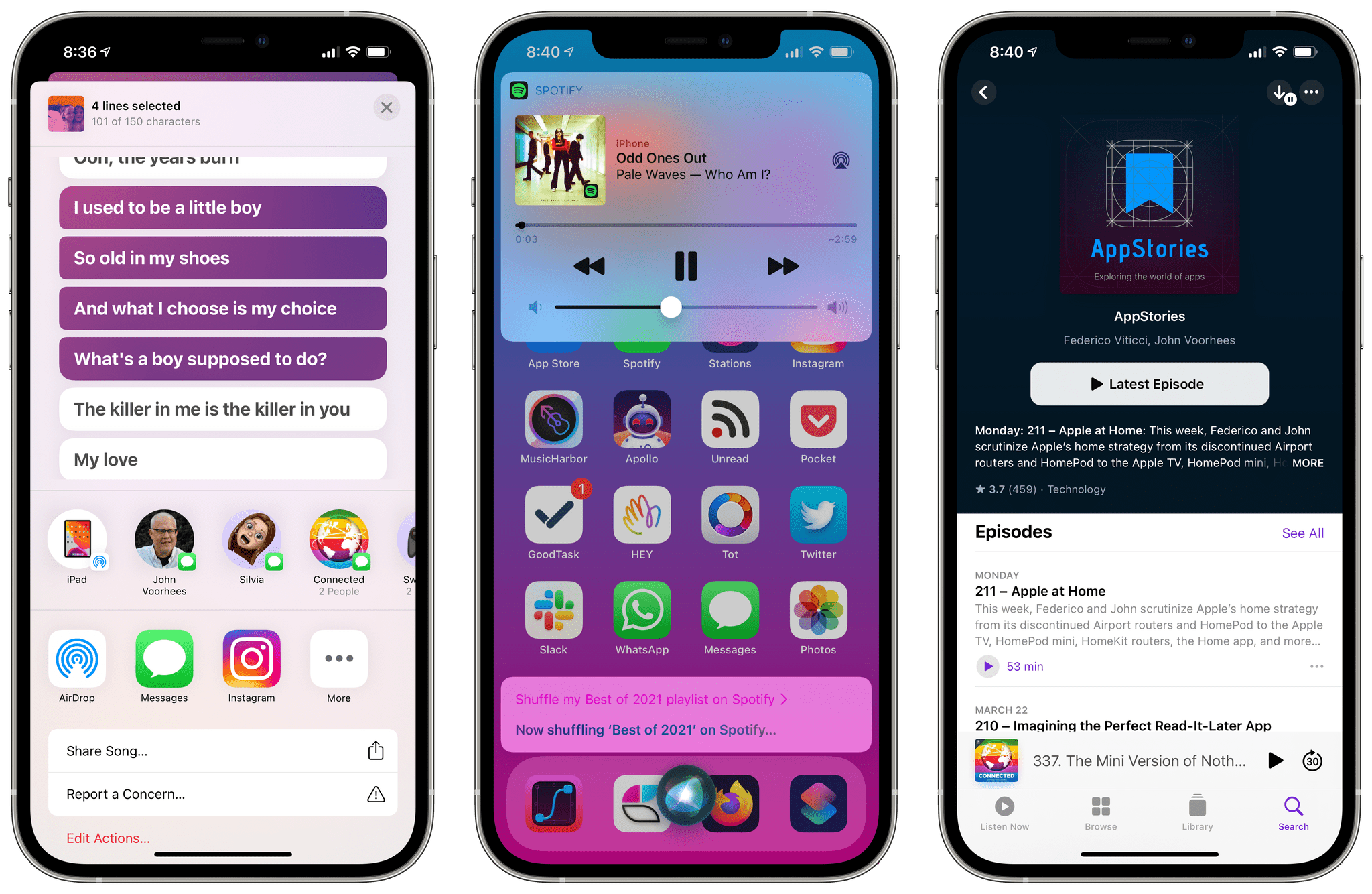
Shareable lyrics, third-party music services for Siri, and the refreshed Podcasts app in iOS 14.5.

Shareable lyrics, third-party music services for Siri, and the refreshed Podcasts app in iOS 14.5.

Apple today released version 14.5 of iOS and iPadOS, a substantial update to the operating system for iPhone and iPad that debuted in September and introduced features such as Home Screen widgets, multi-column app layouts on iPad, compact UI, a redesigned Music app, and more.

Version 14.5 is the biggest – or, at the very least, most interesting – update to iOS and iPadOS we’ve seen in the 14.0 release cycle to date. That’s not to say previous iterations of iOS and iPadOS 14 were low on new features and refinements – it’s quite the opposite, in fact. Perhaps the pandemic and Apple’s work-from-home setup played a role in the company spreading new iOS functionalities across multiple releases throughout 2020 and the first half of 2021, but, regardless of the underlying reason, iOS and iPadOS 14 have evolved considerably since their public launch six months ago.

With iOS 14.2, Apple shipped the traditional “emoji update”, but was also able to include a redesigned AirPlay interface, face detection in AR, and a brand new Shazam integration in Control Center; with iOS 14.3, the company rolled out its new ProRAW photography API alongside support for the Fitness+ service, App Clip codes, and the ability to launch apps directly from Home Screen shortcuts; version 14.4, released earlier this year, saw the arrival of proximity-based music handoff for iPhone and HomePod mini alongside new options for Bluetooth settings and other performance improvements.

It’s difficult to tell whether some of these features were originally planned for a September release and got delayed because of the pandemic1, or how many of these are Apple’s response to user feedback following the release of iOS and iPadOS 14, but one thing’s for sure: Apple hasn’t stood still over the past few months, and today’s iOS and iPadOS 14.5 are continuing the trend of major iOS and iPadOS updates released ahead of WWDC.

Let’s dive in.

Read more


iOS and iPadOS 14.5 In Depth

AppStories+ Deeper into the world of apps

AppStories Episode 215 - iOS and iPadOS 14.5 In Depth

0:00
58:40

AppStories+ Deeper into the world of apps

This week, Federico and John take an in-depth look at everything coming later this week with iOS and iPadOS 14.5, which will be the subject of a comprehensive review by Federico on MacStories.

Read more


‘The iPad Pro Is a Killer Machine but its Software Is Killing Me’

Jason Snell, writing for Macworld about the new iPad Pro’s software limitations compared to its powerful hardware:

With the announcement of USB 4/Thunderbolt support on these new iPad Pro models, I’m thrown back to the past. In 2018, when Apple released the first iPad Pro with a USB-C port on the bottom, it didn’t update the software to read the entire contents of a thumb drive when you plugged it in. The hardware was willing, but the software was weak.

And here we are again. Thunderbolt adds even speedier connectivity, but for what? Faster photo and video imports? Okay, though once again, I’m reminded that Apple’s bread-and-butter pro media apps won’t run on these iPads.

Thunderbolt is great, but it’s difficult to take full advantage of it.

How about external display support? The new iPad Pros can drive even larger external displays, including Apple’s Pro Display XDR. Third-party video apps can take advantage of this to display high-resolution video and even some analytical displays. Which is great, but if you want to display the iPad interface itself, it’ll just be a pillarboxed mirror of what’s on the iPad’s own screen.

The last time a new iPad Pro’s hardware was so obviously more capable than its software demanded, we saw the debut of iPadOS seven months later. The 2021 iPad Pro’s hardware has created new low-hanging fruit for its software; I’d be really surprised if the second half of this story isn’t dropping in six weeks.

Permalink

Apple’s April 2021 Event: All the Little Things

Apple events are always packed with little details that don’t make it into the main presentation or are easy to miss in the flurry of announcements. Some tidbits are buried in footnotes, while others are tucked into word clouds on Keynote slides or in release notes. Today’s event was no exception, so after having a chance to dig in a little deeper, here is an assortment of details about what Apple announced.

Note: you can also check out our standalone overviews for the new iPad Pro, iMac, Apple TV, and AirTags with more details about each product.

Read more


Music Part 3: Alternative and Companion Streaming Services

AppStories+ Deeper into the world of apps

AppStories Episode 214 - Music Part 3: Alternative and Companion Streaming Services

0:00
01:05:26

AppStories+ Deeper into the world of apps

This week, Federico and John conclude their music miniseries with an episode dedicated to alternative and companion streaming services after checking in on Federico’s early experiments with an extensible text editor.

Read more


Music Part 1: How We Listen

AppStories+ Deeper into the world of apps

AppStories Episode 212 - Music Part 1: How We Listen

0:00
54:06

AppStories+ Deeper into the world of apps

This week, Federico and John talk about Apple Arcade’s big expansion and the iOS component of John’s retro gaming project before beginning a new mini-series focused on music. For the first installment, Federico and John focus on hardware and services, covering their current setups, how they listen to music, and the services they use.

Read more


Why Today Feels like a Quiet Turning Point for Video Games

Chris Plante, writing for Polygon on today’s major Apple Arcade news:

Microsoft’s and Apple’s bets on downloadable subscription services would seemingly place them behind their streaming counterparts in the long run, but that’s not quite the case. Their success shows that they’re neither ahead of the curve nor behind it; they’re simply meeting the expectations of their players. Apple debuted 30 games on Friday on a service that costs $4.99 a month and is often included in larger Apple product purchases for free. Microsoft’s Xbox Game Pass Ultimate tier costs $14.99 a month and includes games on Xbox console, Windows PC, and Android devices — and will now regularly feature launch-day releases from Xbox Game Studios, Bethesda Softworks, and even Sony, along with a rotating collection of more than 100 catalog titles. They’re providing the best deals in gaming at this moment.

Compare Friday’s news and these strategies with other industry announcements from this week. Nintendo ceased selling a digital collection of Mario games for no greater reason than artificial scarcity, despite already hosting an online subscription service that could house the games. And Sony confirmed that it will be closing its digital storefronts for the PlayStation 3, PlayStation Portable, and PlayStation Vita — with no clarity on how or if those venues or their games will be preserved, let alone be made available in the future.

The fact that Apple, possibly inspired by Microsoft, has a real chance to do game preservation better than Sony is not a sentence I would have expected to type in 2021.

See also: my story from 2018, App Preservation: Saving the App Store’s History, featuring – among others – Zach Gage, who brought four classic games to Apple Arcade today.

Permalink