This Week's Sponsor:

Turbulence Forecast

Know before you go. Get detailed turbulence forecasts for your exact route, now available 5 days in advance.


Posts in Linked

Where’s the iCloud Storage Bump for the Rest of Us?

Dan Moren, writing for Six Colors on today’s announcement of 200 GB of free iCloud storage for schools:

Look, it’s lovely that Apple has decided to give 200GB of free iCloud storage to any Apple ID associated with a teacher or student. It’s a nice gesture, and one that probably makes things a lot easier for those in school environments.

But, come on, Apple—you’re really going to leave the rest of us at 5GB?

The standard 5GB of free iCloud storage has been in place for years now, and, frankly, it’s starting to wear thin. When most iOS devices come in 32GB configurations at the smallest, and many start at 64GB, 5GB feels pretty paltry. Especially when the next step in the upgrade tier is to pay $0.99 for 50GB of storage space. I realize Services has become a moneymaker for Apple, but it just feels cheap.

I hope that increasing free storage for education is the first step towards more free iCloud for everyone this year. I wouldn’t expect non-education customers to get 200 GB for free, but the measly 5 GB of free storage have become just as user-hostile as 16 GB iPhones used to be. There has to be a better solution in between.

Permalink

Pages Is No iBooks Author Replacement

Stephen Hackett took the updated Pages for a spin and compared its digital book creation features to the existing iBooks Author app for Mac. As it turns out, the new functionality isn’t a replacement for what iBooks Author can do:

It cannot open my iBooks Author file for my book on the iMac G3 and history of Mac OS X. I’m not super surprised by that, but as the future of iBooks Author is unknown, I’d like a way to know I can edit this file using Pages in the future.

The options when creating a book in Pages are currently more limited than what is available in iBooks Author. There are fewer templates available, and the hierarchy of chapters and sections are nowhere to be found. iBooks Author includes tools for a Table of Contents and Glossary, and these are missing from Pages as well.

Pages also lacks iBooks Author’s widgets. These can be used to add Keynote files, pop overs, review questions, videos and even HTML content to books. This is a pretty big oversight, as these tools can add real interactivity to a book.

iMore’s Serenity Caldwell has also clarified with Apple that the eBook creation feature in Pages is not a replacement for iBooks Author, which is still “continuing development” – whatever that means, given its erratic update schedule and lack of an iPad version.

I was hoping to be able to create rich, interactive iBooks using Pages for iPad, but unfortunately this isn’t possible with today’s update. Still, I’m going to experiment with the feature to generate EPUBs for my longform reviews directly from iOS.

See also: AppleScript support for eBook creation in Pages for Mac.

Permalink


Connected , Episode 185: The Myke Hurley School of Excellence

Federico has taken over San Jose line watching, so Stephen gets to join Myke to talk about the long-rumored Beatles iPod, laptop cart repair and the eMac.

I wasn’t on last week’s episode of Connected, but I really enjoyed the discussion about old Apple rumors and the potential for a new education iPad. You can listen here.

Sponsored by:

  • Squarespace: Make your next move. Enter offer code WORLD at checkout to get 10% off your first purchase.
  • Anchor: The easiest way to make a podcast. Ever.
  • Ting: A smarter way to do mobile. Save $25 on selected devices or keep it as Ting credit.
Permalink

Heart Rate Variability in Apple’s Health App, Explained

One lesser known improvement to the Health app in iOS 11 was the addition of Heart Rate Variability data, which can be obtained in a variety of ways, including via the Apple Watch. According to Apple’s description in the Health app:

Heart Rate Variability (HRV) is a measure of the variation in the time interval between heart beats. Apple Watch calculates HRV by using the standard deviation of these beat-to-beat intervals measured by the heart rate sensor (also known as SDNN).

While that offers a basic explanation of this data type, Serenity Caldwell of iMore just completed a deep dive into exactly what HRV is, how tracking it can be beneficial, and Apple’s current methods of tracking it. She writes:

Apple currently records HRV averages in your iPhone’s Health app through Apple Watch readings (as well as any third-party apps that have chosen to write data to the repository). When you first put your Apple Watch on for the day, you’ll trigger an HRV morning reading; the wearable monitors your heartbeat steadily for one minute, then uses under-the-hood calculations* to come up with your HRV average, displayed as ms (milliseconds) in the Health app for iPhone.

Caldwell also shares recommendations for different apps that can be paired with additional tracking methods – such as third-party heart monitors or even just your iPhone’s camera – to obtain more extensive data than the Apple Watch provides with its daily readings.

If you’re interested at all in Heart Rate Variability, and what your iPhone or Apple Watch can do to track it, Caldwell’s write-up is a fantastic resource.

Permalink

Apple Is Targeting Spring or Summer 2019 to Launch Its Video Service According to TV Executives

According to a report in the New York Times, producers and executives who have met with Apple recently said the company is targeting sometime between March 2019 and summer 2019 to launch a video service. With about a dozen shows signed in the past several months, the Times says Apple is on track to spend significantly more than the $1 billion or so that it told TV executives last year it had budgeted to spend on programming. The report says the turning point came last summer:

The week after “Planet of the Apps” made its debut, Mr. Cue greatly improved the company’s standing in the entertainment industry by hiring the veteran television executives Zack Van Amburg and Jamie Erlicht away from Sony Pictures Television, the studio behind “Breaking Bad” and “The Crown.”

The two executives moved quickly to build Apple Worldwide Video from the ground up, expanding its staff to roughly 40 people and opening divisions for adult dramas, children’s shows and Latin American and European programming. In putting together its slate of 12 projects (and counting), Mr. Van Amburg and Mr. Erlicht made deals with big names including Reese Witherspoon (for three shows), Steven Spielberg, Damien Chazelle, M. Night Shyamalan, Jennifer Aniston, Octavia Spencer and Kristen Wiig.

As reports have trickled in about new shows that Apple has signed, it’s become clear that the company has plans to launch a full slate of original programming. Although it remains unclear how Apple intends to roll the shows out to consumers, the New York Times’ report provides an interesting peek at where the project stands today and when it might launch.

Permalink

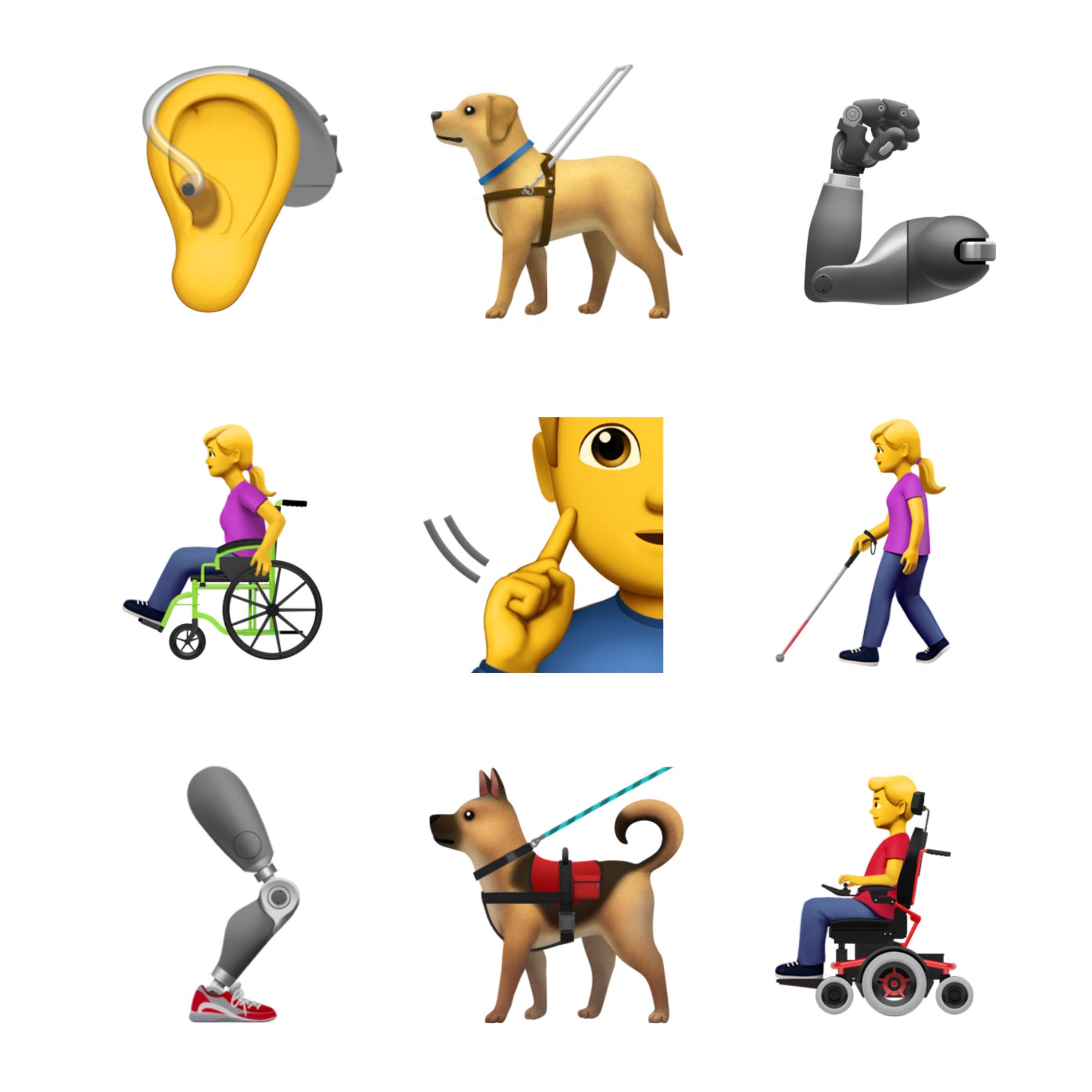
Apple Proposes Accessibility Emoji

Apple has proposed a set of accessibility emoji to the Unicode Consortium. According to Emojipedia:

In the opening line of the proposal, Apple writes:

“Apple is requesting the addition of emoji to better represent individuals with disabilities. Currently, emoji provide a wide range of options, but may not represent the experiences of those with disabilities”

Noting that this is “not meant to be a comprehensive list of all possible depictions of disabilities”, Apple goes on to explain that this is intended as “an initial starting point”.

Apple has worked with the American Council of the Blind, the Cerebral Palsy Foundation, and the National Association of the Deaf to develop the emoji.

Among the emoji included in the set are Guide Dog With Harness, Person With White Cane, Ear With Hearing Aid, Deaf Sign, Person in Mechanized Wheelchair, Person in Manual Wheelchair, Mechanical or Prosthetic Arm and Leg, and Service Dog With Vest and Leash.

The proposed emoji, if adopted, wouldn’t appear until Unicode 12.0 is released sometime in the first half of 2019.

Permalink

Behind the Magic of Apple’s HomePod Ad, ‘Welcome Home’

Today Adweek shared a mini-documentary that offers a behind the scenes look into Apple’s biggest marketing success of 2018 so far: the Spike Jonze-directed HomePod video, ‘Welcome Home.’ The nearly seven-minute video can be viewed here.

Adweek creative editor Tim Nudd shares an overview of what the making-of video documents:

In particular, we get immersed in the choreography (Jonze, choreographer Ryan Heffington and movement coach Theo Lowe all work with FKA twigs on her irresistible interplay with the apartment, and herself) and the production design (the set expanded on hydraulics to allow Jonze to shoot practically). But we also see how other elements came together, like the lighting, music and VFX (it turns out there was very little CGI).

There are other little gems in here, too, like FKA twigs auditioning for Jonze via FaceTime, and Jonze himself dancing with an office chair. (He never stops moving throughout, and you get a real sense for how physically plugged in he is to the ideas here.) We also catch a glimpse of Dunkirk cinematographer Hoyte van Hoytema working with Jonze on the film—he also shot the “It’s a Tide Ad” spots for the Super Bowl (working with directors Traktor).

If you enjoyed ‘Welcome Home,’ the documentary is well worth checking out. Besides being fascinated to see how much work went into the four-minute ad, I especially enjoyed getting an inside look into the creation of the video’s expanding apartment, which, amazingly, was done with practical effects.

Permalink

iOS Plays a Big Role at the Game Developers Conference without Apple’s Direct Participation

Just before the annual Game Developers Conference began in San Francisco, Epic Games released its hit game Fortnite on iOS. In the first four days as an invitation-only game, it made over $1.5 million. As the conference got into full swing this week, PUBG was released. Both games are full versions of their PC and console counterparts and support cross-platform play, which is an impressive accomplishment.

Matthew Panzarino of TechCrunch interviewed Apple Vice President Greg Joswiak about the ramifications for mobile gaming:

“They’re bringing the current generation of console games to iOS,” Joswiak says, of launches like Fortnite and PUBG and notes that he believes we’re at a tipping point when it comes to mobile gaming, because mobile platforms like the iPhone and iOS offer completely unique combinations of hardware and software features that are iterated on quickly.

“Every year we are able to amp up the tech that we bring to developers,” he says, comparing it to the 4-5 year cycle in console gaming hardware. “Before the industry knew it, we were blowing people away [with the tech]. The full gameplay of these titles has woken a lot of people up.”

Ryan Cash of Snowman, part of the team that recently released Alto’s Odyssey agreed:

“We have a few die-hard Fortnite players on the team, and the mobile version has them extremely excited,” says Cash. “I think more than the completeness of these games (which is in of itself a technical feat worth celebrating!), things like Epic’s dedication to cross-platform play are massive. Creating these linked ecosystems where players who prefer gaming on their iPhones can enjoy huge cultural touchstone titles like Fortnite alongside console players is massive. That brings us one step closer to an industry attitude which focuses more on accessibility, and less on siloing off experiences and separating them into tiers of perceived quality.”

There’s a lot to like about iOS if you’re a game developer. The hardware is iterated on faster than consoles, a high percentage of users are on the latest version of the operating system, the device is always with players, and the install base is enormous. Those are all factors that have led iOS devices to succeed as gaming platforms, even though it sometimes feels as if Apple doesn’t quite understand the industry. The fact that Greg Joswiak comprehends the importance of full console games coming to iOS gives me a little hope that we may see better support for games on platforms like the Apple TV in the future.

For more from Ryan Cash about the state of gaming on iOS and a look behind the scenes at the making of Alto’s Odyssey, check out Episode 45 of AppStories.

Permalink