Posts in Linked

AppStories, Episode 362 – What If?: Exploring Alternative Apple Timelines

This week on AppStories, we explore alternative Apple timelines by asking the question: What if?

Sponsored by:

Dropzone 4 – The essential drag and drop productivity enhancer.


On AppStories+, I try to simplify and speed up my backup setup, and Federico has an update on his default apps.

We deliver AppStories+ to subscribers with bonus content, ad-free, and at a high bitrate early every week.

To learn more about the benefits included with an AppStories+ subscription, visit our Plans page, or read the AppStories+ FAQ.

Permalink

Improving the Copy and Paste Prompts on iOS

I couldn’t agree more with all the suggestions proposed by Matt Birchler, who envisions a more flexible permission flow for clipboard access on iOS that is entirely in line with Apple’s current privacy prompts for other personal data.

Apple could even hide the “always allow…” option until the user had allowed an app to see the clipboard like 5 times in a row. That would avoid giving full access to apps that you don’t want to give it to, and it even helps keep the number of apps with this always access down. After saying “allow paste” in Parcel 100+ times in the past few years and never hitting no, it might be safe to let me just say “always allow” at this point, but maybe an app where I paste once in a blue moon doesn’t need it.

They could go the other way as well: if you deny an app a few times in a row, there could be a new option the next time that asks if you want to block this app from the clipboard forever.

And as they’ve done recently with location, photos, and calendar access, it could make sense to occasionally show an alert that tells the user that this app has access to your clipboard and how often it’s used that access in the last X days.

I strongly disliked the redesigned clipboard prompts in the first version of iOS 16 (a perfect example of user experience dictated by security engineers rather than designers at Apple), and I was relieved when the company improved the system with per-app clipboard settings in 16.1. Still, these clipboard prompts feel antiquated, user-hostile, and not intelligent at all. For starters, they should be consistent – like Matt suggests – with Apple’s other privacy prompts. Second, they should learn from user habits in terms of granting access or reminding people to review their apps with clipboard access.

Third, I can’t believe it’s still not possible for third-party developers to make a proper clipboard manager for iOS and iPadOS – a software category that continues to thrive on macOS. I was writing about this stuff 13 (!) years ago, and it’s wild that nothing has changed.

Permalink

Workflow Co-Founders Want to Bring AI to the Desktop

When I read earlier this year that Ari Weinstein, one of the co-founders of Workflow before it was acquired by Apple, had left the company, I had a feeling he’d team up soon enough with Conrad Kramer, another Workflow co-founder. I was right. Alex Heath, writing for The Verge, has some initial details on Software Applications Incorporated, the new venture by Weinstein, Kramer, and Kim Beverett, another Apple vet you may remember from the original Siri Shortcuts demo at WWDC 2018:

In their first interview since leaving Apple to start something new, the trio tells me that their focus is on bringing generative AI to the desktop in a way that “pushes operating systems forward.” While they don’t have a product to show off yet, they are prototyping with a variety of large language models, including OpenAI’s GPT and Meta’s Llama 2. The ultimate goal, according to Weinstein, is to recreate “the magic that you felt when you used computers in the ’80s and ’90s.”

“If you turned on an Apple II or an Atari, you’d get this basic console where you could type in basic code as a user and program the computer to do whatever you wanted,” he explains. “Nowadays, it’s sort of the exact opposite. Everybody spends time in very optimized operating systems with pieces of software that are designed to be extremely easy to use but are not flexible.”

An example he gives: “Sometimes you’ve got a browser window open with a schedule on it, and you just want to say, ‘add this to my calendar,’ and somehow, there’s no way to do that… We think that language models and AI give us the ingredients to make a new kind of software that can unlock this fundamental power of computing and make everyday people able to use computers to actually solve their problems.”

They don’t have a product to show yet, but I’ll say this: if there’s anyone out there who can figure out how to turn generative AI into something more than a text prompt or writing assistant for Word and Notion – something that can be truly integrated with your computer, your data, and, well, your workflow, it’s this trio. I absolutely can’t wait to learn more about what they’re working on.

Also worth noting: the company’s website (great domain, too) is a delightfully retro, emulated browser version of Mac OS 8.

Permalink

AppStories, Episode 361 – Nerding Out for the Holidays (Part 2)

This week on AppStories, we conclude our tour of their geeky holiday projects.

Sponsored by:

  • Notion – Do your most efficient work with Notion AI. Try it free today.
  • Vitally – A new era for customer success productivity. Get a free pair of AirPods Pro when you book a qualified meeting.

On AppStories+, Federico and I address follow up from the first part of Nerding out for the Holidays.

We deliver AppStories+ to subscribers with bonus content, ad-free, and at a high bitrate early every week.

To learn more about the benefits included with an AppStories+ subscription, visit our Plans page, or read the AppStories+ FAQ.

Permalink

AppStories, Episode 360 – Nerding Out for the Holidays (Part 1)

This week on AppStories, we share our geeky holiday season tech projects.

Sponsored by:

  • Vitally – A new era for customer success productivity. Get a free pair of AirPods Pro when you book a qualified meeting.

On AppStories+, Federico and I revisit artificial intelligence and discuss the sorts of tools we’ve been testing.

We deliver AppStories+ to subscribers with bonus content, ad-free, and at a high bitrate early every week.

To learn more about the benefits included with an AppStories+ subscription, visit our Plans page, or read the AppStories+ FAQ.

Permalink

Apple to Support RCS Messaging in 2024

In a surprising move, Apple announced today that it will adopt the RCS messaging standard. The company, which has been under pressure from government regulators around the world and competitors like Google and Samsung, told Chance Miller of 9to5Mac:

Later next year, we will be adding support for RCS Universal Profile, the standard as currently published by the GSM Association. We believe RCS Universal Profile will offer a better interoperability experience when compared to SMS or MMS. This will work alongside iMessage, which will continue to be the best and most secure messaging experience for Apple users.

RCS won’t replace iMessage, SMS, or MMS. Instead, RCS will run in parallel with iMessage on a user’s device for those situations where iMessage isn’t an option, and SMS and MMS will continue to serve as fallbacks in case iMessage and RCS aren’t available.

I don’t think many people saw this coming. I certainly didn’t. SMS and MMS are creaky, old technologies that don’t work over Wi-Fi, so it’s good to see them demoted to the options of last resort. RCS isn’t perfect, but it’s an improvement over those older technologies, and perhaps Apple’s support of the standard, along with the other companies that have already adopted it, will help it continue to improve.

Permalink

AppStories, Episode 359 – Getting Your Digital Life in Order

This week on AppStories, we tackle the struggle with staying organized in the face of the never-ending stream of files and other information.

Sponsored by:

  • Notion – Do your most efficient work with Notion AI. Try it free today.

On AppStories+, The Chamberlain Group’s decision to cut off API support to its garage door controllers is an example of what happens when a company shifts from selling to customers to selling access to those customers.

We deliver AppStories+ to subscribers with bonus content, ad-free, and at a high bitrate early every week.

To learn more about the benefits included with an AppStories+ subscription, visit our Plans page, or read the AppStories+ FAQ.

Permalink

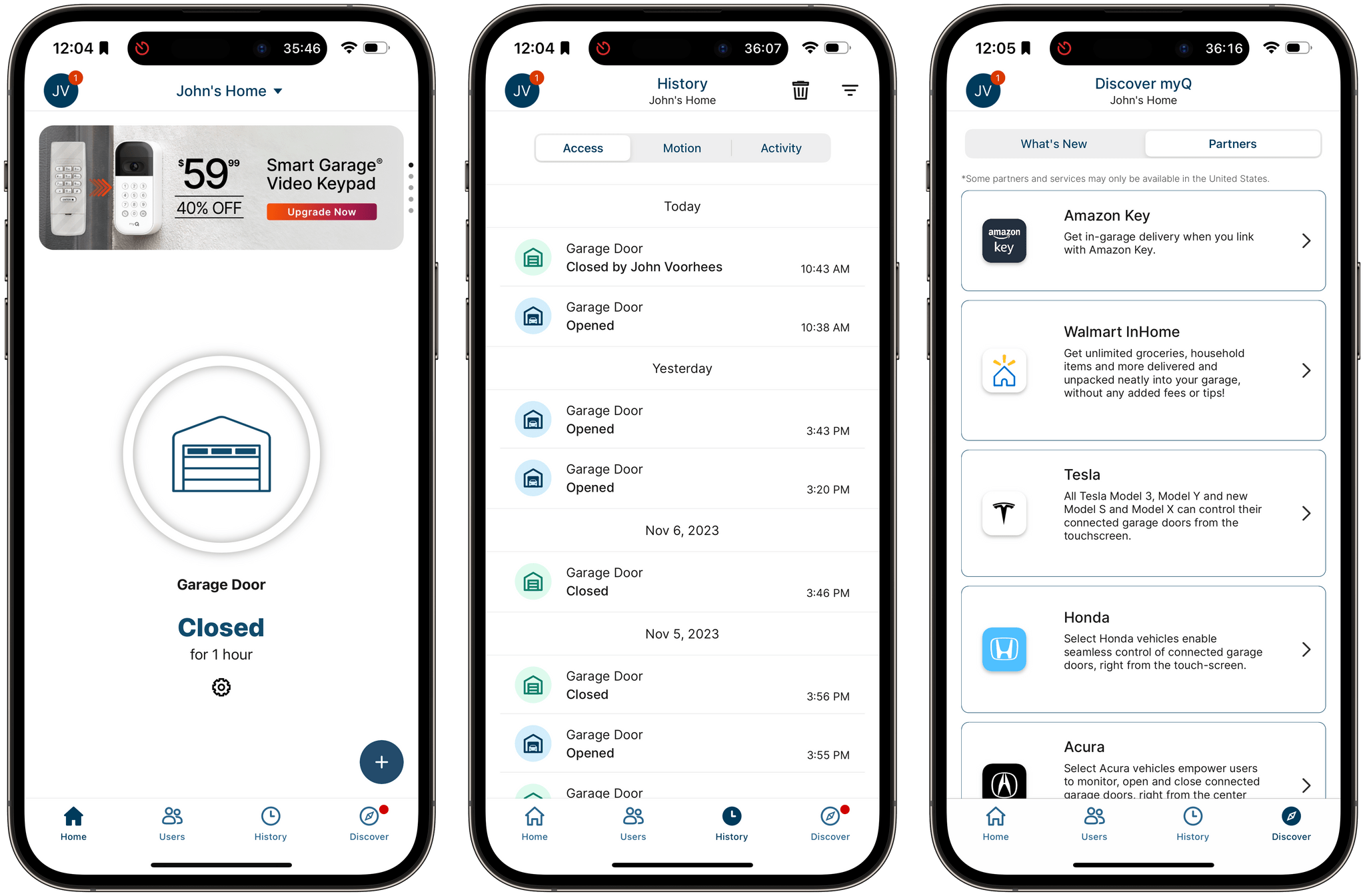
Garage Access as a Service: The Chamberlain Group’s Anti-Consumer Approach to the Smart Home

Source: The Chamberlain Group.

Source: The Chamberlain Group.

When you install a garage door in your home, you expect to have full access to how it works – at least, that’s how it worked historically. As Jennifer Pattison Touhy explains for The Verge, that’s not at all the case with The Chamberlain Group, which has built its myQ smart garage door controller technology into many of the doors it sells and has systematically removed ways for consumers to use the tech:

The move breaks the smart home integrations of thousands of users who relied on platforms such as Homebridge and Home Assistant to do things like shut the garage door when they lock their front door or flash a light if they leave their door open for 10 minutes, or whatever other control or automation they wanted to do with the device they bought and paid for.

The move comes a year after Chamberlain discontinued its official Apple HomeKit integration and a few months after it finally killed support for Google Assistant. It’s sadly another example of how the company continues to be hostile to the interoperable smart home.

The result is that many people who purchased garage doors with myQ’s smart controller technology built in now have a less capable door. The only way to restore smart home interoperability is to buy a new door controller or one of the devices covered in The Verge’s story.

What I find most galling about this story is that The Chamberlain Group is removing these features from its doors while simultaneously expanding its partnerships with auto manufacturers and security companies. Think of it as GaaaS: Garage Access as a Service. Instead of offering consumers control directly, The Chamberlain Group ironically has set itself up as the gatekeeper of your garage. Rather than allowing consumers convenient access to their garage doors, The Chamberlain Group is steering them through paid services, which stinks.

A giant button and ads. That's it. That's the myQ app review.

A giant button and ads. That’s it. That’s the myQ app review.

I have a Chamberlain garage door at home and haven’t decided yet what to do in light of this news. The myQ app is garbage – it’s literally just a big button to open and close the door without access via a widget, the Home app, or Shortcuts. Oh, and it has ads too. I had been planning to go the Home Assistant route after The Chamberlain Group removed HomeKit access last fall, but instead, I expect I’ll buy the Meross Smart Wi-Fi Garage Door Opener that Stephen Hackett has used for a while.

Permalink

AppStories, Episode 358 – The Trouble with Task Management

This week on AppStories, we explore why there are so many good task managers, but none is a perfect fit with the way we work.

Sponsored by:

  • Zocdoc – Find the right doctor, right now with Zocdoc. Sign up for free.
  • Vitally – A new era for customer success productivity. Get a free pair of AirPods Pro when you book a qualified meeting.

On AppStories+, I explore screen maximalism while Federico heads the other direction into screen minimalism.

We deliver AppStories+ to subscribers with bonus content, ad-free, and at a high bitrate early every week.

To learn more about the benefits included with an AppStories+ subscription, visit our Plans page, or read the AppStories+ FAQ.

Permalink