
 MacStories Weekly: Issue 372
MacStories Unwind: A Chicken Truck, Ice Water, and boygenius






This week, John discovers chicken trucks, Federico has some thoughts on American cuisine, and John unwinds post-WWDC with a trip to Wilmington, North Carolina to see boygenius in concert.
Links and Show Notes
- Wilmington, North Carolina
- Why Federico knows Wilmington
- boygenius
MacStories Unwind+

We deliver MacStories Unwind+ to Club MacStories subscribers ad-free and early with high bitrate audio every week.
To learn more about the benefits of a Club MacStories subscription, visit our Plans page.
Apple’s Game Porting Toolkit’s Support for DirectX 12 is a Big Deal for Gaming on the Mac→
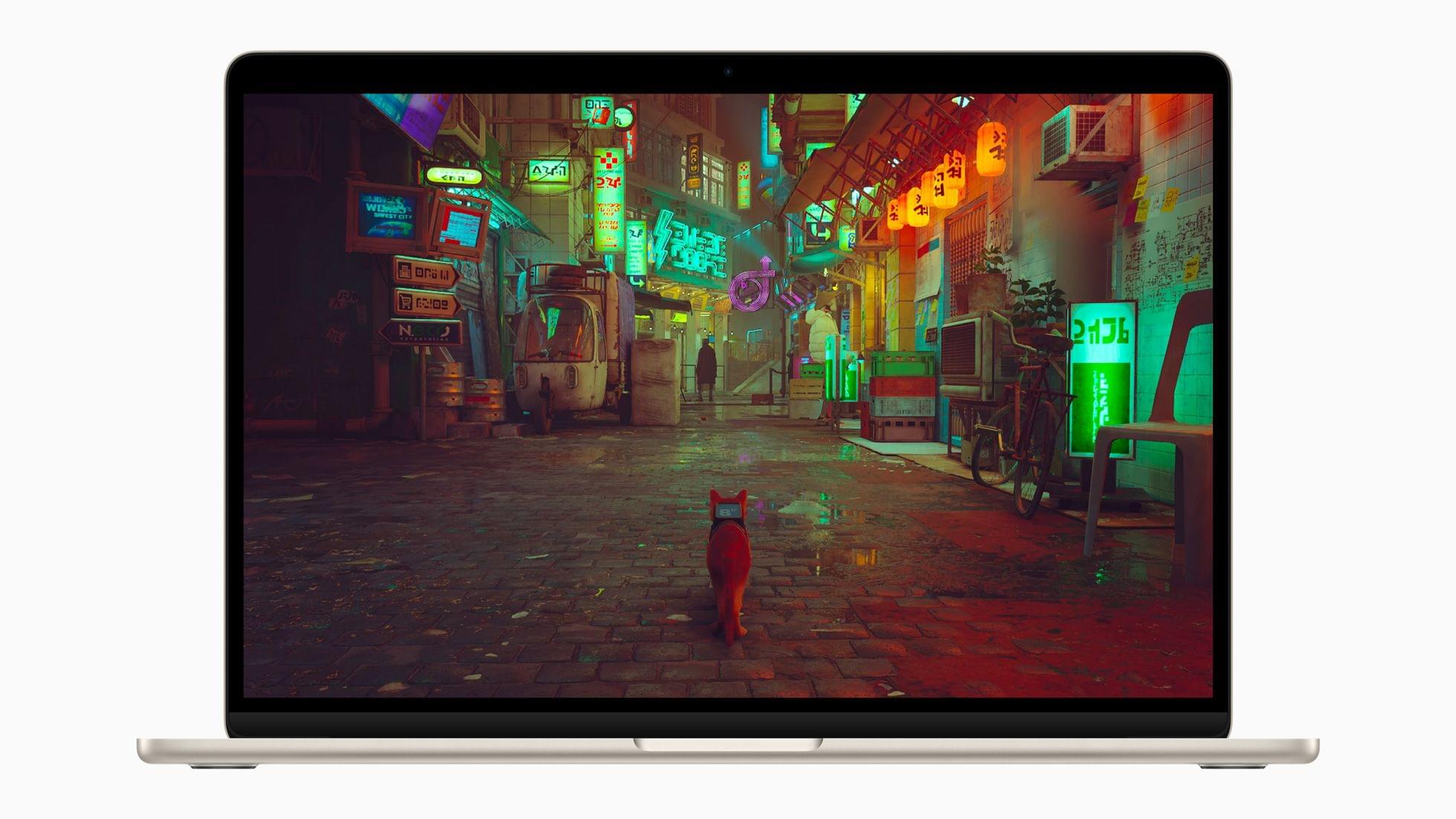
Earlier this week, I linked to Tom Warren’s story on The Verge about Apple’s Game Porting Toolkit and gamers’ early experiments with running Windows games on Apple silicon Macs running macOS Sonoma. Yesterday, Christina Warren, writing for Inverse, published an in-depth look at why Apple’s innocuously Game Porting Toolkit has the potential to be a big deal:
…buried in the keynote was a macOS feature that Apple should have called out with more fanfare: DirectX 12 support for macOS. As PC gamers already know, this software support means the floodgates are open for some real games — not that casual Apple Arcade stuff — on Mac. Maybe, just maybe, this is the beginning of the end to the old joke that Macs can’t play AAA games.
As Warren explains, Apple’s DirectX 12 support is thanks to a patch to Wine that the company developed:
That toolkit largely takes place as a 20,000 line of code patch to Wine, a compatibility layer designed to bring support for Windows games to platforms such as Linux, BSD, and macOS. Wine, which is primarily supported by the company CodeWeavers (which also makes a commercial version called CrossOver), works by converting system calls made to Windows APIs into calls that can be used by other operating systems. It isn’t emulation, but translation (an important semantic difference).
If this all sounds a lot like what Valve did with Proton and the Steam Deck, it’s because it is:
In some ways, the fate of Mac gaming mirrored another desktop platform: Linux. Like the Mac, and in spite of a very vocal contingent of users, Linux gaming largely remained largely elusive until Valve introduced Proton in 2018, a way to play Windows games on its Linux Steam client and on its Linux distribution SteamOS (which at the time, was primarily used for its failed Steam Machine devices). And notably, the open-source technology at the heart of Proton, is the same technology that Apple is using for its Game Porting Toolkit.
Does all of this mean that the Mac is on the cusp of becoming the AAA gaming platform that has eluded it for years? As Warren rightly notes, it’s too early to go that far, but it is cause for optimism and is a big deal even if it remains a niche way to play DirectX 12 games on a Mac.
Stephen Hackett Announces Kickstarter Campaign for His 2024 Apple History Calendar→
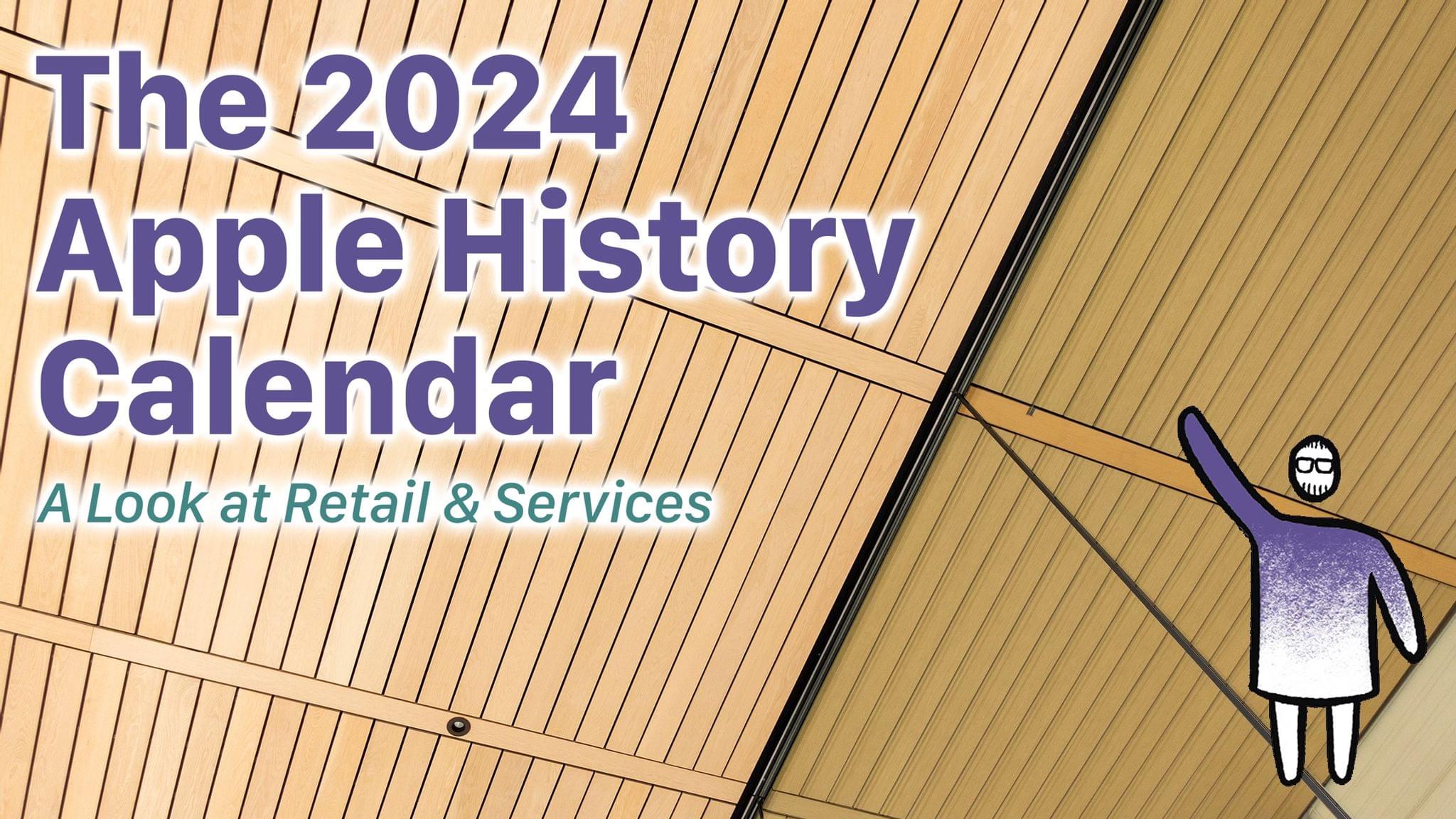
Today, our friend Stephen Hackett launched a follow-up to his successful series of Apple history calendars with a campaign on Kickstarter. This year’s calendar features more of Stephen’s excellent photography, along with notable dates in Apple’s services and retail history.
Here’s what Stephen has to say about this year’s calendar:
The calendar features my own product photography of Apple products, with each month highlighting some of Apple’s services and retail announcements over the years. Each calendar measures 20 inches by 13 inches (50.8 x 33.02 cm) when it’s hanging on your wall with a simple thumbtack or pin.
You can watch Stephen’s announcement video here:
You can also read more about the campaign, which has already reached its goal, on Stephen’s website, 512 Pixels.
In addition to the wall calendar, Stephen has created a digital wallpaper pack for backers who pledge $5 or more. If you pledge $10 or more, you get the wallpapers and a .ics file version of the calendar. Pledge $36, and you’ll add the physical calendar and pledge $40, and you’ll also add four stickers.
The hard work and care that have gone into each of the prior editions of the Apple History Calendar show and make this year’s version a great purchase for any Apple fan, whether that’s you or a friend. I can’t wait to see the images and events Stephen has collected for 2024’s calendar.
AppStories, Episode 338 – What’s Next for Notes, Reminders, and Macs→
This week on AppStories, I was joined by Alex Guyot to talk about the new features coming to Apple Notes and Reminders, as well as new Mac hardware announced at WWDC.
Sponsored by:
- DetailsPro – Design with SwiftUI, no coding required. 50% off throughout June.
- CleanMyMac X – Your Mac. As good as new. Get 5% off today.
- Daylite – Regain Control of Your Business With Daylite
](https://cdn.macstories.net/banneras-1629219199428.png)
On AppStories+, Alex shares his thoughts about WWDC after four years away and I explain what it was like to record in the Apple Podcasts studio at Apple Park.
We deliver AppStories+ to subscribers with bonus content, ad-free, and at a high bitrate early every week.
To learn more about the benefits included with an AppStories+ subscription, visit our Plans page, or read the AppStories+ FAQ.
A Developer’s View of Vision Pro→
Excellent developer-focused take on the Vision Pro by David Smith, who also tested one last week at Apple Park. I particularly liked his reasoning for why it’s important to begin understanding a new Apple platform sooner rather than later:
Another reason I want to develop for visionOS from the start is that it is the only way I know for developing what I’ll call “Platform Intuition”.
This year watchOS 10 introduced a variety of structural and design changes. What was fascinating (and quite satisfying) to see was how many of these changes were things that I was already doing in Pedometer++ (and had discussed their rationale in my Design Diary). This “simultaneous invention” was not really all that surprising, as it is the natural result of my spending years and years becoming intimately familiar with watchOS and thus having an intuition about what would work best for it.
That intuition is developed by following a platform’s development from its early stages. You have to have seen and experienced all the attempts and missteps along the way to know where the next logical step is. Waiting until a platform is mature and then starting to work on it then will let you skip all the messy parts in the middle, but also leave you with only answers to the “what” questions, not so much the “why” questions.
I want that “Platform Intuition” for visionOS and the only way I know how to attain it is to begin my journey with it from the start.
As Underscore concludes, Widgetsmith will be on visionOS from day one in 2024.
AirPods Max Miss Out on Adaptive Audio, New ‘Siri’ Command, and More→
Chance Miller, writing last week at 9to5Mac, notes how Apple’s most expensive AirPods model are going to miss out on two key features announced at WWDC: Adaptive Audio (which blends Active Noise Cancelation and Transparency mode) and the new ‘Siri’ command that does not require saying ‘Hey’.
As my colleague Filipe Espósito also pointed out yesterday, the new “Siri” command is also exclusive to second-generation AirPods Pro. The same also applies to the new Faster Automatic Switching upgrade.
For context, AirPods Max are powered by two H1 chips, with one located in either ear cup. AirPods Pro 2 feature a next-generation H2 chip inside. Unsurprisingly, H1 + H1 does not equal H2.
I like my AirPods Max, but they’re over two years old at this point, and the gap between them and the second-generation AirPods Pro continues to grow.
The performance of noise cancelation is vastly superior on the AirPods Pro. I just had to travel 14+ hours back and forth between Italy and California for WWDC, so I was able to test AirPods Max on a plane for the first time since I bought them. They were fine, but I ultimately preferred using AirPods Pro because they removed more noise.
I hope Apple is working on an AirPods Max revision with support for H2, a foldable design, a new case, and support for the latest software features they just announced.
On the Future of Vision Pro Inside Apple’s Retail Stores→
Earlier today in my Vision Pro story, I wondered about how Apple will showcase and set up the headset for customers in retail stores in the future.
For some excellent analysis on this topic, look no further than Michael Steeber’s latest issue of the Tabletops newsletter. Michael (who’s the leading expert on Apple retail stores) put together some fascinating thoughts on how Vision Pro could marketed and demoed inside the stores, as well as how the product compares to AirPods Pro and Apple Watch from a retail perspective.
Ultimately, the onus of ushering in the era of spatial computing will be on the Specialists and Creatives. The Vision Pro retail experience must be guided from end to end. Apple Stores started as a place to educate, and as technology faded to the background, customers began to intuitively understand their tools and seek out the Apple Store as a product destination. But visionOS is a fundamentally new paradigm that thrusts the role of education front and center once again.
These are just some of the many new challenges and opportunities Vision Pro will bring to Apple Stores. The dawn of spatial computing transforms far more than just the way we interact with software. This new category of device will impel Apple to reshape the retail experience around a more immersive, personalized environment. It’s an incredibly exciting moment.
Check out the concepts and details Michael posted here.
Apple Vision Pro: A Watershed Moment for Personal Computing
I’m going to be direct with this story. My 30-minute demo with Vision Pro last week was the most mind-blowing moment of my 14-year career covering Apple and technology. I left the demo speechless, and it took me a few days to articulate how it felt. How I felt.
It’s not just that I was impressed by it, because obviously I was. It’s that, quite simply, I was part of the future for 30 minutes – I was in it – and then I had to take it off. And once you get a taste of the future, going back to the present feels…incomplete.
I spent 30 minutes on the verge of the future. I have a few moments I want to relive.