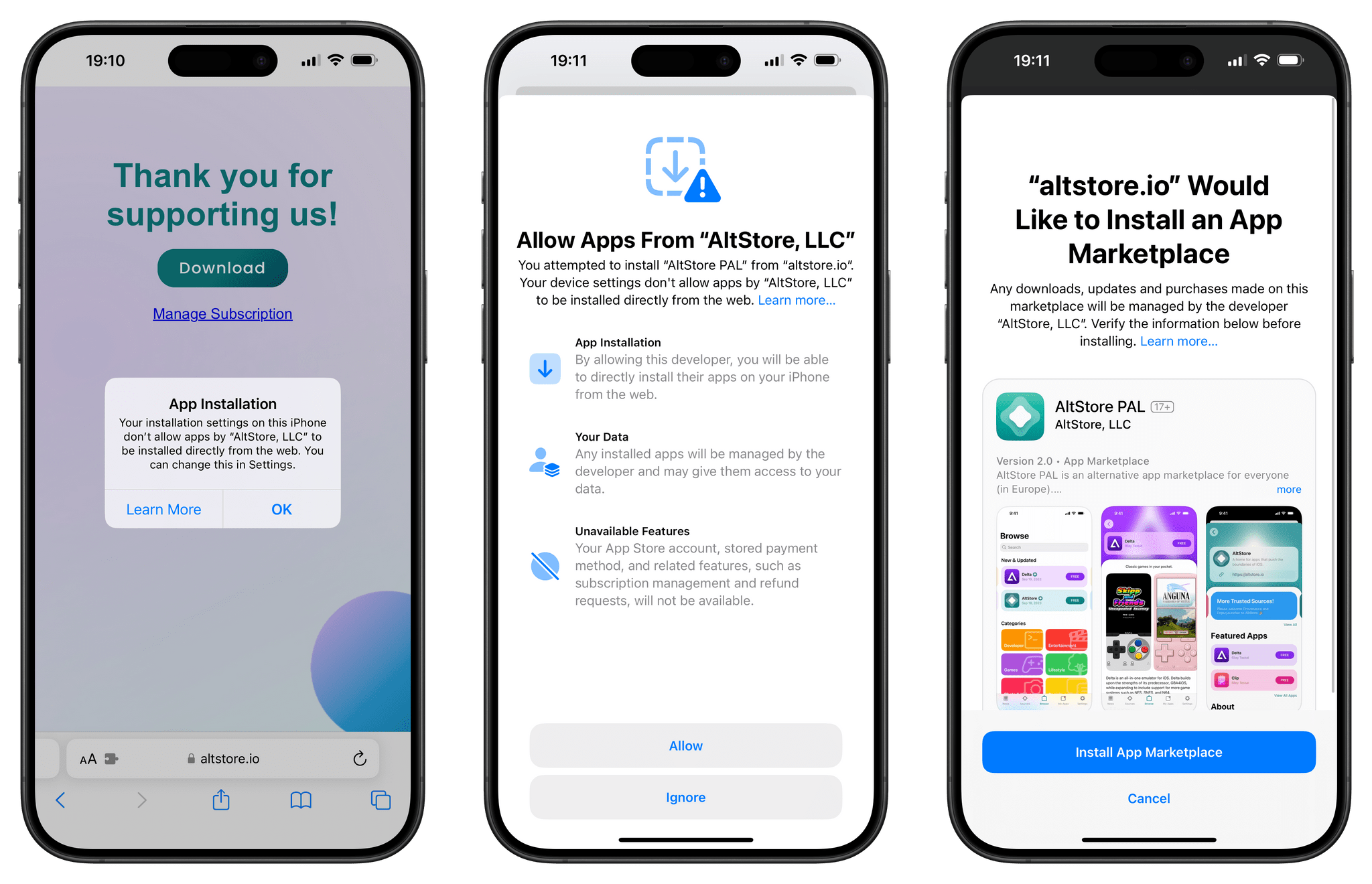
This Week's Sponsor:

Turbulence Forecast

Know before you go. Get detailed turbulence forecasts for your exact route, now available 5 days in advance.


Posts tagged with "app store"

AppStories, Episode 378 – Are We Entering a Post-App World?

This week on AppStories, we explore whether we’re experiencing the beginning of the end of apps and consider what might replace them.


Sponsored by:

  • Genius Scan – A scanner in your pocket.
  • Jam – Developer friendly bug reports in 1 click.

Are We Entering a Post-App World?


On AppStories+, we explain why we’ve said goodbye to time tracking.

We deliver AppStories+ to subscribers with bonus content, ad-free, and at a high bitrate early every week.

To learn more about the benefits included with an AppStories+ subscription, visit our Plans page, or read the AppStories+ FAQ.

Read more


Monument Valley at 10: The Story of the Most Meticulous Puzzle Game Ever Created

Earlier this week, I linked to The Ringer’s profile of Monument Valley on its 10th anniversary, which focused on what’s become of mobile gaming since the game’s release. Today, I have another story about Monument Valley that focuses on the game’s origins and beautiful design.

Jonathan Bell’s article for Wallpaper explores the Monument Valley team’s approach and influences:

The end result had a pixel-perfect axonometric aesthetic that not only went hard on its references to Dutch master artist and printmaker Maurits Cornelis Escher, but also dug deep into classic video game design, going right back to early arcade machines and 8-bit titles. Each of the ten levels is like a piece of fine furniture, built with invisible dovetail joints and inlaid with marquetry, stuffed with secret compartments and little design flourishes. Gray cites the world of theatre and stage design, as well as graphics, as important keystones in the way the levels were constructed. ‘Ken would always talk about flower arranging, and how you frame a silhouette of a level on the screen,’ he says

I love this anecdote about the game’s last minute naming:

The small team was so laser-focused on delivering the best game they could that the name wasn’t even considered until the very end. ‘Right before launch we were going to be interviewed by Edge magazine – the morning of that day we hadn’t picked the name.’ Monument Valley was chosen as being familiar, yet unusual, implying a sense of mystery, grandeur and travel.

Monument Valley is one of the most important indie games ever published on the App Store, so it’s great to see its backstory told in detail by Bell. Be sure to check out the full story, which includes photos of early design sketches of the game’s interface and characters.

Permalink

Apple Amends App Review Guidelines to Permit Game Emulators and Make Other Changes

Yesterday, Apple announced an update to its App Review Guidelines in a brief post on its developer site. The changes to sections 3.1.1(a) and 4.7 of the guidelines, which apply globally to all apps distributed through Apple’s App Store, address three items:

  • game emulators,
  • super apps, and
  • linking to the web from inside music streaming apps to make purchases outside the App Store

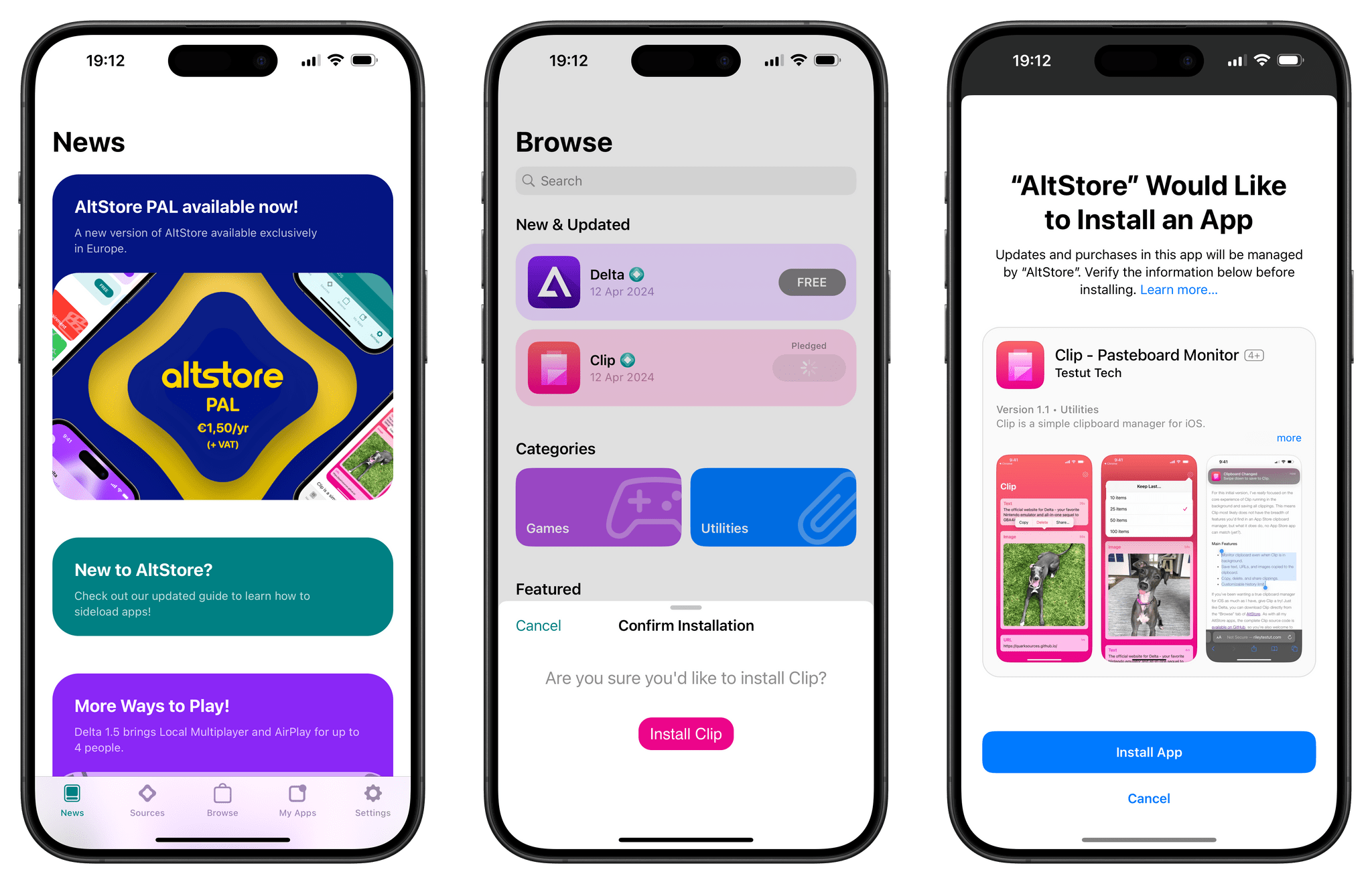
Historically, game emulators were forbidden from the App Store. As a result, an emulator like Delta, which can play games released for Nintendo systems through the N64, could only be used on iPhones through a clever combination of developer tools and a Mail plug-in. In contrast, there are plenty of emulators on the Google Play store for Android users to download.

Revised section 4.7 of the App Review guidelines specifically allows retro gaming emulators:

Mini apps, mini games, streaming games, chatbots, plug-ins, and game emulators

Apps may offer certain software that is not embedded in the binary, specifically HTML5 mini apps and mini games, streaming games, chatbots, and plug-ins. Additionally, retro game console emulator apps can offer to download games.

Presumably, this will allow Delta and other emulators onto the App Store, so they can be used to play game files stored on iPhones.

The change to section 4.7 also says that “mini apps and mini games, streaming games, chatbots, and plug-ins” of the sort found in apps like WeChat must be created with HTML 5, a clarification of the language previously used.

Finally, section 3.1.1(a) of the App Review Guidelines allows music streaming services to link out to the web from their apps so customers can make purchases outside the App Store. The change addresses the anti-steering provisions for which Apple was fined $2 billion by the EU, and Apple has said it will appeal.


Ten Years Later, ‘Monument Valley’ Is a Monument to Mobile Gaming’s Bygone Era

Lewis Gordan, writing for The Ringer, looks back at the 10 years since Monument Valley was released and wonders what has become of premium mobile games:

With such gigantic success, Monument Valley should have become a blueprint for indies on mobile (and it did, for the small cohort of artful titles such as Alto’s Adventure and Old Man’s Journey that followed soon after it). But as the years wore on, it became clear that the game was really more of an aberration. Premium mobile games, that is, those that you pay for, eventually turned into an endangered species, crowded out by free-to-play “forever game” behemoths such as Clash Royale and, most recently, Monopoly Go! (the latter of which is partly bankrolled by Saudi Arabia’s Public Investment Fund and spent an eye-watering sum of nearly $500 million on marketing and user acquisition alone). A binary, then (and thus a battle), presents itself, pitting the art game that values people’s time against the commercial product that seeks to exploit it with ever-increasing, capitalistic intensity. “In 2014, it was just the beginning of that battle,” says Orland. “We didn’t have a clear winner.”

Gordon argues that Monument Valley’s release marked a high water mark and the beginning of the end of artful mobile games. As he recounts, the game was profitable within a week, but just six months later, users were leaving one-star reviews for a $1.99 expansion pack to a game that was only $3.99 to begin with. Gamers had been trained by the Candy Crush Sagas of the world to expect endless free updates.

Adriaan de Jongh, who Federico and I interviewed on AppStories years ago, points to the 2017 redesign of the App Store as another factor in the decline of premium titles:

Before, says de Jongh, Apple “featured” a couple of titles per week, promoting them to anyone across the entire globe who opened the App Store. It was the “single biggest marketing beat” for Hidden Folks, helping the game earn just more than $50,000 on its very first day. Then, with the redesign, the opportunity practically vanished. iPhone users had to navigate to a different tab to see new games. In de Jongh’s view, this was a fundamental and ultimately fatal layer of friction.

Gordon’s story is worth reading in its entirety because it’s one of the best tours of the business of selling iPhone games that I’ve read. At the same time, though, I think Gordon paints a bleaker picture than is justified. There’s no denying that the iPhone gaming universe has changed a lot from the days when games like Monument Valley, Alto’s Adventure, and Hidden Folks were first released. However, it’s also too soon to declare the end of premium iPhone gaming. Few of those titles may break into the top paid games category these days, but that doesn’t mean there aren’t innovative, artistic games being released on the App Store. You need to work a little harder, cutting through the jungle of free-to-play games to find them, but they’re there.

Permalink

The App Store’s Updated Purchase History

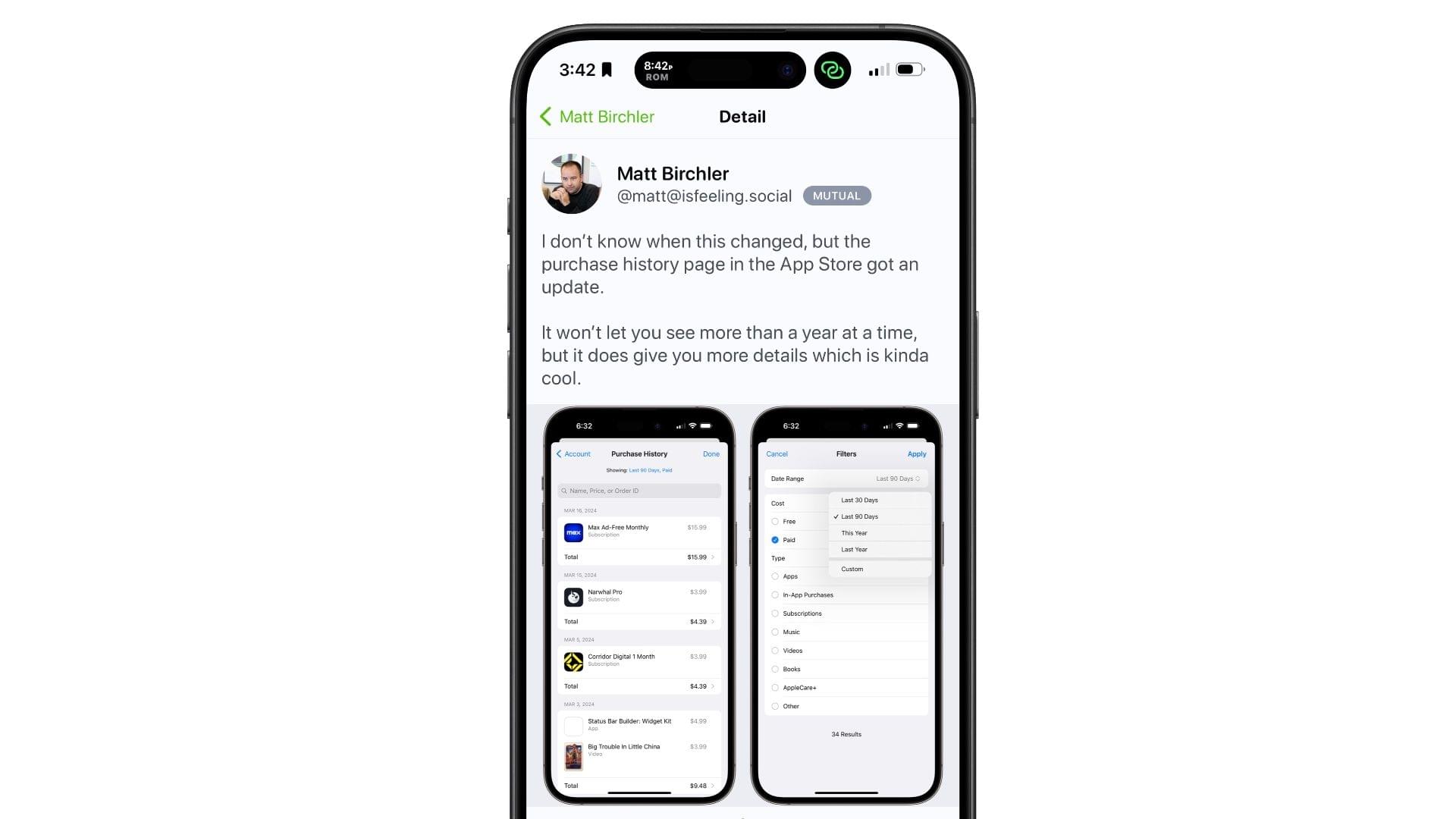
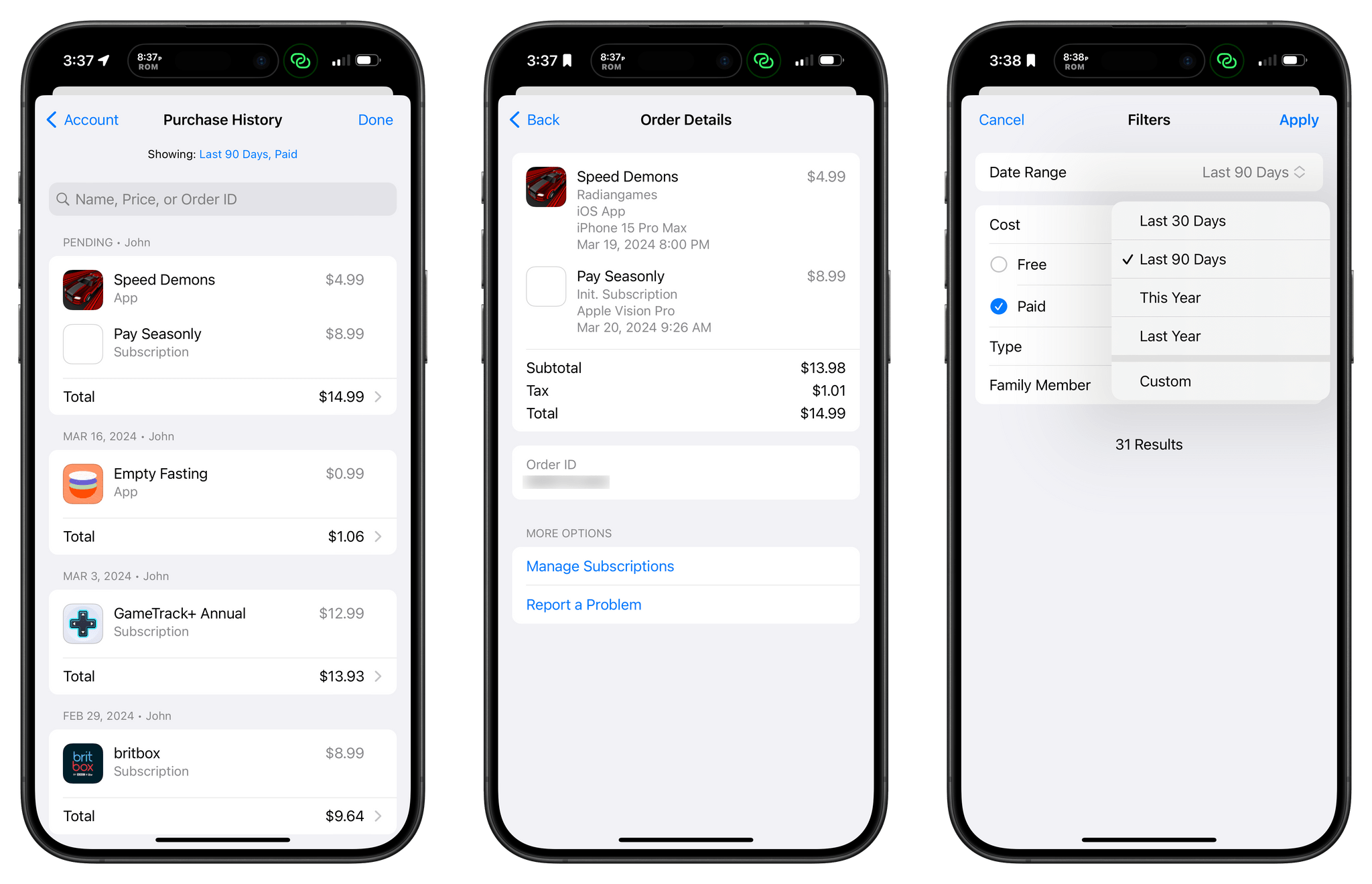
Matt Birchler discovered a change to the App Store’s Purchase Page that seems to have largely flown under the radar. There are more details on the new page than before, which makes it easier to review past purchases. By default, you’ll see your last 90 days of paid purchases grouped by day. However, you can filter by free and paid, purchase type, and family member who made the purchases. You can also limit results to the last 30 or 90 days, this year, last year, or a custom period, which Matt points out displays, at most, one year of purchases.

A few of my recent purchases.

A few of my recent purchases.

It’s also worth noting that your purchase history is not limited to apps. My purchases go all the way back to 2005, when I started buying music on iTunes. Playing with the filters is like opening a time capsule full of classic media finds and embarrassing ‘What were you thinking?’ purchases.

Permalink

FinanceKit Opens Real-Time Apple Card, Apple Cash, and Apple Savings Transaction Data to Third-Party Apps

Ivan Mehta, writing for TechCrunch:

Apple’s iOS 17.4 update is primarily about adapting iOS to EU’s Digital Market Act Regulation. But the company has also released a new API called FinanceKit that lets developers fetch transactions and balance information from Apple Card, Apple Cash, and Savings with Apple.

If you use an Apple Card and a budgeting and financial tracking app, you’ll know why this is a big deal. I’ve been tracking my expenses with Copilot for over a year now, and I was pleased to see in Mehta’s story that Copilot, along with YNAB, Monarch, have teamed up with Apple to be the first third-party apps to use FinanceKit.

Before FinanceKit, I could only track my Apple Card expenses by importing a CSV file of my transactions one time each month when a new statement appeared in the Wallet app. Not only was that laborious, but it defeated the purpose of an app like Copilot, which otherwise lets you see where you stand with your budget in real-time. The process was such a bad experience that I used my Apple Card a lot less than I would have otherwise. Now, those Apple Card transactions will be recorded in Copilot, YNAB, and Monarch as they’re made, just like any other credit card.

Permalink

The European Commission Fines Apple Over €1.8 Billion

In a decision issued today, the European Commission leveled a fine of over €1.8 billion against Apple for preventing developers of music streaming services from letting iOS users know about subscriptions available outside their apps. After an investigation, the Commission concluded that Apple’s practices violated Article 102 of the TFEU and Article 54 of the European Economic Area Agreement.

In a forceful response, Apple pointed at Spotify as the instigator of the EU investigation and accused the EC of protectionist behavior, noting that:

Over the next eight years, and more than 65 meetings with Spotify, the European Commission has tried to build three different cases. With every pivot, they’ve narrowed the scope of their claims — but each theory has had a couple of features in common:

  • No evidence of consumer harm: European consumers have more choices than ever in a digital music market that’s grown exponentially. In just eight years, it’s gone from 25 million subscribers to almost 160 million — with more than 300 million active listeners — and Spotify has been the biggest winner.
  • No evidence of anti-competitive behavior: Eight years of investigations have never yielded a viable theory explaining how Apple has thwarted competition in a market that is so clearly thriving.

The European Commission is issuing this decision just before their new regulation — the Digital Markets Act (DMA) — comes into force. Apple is set to comply with the DMA in days, and our plans include changes to the rules challenged here. What’s clear is that this decision is not grounded in existing competition law. It’s an effort by the Commission to enforce the DMA before the DMA becomes law.

The reality is that European consumers have more choices than ever. Ironically, in the name of competition, today’s decision just cements the dominant position of a successful European company that is the digital music market’s runaway leader.

Apple has said it will appeal the fine, which was set at a level designed to “achieve deterrence.”


Apple Arcade’s Prestige Problem

Brendon Bigley wrote about the Apple Arcade report by mobilegamer.biz today on Wavelengths too. This part really rang true to me:

I don’t agree that there is any “real” difference in prestige between mediums beyond ever-changing societal norms, all art is capable of rising to sit upon a pedestal. I also don’t agree that any art necessarily needs to rise up in that way, and games built for quick hit sessions or telling small and relatable stories are just as valuable to the culture as anything else. Apple Arcade launched with a lineup that seemed to make a statement aligning with that belief, and has since drifted away from it while Netflix Games has run with the baton.

That belief is exactly the vibe Apple Arcade started with and still has – to a degree. But it’s also a vibe that people seem to sense is fading. I hope not. As much as I enjoy AAA titles, there need to be places to showcase games from small studios and for indie ‘finds.’ I’d love Apple Arcade to continue to be one of those places.

Permalink

Some Game Developers Are Unhappy about Apple Arcade

According to multiple unnamed mobilegamer.biz sources, some game developers are unhappy with Apple Arcade, citing shrinking payouts and canceled games. No specifics about canceled projects are cited in the story. Nor are concrete revenue numbers shared. Moreover, the criticisms leveled by some developers were not universal, with some sources speaking favorably about their relationship with Apple. Clearly, however, not everyone who has worked on Arcade titles is happy.

The details of mobilegamer.biz’s story that I think are most interesting are the ones about the business terms Apple has struck with game developers. Those are details that developers seem to be contractually prohibited from talking about. I know because I’ve asked developers about how it works before. However, according to mobilegamer.biz, Arcade developers are paid an up-front fee and from a ‘bonus pool’ based on something called ‘qualifying sessions’:

“They have this opaque metric that they call a qualifying session, and bonus pool payments are made based on that,” said one source. “But no-one knows what a qualifying session actually is – it has something to do with if the game was launched, how long the player played for and how often they return. But it’s a black box, really.”

It will be interesting to see if those arrangements change in light of the purportedly declining revenue developers are earning and the money that Netflix is spending to attract games to its newish subscription-based videogame service.

We’re about three weeks away from the annual Game Developers Conference in San Francisco, and this story strikes me as an attempt to send a message to Apple by developers who feel their games have been abandoned by the service as it has evolved. Maybe Apple hasn’t been as clear with developers as some would like. However, it’s hard to imagine that game developers paying attention to Arcade are truly surprised by the projects it approves.

Permalink