


Here are today’s @MacStoriesDeals on iOS, Mac, and Mac App Store apps that are on sale for a limited time, so get them before they end!
Posts tagged with "iOS"
#MacStoriesDeals - Wednesday
#MacStoriesDeals - Tuesday

Here are today’s @MacStoriesDeals on iOS, Mac, and Mac App Store apps that are on sale for a limited time, so get them before they end!
#MacStoriesDeals - Monday

We’re back! Here are today’s @MacStoriesDeals on iOS, Mac, and Mac App Store apps that are on sale for a limited time, so get them before they end!
Cloud Connect for iOS Gets 3.0 Update, Brings Finder Integration

When it comes to remotely accessing your computer, AirPort Extreme station, FTP, Dropbox or WebDAV servers, Cloud Connect Pro is a staff favorite here at MacStories. Not only the app provides a full-featured solution to connect to all kinds of machines, servers and online services, it also offers a neat way to browse files and media in a Finder-like view for iPhones, iPod touches and iPads. We have covered the app a few times in the past, and I was impressed when Antacea managed to port the whole tablet experience to the iPhone.
The latest 3.0 update, however, makes things look much better with some UI refinements, a new audio player, a proper PDF viewer and some stability enhancements. The app retains all the functionalities of the previous versions, but introduces some welcome features and little touches throughout the whole package that add a new layer of accessibility, communication with iOS built-in tools, and more. For example, Cloud Connect 3.0 can directly play music stored in the iPod.app library, or visualize photos and videos from the camera roll. Songs can be sent to the new audio player’s playlist, which sits at the bottom of the app and displays album artwork, a list of songs waiting in the queue, as well as an AirPlay button to beam music to external speakers. Speaking of which, gone is the hideous Mac-like dock, leaving room for a more minimal bar of icons. Browsing files and folders in Cloud Connect has been improved, too: alongside the (great) column view, the developers have implemented icon-based navigation to tap your way around the filesystem. What’s cool is that you can switch between views with a tap in the toolbar, and a new button in the column view allows you to bookmark, copy, download & compress or delete any file or folder. On top of that, this new version allows you to browse songs and media from the camera roll using your Mac’s Finder by connecting to the “iPad” device under the Shared tab once Cloud Connect is running. This is by far the easiest way to import photos and music off an iOS device and onto an OS X machine I’ve tried, with Cloud Connect acting as a bridge between the two. It works great.
The app could still use some UI polish (I personally can’t stand those blue and grey tones), but I can see why Antacea decided to focus on adding and refining features for now. The lack of a serious PDF viewer, for example, was a major disappointment in Cloud Connect 1.0: the new PDF viewer introduced in version 3.0 is quite fast and responsive, lets you create bookmarks and search for text within a document.
Other features in Cloud Connect 3.0 include Google Picasa support, possibility to use a Mac or PC as a gateway to connect to other Easy Connect computers, and RDP for HP printers only. At $24.99 in the App Store, Cloud Connect doesn’t come cheap but it’s powerful, easy to use and works both on the iPhone and iPad. The app keeps getting better on each release, and I’m looking forward to some serious design improvements in the next version. For now though, Cloud Connect surely is one of the best ways to manage your remote and local connections. Read more
Castlerama Takes On Epic Citadel with Unreal Engine for iOS

If you were one of those who followed or watched Apple’s September 1, 2010 media event – where, among other things, iOS 4.1 and Game Center were officially unveiled – then you most definitely remember Epic Games’ Mike Capps and Steve Jobs talking about a revolutionary game that would set new technical standards on iOS devices. The game was based on the popular Unreal Engine ported to iOS, and on stage it was presented as a work-in-progress demo called Epic Citadel, also released for free on the App Store. The demo was impressive: there was nothing to do besides wandering around a medieval village, but the graphics, the lightning and the details were impressive. Tech-wise, everything about Epic Citadel was amazing. And as you may know, the game evolved and eventually became a real adventure with a plot and sword fights: Infinity Blade, based off the Unreal Engine and Epic Citadel’s first-person setting, was a huge success on iPhones and iPads.
As the story goes, however, other developers have tried to implement the Unreal Engine powerful set of tools in their games. The latest entry in the Unreal Engine-based game market is Castlerama by the Codenrama development studio, a first-person game with a striking resemblance to Epic Citadel and its environment. Castlerama seems to offer different landscapes though, as well as its own control scheme based on two virtual analog sticks displayed on screen.
The developers also explain their decision to accept “compromises” in order to make the game run on new devices like the iPad 2 and older units like the iPhone 3GS:
While developing Castlerama, we had to face the fact that newer devices such as iPhone4s and iPad2s are very different from their predecessors, iPhone3GSs and iPads, in that the former have twice as much memory. In order to have the app run on all devices, we had to compromise quite a bit, pushing the old devices to their limits (risking crash if other applications are left running) while keeping the new devices well behind their capabilities. In the future we believe we will have to develop two versions for each application.
Castlerama is available for free in the App Store as a universal download. With more games supporting the Unreal Engine coming out in the near future, it’ll be interesting to see how Castlerama will manage to provide a unique experience for iPhone and iPad owners. In the meantime, check out the app’s demo video and a walk down the Epic Citadel memory lane below. [9to5mac via TouchArcade]
Read more
Google News Goes Local on Mobile Browsers

With an official post on Google News’ blog, Google has announced that starting today in the United States, Google News will be able of displaying location-based content on iOS and Android mobile browsers. By giving access to your location information in iOS Safari, Google News will find news relevant to where you are in the US with a new section called “News near you.”
To use this feature, visit Google News from the browser of your Android smartphone or iPhone. If this is the first time you are visiting Google News on your phone since this feature became available, a pop-up will ask you if you want to share your location. If you say yes, news relevant to your location will appear in a new section called “News near you” which will be added at the bottom of the homepage. You can reorganize the sections later via the personalization page.
The updated section is available now on news.google.com, but it’s restricted to the United States. Remember you’ll have to grant Safari access to your location, otherwise the feature won’t work.
#MacStoriesDeals - Friday

We’re back! Here are today’s @MacStoriesDeals on iOS, Mac, and Mac App Store apps that are on sale for a limited time, so get them before they end!
iOS Devs Hit by Patent Infringement Notices For In-App Purchases
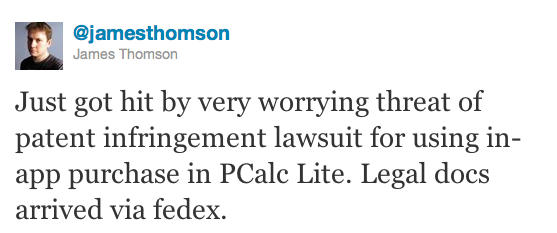
Here’s an interesting news that’s making the rounds of Twitter this morning, and it appears to be spreading quickly among iOS developers. As first reported by James Thomson, indie iOS and Mac developer of DragThing and PCalc, he woke up this morning to find a ”very worrying threat of patent infringement lawsuit” in a FedEx parcel. While Thomson won’t say the name of the company that is threatening to sue him before he gets a reply from Apple Legal on the matter, what’s really curious is the reason behind the alleged patent infringement: it’s not the app Thomson developed, apparently it’s the in-app purchase system he chose to implement in PCalc Lite. Apple’s own in-app purchase payment method, certainly not created by Thomson. This developer, and others with him, are receiving notices from a “patent troll” who’s going after indie developers for using IAP, rather than Apple. The legal threat is worrisome as this company claims developers are given 21 days to license the patent they’re infringing. But this patent, these developers say, it’s not about intellectual property for apps – again, it’s about the payment system. Which Apple created, not the developers.
Looking at the tweets from Thomson, this story doesn’t really make sense. Someone is threatening to sue indie developers because they’re using Apple’s in-app purchase? If so, wouldn’t it be appropriate to sue Apple, which invented the system? And why going after the indie devs in the first place – just to cause anxiety and doubt for the fear of a lawsuit? Read more
Halo Creators Likely Working On New Game for Mobile Devices

Take this with a grain of salt, but the creators of popular first-person shooter Halo may be working on a new online game for iOS and Android devices. As noted by TouchArcade and GameInformer today, a new filing at the USPTO confirms Bungie Aerospace has trademarked “Crimson”, a “computer game software for use on mobile and cellular phones.” Sounds intriguing, but what’s Bungie Aerospace? The company is likely a subsidiary of the “real thing” Bungie, and that’s already been incorporated in Delaware and Washington. Mounting speculation suggests that this new company is the official mobile division of Bungie, something that the Halo developers hinted several times in the past. Bungie has been busy hiring and opening positions for mobile developers in the past months, so it seems pretty clear at this point that something in mobile is going on. And mobile these days means two things: iOS and Android. If Bungie is really working on a new mobile game, than we can assume it’s most definitely coming to the iPhone or iPad.
What the game really is, however, it’s unclear. TouchArcade speculates it might be heavily online based, as also suggested by a Bungie staff writer in 2010 when he said it’s be great to have a world that’s “always there for you, with lots of stories to tell.”
What this project actually is, however, is still shrouded in a cloud of secrecy and, presumably, really hardcore non-disclosure agreements.
My gut says Bungie Aerospace and “Crimson” are connected to the studio’s next project, an original IP set to be published by Activision. Word on the street is that this game is a shooter MMO — an MMO that might just offer increased connectivity via mobile apps.
As a big Halo and Bungie fan, I’m looking forward to what’s next for the company in the mobile space. A new iOS game would sure make for a big announcement at a certain Apple event in September.