

It’s the end of the year, and with a couple of weeks off from some of my weekly responsibilities at MacStories, I’ve been clearing away the digital clutter that has accumulated. This has become an annual task that I like to do during my extra downtime because it doesn’t require much mental energy, but...
Stephen Coyle on the Reduced Bluetooth Latency of AirPods Pro→
Stephen Coyle has followed up on previous tests he conducted on Bluetooth latency of AirPods. This time, he tested the AirPods Pro using the iOS system keyboard, his rhythm game Tapt, and a shotgun microphone, to measure the delay between triggering a sound on an iPad Pro and playback through the Apple’s wireless earphones and other Bluetooth headphones.
As Coyle explains, latency affects certain use cases, such as user-triggered UI sounds like the keyboard, accessibility features like VoiceOver, and game sound effects, more than others. While delayed keyboard clicks may merely be annoying, delayed VoiceOver responses are a serious usability issue for people who depend on the feature.
What Coyle discovered was that the the latency of the AirPods Pro is substantially less than the original model of AirPods. As Coyle puts it:
If it’s possible for the trend line to continue in the same direction, the next generation or two of AirPods will be very exciting. Not being a VoiceOver user, I’m unsure how much AirPods Pro improve its user experience in real terms, but I think this general trend can only be for the good. Similarly, for mobile gaming and general user experience, this trend means that what is, in my opinion, the primary downside of Bluetooth earphones may be gradually disappearing.
I found Coyle’s comment on using AirPods Pro to make and edit music intriguing too:
Their status as the lowest latency Bluetooth earphones notwithstanding, the AirPods Pro make for a deeply unsettling experience when using them as monitors to play piano in Logic Pro; there’s still far too much delay to make for a comfortable experience (and I’m not alone in thinking similar). They are, however, just about usable when editing music or video, and shaving a few dozen more milliseconds off this each generation would fast make them a preferable option over wired earphones.
As someone who edits podcast audio regularly, I’ve never considered using AirPods Pro because I’ve assumed that the latency would be a roadblock. What Coyle’s test show is that it’s time to rethink old assumptions whether it’s the role of AirPods Pro in accessibility features like VoiceOver, audio production, or gaming. As Apple reduces the latency of its wireless earphones, the use cases for them will only expand further, which is exciting.
 App Debuts
 Ryan
RyanNighthawk Nighthawk is a brand new Twitter client that launched this week for iPhone and iPad, specializing primarily in timeline filtering. The app includes two mechanisms for easily tailoring the timeline to your need: Smart Filters and Close Friends. Smart Filters are a selection of preset filters crafted by Nighthawk’s developers, including things like...
Countdowns

In a couple of weeks, people around the world will be counting down the seconds to the end of 2019 as they ring in the New Year. While you don’t need an app to help with that particular countdown, New Year’s Eve got me thinking about countdowns in general and my favorite app for...
A Special New Year’s Issue of MacStories Weekly is Coming January 10th Along with a New Club Perk
The New Year has traditionally been a time to reflect and plan. For many people, that means resolving to improve some aspect of their lives, like being more productive at work, improving their fitness level, working on personal finances, or something else. When I start thinking about things I can do better in the...
Satechi Debuts Cleverly-Designed USB-C Apple Watch Charger
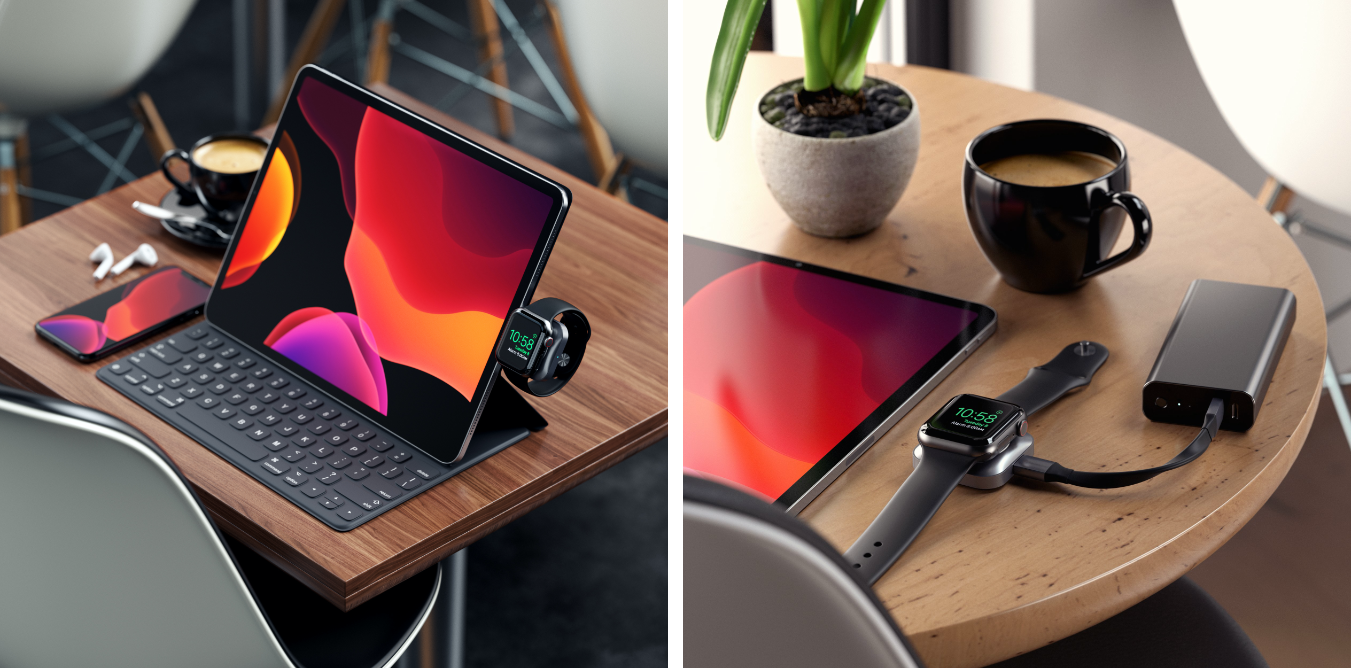
Satechi began selling a new MFi-certified Apple Watch charger today with a clever design that looks perfect for iPad Pro users.
The charger, which is made of space gray aluminum and retails for $44.99 in the US, has a USB-C connector that plugs directly into devices with USB-C ports. Attached to an iPad Pro while using a Smart Keyboard Folio, you can charge your Watch and conveniently see the time thanks to the Watch’s Nightstand Mode. Satechi includes a short USB-C male to female cable in the box for situations where you don’t want the charger connected directly to a device, such as a MacBook Pro where it would block other USB-C ports.
I haven’t had a chance to try it yet, but this charger looks like it would have been perfect when I was traveling last week, so I ordered one immediately. During that trip, I worked on my iPad Pro on and off throughout the day, and Satechi’s charger would have been an excellent way to charge my Watch and had a minimal impact on the iPad Pro’s large battery.
For a limited time you can use the coupon code GIFTSATECHI to get Satechi’s USB-C Magnetic Charging Dock for Apple Watch for 20% off.
AppStories, Episode 143 – The 2019 MacStories Selects Awards→
This week, we reveal the 2019 MacStories Selects Awards.
Sponsored by:
- Linode – High-performance SSD Linux servers for all of your infrastructure needs. Get a $20 credit.
- Kensington The Professionals Choice. Find the right docking solutions for your organization today.
- Re:Schedule – The app that helps you be more productive by organizing your collaboration with your schedule.
https://staging.macstories.net/podcasts/appstories/episodes/143/embed/






 The 2019 MacStories Selects Awards
 Federico
Apple, Google, Amazon, and the Zigbee Alliance Announce Project Connected Home Over IP
In a press release today, Apple announced that it is part of a new working group with Google, Amazon, and the Zigbee Alliance called Project Connected Home over IP. According to Apple’s press release:
The goal of the Connected Home over IP project is to simplify development for manufacturers and increase compatibility for consumers. The project is built around a shared belief that smart home devices should be secure, reliable, and seamless to use. By building upon Internet Protocol (IP), the project aims to enable communication across smart home devices, mobile apps, and cloud services and to define a specific set of IP-based networking technologies for device certification.
Apple says smart home device makers IKEA, Legrand, NXP Semiconductors, Resideo, Samsung SmartThings, Schneider Electric, Signify (formerly Philips Lighting), Silicon Labs, Somfy, and Wulian will also contribute to the project. The group wants to make it easier for manufacturers of smart home devices to integrate with Amazon’s Alexa, Apple’s Siri, and Google’s Assistant and will take an open source approach to the development of the joint protocol.
This is fantastic news. To date, many smart home devices have adopted support for some, but not all, smart assistants. It has also become all too common for companies to announce support for certain assistants was coming to their products only to delay or abandon it altogether. With a unified approach across the three major companies with smart assistants, support will hopefully be more consistent in the future.