

Postbox Postbox 7, the Mac email client, was released this week with some interesting new features. The app now supports 20 themes, so your email client can match your tastes. There are also HTML clips, a new way to drop in bits of customizable HTML like callouts, block quotes, bulleted and numbered lists, tables,...
 CalZones

David Smith’s iPhone and iPad app, CalZones, came into my life at precisely the right time. Federico and I were in the middle of getting our podcast Dialog off the ground, and I was handling the scheduling of guests for interviews. Keeping track of the time in Rome is easy. I’ve been working with...
Apple Launches Web-Based Music App as Public Beta
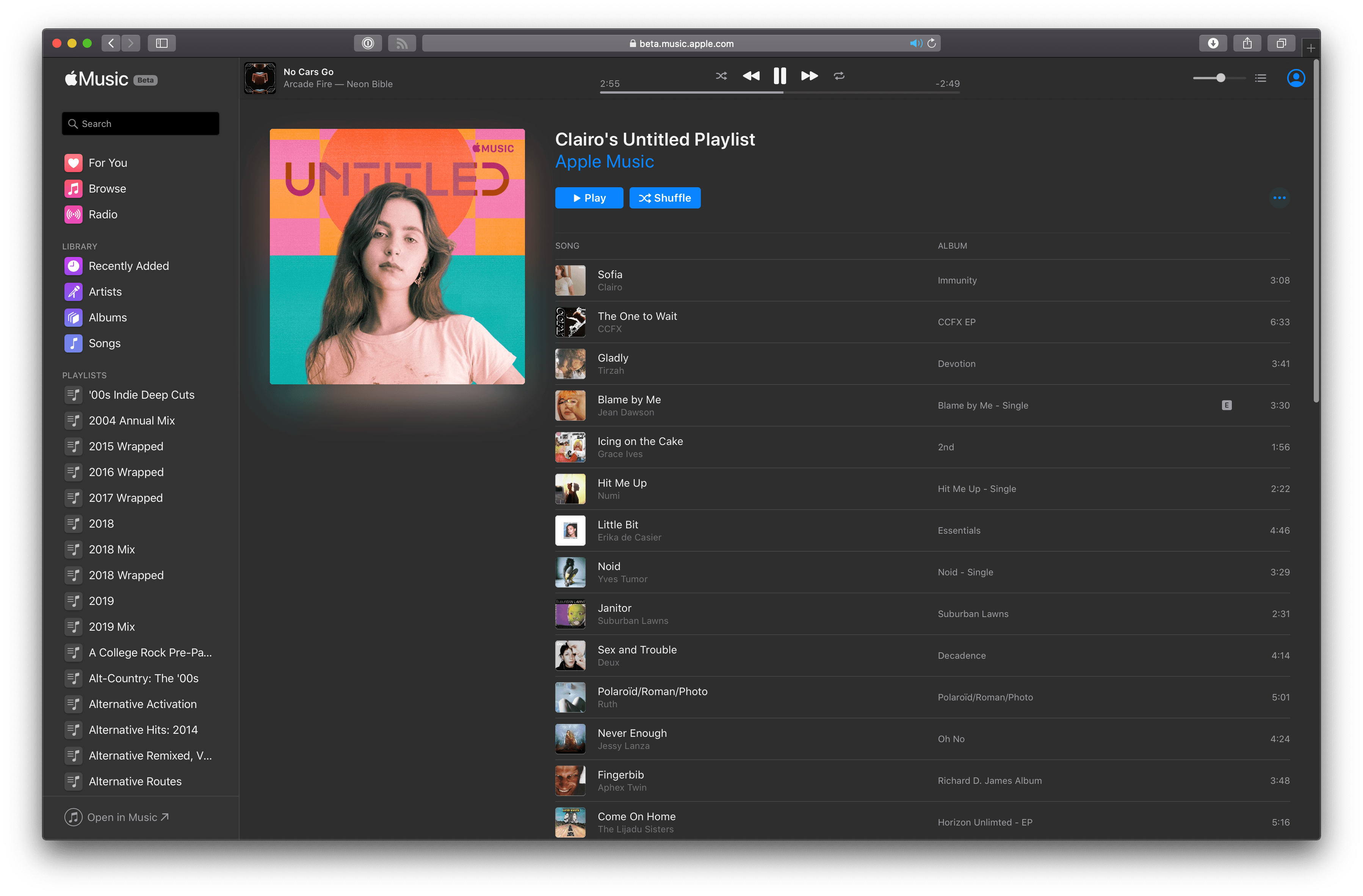
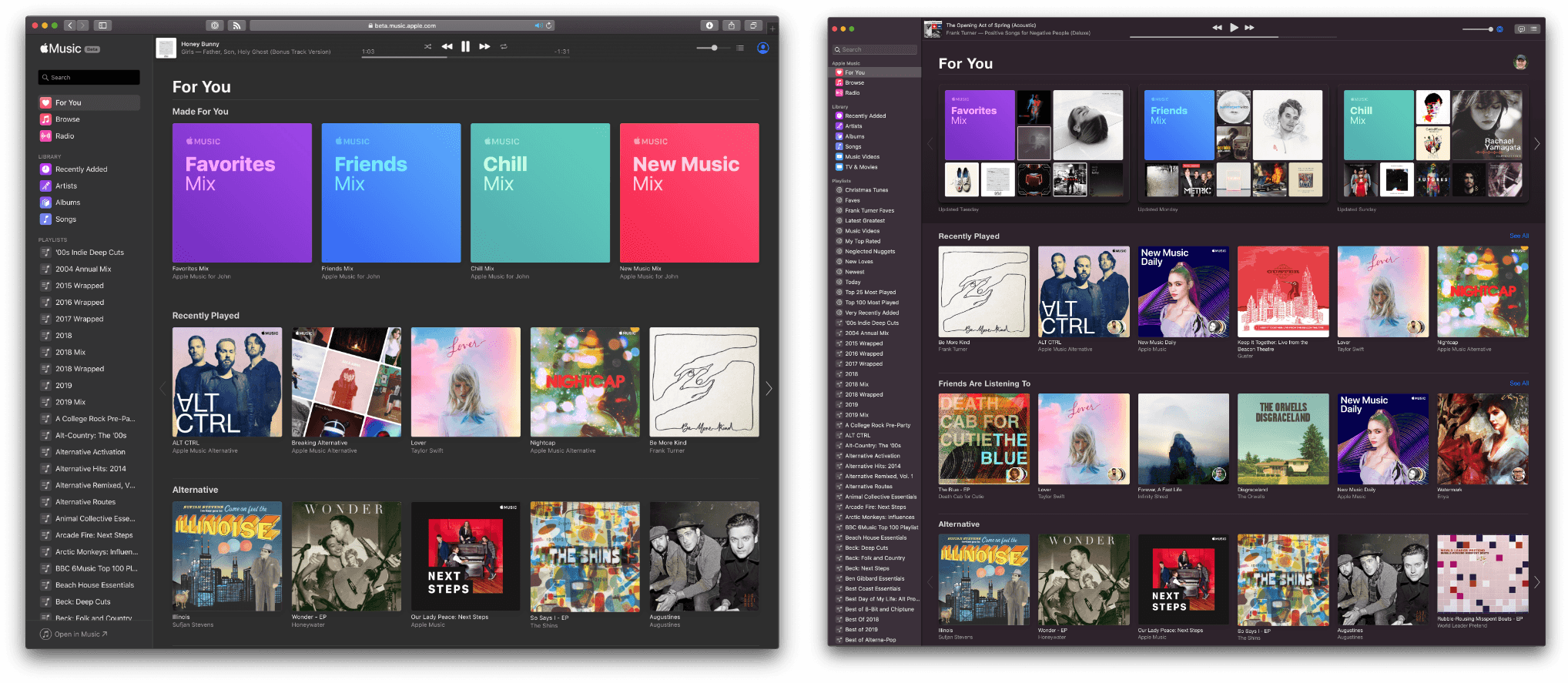
As first reported by TechCrunch and The Verge, Apple has launched a web-based version of its Music app as a public beta at beta.music.apple.com. The app looks and feels a lot like the Music app coming to Catalina later this fall. The two are so close in fact that it’s easy to confuse the two if they’re open at the same time, which I did almost immediately.
The app features a left sidebar that’s divided into Apple Music’s For You, Browse, and Radio sections followed by your music library which contains Recently Added, Artists, Albums, and Songs. The final section includes playlists you’ve added from Apple Music as well as ones you’ve created yourself.
Playback controls are arrayed across the top of the window. In addition to play/pause and skip forward and back buttons, there are buttons to shuffle and repeat tracks, albums, and playlists, a volume slider, and a button that reveals an Up Next drop-down of songs you’ve queued for playback. When you visit an album or playlist page, there’s a ellipses button the reveals options to Add to Library, Play Next, Play Later, Like, and Suggest Less of This.
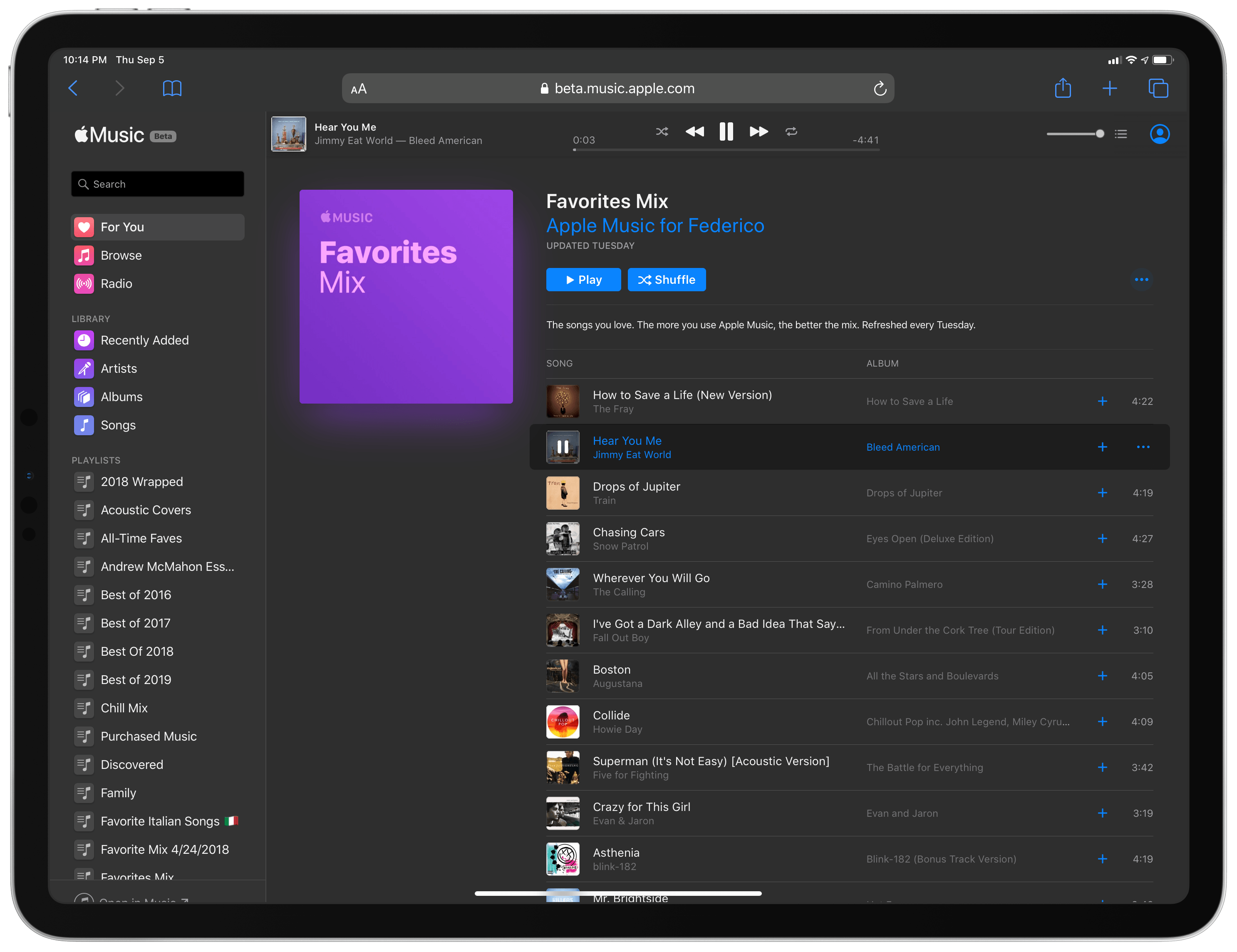
The experience is impressively close to the Mac Music app, though there are differences. The artwork for algorithmically generated playlists like the Favorites Mix doesn’t include album artwork. Also, I didn’t see a ‘Friends Are Listening To’ section in the beta, and my Recently Played albums and playlists were in a different order than in the Mac app.
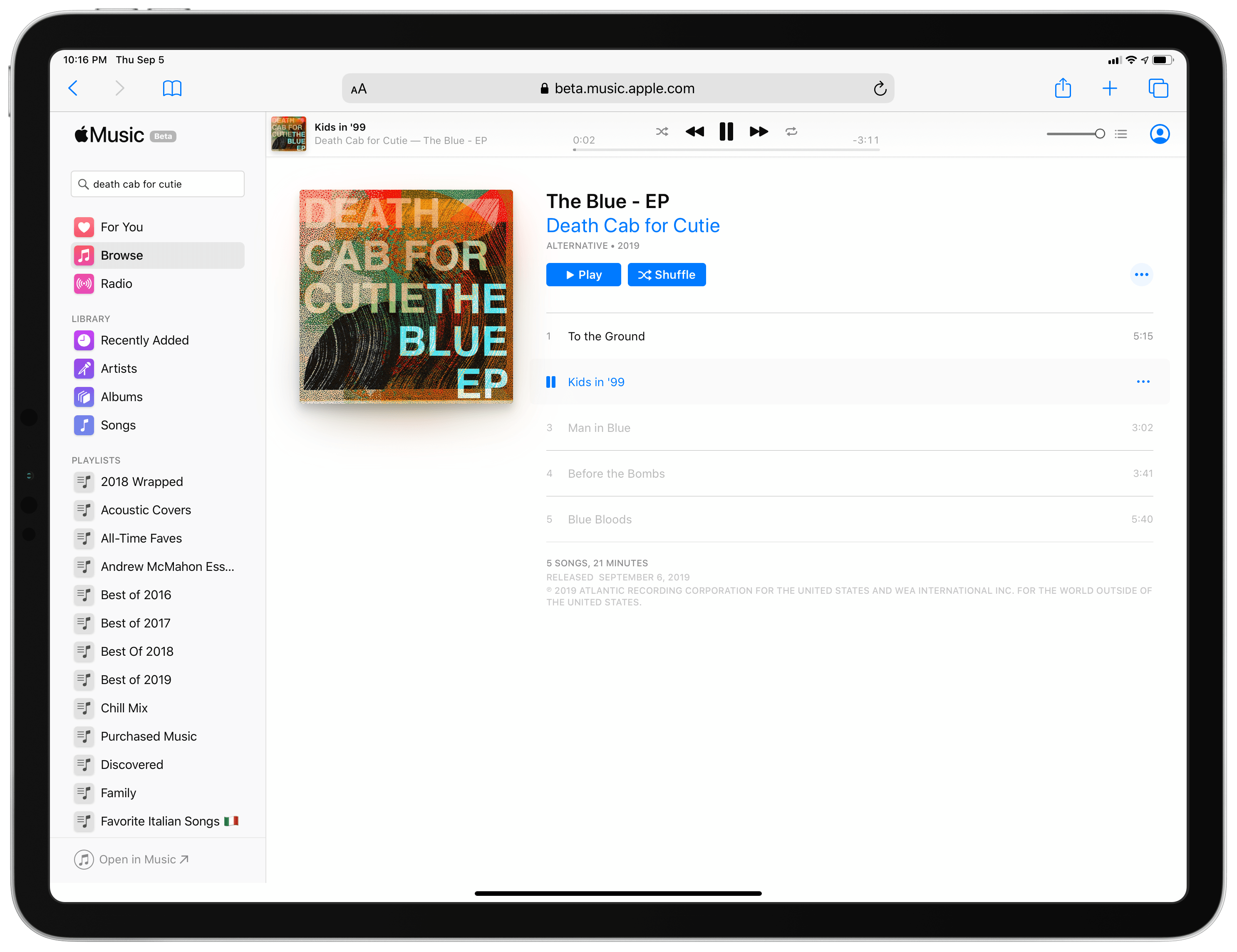
The web app works on both desktop and mobile Safari where it can be saved to your Home screen as a progressive web app. On the iPad, Safari-based Music supports dark mode and Split View too.
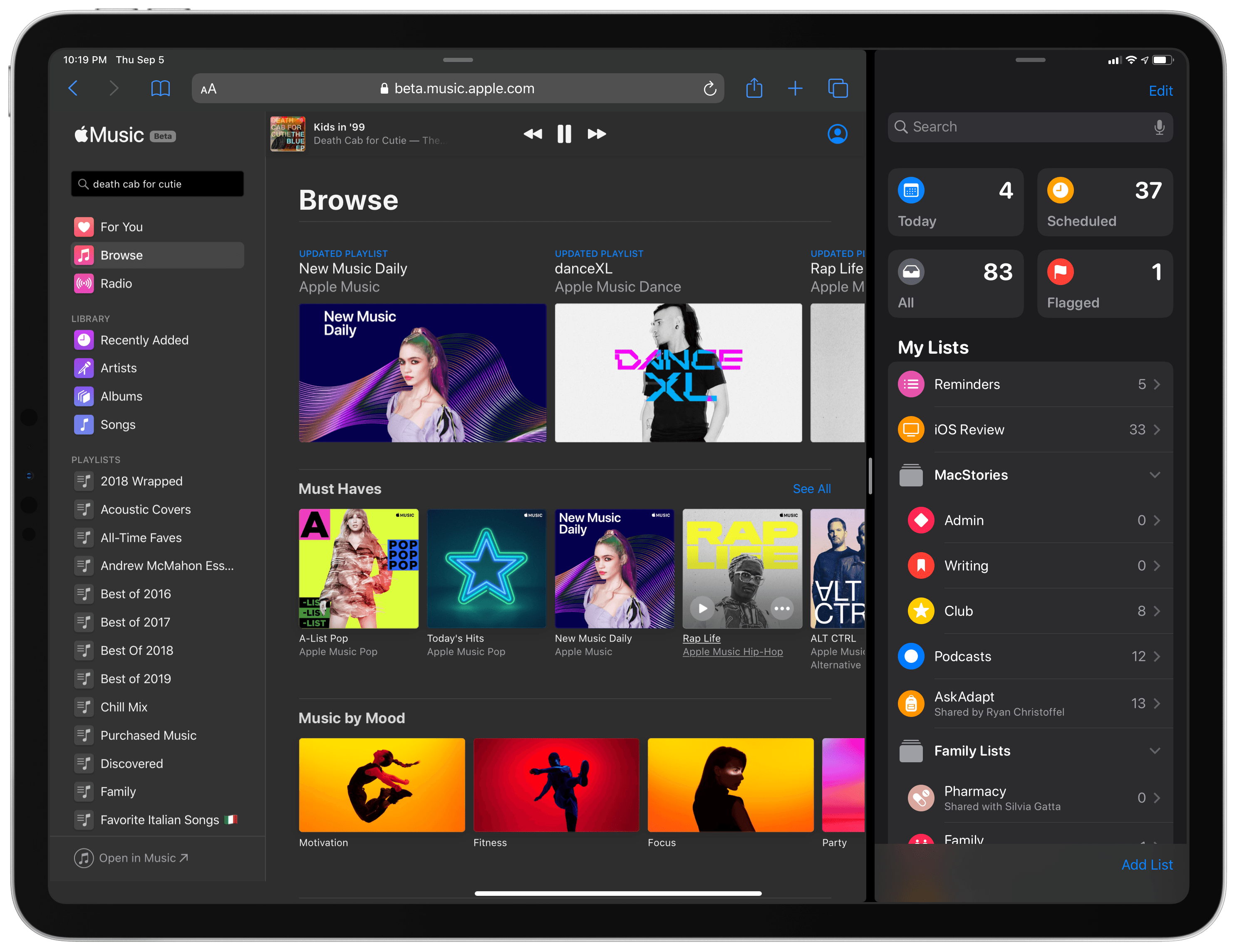
I’ve only had a short time to play with Music in Safari, but I’m impressed with what I’ve seen so far. With very few exceptions, the beta is already the full Music experience providing access not only to Apple Music streaming content but also your entire music library. This is an excellent option for anyone who doesn’t have access to a Mac or iTunes on Windows at work or elsewhere. I wouldn’t be surprised if this solution eventually replaces iTunes on Windows, which does not appear to be getting an update alongside Catalina.
Club MacStories Fourth Anniversary: Exclusive Discounts on Apps and Services, Plus Other Perks for Members
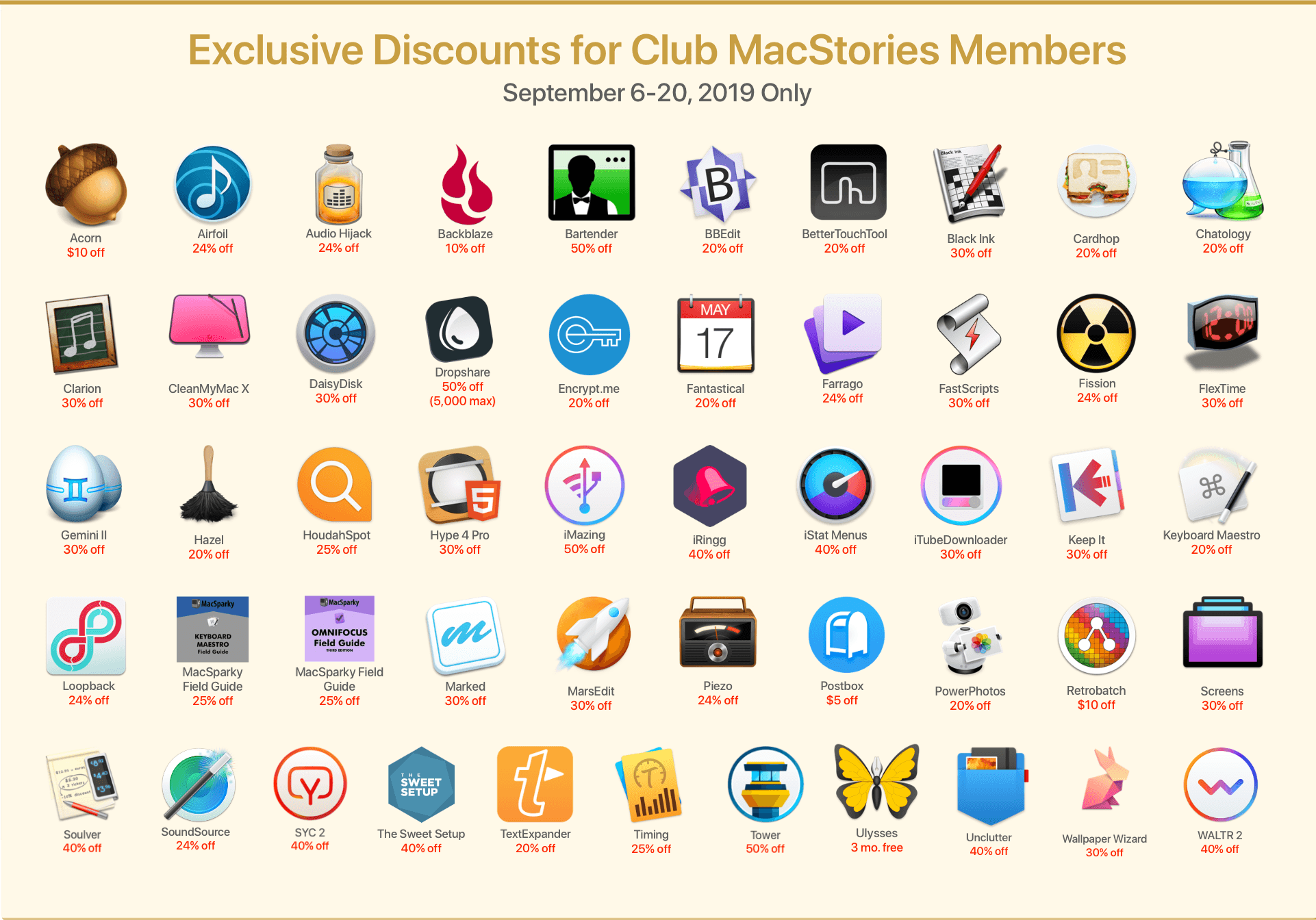
This time every year, we like to pause to mark the anniversary of Club MacStories and thank all of our members for being part of what makes MacStories special. So, whether you’ve been along for the ride all four years or just signed up this week, thank you. We sincerely appreciate your support.
In just four short years, the Club has become part of the fabric of MacStories. It’s helped us weather changes in the online media industry that have hurt so many other sites. More importantly, though, Club MacStories has provided us with an outlet to share more of the apps we love and the stories behind them than we could do otherwise.
The Club has also played a big role in MacStories’ expansion these past four years, just as Federico hoped when he announced it in 2015:
On top of the extra content that you pay for, you’ll also get a chance to be an awesome reader who makes a direct contribution to the MacStories team. Effectively, Club MacStories will enable us to expand and produce even more articles for the site. It’s a virtuous cycle: I want to keep writing MacStories forever – if that wasn’t clear enough – and I want to keep reaching new readers every day together with my team. Hopefully, with time those readers will find MacStories valuable and they’ll choose to become Club members, getting more great content in return and facilitating further expansions.
The virtuous cycle Federico imagined materialized and has allowed us to play to our greatest strength at MacStories, which is writing thorough, thoughtful analyses of apps and other topics. It has also permitted us to branch into podcasting and take on broad-scope projects like the celebration of the App Store’s 10th anniversary last year and MacStories Selects, our annual picks of the best apps in a bunch of categories.
To celebrate the Club’s anniversary this year, we have collected another amazing list of exclusive Club discounts on apps and services from our friends in the developer community. Every year, their generosity is amazing. Thanks to every developer for both contributing discounts to our celebration and for the apps you make. Despite the length of time we’ve been writing about apps, we’re still surprised and delighted all the time by your amazing creations.
Apple Hits Restart on Game Controller Support
It’s hard to believe it’s been nearly six years since Apple added game controller support to iOS. The big news at WWDC in 2013 was the iOS 7 redesign, but for game developers, it was rivaled by the announcement that third-party Made For iPhone (MFi) controllers were coming.
The game press and developers understood the potential of controller support immediately. Even though it wasn’t announced there, Chris Plante of Polygon declared controller support the biggest story of E3, the game industry trade show that was happening at the same time as WWDC. Plante imagined that:
If Apple finds a way to standardize traditional controls, every iOS device will become a transportable console. In a year, both iPhones and iPads will approach the processing power of the current-generation devices. Companies will have the ability to port controller-based games for the mobile devices in millions of pockets — an install-base far greater than they’ve ever had before.
Game industry veteran Gabe Newell, the co-founder of Valve, saw Apple’s entry as a big risk to companies making PC and console games:
The threat right now is that Apple has gained a huge amount of market share, and has a relatively obvious pathway towards entering the living room with their platform…I think Apple rolls the console guys really easily.
I was right there with them. iOS devices couldn’t match the power of a traditional console in 2013, but you could see that they were on a trajectory to get there. With the addition of controller support, Apple felt poised to make a meaningful run at incumbents like Sony and Microsoft.
It didn’t work out that way though. iOS’ controller support was rushed to market. Early controllers were priced at around $100, in part because of the requirements of the MFi certification, and they couldn’t match the quality of controllers from Sony and Microsoft.
As anticipated, controller support was extended to the Apple TV when its App Store launched in 2015. Initially, it looked as though Apple would allow game developers to require a controller. In the end, though, the company went an entirely different direction by requiring that games support the Apple TV Remote, a decision that complicated development and dumbed down controller integration to match the remote’s limited input methods. Apple changed course eventually, and now lets developers require controllers, but by the time of that change the damage had been done. Many developers had already lost interest in controller support. It didn’t help either that for a very long time, the App Store didn’t indicate which games were compatible with MFi controllers, leaving the void to be filled by third-party sites.
Last year, when I looked back at the history of games on the App Store for its tenth anniversary, I came away pessimistic about the future of games on Apple’s platforms. After a decade, I felt like we were still asking the same question that Federico posed in 2013:
Will Apple ever develop a culture and appreciation for gaming as a medium, not just an App Store category?
Sadly, Federico’s question remains as relevant today as it was six years ago. Still, I’m cautiously optimistic based on what’s happened in the past year. Part of that is the App Store editorial team’s excellent track record of championing high-quality games in the stories published on the App Store. Another factor is Apple Arcade, the game subscription service we still don’t know a lot about, but which appears designed to showcase high-quality, artistically important games.
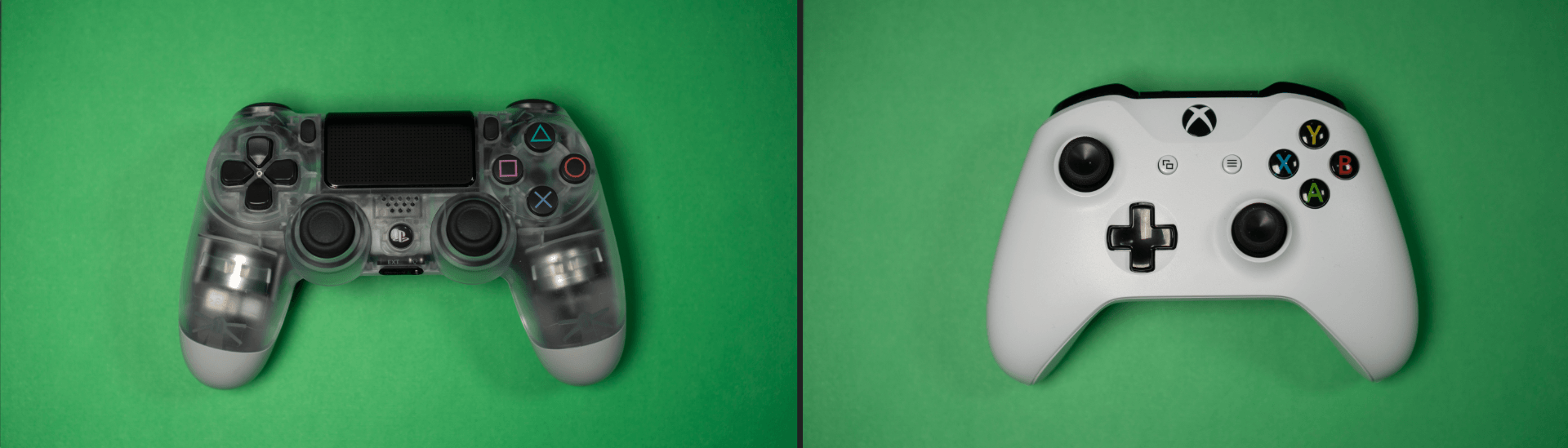
The latest cause for optimism is Apple’s announcement at WWDC this past June that iOS, iPadOS, tvOS, and macOS would all support the Sony DualShock 4 and Bluetooth-based Xbox controllers when Apple’s OSes are updated this fall. The reaction from developers and other observers was a combination of surprise and excitement that was uncannily similar to the MFi announcement in 2013. Yet, the news begs the question: ‘How is this time any different?’ The answer to that question lies in how the new controllers work and the role they will play in Arcade.
AppStories, Episode 127 – Returning to Apple Mail→
On this week’s episode of AppStories, we discuss why we’ve both returned to Apple Mail after years of looking for a better email solution.
Sponsored by:
- Monday.com – Start your 14-day free trial by going to monday.com/appstories
- Pingdom – Start monitoring your website performance and availability today, and get instant alerts when an outage occurs or a site transaction fails. Use offer code APPSTORIES to get 30% off.
https://staging.macstories.net/podcasts/appstories/episodes/127/embed/






 Returning to Apple Mail
 Federico
Time for a Rule-Based Overhaul of Notifications and Do Not Disturb
With macOS Catalina, Screen Time will be available on the Mac for the first time and will integrate with similar data collected on iOS. As someone who works on both platforms, I’m glad I’ll be getting a more complete picture of my time in front of screens for the first time. However, without better...
CarPlay Apps (Vol. 2)
All the way back in Issue 51, I did a collection of CarPlay entertainment apps. Since then, the CarPlay app landscape has changed quite a bit. The types of apps that can participate in CarPlay is still limited, but nonetheless, the options have expanded, driven by increased CarPlay adoption by car manufacturers. With...