Federico Viticci

10804 posts on MacStories since April 2009

Federico is the founder and Editor-in-Chief of MacStories, where he writes about Apple with a focus on apps, developers, iPad, and iOS productivity. He founded MacStories in April 2009 and has been writing about Apple since. Federico is also the co-host of AppStories, a weekly podcast exploring the world of apps, Unwind, a fun exploration of media and more, and NPC: Next Portable Console, a show about portable gaming and the handheld revolution.

Lion Will Be Mac App Store-only, $29 - Coming In July

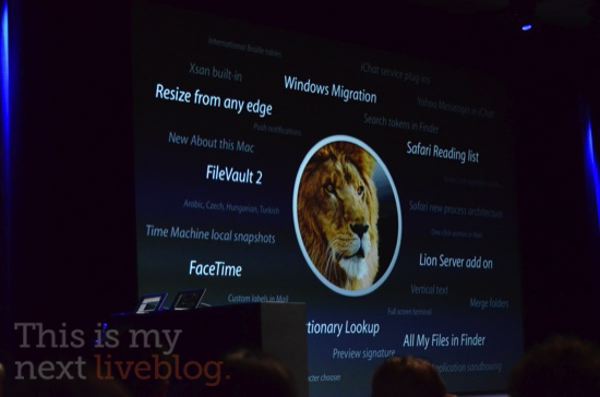
At the WWDC keynote, Phil Schiller has just announced that OS X Lion will be available only through the Mac App Store as a 4 GB download. The surprising news comes after rumors of Lion also set to be distributed on DVDs and portable USB keys – that is no longer the case.

With 3000 new APIs and 250 new features, Lion will be released in July at $29 in the Mac App Store. A new developer preview will be available later today.

Photos courtesy of This is my Next.


Lion: New Photo Booth Goes Full Screen and Does Face Tracking

At Apple’s ongoing demo of OS X Lion at the WWDC, the company has announced the new OS will come with 250 new features, highlighting 10 of the most important ones on stage. Among them, a new version of Photo Booth that goes fullscreen thanks to Lion’s new functionalities and is able of some basic face-tracking for a new “dizzy” effect that puts a nice bird animation around your head.

We expect a new Lion build to become available later today. Photos courtesy of This is my Next.


Last Minute iOS 5 Rumors: New Apple Messaging Protocol, Android-like Notifications

The WWDC 2011 keynote kicks off in less than two hours, and people waiting at the Moscone West are being let inside the convention center as we speak. As last minute speculation on what Apple is going to unveil with its upcoming major new version of iOS, This Is My Next claims it has received word from an inside source that iOS 5 will feature a new Apple messaging protocol for free SMS and MMS texts between iOS users – in the style of RIM’S Messenger application that lets BlackBerry owners communicate with each other for free. Just like FaceTime allows iPhone owners to video chat, the new messaging app could enable iPhone, iPad and iPod touch owners to exchange text messages for free using Apple’s own solution:

The word is that Apple is readying it’s own MMS / SMS protocol which will be a native part of the phone. We’re not entirely clear on how this would work, but apparently it will be able to automatically identify iOS users and route the message accordingly. We’re told the functionality would be similar to third party applications like Textie, but with less fuss.

Furthermore, This Is My Next also corroborates rumors we’ve heard about the revamped notification system and widgets, claiming that iOS 5 will feature Android-like notifications with a white pulldown menu from the status bar that will list recent notifications and widgets.

Messages will appear and then slide back up in a unobtrusive manner, similar to webOS. There have been some leaked screenshots floating around the web for the last 24 hours, but those are not the real deal. The actual window looks more like a white, gradient Growl notification.

The notifications will be constantly accessible through a pulldown window which you reach by swiping at the top of the screen downward… just like Android. Not only will this screen house your recent notifications, but it will tout proper widgets like weather, stocks, and more.

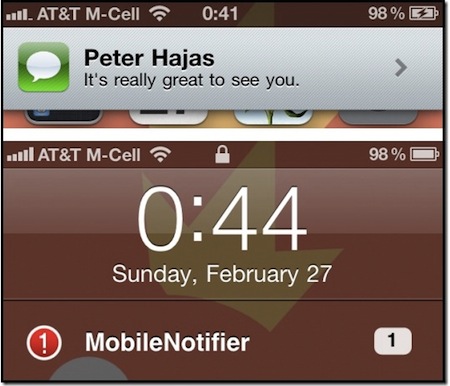
Last, according to the website the lock screen will also go under a major refresh with notifications displayed on screen with the app’s icon on the left so users will be able to swipe over them to go to the specific application that sent the message.

We’ll be liveblogging the WWDC 2011 keynote here in less than an hour.


iPhone Now Available On 200 Carriers Worldwide

As reported by John Paczkowski at All Things Digital, according to Apple executives the number of mobile operators carrying the iPhone worldwide has increased to 200, from 186 at the end of March. The expansion, teased by COO Tim Cook in late February alongside the possibility of “lower priced offerings” and other prepaid market offers, is noteworthy for Apple, but still a relatively low figure when compared to RIM’s 500+ carriers selling BlackBerry devices.

Aggressive expansion, actually. Since the end of the March quarter, Apple has expanded the number of iPhone carriers to 200 from 186, according to company executives.

So 14 new customer bases in which to dip, further juicing sales of the device.

Following speculation of low iPhone sales in Q3 2011 due to the rumored lack of a hardware refresh in June (being the WWDC focused on software-related announcements such as iOS 5 and iCloud) with a new iPhone likely coming out this Fall, analysts and investors seem to believe that Apple’s iPhone sales will manage to meet expectations thanks to the release of the white iPhone 4 and the aforementioned carrier expansion. For instance, the iPhone 4 launched in India two weeks ago after an 11-month wait. Apple is also expected to introduce the iPhone 4 on more international CDMA networks to expand into a new market segment, though as of today the CDMA iPhone 4 is only available on Verizon Wireless’ US network.


Unconfirmed iOS 5 Photo Surfaces

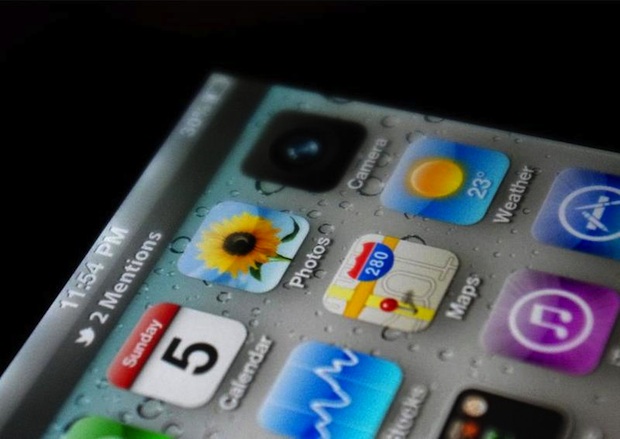
TechCrunch posts a photo of what could be the Home screen of an iPhone running iOS 5, set to be officially introduced tomorrow at the WWDC keynote in San Francisco. TechCrunch doesn’t report the original source of the photo and says this might be a well-realized mockup based on recent rumors and speculation, but MG Siegler notes some interesting facts about the image may suggest it is genuine and not another Internet fake:

Could it be? Is this it? iOS 5?! I honestly have absolutely no clue. But it certainly seems like it at least could have the right idea.

Before you go yelling “fake” on the obvious things, a couple notes. First of all, yes, 11:54 PM is in the future — in the United States. But if the Weather app is to be believed, this is clearly a European version of iOS (note the 23 degree Celsius in the icon instead of 72 degree Fahrenheit as you would see in the U.S.). Second, the Camera app icon is totally different, and looks a little odd being all-black, but who knows, maybe it’s changing. The icons are in the “correct” default order. Finally, if the talk of deep Twitter integration into iOS 5 is to be believed (we heard a bit, others have heard a bit more), it’s entirely possible that these new-style Twitter notifications could be working in iOS 5 right out of the box.

It is true the photo above has the icons in the same default order every device comes out of the box with. Another detail: in the Utilities folder next to the iTunes Store, there seems to be another app right below Calculator. In Apple’s default configuration, there are only four apps in the stock Utilities folder. If the image is to believed, iOS 5 would come with the old iOS 4 default wallpaper (as the WWDC banners indicated) and a revamped camera icon. It wouldn’t be the first time Apple updated a stock app’s icon with the launch of a new version of iOS 5.

More importantly, the image shows the rumored Twitter integration with a new notification bar. Several reports in the past week claimed Apple was working on “deep” Twitter integration for iOS 5 with features such as native photo uploading and contact access from the Address Book.

TechCrunch has a pretty solid track record when it comes to Apple rumors and last-minute leaks, though there are always some questionable images showing up before every major Apple event. We don’t put much faith in the photo either, but we’re posting it for discussion as it seems to fall in line with rumors we’ve heard in the months leading up to WWDC 2011.

Update: TechCrunch now says they’re hearing this is the “right idea”. We’ll know more tomorrow.


“Think Of iCloud As The New iTunes”

“Think Of iCloud As The New iTunes”

Daring Fireball’s John Gruber, in a post where he details some of the iCloud features he has “heard” from sources (but doesn’t state as a fact) and other personal wishes about iOS 5, doesn’t describe iCloud as a new music service or “cloud services offering” – rather, he says he’s heard iCloud is something more on the lines of a full replacement for iTunes:

The italicized sentence that follows is fourth-hand information, at best, and also the sort of thing that many of you might have already guessed based merely on your own hunches and hopes. But here goes:

Don’t think of iCloud as the new MobileMe; think of iCloud as the new iTunes.

Instead of simply overhauling MobileMe with a new name, new UI, new functionalities and call it iCloud, Gruber pictures a scenario (again, based on unconfirmed sources) where iCloud becomes the de-facto standard to sync all kinds of media and information to an iOS device:

But in short let’s just think about the ways that iCloud might be a major, dare I say game-changing, step away from USB tethering between iOS devices and iTunes running on your Mac/PC. Consider just the new out-of-box experience. Rather than “Take this out, plug it into your Mac or PC (after first making sure your Mac/PC is running the latest version of iTunes), wait for it to sync before you actually play with it”, you might get something like “Take this out, turn it on, sign into your iTunes account, and start playing with it.

There’s been a lot of speculation around iCloud, iOS 5 and the rumored Time Capsule refresh in the past couple of days. Whilst many had initially pegged iCloud as a standalone music service with streaming features, others later claimed iCloud would be a rebranding of the existing MobileMe service, accommodating options previously reserved to me.com subscribers and new features like music, movie and TV show storage and streaming. A new option surfaced in the iTunes Store earlier this week suggested iOS devices would soon get the possibility to receive automatic app updates, and indeed over-the-air sync of applications and media has long been rumored as a major functionality coming to iOS.

Permalink

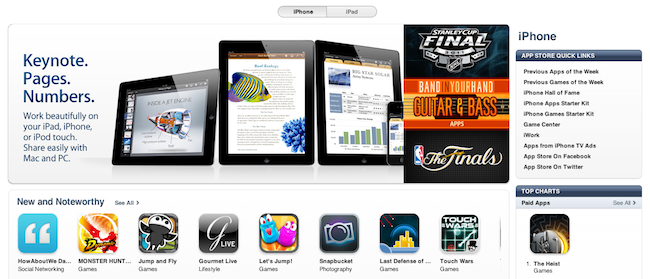
App Store Reaches 400,000 iOS Apps?

Just ahead of the WWDC keynote that kicks off tomorrow at 10 AM PDT in San Francisco, AppAdvice reports the App Store has passed 400,000 available iOS applications. According to data provided by App Store tracking system AppShopper, there are 401,446 iOS apps at the moment of writing this, though in three years Apple approved just over 500,000 apps – 507,293 to be exact. The important milestone of 400,000 apps (if AppShopper’s figure is to be trusted, but we believe so considering 148Apps reports 398,845 as of May 30, 2011) will surely be part of Steve Jobs’ keynote slides tomorrow as he explains why the App Store is a thriving marketplace for developers willing to monetize their efforts, in spite of the recent Lodsys controversy that, perhaps, will also be briefly addressed by Apple executives on stage for the purpose of clarification. Interestingly enough, however, AppShopper reports 97,946 iPad apps available whilst the App Store app on my iPad says there are 92,483 apps as of today.

The App Store officially launched on July 10, 2008, a day before the release of the iPhone 3G running iPhone OS 2.0.1. In 1060 days – or 34 months and 26 days as Wolfram Alpha calculates – the original App Store has been organized in two different sections in iTunes (iPhone and iPad apps) and a separate one living in its own application, the Mac App Store, launched on January 6, 2011.


New Apple Store Opens In Lyon, France

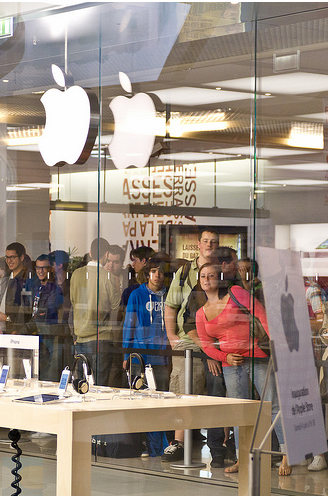
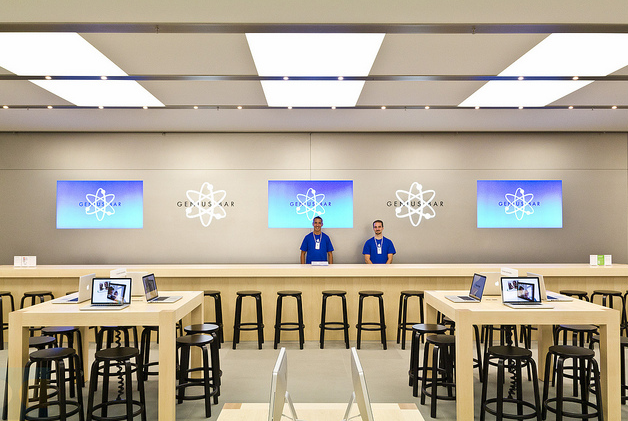
Announced by several media outlets earlier this week, Apple opened a new retail store today in Lyon, France. The seventh Apple Store in the country is located in the La Part-Dieu shopping mall which, as noted by MacRumors, is very close to the Lyon Part-Dieu railway station – a transportation hub that will surely make it easy to customers to reach the Store.

French website AccessoWeb has posted some photos and a video of the grand opening, showing a long queue to get in and the usual cheering and clapping from Apple Store employees. Other videos posted on YouTube, and embedded after the break, show the interactive iPad displays on each store table as recently introduced by Apple in the so-called Apple Store 2.0 experience.

Check out more photos here, and the store’s official page on Apple’s website.

Update: More photos of the grand opening, courtesy of Anthony Nelzin. Check out his full photo set on Flickr.

Read more


Video: Steve Jobs Discusses Remote Computing in 1997

Here’s an interesting video from WWDC 1997 brought to our attention by our friend Dave Caolo at 52 Tiger: at the conference’s keynote, as you can see from the video around the 13 minute mark, Steve Jobs starts talking about the “connected” world he lives in where, thanks to networking hardware at NeXT, Apple and Pixar, he’s able to take all his files and folders, his entire “home directory” wherever he goes thanks to what we call the “cloud” nowadays. By storing his personal data in the cloud, on the server, Steve says he doesn’t have to care about data loss and backups anymore – he can simply change computers and, thanks to the speed and RAM capacity of the servers,  have the Home folder quickly coming down from the server in seconds. He says this was already happening in 1990 at NeXT.

Let me describe the world I live in. About eight years ago 1 we had high-speed networking connected to our NeXT hardware. Because we were using NFS, we were able to take all of our personal data — our “home directory” we called them — off of our local machines and put them on a server. The software made that completely transparent…a professional could be hired to back up that server every night.

In the last seven years, do you know how many times I lost any personal data? Zero. Do you how many times I’ve backed up my computer? Zero.

I have computers at Apple, at Pixar, at NeXT and at home. I walk over to any of them and log in as myself. It goes over the network, finds my home directory on the server and I’ve got my stuff, where ever I am. And none of that is on a local disc. The server…is my local disc.

Read more