Posts tagged with "mac"

Internal AppleCare Document Directs Employees Not To Help With Malware Removal

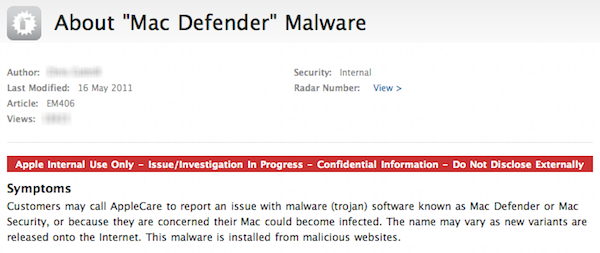
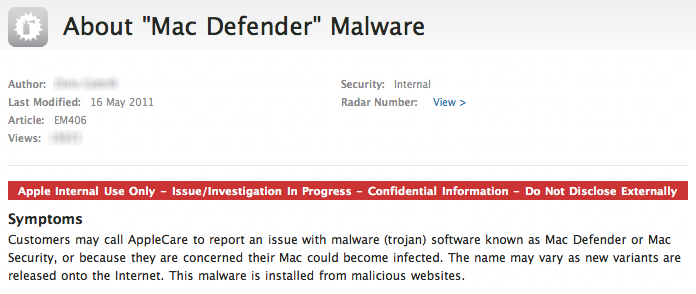
An internal AppleCare document posted earlier this week reveals that Apple is investigating ‘Mac Defender’ – a recently unleashed malicious application that pretends to be an anti-virus application when users download it. The document, which Apple clearly notes is for internal use only, tells its employees not to confirm or deny whether the application has been installed on a users computer, not to attempt to remove it or escalate the issue.

The bizarre document, which is posted in full after the break, seems to be instructing Apple employees to take no part in resolving malware issues on a users computer.

AppleCare does not provide support for removal of the malware. You should not confirm or deny whether the customer’s Mac is infected or not.

However, the document does tell employees to instruct customers that if the Mac Defender installer pops up on their screen, to cancel the installer and delete the installer immediately. Whilst if the application is already installed they are told to tell the customer to make sure all security updates have been installed with Software Update and then direct them to the “What is Malware?” document. But the document is clear in saying that Apple doesn’t deal with malware – even recommending anti-virus software in the Mac App Store.

Explain that Apple does not make recommendations for specific software to assist in removing malware. The customer can be directed to the Apple Online Store and the Mac App Store for antivirus software options.

[Via ZDNet]

Read more


DropIn Enhances Dropbox with Menubar Drag & Drop, Filters, Previews

I rely on Dropbox on a daily basis to sync files between computers, my iTunes music library and have access to folders shared with the MacStories team or my friends. In fact, Dropbox is the first app I install on every new Mac or fresh installation of OS X, being the service that stores my most important data, app libraries, and more. But for as much as I love Dropbox and couldn’t work without it anymore, I loathe the desktop Mac app. Not the syncing service that displays a badge next to my files or folders, or the preference panel that (in the latest version) allows me to set up selective sync: I can’t stand the menubar utility, which is an icon that does nothing but displaying my available space on Dropbox and changing its looks depending on whether Dropbox is syncing or not. It doesn’t do anything else, and more importantly it sits in the menubar but it doesn’t let me drag files onto it for quick uploading.

Meet DropIn, a $1.99 utility from the Mac App Store that enhances your local Dropbox installation by letting you drag files in the menubar, browse recent files, set up notifications and filters. Sure, it’s another icon in the menubar, but at least it lets me do a bunch of things the official app can’t. DropIn has two main functionalities: it displays a preview of recently changed files and enables you to create filters for the files you want to see in there; it comes with a Droplet feature that allows you to move files to Dropbox by dragging them onto the menubar, avoiding the Finder altogether. In DropIn’s preferences I told the app to simply copy files into my Dropbox main directory, but you can choose sub-folders as well or enter your account ID to upload files to the public folder and get a link in your clipboard automatically. This one’s a feature I’ve been looking forward to have on my Mac because I dislike stacks in my dock, and I’d rather have an icon in my menubar instead of having to open a new Finder window every time. And it works great in DropIn.

As for recently changed files and notifications, this is something you can do with the official Dropbox app and Growl, but DropIn lets you set up the number of updated files to display in the dropdown menu and it’s also got inline previews and a button to reveal a file in the Finder. Furthermore, you can set up advanced rules in the Filters section to show / hide specific files and make sure you’re only being notified about things you care about, and not those info.plist files from iTunes.

At $1.99, DropIn is a great addition to Dropbox, if only for the drag & drop functionality that makes it incredibly easy to move anything to your personal cloud. You can get the app from the Mac App Store here. Check out more screenshots below. Read more


OS X 10.6.7 Changes Finder Sidebar Behavior

OS X 10.6.7 Changes Finder Sidebar Behavior

Adam C. Engst at TidBITS:

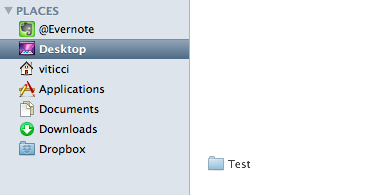
With Mac OS X 10.6.7, Apple not only messed up (and then fixed) font handling (see “OpenType PostScript Fonts Troublesome in 10.6.7,” 27 March 2011, and “Apple Releases Snow Leopard Font Update,” 26 April 2011), they also changed the way you remove items from the sidebar. Now, instead of just dragging items out, you must either Command-drag them out or Control-click them and choose Remove from Sidebar.

I’ve noticed the change too: I was trying to drag a folder out of the “Places” tab, but it wasn’t working. At first I thought I had to restart my Finder for some reason, but that didn’t work either. So I realized maybe something had changed since the 10.6.7 software update, and tried to CMD-drag like I would for items in the menubar. Items in the Finder’s sidebar now share the same behavior of draggable items in the top menubar; Engst believes the change was made after some complaints about accidental removals happening too often, but, frankly, I never removed an item from the Places tab by accident.

Permalink


Parallels Transporter Makes PC to Mac Migration Dead Simple

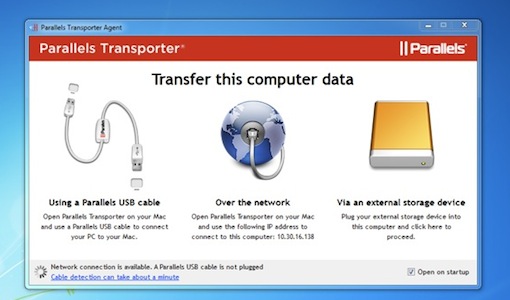
Parallels, probably best known for its popular virtualization software, has today released a new product that lets you make migration from Windows to OS X dead simple. The product, Parallels Transporter is being offered at a special introductory price of $0.99 on the Mac App Store (it’s regular price will be a rather expensive $39.99) and allows users to automatically transfer music, pictures, documents and more from a Windows computer to a Mac.

Using an external hard drive, wireless network or a Parallels USB transfer cable, Transporter will automatically transfer the data to the appropriate locations the Mac. Whether it is documents in the home directory or bookmarks for browsers, Transporter will do all the work in correctly transferring the users files.

We created Parallels Transporter to be the simplest, most efficient way to transfer everything you need from your old PC to your Mac in just a few easy steps. Now you can move to a Mac without the time-consuming chore of manually moving files and without the expense of hiring somebody to do it for you.

Transporter will even transfer over Windows applications and other files into a virtual machine on the Mac so that if you end up using Parallels Desktop, everything will be set up and ready to go for you – although note that this does require the purchase of Parallels Desktop which isn’t included in Transporter.


Screenstagram: An Instagram Screensaver On Your Mac

After the release of an official API months ago, Instagram has become a ubiquitous service that already has a plethora of third-party tools for Mac, Windows and iOS devices in spite of the lack of a website to browse photos and the fact that it still is ”just an iPhone app.” The ecosystem built by Instagram is amazing, especially considering the kind of growth the developers had to face and the number of devs that suddenly signed up for the API to start creating external tools and toys like Postagram, an iPhone app that sends you real postcards based off Instagram photos. Like I said multiple times in the past, Instagram’s success on the iPhone has no equal. And we have seen there are some pretty good clients on the Mac, too.

If you feel like there’s never enough Instagram around, perhaps you should check out this new utility called screenstagram, a Mac screensaver based on, you guessed it, Instagram pictures. That’s it: just photos rotating on a grid once your Mac is in screensaver mode. The cool thing the developers added? You can log in with your account and have the screensaver serve photos found in your feed. Otherwise, screenstagram will simply use Instagram’s popular feed to deliver its magic to a sleeping OS X. The developers write on their blog:

It took us a while to figure out what to build with the new web service. We’re no strangers to leveraging that kind of resource, but it’s generally for data-driven services, like Twitter or Foursquare. It’s not too often that a visually rich system like Instagram comes along and releases an API. We wanted to do something that took advantage of the eye candy, something beyond a web-based photo browser – something to really showcase our friends’ grainy, bar room photography. A way we could sit with the photos and soak them in longer than usually allowed by the ephemeral, wham-bam-thank-you-ma’am approach taken by the feed in the Instagram iPhone app. Once those photos are out of your friends’ feed, they’re sort of gone, never to be seen again without some digging on your part. So we decided on an old fashioned screen saver, a medium that doesn’t get much love these days.

The idea is very neat and well-implemented. We recommend you check it out here, as it’s a free and lightweight download. Read more


Mailplane Adds Evernote Integration

Users of Mailplane, a desktop interface for Gmail’s online web application, will find a new feature in the latest 2.4 update, released yesterday, that adds complete integration with capturing tool Evernote, a staff favorite here at MacStories. As you may know, Evernote allows you to easily capture your ideas in the form of notes, images, PDF documents and all sorts of document archives; with a wide range of apps that go from a native Mac client to a recently revamped iPhone app and a new version coming out soon for Android Honeycomb tablets, Evernote is a ubiquitous system that helps you save, organize and archive all the important things in your life.

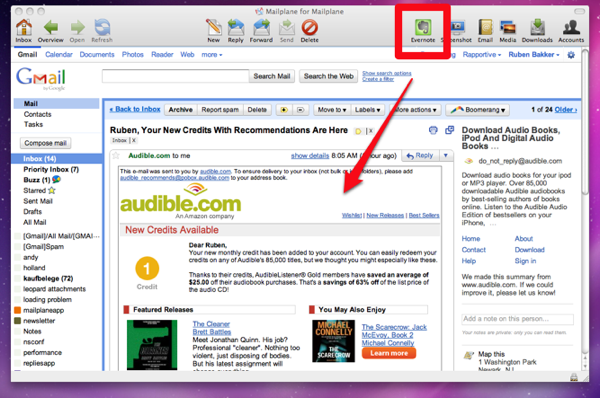
The new Mailplane 2.4 adds an Evernote-specific button in the top toolbar that enables you capture a conversation, archive it in Evernote and have the app automatically include a link to the email message you previously selected in Mailplane. As the new feature saves a full copy of the message as a new note, you’ll have the possibility to enter a title, tags, as well as edit text from the message. Furthermore, a new option in Mailplane’s download manager lets you quickly send attachments to Evernote without saving them in the OS X Finder first.

Mailplane 2.4 can be downloaded here.


Fantastical: Your Personal iCal Assistant


In my preview of Fantastical, a new Mac application by Flexibits, I noted how developing a new calendar utility for OS X wasn’t an easy task at all: not only does the competition offer some great alternatives, Apple itself bundles the free iCal into the main installation of Mac OS X Snow Leopard, giving users a relatively powerful tool to manage appointments, invites, to-dos and all sorts of calendar needs. Whilst iCal – and on iOS, the Calendar app for iPhones and iPads – makes it super-simple to see all events at a glance with the supported Google Calendar, MobileMe, CalDAV and other protocols, it appears Apple didn’t really focus on letting users quickly and easily add new items with a few keystrokes and commands. To enter a new event in Apple’s default iCal, you have to open the app, head over the day you’ve chosen (or hit a keyboard shortcut) and type in every single field for the new event. That includes things like name, location, all-day checkbox, date and time, repeat, invitees and status.

Being forced to manually type all info and move the cursor around every single time is boring, and annoying; that’s exactly what Flexibits wants to fix and improve with Fantastical.

As I highlighted in my initial preview, Fantastical’s biggest feature lies in the way it allows you to enter events with natural language. Plain English, that’s it. Once the app is configured with your calendars and up and running in the menubar, you’ll be able to invoke its main window with a shortcut (or by clicking on the menubar icon), be automatically focused in the text entry field, and start typing. Before I delve deeper into this, a quick note about Fantastical’s calendar support: being the app an external tool that can be integrated with iCal, the app perfectly supports all the protocols already supported by Apple out of the box. That means MobileMe, Google Calendar, CalDAV, shared calendars – anything, really. In my tests, the app (and iCal, set as my default calendar app, more on this in a minute) worked just fine with a personal Me calendar, two Google Calendars, as well as a shared cal configured through Exchange both on Mac and iOS. As far as calendar support goes, there’s nothing to worry about if your calendars are already working in iCal. In fact, the app looks directly into it to fetch local and online calendars you might want to use, and iCal doesn’t even need to be running for Fantastical to add new events. Furthermore, the app also supports Outlook and Entourage, Yahoo! Calendar accounts as well as delegates both on Google and Yahoo.

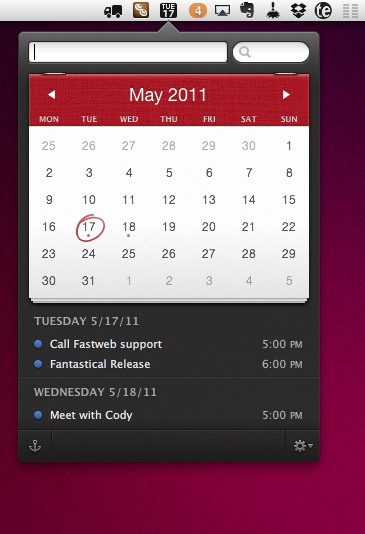
Fantastical’s natural language system is without a doubt the most important feature that sets it apart from other calendar utilities for Mac and Apple’s own iCal. As I noted in my preview, writing “Meet with Cody tomorrow at Apple Store, Viterbo 5 PM to 6 PM” in iCal does nothing, in spite of the sentence being correct and relatively simple to understand for a computer. Writing the same sentence in plain English in Fantastical adds a new event with all the fields already filled in. I’m talking about the event’s name (Meet with Cody), location (Apple Store, Viterbo), relative date (tomorrow) and time (from 5 PM to 6 PM). Fantastical understand what you’ve written, and leaves room for typos such as “Thrsday” or “tomorow.” The system implemented by Flexibits is very powerful and, as the company’s name reflects, flexible, allowing you to enter an event’s name in almost any way you want with the app still recognizing it correctly. Why is it a big deal? Because it’s smart and it helps me save time. Instead of having to move my cursor to select checkboxes and repeat the same actions over and over again, I just write a quick sentence like I’m used to and the app does the job for me. Indeed, Fantastical is the closest thing to a “calendar assistant” the Mac has ever seen. More importantly, the system is smart in the way it knows when I’m referring to people already in my Address Book. In the screenshot below, you can see how I wrote “Meet with Cody” and the app knew “Cody” was an entry in the Mac’s Address Book. From there, it fetched the two email addresses saved with Cody’s contact information and enabled me to send an invitation without leaving the app or having to open a browser. Overall, Fantastical’s natural input technology is the best thing that ever happened to a calendar application, for all the reasons listed above.

Fantastical, however, is also a great utility because of its intelligent and clever design. Let alone the fact that the app looks beautiful (just take a look at the screenshot or download the trial and play with it for 5 minutes), the design is functional to what a user has to accomplish: entering events quickly, in seconds, without opening a full-featured calendar app. Fantastical is unobtrusive, sits in the menubar and can be launched with a keyboard shortcut. If you feel like you want to look at it all the time, you can pin the app to stay above other windows. I don’t do that, but the feature might come in handy when adding events from other applications. The calendar design is minimal, tasteful, and allows you to navigate between months with ease. Marked days and events are done the right way with subtle indicators and graphics overlaying the main calendar. Nothing about Fantastical is “too much” or redundant: events can be previewed in a small popup if you head over them with your mouse, and if you double-click them iCal will launch. Events can’t be deleted from within Fantastical, but the app allows you to enter a new one from any app or browser – as you can see in the screenshot below. The system-wide service is incredibly useful when dealing with receipts and expenses in PDF documents, or just about any date displayed on screen. It’d be nice to be able to delete events in Fantastical, but I think the focus for the developers now is to let users add events in any way they want, as fast as possible.

There are other functionalities worth mentioning, too. From Fantastical’s window, you can decide how many “next events” or “next days” to show, so you’ll always be focused on the right amount of time and events. From the same menu, you can jump to today’s view. There are some things to tweak in the Preferences as well: you can choose a default calendar and calendar app, which will be the one that handles event management in the background as you add new stuff in Fantastical. The keyboard shortcut for quick entry can be customized, alongside the menubar icon that can show date, date and weekday, or date and month. Calendars can be managed in the preferences’ second tab, and you can set default alarms for timed and all-day events so you’ll always end up with a standard alarm for every new event – very useful.

Fantastical is the calendar assistant to install on every Mac that has to deal with calendars. Not because Fantastical is more powerful than other solutions like iCal and Outlook, but because is smarter and different. Fantastical wants to be the best, fastest and most intuitive way to add new events, whereas other desktop applications focus on letting you manage your calendar, sometimes packing features that slow down the whole process of adding new events. Fantastical is available on the Mac App Store at an introductory price of $14.99, with a free trial available here. Read more