


Long ago, I gave up on trying to pick just one RSS client on iOS. There are a bunch I like and keep installed on my iOS devices, but the two I use most often are Fiery Feeds and lire. Fortunately, it’s easy to keep all of them installed and use whichever suits my...
 Q&A
Q&A
Question: What are your recommendations for charging stations for an iPhone XS Max, Apple Watch, and AirPods case? (Melissa)
 Federico
I haven’t tried any third-party AirPods cases that add Qi-charging capabilities for two reasons: I don’t love the idea of making my AirPods case thicker and bigger by adding another case to it, and I’d...
CES AirPlay, HomeKit, and Accessory Roundup, Part 1

Apple may not be exhibiting at CES, but its presence is felt nonetheless. More than ever, Apple’s technologies like HomeKit and AirPlay are showing up in third-party hardware. What’s different this year is the first appearance of Apple video content on third-party devices in what is undoubtedly the first step in the company’s emerging video strategy, which breaks from the traditionally tight integration between Apple hardware and software.
As in past years, the MacStories team is sifting through the hundreds of press releases to find the announcements that are most relevant to our readers. CES has only just begun, and we’ve already seen a long list of product announcements that affect iOS and Mac users. Below are the highlights of those early announcements. We’ll follow up with another roundup later this week collecting additional products showcased at CES.
It’s worth noting that CES announcements rarely indicate the countries in which new products will be available, so it’s worth keeping an eye out for additional details if you see something that interests you.
AppStories, Episode 93 – 2019 Themes from Our Must-Have iOS and Mac Apps→
On this week’s episode of AppStories, we discuss the themes that run throughout our 2018 iOS and Mac must-have apps and what they mean for 2019.
Sponsored by:
- Techmeme Ride Home – Search in your favorite podcast app for ‘ride home’ and subscribe to the Techmeme Ride Home podcast.
- Linode – High-performance SSD Linux servers for all of your infrastructure needs. Get a $20 credit with promo code ‘appstories2018’
https://staging.macstories.net/podcasts/appstories/episodes/93/embed/






 2019 Themes from Our Must-Have iOS and Mac Apps

Apple Updates AirPlay 2 Page with Upcoming TV Features Including Siri Control

On the heels of the announcement that Samsung Smart TVs are gaining an iTunes Movie and TV Shows app and AirPlay 2 support, Apple has updated its AirPlay 2 page to highlight additional features that are coming to AirPlay 2.
AirPlay 2-Enabled TVs: Samsung may have been the first to announce support for AirPlay 2, but Apple’s webpage indicates that the feature is coming to ‘leading manufacturers,’ so expect more announcements at CES and beyond. In addition to using AirPlay 2 to send video from an iOS device or Mac to a compatible TV, consumers will be able to play music on their TVs and sync it with other AirPlay 2-compatible devices in their homes.
Control Your TV with Siri: Perhaps the most interesting feature is the ability to use Siri on your iPhone to send video to your TV. Because the new feature works in tandem with HomeKit, if you have multiple AirPlay 2 TVs, you’ll be able to specify the room in which you want the video to play.
Remote Control: Apple also indicates that remote control features are coming soon:
Convenient built-in controls appear in apps, on the Lock screen, and in Control Center. So you can easily play, pause, fast-forward, rewind, and adjust the volume on your TV.
Controlling the volume of a TV via AirPlay 2 would be new, and perhaps there’s something coming related to Apple’s reference to “built-in controls… in apps,’ but playback controls on the Lock screen and in Control Center already exist.
Apple is clearly using the days leading up to CES to implement the first moves in its video strategy. Observers have long wondered how Apple planned to extend the reach of a video service beyond the relatively small number of Apple TV owners. By cutting deals with TV manufacturers, Apple is moving down a path that is similar to the one Google has taken with the Chromecast and will be able to reach many more consumers. I wouldn’t be surprised if we see these new AirPlay 2 features begin to appear when Apple ships its first iOS 12.2 betas.
Samsung Announces iTunes Movies and TV Shows App and AirPlay 2 Support for Its Smart TVs
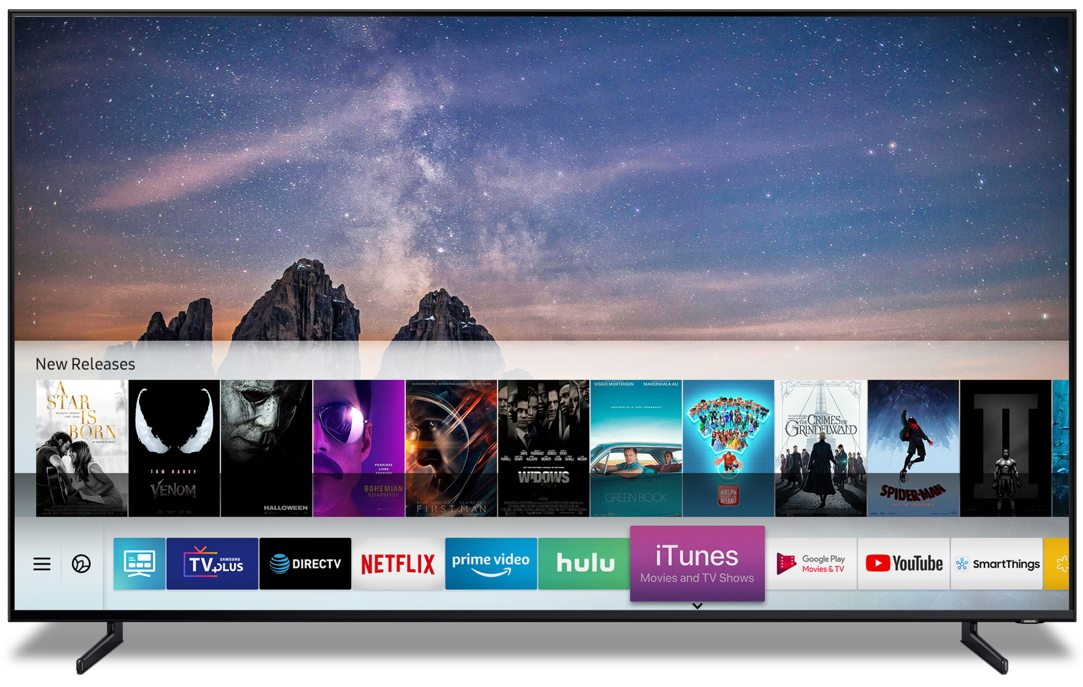
In a first among TV manufacturers, Samsung has announced that its 2019 TVs will ship with an iTunes Movies and TV Shows app in over 100 countries as well as AirPlay 2 support in 190 countries. 2018 models will receive the same support via a firmware update.
With the Consumer Electronics Show in Las Vegas just around the corner, Samsung’s US newsroom site issued a press release stating:
With the new iTunes Movies and TV Shows app on Samsung Smart TVs, Samsung customers can access their existing iTunes library and browse the iTunes Store to buy or rent from a selection of hundreds of thousands of movies and TV episodes — including the largest selection of 4K HDR movies. iTunes Movies and TV Shows will work seamlessly with Samsung’s Smart TV Services, such as Universal Guide, the New Bixby and Search, to create a consistent experience across Samsung’s platform.
With AirPlay 2 support, Samsung customers will be able to effortlessly play videos, photos, music, podcasts and more from Apple devices directly to Samsung Smart TVs, including QLED 4K and 8K TVs, The Frame and Serif lifestyle TVs, as well as other Samsung UHD and HD models.
The press release also reports Apple’s Eddy Cue as saying:
We look forward to bringing the iTunes and AirPlay 2 experience to even more customers around the world through Samsung Smart TVs, so iPhone, iPad and Mac users have yet another way to enjoy all their favorite content on the biggest screen in their home.
Apple’s partnership with Samsung, one of the largest global TV manufacturers, is particularly notable given Apple’s efforts to amass a stable of original content for a long-rumored video streaming service. By making existing and future content available directly within Samsung’s Smart TV system and providing a means for iOS device and Mac owners to easily play content on Samsung TVs, Apple greatly expands the potential viewership for the content it offers.
Apple Revises Q1 Financial Guidance Following Poor iPhone Sales
In a letter to investors, Apple CEO Tim Cook has stated that the company has revised its financial guidance for the holiday fiscal quarter that ended on December 29th as follows:
- Revenue of approximately $84 billion
- Gross margin of approximately 38 percent
- Operating expenses of approximately $8.7 billion
- Other income/(expense) of approximately $550 million
- Tax rate of approximately 16.5 percent before discrete items
We expect the number of shares used in computing diluted EPS to be approximately 4.77 billion.
Here’s the guidance that Apple gave November 1, 2018 when it reported its fourth quarter 2018 results:
- revenue between $89 billion and $93 billion
- gross margin between 38 percent and 38.5 percent
- operating expenses between $8.7 billion and $8.8 billion
- other income/(expense) of $300 million
- tax rate of approximately 16.5 percent before discrete items
That’s a miss of $5-9 billion in revenue. Cook’s letter is lengthy, but the lion’s share of the problem comes down to lower than expected iPhone revenue:
Lower than anticipated iPhone revenue, primarily in Greater China, accounts for all of our revenue shortfall to our guidance and for much more than our entire year-over-year revenue decline. In fact, categories outside of iPhone (Services, Mac, iPad, Wearables/Home/Accessories) combined to grow almost 19 percent year-over-year.
While Greater China and other emerging markets accounted for the vast majority of the year-over-year iPhone revenue decline, in some developed markets, iPhone upgrades also were not as strong as we thought they would be. While macroeconomic challenges in some markets were a key contributor to this trend, we believe there are other factors broadly impacting our iPhone performance, including consumers adapting to a world with fewer carrier subsidies, US dollar strength-related price increases, and some customers taking advantage of significantly reduced pricing for iPhone battery replacements.
Although there have been rumors of lackluster iPhone sales for weeks based on supply chain leaks, a miss of this magnitude caused by falling iPhone revenue is still a big surprise, which is no doubt why Apple chose to address the issue before its next earnings report is released.
Macworld Profiles Mac Apps Developed for Over 25 Years→
As we start a new year that could bring significant change to macOS, Glenn Fleishman, writing for Macworld, spoke to the creators of four Mac apps – BBEdit, PCalc, Fetch, and GraphicConverter – that have been around for at least 25 years and weathered a variety of past macOS and hardware transitions.
Rich Siegel of Bare Bones Software, which can trace BBEdit’s lineage back to 1989 when the app was built for System 7, told Macworld that over the years:
We’ve extensively rewritten, upgraded, and optimized [BBEdit’s] internal architecture.… Even though it has evolved a great deal, BBEdit has stayed very close to its fundamental mission: empowering its users to accomplish tasks which would challenge or defeat other tools.
Not long after BBEdit came on the scene, James Thomson released the first version of PCalc on the Mac, which was also built for System 7. For Thomson, PCalc’s evolving UI has kept working on the app fresh:
My passion since I first discovered the Mac nearly 30 years ago has always been making interesting and fun user interfaces. And look forward to keep doing it for a long time to come.
Fleishman also spoke to Jim Matthews, for whom FTP client Fetch has gone from full-time job to side project over the years, and Thorsten Lemke, whose GraphicConverter app has evolved from converting a handful of image formats to over 200.
Twenty-five or more years on one app is a remarkable accomplishment. The story of each app is different, but their developers share a common commitment to maintaining their apps for their customers notwithstanding the changes to the Mac and its OS over the years. Later this year, we should hear more about Apple’s plans to help iOS developers bring their apps to the Mac App Store. Whatever impact those changes end up having on the Mac app ecosystem, I hope the sort of developer dedication that has kept BBEdit, PCalc, Fetch, and GraphicConverter around for over a quarter century perseveres.